Q3 Global Community Call: Strategic Address [Part 1 of 3]
Spark recently held its Q3 Global Community Call, covering financial results, key metrics, strategic priorities, and SPK updates.
In this first clip, Sam (CEO & Co-Founder) delivers a strategic address and an update on the business.
~5 min watch���
IRIS brings fixed-rate borrowing on top of SparkLend.
Competitive fixed-rate quotes, back in seconds, for any number of days.
Settled on SparkLend’s deep liquidity, from launch.👇
Time for the Spark Chinese community call has now been set.
The team will be hosting the live stream on 9th November (this Monday) at 12 noon UTC/8pm (UTC+8).
Streamed across X and DC.⚡️
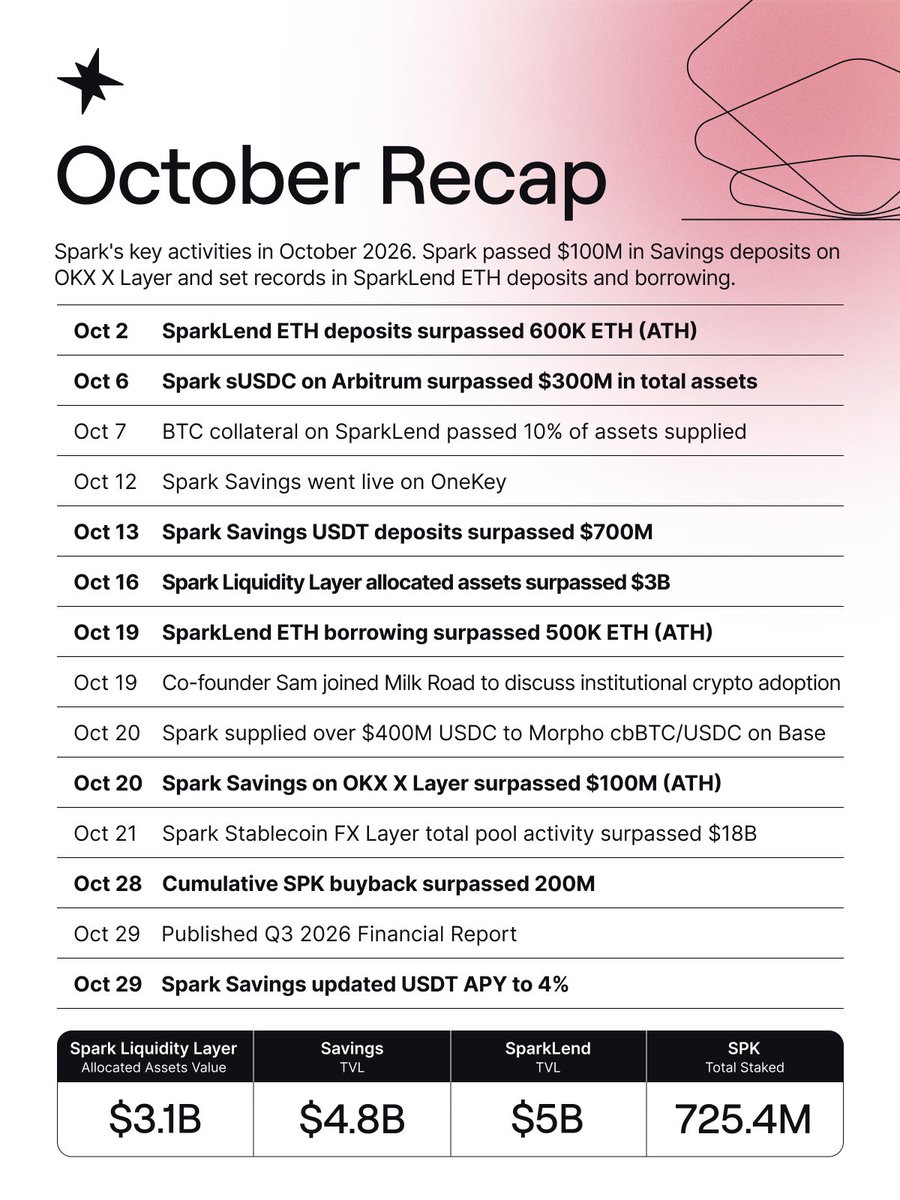
October was about distribution and collateral.
Spark Savings expanded to new apps and chains. It went live in @OneKeyHQ and passed $100M in deposits on @okx X Layer. USDT deposits also passed $700M.
On SparkLend, ETH and BTC both had a record month. ETH deposits and ETH borrowing both set all time highs, and BTC collateral passed 10% of assets supplied.
Spark Liquidity Layer allocated more than $3B in assets once again, including more than $400M USDC supplied to a @Morpho cbBTC/USDC market on @base.
Here's the October 2026 recap:
Spark's Stablecoin FX Layer has passed $20B in pool activity.
Pool activity has averaged more than $150M per day since launch, with monthly activity averaging around ~$5B the past two full months.
The FX Layer connects PYUSD, RLUSD and USDT through USDS on @Uniswap v4. @SkyEcosystem's PSM extends that shared liquidity network to USDC.
New Earning Rate: Deposit USDT into Spark Savings and earn 4%.
USDT APY in Spark Savings moves up again! It's the first time the rate has reached 4% since February.
Deposit USDT into Savings:
https://t.co/gjvlwwDk0X
Spark's Q3 2026 financial report has been published.
Key highlights:
• Gross protocol returns: $29.4M (QoQ -18%) (aggregate returns across all protocol components)
• Net protocol returns: $5.63M (QoQ +33%) (gross returns less cost of capital)
• Net protocol surplus: $2.55M (QoQ +300%) (gross returns less cost of capital and operating expenses)
• Spark Protocol treasury (end of quarter): $56.6M
• SPK token buybacks: $2.00M (capital returned via open-market purchases)
Overall, Q3 saw stronger SLL net returns alongside continued growth in Spark's Liquidity as a Service (LaaS) programs with stablecoin issuers and the Stablecoin FX Layer, both of which scaled significantly during the quarter. SLL allocations closed the quarter at their Q3 high of $2.90B.
Read the full report here: https://t.co/lyx1sgVPc5
Launching a stablecoin usually means funding a separate pool against every asset your users hold. Spark’s FX Layer offers a different model.
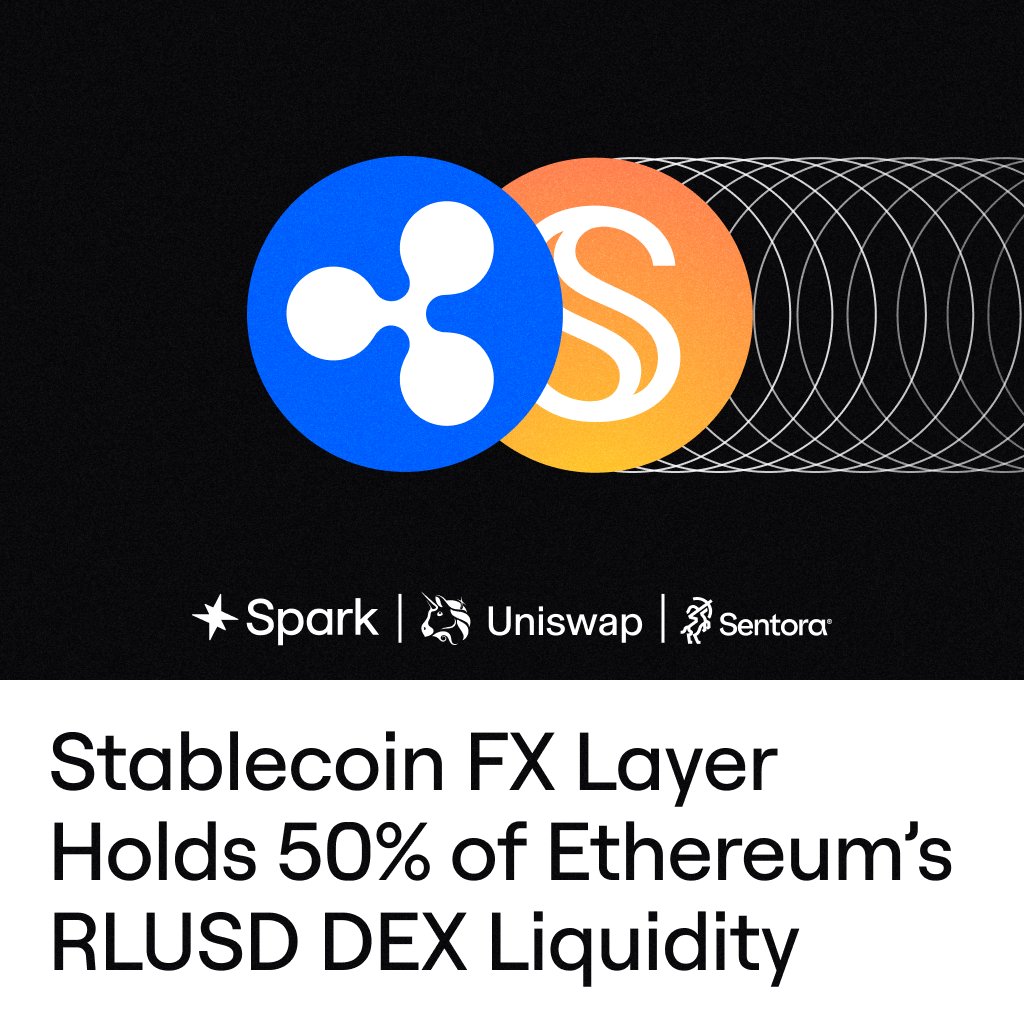
Spark funds both sides of the RLUSD/USDS pool, with @SentoraHQ supporting deployment. The issuer gets trading liquidity without committing its own capital to the pool.
One pool reaches the wider market. RLUSD holders swap to USDC in a single transaction through Spark’s FX Layer and @SkyEcosystem’s PSM, routed by @Uniswap. USDC holders take the same route in reverse.
The result: Spark’s FX Layer holds about half of the RLUSD in Ethereum DEX pools, and pool assets are up 150% since October 1st.
For an institution launching a stablecoin, that means users can move in and out of the stablecoin, and the team can spend its capital on payment and treasury products.
Why SparkLend is the place to borrow size onchain:
Rates that hold steady
Liquidity serviced directly by Spark
Blue chip collateral only
$888M USDS borrowed and counting.
Another great breakdown from independent contributor @WalleDAO on what RLUSD/USDS activity looked like onchain.
$453M through the pool in 30 days.
65% of that volume connected to yield, loans, or exchange wallets.
One USDS pool gives RLUSD a route into the rest of DeFi.
Another $100M milestone is coming for Spark Savings.
Deposits into the USDC vault on @okx's X Layer are approaching $100M, up from $3.5M just one week ago.
OKX users can access Spark Savings USDC through On-chain Earn in the app. OKX handles the onchain interaction on @XLayerOfficial, with no wallet setup, bridging or separate DeFi steps required from users.
Put your USDC to work on OKX: https://t.co/PDPDWKOXSi
Sam joined @milkroaddaily last night to talk about the next wave of institutional crypto adoption and what it means for stablecoins, ETH, DeFi lending, and RWAs.
Banks, fintechs, and Wall Street are all moving into stablecoins. Spark is built to supply the rails and liquidity they’ll need.
Watch the full interview here: https://t.co/tZv0Z0WCCf
Spark supplies nearly a quarter of the USDC in a @Morpho cbBTC/USDC market on @base.
The market currently has $1.8B USDC in total supply, with Spark providing more than $400M USDC.
Borrowers post cbBTC as collateral to access USDC financing while retaining BTC exposure.
The Spark Liquidity Layer provides this capital through the Spark USDC vault, which Spark curates. Borrower interest is reflected in the value of the vault shares the SLL holds.
Spark can adjust this allocation as borrowing conditions change. Governance sets how much capital can move within a given period, while the vault's supply cap limits allocations to this market.
Total ETH borrowing on SparkLend exceeds 500K ETH, up 12% over the past 30 days.
Most of the collateral backing this borrowing is wstETH. Borrowers using wstETH as collateral can enable ETH E-Mode when borrowing ETH. This allows a higher LTV ratio than standard mode, so they can borrow more ETH against the same collateral.
The higher limit reflects the close price correlation between wstETH and ETH.
Borrowers can use the ETH in staking or other positions. SparkLend borrows have no fixed repayment date, so a position can stay open as long as it remains sufficiently collateralized.
Easy borrow markets here 👇
https://t.co/2NqMjCerWS