A lot of overblown headlines about Sky today.
Sky Protocol is operating normally. USDS remains over collateralized with ~$10B in backing and working as designed. Holders can use, save and redeem as usual. Sky handled over $2B in outflows in the past day, stablecoin liquidity available to support the peg never dropped below $2B, and it’s now back above $2.25B.
Sky continues to generate strong revenue, with ~ $400m of revenue over the past year, and remains in a solid market position. The Core Council has also announced a one-off SKY buyback, through the process set out in the Sky Atlas: 750k USDS a day for 7 days, 5.25M USDS in total. https://t.co/UEyVl5iDD1
I know there are questions about stUSDS. It’s a separate, opt-in product, it doesn’t back USDS, and USDS and sUSDS holders aren’t exposed to it. More on stUSDS soon.
There’s nothing wrong with @SkyEcosystem and sUSDS.
1) stUSDS is Rune private credit line to fund his pet projects segregated from the main saving yield.
Only real exposure is for the people that believe $SKY has any value, if you’re part of them feel free to report to the nearest madhouse.
2) H.E @justinsuntron DeFi team is probably one of the best in the game, they’re conservative and don’t take risk, he withdrew more than a dozen times from Aave over the years and decided after stani takeover and kelp issue to temporarily set his mainnet basecamp with sUSDS. I’m quite confident he’ll deposit back there when things settle a bit.
3) My money is where my mouth is. Most of Acier treasury (until we deploy) is comfy earning with SKY as we believe it’s one of least risky decentralized yield source on the market we have no intention to withdraw at the moment.
We’re aware of the recent CoinDesk report on activity involving the Sky Protocol Peg Stability Module (PSM), predominantly via third-party permissionless platforms.
Reports like this are taken seriously across the Sky Ecosystem.
For scale: the PSM has processed over $968 billion in volume since inception. The alleged figures would represent roughly 0.03% of that.
The PSM is open, onchain infrastructure that supports the USDS and DAI peg by swapping stablecoins 1:1.
Within Sky Ecosystem, associated Sky Agent front ends such as @sparkfinance, @grovedotfinance, @SkyMoney and @OseroHQ block users in sanctioned jurisdictions by screening and blocking flagged wallets.
Participants across the Sky Ecosystem will continue doing their part alongside the rest of DeFi.
this is a fundamental (and obviously commercially motivated) misunderstanding of how sky works
usds minting is permissioned, exactly the same as it is for usde - only the sky protocol and prime agents may mint or burn usds
the usdc-psm is a permissionless dex pool, which allows for users to trade usds for usdc on the secondary market. this is essentially the same way that ethena's usde is made available to international and US retail investors and non-onboarded institutions, via dex liquidity pools on uniswap, curve, and other venues
if usde had better liquidity, they would face similar challenges related to bad actors routing through permissionless secondary market trading venues
for anyone confused-
the psm is a constant-sum DEX pool. basically curve or uniswap with a different formula for calculating swap pricing
not sure why permissionless DEX swaps are suddenly news 🤷♂️
Great explainer of Spark Savings USDT. Active liquidity management (vaults) with smart contract risk controls are likely to be dominant form of DeFi yield in the near future and Savings USDT is well situated to capture a sizable part of this market.
While Spark Savings USDT (currently paying 4.25%) shines for institutional allocators, in the increasingly volatile crypto market it's starting to be a better and better fit for medium-sized traders and shops that want to park a few million USDT with a very high certainty that their funds will be there when they need to recall them the most.
Perhaps more importantly, they will not be exposed to a leveraged tokenised hedge fund trade that introduces acute tail risk that might make them lose a good chunk of their principal should some of the risks of the underlying crystallise.
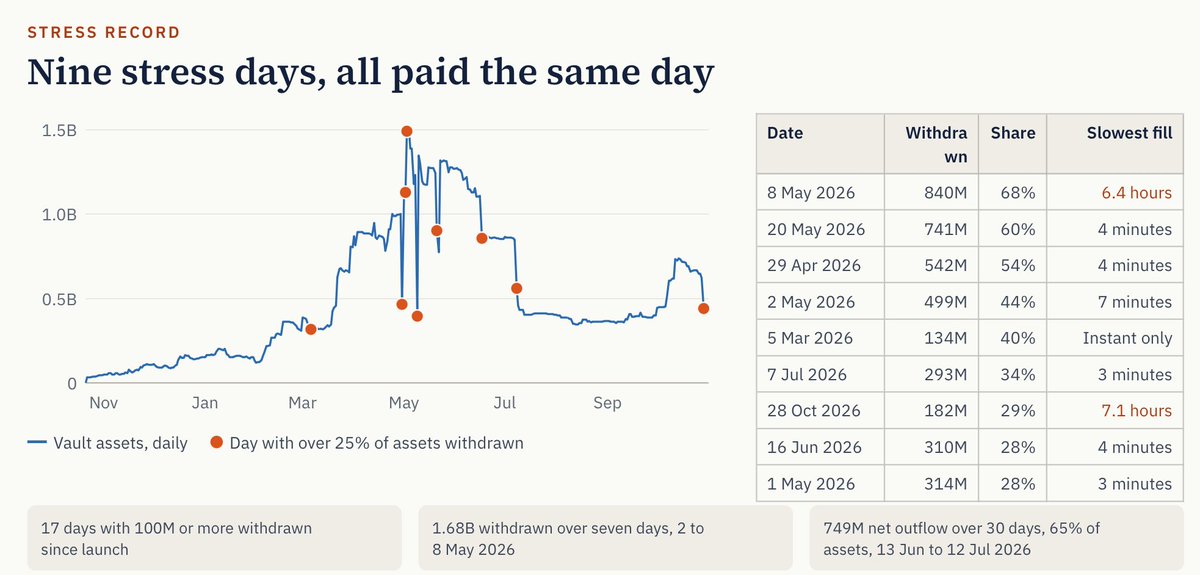
Spark Savings USDT is an institutional yield product, operating under the SKY umbrella and managed by the Spark allocator system.
The primary mandate of the product is liquidity. This is why the standard 'redeem/withdraw' function fell short for the type of clients we aim to service. Because we regularly need to service 100s of millions in no-notice withdrawals, the Spark system splits withdrawals into two:
- Small withdrawals (under 5M): they get processed instantly from the 4626 reserve
- Larger withdrawals: 5M+: Should there not be enough liquidity in the 4626, a withdrawal intent is submitted.
When an intent is submitted, a user signals their desire to exit and the Spark allocator system starts recalling liquidity to service it (raising rates, unwinding positions and swapping to USDT) until it meets the requested amount.
Since launch small withdrawals have all been immediately processed with 0 downtime.
Large withdrawals averaged 86M clip size and median time to fill was 1.4 minutes.
Spark Savings USDT is the best USDT product in the market for two three reasons.
1. Unique access to SKY balance sheet. This allows Spark to access scalable above-SOFR yield and the capability to tap into on-demand capital to satisfy liquidity requirements
2. Infrastructure edge. Smart contracts with strict rate limits and timelocks under SKY governance provide guarantees to depositors, which, paired with our sophisticated allocator system, makes for a superior USDT product that's hard to replicate elsewhere.
Even if you the reader most probably will not be pulling 100M+ at a time (hopefully you are, if so please feel free to DM), knowing that this is a possibility and that the system was built in a way to structurally serve liquidity much in excess of your needs should give you the peace of mind you need to get some decent yield while you wait to deploy capital in whatever type of risk your heart desires when it presents itself.
@LorenzoARK Multiple token holders with the largest ones likely holding in custody anyways. Public governance process is heavily monitored.
Sky has a 2 day delay, so it is enough time to react in the event a malicious proposal is scheduled.
With @sparkfinance , your crypto can do more than just sit there.
With @sparkfinance on https://t.co/40bw4RygDp, your crypto can do more without any extra effort or complexity.
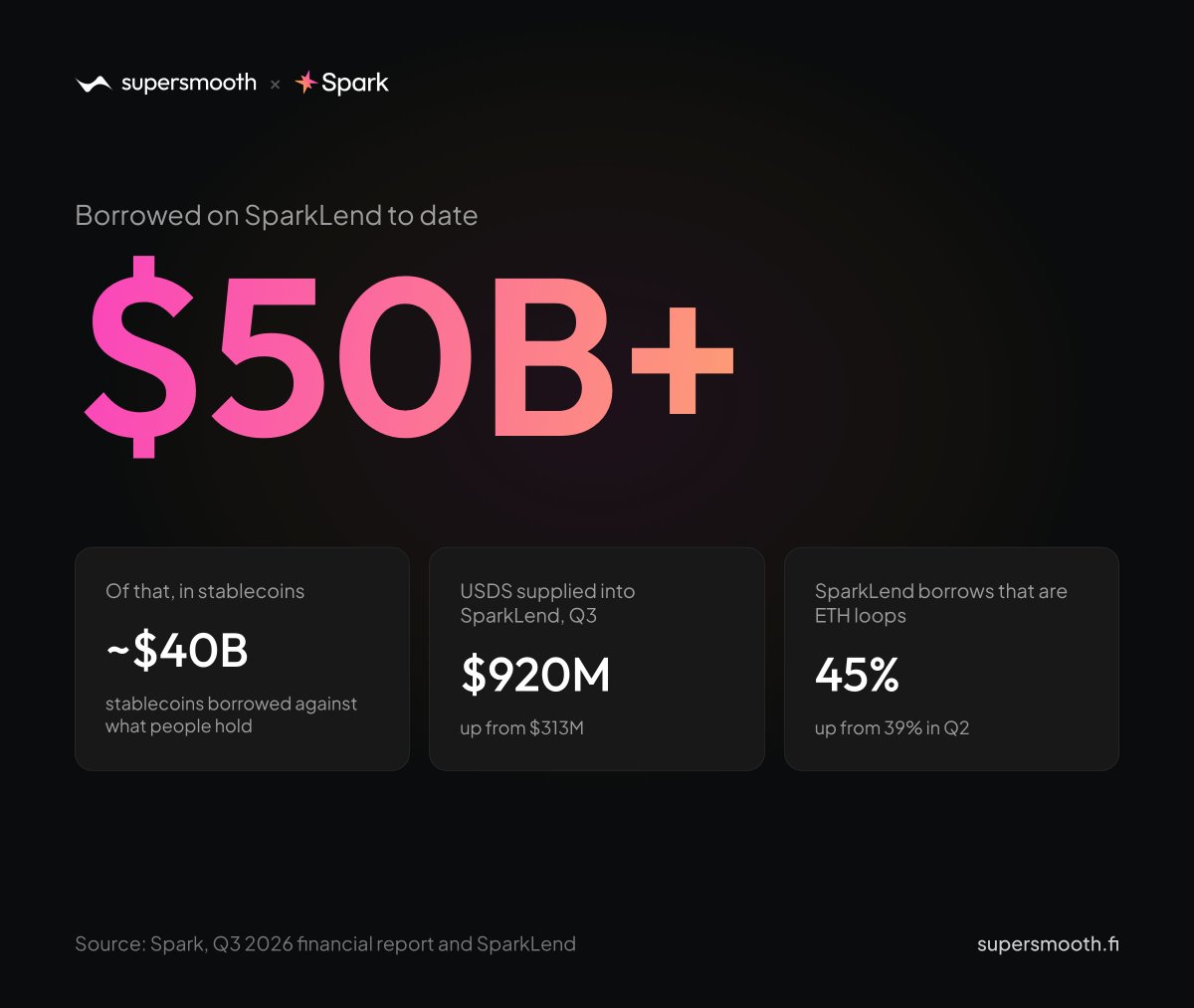
Over $50B has been borrowed on @sparkfinance to dat, and about $40B of it was stablecoins.
... demand has kept growing, in Q3 Sparklend ended the quarter with $8.5B supplied, USDS supplied into nearly 3X'd to $920M, and ETH loops made up 45% of all borrows, up from 39%.
So, where are those stablecoins going?
They are used against bluechip crypto collateral.
Borrow stablecoins against your BTC or ETH, keep the upside, never sell.
Why borrow?
- Liquidity without selling: use borrowed stables to pay for things, as working capital, or for a financial opportunity you don't want to miss.
- Carry trade: borrow stables at one rate, deposit them at another venue for a higher rate and keep the difference.
- Amplify exposure: Multiply your ETH or BTC
- Loop: Borrow ETH against staked ETH and earn the spread, amplified by borrowing.
Today there is $230M of USDS ready to borrow on @sparkfinance against BTC and ETH.
@joshfraser@supersmooth_fi@binji_x As I said in the post, the constraint is demand for loans against ETH not demand for the stablecoin.
I'm sure the demand for decentralized stablecoins is much larger than 100m. The problem is you need to balance supply and demand to target $1.