@oraichain Team, I have been waiting for Claim but your claim account has insufficient balance. I raised support ticket 5 days back and following up as well but the reply I got is that it will be topped up soon. There is no seriousness to resolve the issue. Hence I had to reach out
📌 Hey everyone. We have been closely following recent discussions and charts circulating about emissions on Zerochain focused on $CELL native token CF20. Some technical misinterpretations of the network architecture are creating unnecessary FUD.
Here is the real and 100 percent accurate mechanics of our network so everyone understands exactly how the ecosystem works:
1. The Myth of Inflation versus The Reality of Bridge Fulfillment
Some charts show aggregated emissions on Zerochain and label them as inflation of the supply. This is a technical misunderstanding. What is actually happening is Bridge Fulfillment. This is the essential process required to operate any multichain bridge.
To move tokens from external networks (Ethereum or BSC) to the native Cellframe network, Zerochain must issue the equivalent tokens in CF20 format. This is not arbitrary inflation. It is the bridge doing its job.
→ Official: https://t.co/jtOQHUm8AI
2. The Mathematics of the Bridge (Lock and Burn Side)
The ecosystem math is perfectly balanced. For every CF20 token that is born on Zerochain via the bridge, an equivalent lock or burn occurs on the origin network (Ethereum or BSC).
The total supply across all chains does not increase. The tokens are simply migrating between layers. The alarmist charts usually show only one side of the equation and omit the lock and burn on the source chain.
3. Tokens Outside of Circulation
A key technical detail explained by Dmitry Gerasimov: many users have difficulty visually distinguishing between circulating emissions and emissions related to the bridge.
A large portion of these issued tokens goes directly to the shared bridge wallets operated by the bridge nodes. These wallets exist strictly to provide technical liquidity and ensure smooth user transactions.
These tokens remain OUT OF CIRCULATION. They are not dumped on the market. Any movement from these shared wallets requires full network consensus.
→ Dmitry's full explanation (March 26 2026 AMA): https://t.co/52hTK8j5dg
4. The Role of Zerochain
Zerochain is the master infrastructure layer that securely processes all bridge crossings. The CF20 issuance on Zerochain is simply the official and cryptographically verified record that your token has successfully moved into the Cellframe ecosystem.
Summary
Analyzing the emission graph of a multichain bridge without considering the corresponding lock on the origin network and the tokens held in shared bridge wallets (outside circulation) leads to a completely unrealistic view of the market.
Dmitry will provide even more details in the next AMA to close this topic once and for all. In the meantime, you now have the exact facts about how our technology actually operates and share when necessary. Don’t fall for FUD 🫡
We remain fully focused on development and delivering real utility.
Official Resources
- Cellframe Network: https://t.co/aqgYC5U022
- Cellframe Bridge: https://t.co/xHp7Cwxgz8
- Explorer: https://t.co/1ESNugJfJQ
- Full Wiki: https://t.co/75AU6hXGLP
- White Paper: https://t.co/7EqBJIUO15
People keep asking me which is actually more quantum resistant:
$QANX or $CELL
Most of you want a clean winner.
I do not think there is one.
And if someone gives you a one word answer, they are probably oversimplifying it.
My honest verdict:
If you care most about which design is closer to today’s finalized NIST signature path, I lean QANX.
If you care most about which design looks better built to survive future cryptographic changes and single algorithm surprises, I lean Cellframe.
The easiest way to understand it is this:
QANX is like taking Ethereum’s existing machine and bolting on a quantum safe security layer so the same wallets, the same tools, and the same user habits still work.
Cellframe is like building the machine from the ground up so quantum safe cryptography is baked into the core, and if one cryptographic approach ever fails, you can swap to another without rebuilding the whole system.
That difference matters.
QANX feels compatibility first.
Hybrid.
Conservative.
Standards focused.
Cellframe feels more quantum native.
More flexible.
More adaptable to changes in cryptographic algorithms over time, meaning if one approach becomes outdated or vulnerable, it can shift to another without breaking the system.
Built for algorithm changes.
Now check this out:
QANX keeps coming back to ML DSA, which is NIST’s standardized name for CRYSTALS Dilithium.
That matters because QAN is anchoring its public security story to one finalized and standards mature post quantum signature path.
Cleaner standards story.
Cleaner alignment.
Less complexity in the public narrative.
Cellframe goes broader.
Falcon alongside the Dilithium family, which is now standardized by NIST as ML DSA.
Support for using multiple algorithms instead of relying on just one.
Wallets and signatures can specify which algorithm is being used.
That is powerful because it means the system can evolve if one algorithm, one implementation, or one version later becomes a problem.
But that also means the architecture is more flexible than the standards process itself in some areas.
So the real answer depends on what you mean by “more resistant.”
If you mean:
What looks more conservative and standards mature today?
QANX.
If you mean:
What looks harder to trap if crypto standards evolve or one approach fails later?
Cellframe.
If you define “more resistant” as being more conservative against the known quantum threat using the most standards mature signature path available today, then QANX has the edge.
Its public design keeps coming back to one finalized NIST primary signature standard, ML DSA, which is the standardized form of CRYSTALS Dilithium, and wraps that into a hybrid EVM compatible cross signing model, meaning transactions can be signed in a way that satisfies both traditional Ethereum style verification and post quantum verification at the same time, allowing existing wallets and infrastructure to function while gradually introducing quantum safe security without forcing a complete ecosystem overhaul.
If you define “more resistant” as being less likely to get trapped if one post quantum algorithm, one implementation, or one version later turns out to be a problem, then Cellframe has the edge.
Its address format, signature format, wallet creation flow, and multi algorithm support are designed for algorithm agility in a way QAN’s public design does not describe as deeply. What this means in practice is that the system is not locked into a single cryptographic assumption. If one algorithm becomes weaker, deprecated, or replaced by a better standard, the network can transition without forcing users to migrate funds, regenerate wallets, or rebuild core infrastructure.
This works because Cellframe separates the cryptography layer from the rest of the system. Instead of hardcoding one signature method into everything, it uses formats where the algorithm is explicitly identified, so wallets, addresses, and transactions know which scheme is being used. That means new algorithms can be introduced or swapped in without breaking compatibility or forcing a full system redesign.
It also reaches beyond signatures and leans into broader cryptographic flexibility at the SDK level, allowing developers to work with different cryptographic primitives and adapt more easily as standards and best practices evolve.
There is also a practical difference most people miss:
QANplatform looks stronger on migration, compatibility, and developer onboarding.
It is clearly trying to make post quantum security usable without forcing developers to abandon familiar Ethereum style tooling, wallet flows, and coding habits. That matters if adoption is the goal.
Cellframe looks stronger on native cryptographic depth.
It is harder for most people to understand and probably less convenient for developers coming from the EVM world, but that is partly because quantum resistance is built much deeper into the system itself rather than being layered in for compatibility.
So QANX feels like the better bridge from today’s stack into a quantum safer future.
Cellframe feels like the system that was designed with cryptographic agility much closer to the core from the start.
That is the actual split.
And this is where most people get it wrong.
They keep asking for one universal winner.
There probably is not one.
One looks easier to explain to standards people and institutions.
The other looks easier to defend if you are paranoid about future cryptographic surprises.
My one sentence verdict:
Cellframe looks more quantum native.
QANX looks more standards mature.
I have an upcoming report that will do a deeper comparison between the two going beyond just who is more Quantum ready, so definitely stick around if you want that.
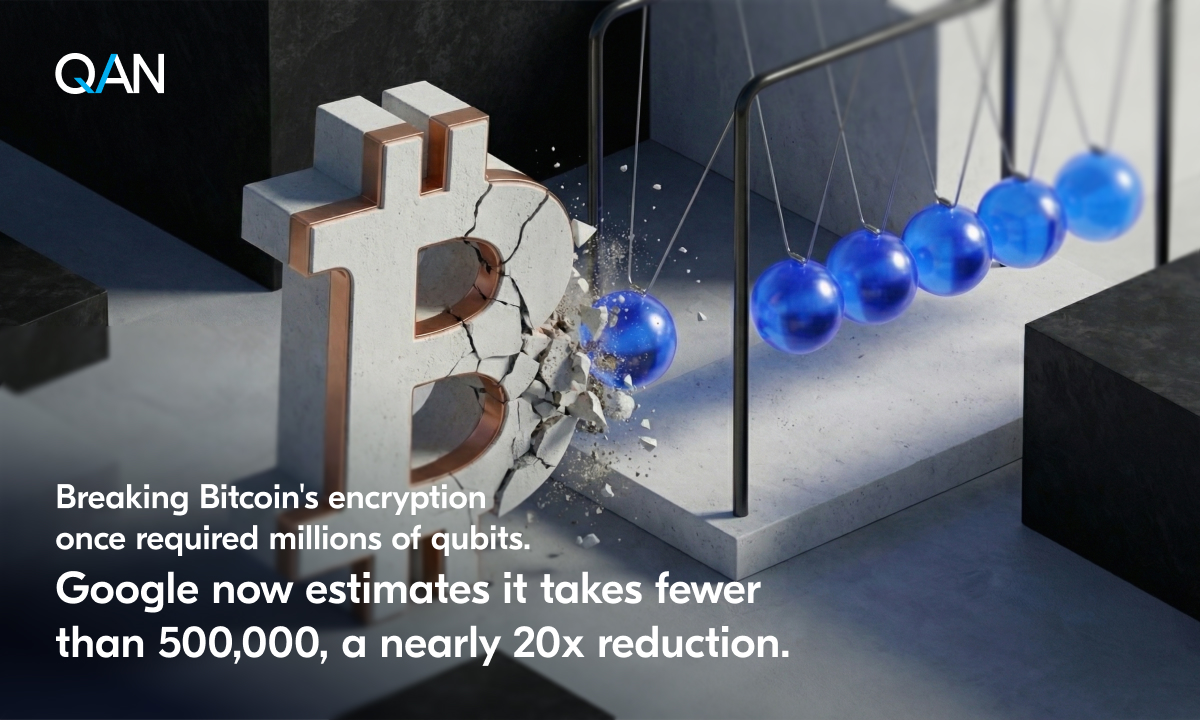
Google Quantum AI just published a landmark paper on quantum threats to cryptocurrency and the numbers are sobering.
Here's what every blockchain builder needs to know 🧵
Band Protocol keeps shipping — and this is exactly why it matters.
Real use cases.
Real integrations.
Real value flowing on-chain.
Not just another oracle — this is verifiable data infrastructure for the next wave of DeFi + AI.
$BAND
Guided by visionary leadership and united in purpose, the nation stands resolute, confident, and resilient.
Proud to serve and grow alongside this remarkable nation, Richmond Properties celebrates the UAE’s safety, progress, and enduring strength 🇦🇪
Band Protocol just took another step forward with verifiable randomness (VRF) 🚀
This isn’t just a feature — it’s core infra for both DeFi an TradFi use cases
From fair on-chain games to transparent financial systems,
unbiased randomness = trust
$BAND is becoming essential
No one trades crypto anymore? Think again.
TradFi is pouring into tokenized stocks, oil, gold & indices… but they’re still stuck with 9-to-5 trading hours.
DeFi can unlock true 24/7 access.
The missing piece? Reliable price feeds that never sleep.
🧵👇
Two things matter in this cycle:
⚡ speed of information
🔒 trust of data
Membit AI solves the first (real-time trends)
Band Protocol solves the second (verifiable data + randomness)
That combo is extremely underrated.
$BAND 👀
The biggest edge in crypto isn’t speed anymore.
It’s seeing narratives BEFORE they trend.
Membit just enabled sort-by-time → raw signal, no delay.
And guess what powers that data layer?
Band Protocol
AI + real-time data = unfair advantage 👀
$BAND
Big move from @BandProtocol 👏
VRF + real-time data + Membit = next-gen data infra
→ Verifiable randomness for fairness
→ Real-time oracle feeds
→ AI-ready data layer via Membit
This is no longer “just an oracle” — it’s the backbone of Web3 + AI 🚀
$BAND
"What if?" is the most important question you can ask.
Without it, Band wouldn't have been born in 2017.
Without it, @membit_ai wouldn't have launched in 2025.
Everything we've built started with two words.
People still think $BAND is “just an oracle”…
Reality:
• 1s block times + high throughput (v3)
• Cross-chain data across 60+ ecosystems
• AI data layer via Membit
This is not just infra — it’s the DATA backbone for DeFi + AI.
Proud to secure the network as a validator 💪