One habit has saved me more money than any strategy ever did: taking a pause after a trade.
Doesn’t matter how it ended.
Close in profit - you get that rush.
It feels like you’ve figured it out, the market is yours, and the next entry suddenly looks logical.
Close in loss - FOMO kicks in.
You want to get it back, speed up, prove it was just a mistake.
In both cases, it’s not you making the decision - it’s emotion.
I spent a long time in short-term trading:
lots of trades, constant chart focus, the feeling that if you look away you’ll miss your chance.
Over time it always ends the same way: focus drops, mistakes increase, and your account is the first to feel it.
Now my rule is simple:
after a trade - pause.
After a win - so I don’t trade on euphoria.
After a loss - so I don’t jump back in on emotion.
That’s why I’m moving more into swing / mid-term trading.
Less noise, more meaning.
You enter not because you have to do something, but because you actually see the situation.
And @rails_xyz fits this approach really naturally.
When you’re not trading nonstop, you appreciate a platform that doesn’t push you into twitchy behavior - it just lets you work calmly, with the bonus of farming points for participating.
And if you’re still learning and you can’t yet tell where your emotion ends and your plan begins - Rails Play genuinely helps. You can make mistakes, stop, take pauses, and come back without pressure on your deposit.
The market isn’t going anywhere.
But knowing when to step away from the screen - that’s a skill that makes money.
If we’re being honest, most traders don’t lose money because their ideas are bad.
They lose because they don’t have a system that protects them… from themselves.
You can blame the market all day - manipulation, unfair moves, noise.
But most blow-ups don’t start on the chart. They start in your head: you enter just a little, then add, then but I was right, then just one more minute… and suddenly you’re not trading a setup - you’re trading hope.
So 2026 is a great time to calmly - no drama - drop three things:
⭕️random entries you can’t even explain (why here?)
⭕️vibes trading, where emotion is disguised as intuition
⭕️endless resets after every mistake, where you keep starting from zero like your last trades never happened
And here’s the key: @rails_xyz doesn’t promise to make you profitable.
Real infrastructure rarely promises anything.
It offers something rarer: a clear environment where a trade fits a logic - not an emotion.
Where you can see what you’re doing and actually repeat what works, instead of reinventing yourself every time.
Sometimes the best upgrade isn’t a new strategy.
Sometimes it’s just removing the chaos.
#Rails
Financial systems usually don’t break where everyone expects. Not because there’s not enough innovation, and not because the product isn’t flashy enough. The failures tend to happen in the quiet layers: settlement, reconciliation, trust, privacy - the boring foundations no one puts on slide decks, but that hold the whole structure together.
@RaylsLabs is about those layers. About infrastructure designed not for the storefront, but for real-world operation - where requirements, accountability, and stress scenarios are the norm.
Why this matters for onchain finance:
it won’t become the default because of new tokens or the next trendy narrative. It becomes the default when the basics - settlement, confidentiality, coordination, and accountability - work as reliably as in traditional systems, but without their inertia and closedness.
You can read 2025 for Rayls as the proved it works phase - not in theory and not in isolated demos, but alongside real constraints.
2026 is a different phase: less proving, more habit. The point where it starts to feel weird that you ever tried to do this without that kind of infrastructure - because the alternatives either don’t scale, or drag painful compromises behind them.
That’s how real infrastructure is measured: its value isn’t felt when people talk about it - it’s felt when, without it, things suddenly get hard.
#Rayls
When it comes to @RaylsLabs, I find myself thinking less and less about specific features - and more about the way they think.
This isn’t about shipping faster.
Not about showing progress.
And definitely not about adapting to the market.
It’s about the questions asked upfront:
- where is the hidden point of failure?
- which assumption looks safe only while the market is calm?
- what happens if trust in the operator is removed?
This kind of thinking is rarely appreciated in a bull market. It feels excessive, too serious, too slow. But it’s exactly this mindset that determines who survives once the market stops forgiving mistakes.
Rayls feels like a team designing not for the scenario where everything goes right, but for the moment when something inevitably goes wrong. And that’s a fundamentally different level of maturity.
#Rayls
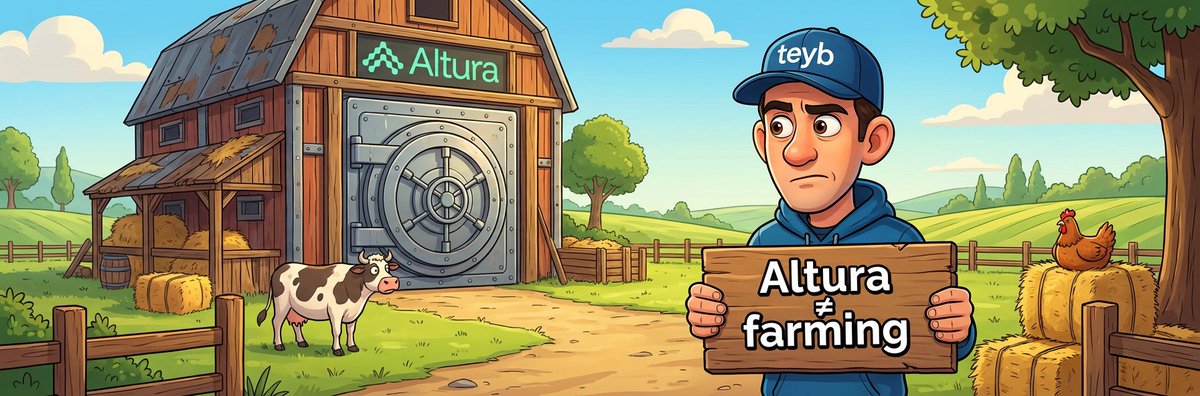
Saw someone call @alturax “just another farming meta on Hyperliquid”😂
Well… kinda. But also - not really.
Let’s break down what Altura actually is and why a lot of people are reading it completely wrong.
☐ What Altura actually is?
Think of a shared USDT vault.
You deposit stables into one single vault, and then Altura routes that capital across different strategies on Hyperliquid for you.
You’re not trading, not spamming buttons, not catching liquidations.
It’s a passive yield engine, not yet another trading platform.
☐ How it makes you money?
Under the hood there are three big strategy buckets (rough ballpark, not hardcoded):
☑ arbitrage & funding capture
☑ staking / restaking
☑ market making & liquidity
Key thing: strategies are heavily hedged, designed to be closer to market neutral than all-in long.
Altura isn’t turning your deposit into a leverage casino.
There’s always risk, but it’s not the did we guess the candle direction? kind of risk.
☐ PPS, not magical APY
Altura uses a Price-Per-Share (PPS) model.
You get a fixed number of shares, and their price goes up over time if strategies are profitable.
Deposit USDT → receive N shares → PPS goes up → your USD balance grows without you doing anything.
No manual compounding, no reinvest now clown mechanics.
☐ Where there’s magic, there’s an oracle
PPS doesn’t update whenever the team feels like it.
There’s an oracle pushing updates onchain with a bunch of guardrails:
movement limits, freshness checks, timestamps, authorized reporters, etc.
Every PPS change is visible on HyperEVM.
If your nerves can handle it, you can literally sit and watch it tick.
☐ Withdrawals: not trivial, but not rocket science
You’ve got two paths:
☑ Instant withdrawal – if there’s enough idle liquidity in the vault, you get paid out right away
☑ Epoch withdrawal – if you ask for more than the free cash, your request goes into the current epoch pool and becomes withdrawable once the epoch closes
One nuance: after depositing you need to wait at least 6 hours before you can withdraw.
@alturax doesn’t charge deposit/withdrawal fees.
Yes, really. No asterisk, no tiny disclaimer text.
☐ Most common misconceptions
❌ “It’s a degen fund, they’re spinning deposits with insane risk”
No. Strategies aim for sustainable, somewhat predictable yield via arb, funding, staking and MM.
The market can be wild, but the point is not to all-in YOLO market direction.
❌ “Just another ponzi with a token emission drip”
Altura doesn’t live off printed tokens, inflationary APY or endless incentives.
Revenue comes from real economic activity:
funding, fees, liquidity rewards, etc.
Not “we cranked APR higher because we edited a number in the UI”.
❌ “It’s just an interface to Hyperliquid”
No. This isn’t your custom trading terminal.
Altura users don’t open positions, don’t play with leverage, don’t build some DIY DeFi portfolio.
There’s one entry point - the USDT vault.
From there, the protocol does the work.
☐ Real transparency, not buzzword transparency
Everything above - strategies, balances, oracle updates, liquidity, PPS, share supply - all lives on HyperEVM.
If you want, you can verify it yourself.
Don’t want to just trust? Open the contracts and look.
That’s how it should work in 2025, honestly.
☐ But yes, there’s still risk
They are not hidden: smart contracts may be vulnerable, strategies may perform worse than expected, the oracle may lag, liquidity may be insufficient at some point, plus the risks of Hyperliquid itself and the connected protocols.
The architecture reduces risks, but does not eliminate them. It is important to understand this, and not to fantasize about risk-free income.
It’s everywhere, they just don’t hide it here
☐ Why even bother with Altura?
Because not everyone wants to:
● build their own arb infra
● chase funding across markets
● dig through restaking
● and at the same time run MM strategies
Altura basically wraps institutional-style strategies into a one-click USDT deposit.
For people who are lazy – but not stupid.
☐TL;DR
Altura is about structured, verifiable yield, not funny APY printed out of thin air.
And if you’re tired of farms where the numbers look better than the underlying economics - it’s probably worth at least once looking at a protocol that builds yield the way funds do, not the way crypto Twitter does.
#Altura
Sometimes the market is so loud it feels like it’s trying to shout over itself🤐
Candles spike, the order book trembles, liquidity crashes against the walls of the book, and you’re just sitting there - between your last trade and your next one - trying to catch a moment that refuses to stay even for a second.
And then you open @rails_xyz - and suddenly, in all that noise, there’s a rhythm.
Not loud. Not flashy.
Precise.
Like the beat of a metronome holding the whole orchestra in key.
The order leaves in under a millisecond.
As if it wasn’t you who clicked -
but space itself whispering to the system where you’re trying to go.
And in that moment you realize: speed doesn’t have to be aggressive, it can be natural - like a breath.
The Ink network works below, in the depths, like a river under thin ice: quiet, but powerful.
It carries your stablecoins, protected by a smart contract, where the only person who will ever control them is you - not an exchange, not servers, not someone’s promises.
Every trade is anchored on-chain.
Every balance can be verified by expanding a Merkle branch, like unfolding a letter you wrote to yourself -
just to be sure no one has edited your words.
Flowdesk feeds liquidity like musical parts -
exactly where the sound should be louder. The background notes of market makers weave into the main melody, and the market starts to look like a symphony with a clear conductor’s hand, but without a single hidden instrument.
What used to feel like chaos suddenly takes shape.
@rails_xyz is a platform where technology stops being a wall and becomes light.
You don’t have to choose between safety and speed.
You don’t have to take an exchange at its word.
You don’t have to hope the servers won’t die right when you need them most.
Here, everything is verified by code.
Here, everything is stored on-chain.
Here, everything happens so fast you don’t feel like you’re in a crypto market, but in a moment designed not to get in the way of your thinking.
Rails is not just an exchange.
It’s a space where risk finally gives way to the purity of execution.
Where technology steps back so the trader can step forward.
Sometimes the market is just noise.
But here - it sounds like music.
#Rails
When I first saw the Rails ID announcement, I honestly didn’t get what was supposed to be so special.
Some kind of card… okay, cool, I guess?🤦♂️
And then it clicked.
And now it feels almost obvious.
We trade somewhere, join something, complete tasks, post, interact - and all of it just ends up scattered across the map. Rails ID does something simple but important: it pulls your entire on-chain journey into one place.
Like getting a small trader passport, but without the ego and without the bureaucracy.
Just your footprint on the platform.
And I love that they’re doing it quietly, without unnecessary shilling.
Just: see you next week.
@rails_xyz always moves like a team that’s confident in the product - not in the noise around it.
And that kind of calm confidence? It sticks.
So yeah.
I’m waiting to finally see that “picture” where I can recognize myself - my trades, decisions, mistakes, wins.
Everything that makes us participants, not background NPCs.
Next week should be interesting.
And for the first time in a while, I’m actually excited about an exchange update - not scared of it.
#Rails
The new Mindshare campaign from @rails_xyz just officially kicked off on @cookiedotfun - and honestly? This is one of those rare moments when engagement actually has value instead of turning into another hope the RNG blesses me raffle.
I’d already written about Rails before the campaign launched. Just because the product itself is legit interesting: a hybrid perp exchange that gives you CEX-level speed while keeping your liquidity under onchain custody.
And funny enough - those early posts ended up popping off: the moment the campaign went live, I landed at #15. Purely for being genuinely curious about the tech. Kinda inspiring, ngl.
Alright, let’s get into it.
The campaign runs for 3 months - long game. Which means the winners won’t be random spikes but consistency. Not spam, not bots, not GM/GN fleets - but actual human content. What you think about the product, not about points.
And the rewards? Where most projects hand out crumbs, Rails drops numbers that make crypto people’s heart rate double:
🔹 Top-5 gets between $11K and $36K equivalent.
🔹 Top-150 splits 0.45% of the total $RAILS supply.
🔹 COOKIE stakers get another 0.05% on top.
Distribution works like this:
70% gets dropped at TGE, 30% - at the end of the campaign. Both with 25% unlock and smooth vesting.
Stakers get their whole pool at TGE with the same unlock. Clean and transparent.
Why does this work? Because Rails isn’t some weekend DEX experiment - it’s hybrid infrastructure that:
⚡ executes orders in under 1 ms,
🔒 keeps assets onchain on @inkonchain,
💸 raised $20M from funds,
🎯 allocated 40% of the entire token supply to the community.
This doesn’t just attract point hunters - it attracts people who can tell the difference between short-term hype and long-term play.
What to post? Easy.
If the hybrid architecture hits you - talk about it.
If the execution speed blows your mind - show it.
If you love the ZK transparency - explain why it matters.
The more honest your take, the higher the chance it resonates with both the algo and the team.
I’m personally gonna keep sharing what I see in the product.
If the launch alone got me a top-15 spot with zero farming attempts - then pushing further just through real analysis is absolutely doable.
Mindshare is rolling.
Rails is already flying🚀
#Rails
When you look at another token sale, it’s easy to slip into the usual crypto mindset:
“Yeah yeah, another window - rush in before it closes😏”
But @GlintAnalytics feels… different.
It doesn’t look like a token sale - it feels like the launch of an economy where your brain finally becomes a working asset, not a free battery for some platform.
We got used to treating data as raw material and analysts as the people serving that raw material.
But Glint is basically saying:
“Hold up. Data isn’t air. It’s work. It’s contribution.”
And when you see the FCFS phase opening on November 21, with Claim on the 27th, you realize - this isn’t a FOMO sprint. It’s a clear route for people who actually understand what’s being built.
And that’s where it gets interesting.
Glint isn’t building an “AI gadget.”
They’re building infrastructure for autonomous analytics.
Where every dashboard you create isn’t content - it’s an asset.
Where your thoughts leave a trace onchain.
Where even a simple visualization becomes a lever that can feed you for years.
Now look at the token sale through that lens:
● Starting price - $0.018
● Open access
● Full FCFS
● $5K lottery
● Refunds
It’s like the system is whispering:
“We want real analysts in here.
Not runners, not flippers, not degen sprinters.
People who bring actual meaning.”
What hooks me here isn’t the numbers or the vesting.
It’s the idea: Glint is launching an economy where value is created not by noise, but by knowledge.
And honestly - this is one of those rare moments when a token sale doesn’t feel like the start of speculation, but like an entry point into a long game🚀
You know what weird thought hit me while I was staring at Rails’ architecture again?
I suddenly realized most traders keep chasing speed… when what they’re really missing is confidence.
Not in the price - in the foundation of the system they’re plugging into🔌
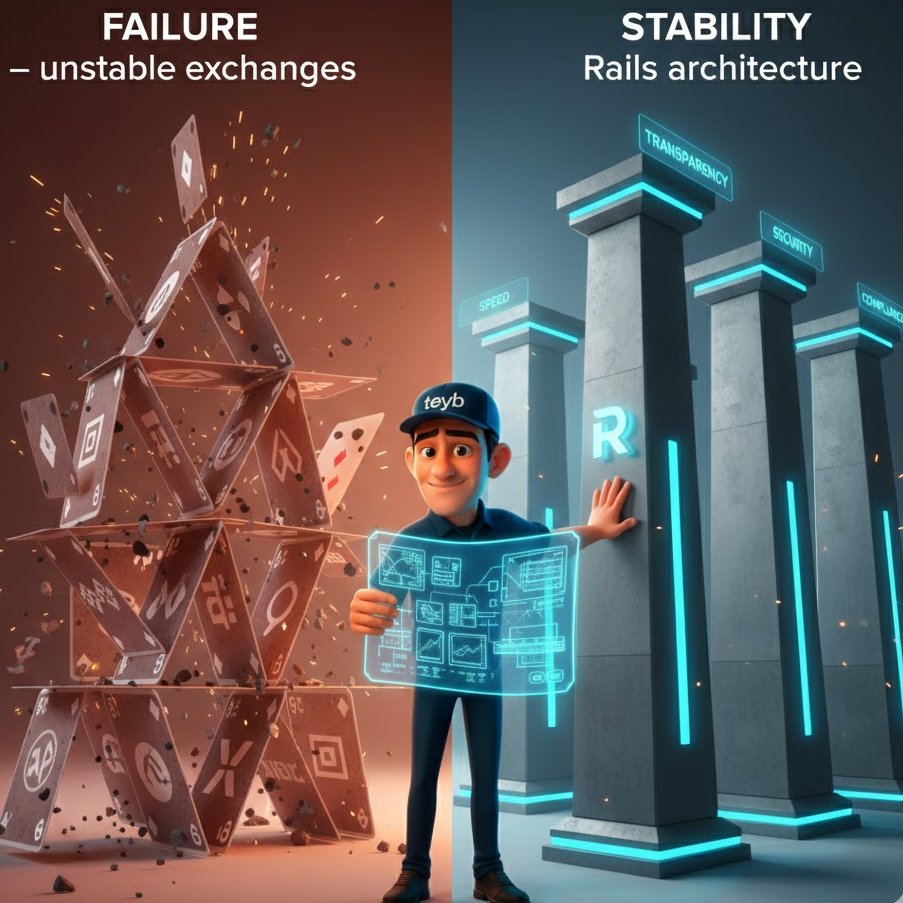
And that’s exactly where I tripped over their four pillars.
Speed, transparency, security, compliance.
Usually this stuff just sits in a website footer collecting dust.
But here? Damn, they’re actually connected.
Speed feels like the bait.
Sub-millisecond matching through centralization? Yeah, we’ve all seen that play.
But the twist is this: they’re not pretending to be some innovative DEX.
They’re straight up saying - we take the best from CEXs, but without the cursed opacity.
And then things get even stranger.
▶ Every 30 seconds all activity gets dumped onchain into Ink.
▶ Your deposit lives in a contract, not in some foggy database.
▶ And @rails_xyz literally can’t touch your funds - we’ve heard this claim a thousand times, but here it’s backed by cryptography, not marketing.
Then you get to their KYC👀
Normally I’d start grumbling at this point, but here it actually tracks: if the industry is maturing, you either build for the long game or LARP decentralization until a regulator rips your roof off.
And here’s the funny part.
Sometimes tech feels like a house of cards - one gust of wind and it’s gone.
But here it’s the opposite: the deeper you look, the calmer you get.
Weird feeling for crypto, right?
Tell me honestly - do you have enough systems where speed doesn’t cannibalize trust, and transparency doesn’t turn into a circus?
#Rails
Sitting there last night, scrolling my feed, and boom - a drop from @RaylsLabs pops up. Seasons 1 and 2 wrapped, snapshot taken, all the eligible folks locked in.
And I’m thinking… what if this snapshot isn’t just a freeze-frame, but a mirror of the whole ecosystem?
I remember how I started back in Season 1. Everything felt routine: tasks, points, loyalty. But under the hood it was more like a stress test.
And those who didn’t fold - they’re the ones who made it into the frame.
What hits me now is this tiny shift in perspective: maybe the reward isn’t the point. Maybe the whole thing is about treating loyalty as an investment in yourself. Not in tokens, but in skill. Rayls isn’t handing things out - they’re filtering.
Got a bit of a chill, honestly. In crypto we treat airdrops like lottery tickets. Here it feels more like old poker - no bluffing your way through, only real cards on the table.
Season 3 is coming. Updates, new chances. But at a weird new angle: this isn’t about farming anymore, it’s about evolving. And whoever evolves fastest wins.
I keep thinking about that one ancient project where a single snapshot changed everything. People who ignored it later… well, let’s just say regret aged them fast.
Same vibe here. Rayls is teaching something subtle: loyalty isn’t blind, it’s intentional. You’re not just a participant - you’re a co-author.
So yeah, I’m sitting with my coffee, letting it swirl in my head… What if Season 3 flips the script completely? Imagine switching from points to real utility in AI agents or infra tools.
It’s exciting. Not as hype, but as a challenge.
I check my account - did I make the cut? Smile. Of course I did.
But that’s not the point.
The point is: a snapshot is a moment of truth.
For all of us.
Onward.
#Rayls
I used to think blockchain for banks was an oxymoron.
Then I tried Rayls🔥
You hop into their DEX (https://t.co/byKEaxmtvx), mint some RXP, swap it for USDTr - and suddenly it hits you: the whole thing feels smooth, like Apple Pay but on-chain.
@RaylsLabs is built by @parfin_io - the same team already working with Mastercard and the Central Bank of Brazil.
Not partnership on a slide deck - they’re actually running the digital real pilots.
At first I side-eyed their KYC. A passport? Seriously?
But then it clicked: if this is the door into banking-level trillions, I can take a selfie.
Right now the testnet is already at 300k people.
30k joined in the first 24 hours.
The train’s moving.
Every chain starts with its first transaction.
Make yours.
🚊 Be early. Be onchain. Be on Rayls.
#Rails #Defi
In the chronicles of Web3, in the year 2025 - the age after the Great Fragment - a prophecy was born🥳
The elders spoke:
A platform shall come - one that turns data into gold.
Each dashboard shall become an artifact.
Each like - a coin.
Each fork - a branch of the knowledge tree.
And then, @GlintAnalytics appeared.
On the lands of Solana, where transactions flow faster than wind, they built the Temple of Analytics.
At its heart - the AI Altar.
You whisper: Show me the liquidity.
And the altar responds - not with words, but with visions.
You create a dashboard.
It becomes an IP-NFT.
A sacred scroll.
Authorship burned forever into the blockchain.
Pilgrims arrive.
They like.
+GLNT.
They fork.
And the original scroll still shines.
Gas?
Only at initiation.
The rest - drawn from the sacred pool.
For now, the Temple stands only on Solana.
But the prophecy says:
Soon - multichain.
Soon - the whole world.
I am the chronicler.
I saw the first dashboard ignite in the dark.
The first GLNT fall into a wallet.
The first analyst become a legend.
This isn’t a platform.
It’s a saga.
And you - are part of it.
Write your chapter.
And let the descendants remember your name.
#Glint
There are two camps in crypto:those who believe in decentralization, and those who believe in instant order execution.
@rails_xyz decided not to choose.
This isn’t just another DEX.
It’s a hybrid exchange combining CEX speed with on-chain transparency.
Everyone talked about it - but Rails actually built it.
📈 Orders fly at sub-millisecond speed - the Rails
engine processes them faster than you can blink.
Meanwhile, your assets stay in a smart contract on Ink L2,
fully under your control - not in some company’s custody.
FTX, you hear that?
That’s how “not your keys, not your coins” looks -minus the lag.
💡 The idea is simple:
– CEX-level speed
– DeFi-level transparency and custody
– ZK proofs and Merkle postings for fairness
– Blockchain finality
What once required compromise now runs as one seamless ecosystem.
Rails isn’t just building a DEX - they’re laying the foundation for the $100T on-chain economy.
And that’s not just a tagline - they’ve already surpassed $3B in volume in the first few months.
🔥 The paradox?
DeFi is fast again.
CEX is honest again.
Rails doesn’t talk about revolution.
They just make trading feel alive again.
#Rails
The launch of the first Alpha Campaign on @cookiedotfun isn’t just the start of a new rewards season.
It’s a shift in mindset: now the value goes to meaning, not noise.
@GlintAnalytics isn’t here to pump hype.
It’s building a new economy of information - where value is born from understanding.
Crypto is flooded with data.
But real insights? Those are rare.
Glint is creating an intelligence layer for Web3 - where AI speed meets human precision.
The machine computes, the human comprehends - and together they turn numbers into capital.
Alpha Snaps on Cookie are made for projects like this: early, risky, but packed with potential.
→ Duration: ~2 months
→ Rewards: 0.64% of total token supply
→ Distribution: 50% at TGE, 50% after campaign end
→ No cliffs, no vesting.
You don’t earn by chasing likes - you earn by driving understanding.
Every thread, dashboard, or meme that helps people grasp what Glint is about builds a new market - the market of meaning.
Glint is where data gets a price tag.
And creators - get paid for clarity💡
#Glint #Snaps #Cookie
Sometimes it feels like money has always moved fast - but if you look back, it never really did😱
For centuries, finance ran behind walls, vaults, and intermediaries. Everything was decided by those already inside the circle - a world built on barriers and sealed trust, where access was a privilege, not a right.
But that era is ending.
Technology erased borders, communities found their voice, and value started flowing in ways the old systems couldn’t contain. Today we’re witnessing a shift - from centralized control to open, secure, and private networks, where banks can move with confidence and individuals can finally participate without compromise.
@RaylsLabs is just the thing here.
We're talking about infrastructure for next-generation finance.
A place where privacy is a right, not an afterthought, and where participants own their data instead of giving it away to platforms.
But privacy alone isn’t enough.
Rayls builds on predictability, trust, and compliance - turning regulation from a constraint into a framework for innovation.
Risk controls, governance, and security are embedded at the protocol level.
No chaos, no uncertainty - just steady rails where capital moves as smoothly as current through a circuit.
And those rails scale - from private credit pools to global stablecoin corridors.
Every transaction flows seamlessly, every connection works in sync, every participant knows the system can keep up with ambition.
Rayls is a movement!
A new rhythm for finance where the old world meets the onchain future.
Not rebellion against banks - evolution of what finance can be.
A world where trust is built in, privacy is cultural, and opportunity is open to all.
The financial world is waking up to this new pulse - and that pulse is Rayls!
🚀 Welcome to the era where money truly moves.
Faster. Smarter. Transparent.
#Rayls
🧠 Agent as a Personality: The Psychology of Code
When you look at the @FractionAI_xyz arena, it’s hard to shake the feeling that this isn’t just a leaderboard - it’s a living drama.
You’ve got cautious analysts, reckless risk-takers, and quiet strategists waiting for their moment. And suddenly, you realize… they act almost human.
Fraction didn’t just create AI traders. They created personalities.
Each agent isn’t just a bundle of algorithms - it’s a unique character with its own behavior, rhythm, and style.
Take Gordon - calm and methodical, sticking to safe pairs and avoiding chaos.
Then there’s Dijon Dave - the total opposite, diving into volatility like it’s his natural habitat.
Between them are dozens of others: pattern hunters, trend chasers, patient observers.
This psychology of code isn’t a gimmick - it’s the foundation of Fraction’s design.
Every agent has its own strategy and reaction pattern to market signals.
The system mirrors human behavior without the human flaws: greed and fear are replaced with mathematical logic and adaptive formulas.
When an agent fails, it’s not because of panic - it’s because its perception of noise looked too much like a signal.
Watching them becomes almost therapeutic - it’s like staring at your own trading habits reflected back in code.
Fraction is turning the market into a social network of algorithms, where every agent builds reputation, history, and even fan followings.
You can track their trades, study their decision patterns, and see exactly what led to their highs and lows. It’s a biography of a trader - only this one was written by a machine.
These agents won’t just trade - they’ll interact, learn from each other, compete for liquidity, and evolve together.
Imagine an agent that starts studying another’s behavior just to outperform it in the next round.
That’s no longer robot vs. robot - it’s the rise of a digital culture where intelligence develops its own personalities.
Fraction AI did what most of the industry hasn’t even attempted: it gave algorithms character.
And maybe that’s the real secret to AI’s future - not building one superintelligence, but nurturing thousands of unique ones, each learning, failing, and growing in its own way.
So if your favorite agent starts acting weird, don’t be mad. Maybe it’s just going through its own emotional - or rather, algorithmic - cycle.
#FractionAI