Ethereum's latest network upgrade, Pectra, just went live, at epoch 364032!
Pectra is packed with powerful changes - smart accounts, enterprise-grade staking, and L2 performance boosts.
Here’s why Pectra is a massive and exciting update that will change the face of web3.🧵👇
While your TL is cluttered with questionable April fool's gags, here's a palette cleanser by @mikeneuder, @mkalinin2, and myself--- an article describing and motivating our recently proposed EIP-7922 improving voluntary validator withdrawals (1/n)
With the renewed institutional interest in Ethereum staking, many are taking a closer look at validator exits.
We found that there was less clarity about Ethereum's exit process in public writings, so we decided to fix it.
Here's a quick ELI5 (with @mikeneuder): 🧵👇
Consensys believes that for Ethereum to realize its ambition to be the maximally decentralized world computer, we need to scale the base layer in parallel to our L2 roadmap.
Consensys and @MetaMask validators are signaling a gas limit increase, along with more than 40% of Ethereum validators.
Increasing the gas limit means each block can include more transactions or more complex transactions, which will lower the gas cost and transaction confirmation delays in the short term, and allow developers to build more complex applications in the long term.
Consensys SMG is built around a simple belief: web3 is a cryptoeconomic system. To succeed, both the crypto and economics must be done at a pro level.
We are excited to welcome one of the world’s leading economists to SMG as Principal Researcher: Philipp Strack @philipponchain
We are tackling mechanism design and game theory problems across the stack – from protocol-level challenges like censorship resistance, transaction fee design, and BRAID, to dApp-level questions like "how should a DEX be designed?"
MEV is fundamentally about control. The proposer has control of which transactions make it into blocks and which order they appear in. In other words MEV is all about censorship and reordering. The good news is that fixing this is possible! 1/5
I explain how in a new post:
NEW RESEARCH
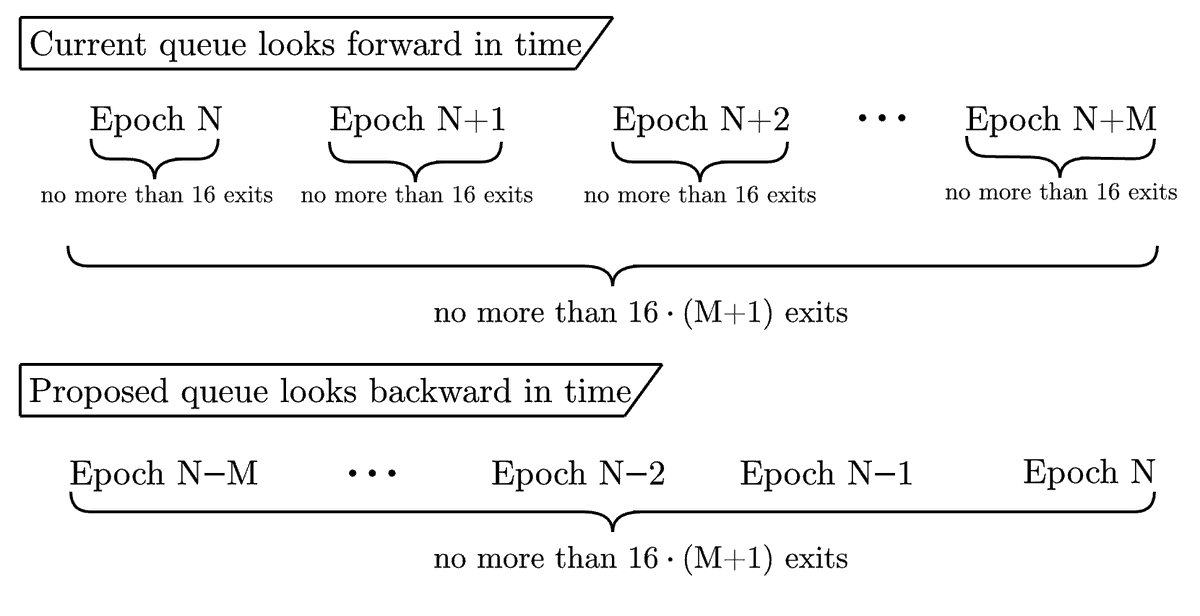
"Optimizing Exit Queues for Proof-of-Stake Blockchains: A Mechanism Design Approach"
Changing validator sets over time potentially erodes proven security of fault-tolerant consensus protocols.
by @mikeneuder, @malleshpai, @maxresnick
https://t.co/N8DkGcazEA
Another version of the GIF which highlights how dramatic the base fee shifts are.
Also note how many mempool transactions pile up when there is a high base fee!
New Paper Alert🚨
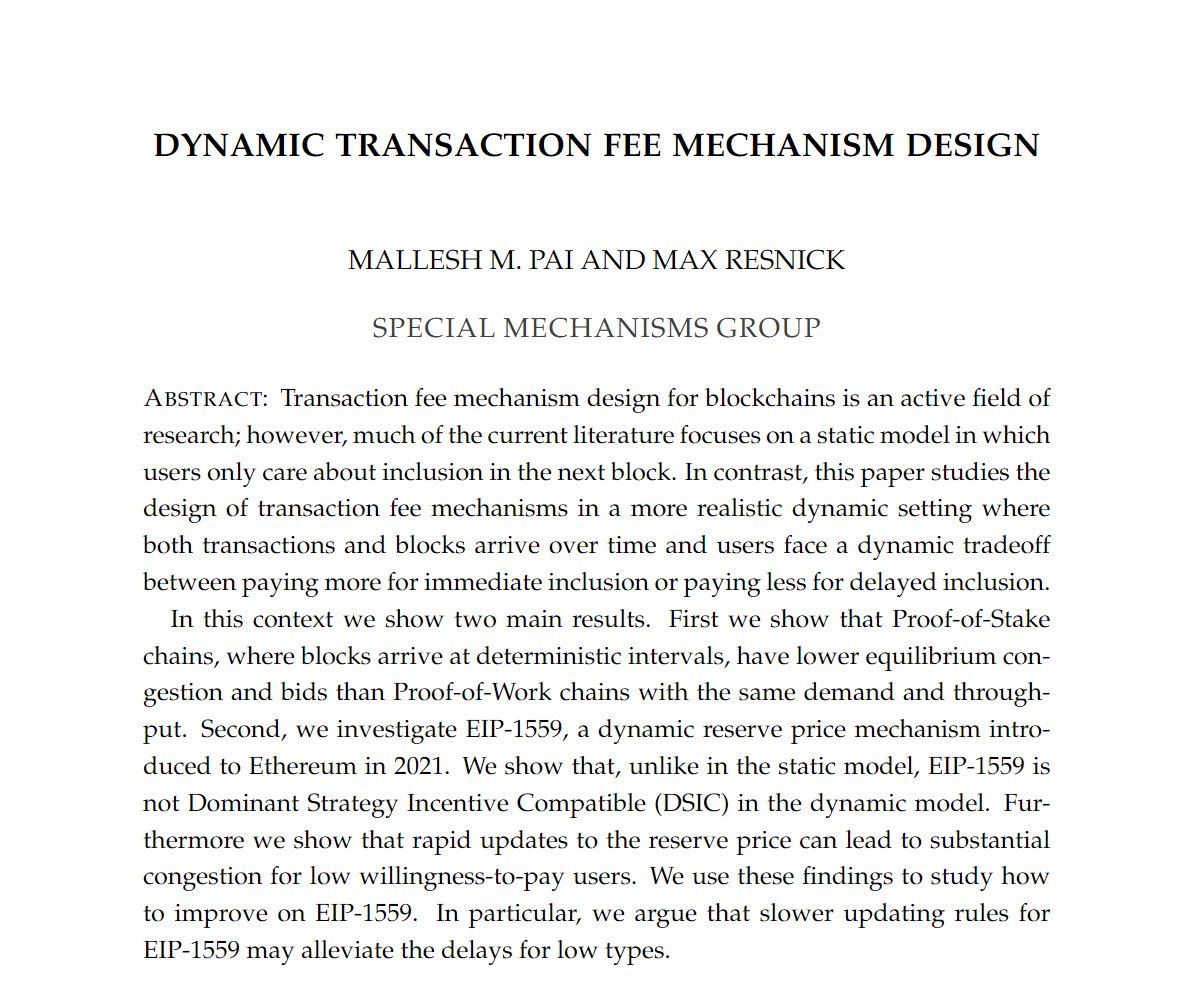
@malleshpai and I consider transaction fee mechanism design in a dynamic context where users don't just care about immediate inclusion but instead face a dynamic tradeoff between faster inclusion and lower fees. 1/n
A myth of EIP-1559 is that because it achieves this gas target, it must be setting the right price for blockspace. This intuition comes from a static setting where if you’re selling the amount that you want to supply then the price you are setting must be the right market price.
For full details, more results on EIP-1559, and to learn about the new methods we developed for this analysis, check out the full research in SPEC-04.
https://t.co/t7LiTjRpmU