to do list:
bite the hand that feeds me
put all my eggs in one basket
kill two birds with one stone
let the cat out of the bag
think inside the box
burn bridges
walk on thin ice
play with fire
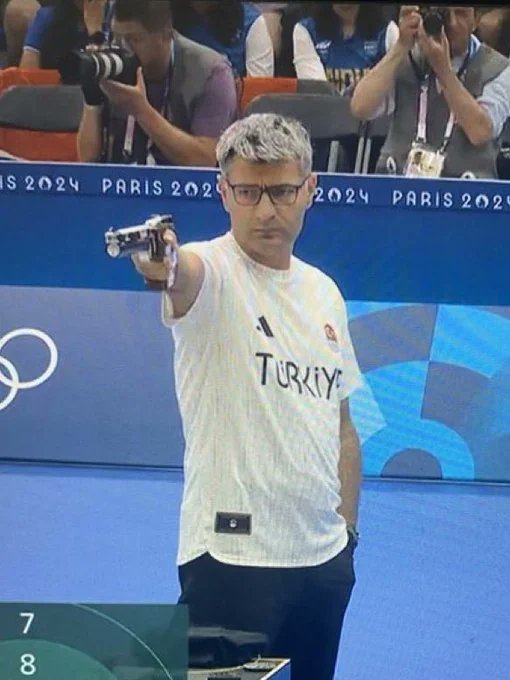
South Korea sent a fully-kitted out player for the Olympic shooting.
Turkey sent an 51 yr old guy with no specialized lenses, eye cover or ear protection and got the silver medal.
What are the odds? This story gave me goosebumps:
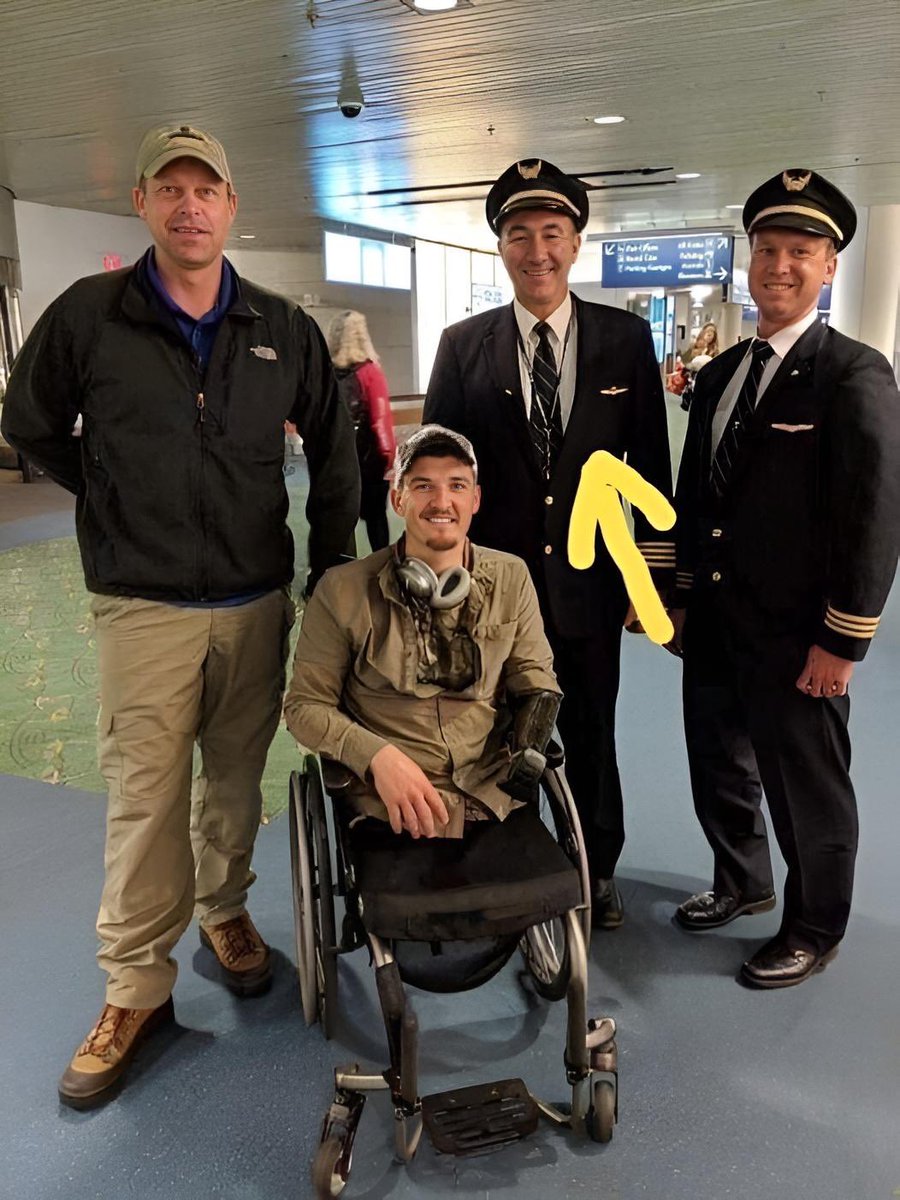
"The pilot was standing around as I got out of my wheelchair to board my flight to Portland.
He followed me and the flight attendant who volunteered to carry my bag. As I flung myself into my seat, he quickly asks, "were you in the military." I replied "yes."
He said, "Afghanistan 2010?"
Again, although surprised this time, I said slowly "yessss."
He then told me that he recognized me, my injuries, and my face. He told me he never knew if I survived or not.
Marc Vincequere is his name.
He flys with United now. Crazy small world.
…He was the pilot that flew me out of Afghanistan."
Credit: Todd Love
This is Japanese diplomat Chiune Sugihara and his wife Yukiko. They spent 18-20 hours a day writing and signing transit visas by hand in Lithuania for thousands of Jews for 29 days from July 31 to August 28, 1940.
Yukiko described their last days in Lithuania: "He was so exhausted, like a sick person. Even though he was ordered to go to Berlin, he said he couldn't make it to Berlin and suggested we go to a hotel and rest before leaving. When we got to the hotel, the Jewish people came looking for us there. So he wrote some more visas in the hotel.
The next day when we got to the train station, they were there too. So he wrote more visas on the platform until the train left. Once we were on board, they were hanging on the windows, and he wrote some more. When the train started moving, he couldn't write anymore. Everyone was waving their hands. One of them called out, 'Thank you Mr. Sugihara, we will come to see you again,' and he came running after the train. I couldn't stop crying. When I think about it, even now, I can't help crying."
As the train left the station, Sugihara said, "Please forgive me. I cannot write anymore. I wish you the best." It is estimated that the actions undertaken by him and his wife are responsible for the present lives of around 100,000 people.
After the war, Sugihara was forced to resign and work menial jobs (selling light bulbs door to door). He languished in relative obscurity until 1968 when an Israeli diplomat managed to find him and finally got him the recognition that he deserved.
Sugihara never told anyone what he had done during the war. Even his closest friends had no idea. "I may have disobeyed my government, but if I didn't, I would be disobeying God. In life, do what's right because it's right, and leave it alone."
A Brief Disagreement by Steve Cutts is a brilliant animated short depicting a visual journey into mankind's favourite pastime throughout the ages.
Meaning — humanity's inclination to fight each other.
https://t.co/1d9zKIuXg1
Fun fact: you can get paid to be a pandahugger in China. And being a “professional panda hugger” is a viable career choice with a regular income
[read more: https://t.co/PzaLjaFH7O]
https://t.co/FG76WbAIu2
An image is nothing but a matrix of pixel values.
Sending a photo through a pasta machine twice to obtain 4 understandable images from it, visualizing at the same time the principle on which Convolutional Neural Networks operate
[📹 Kensuke Koike]
1,255 years ago today Charlemagne was crowned King of the Franks.
You've heard of him before, but why is he so famous?
Well, it wasn't because of his military conquests. Even though he couldn't read or write, the mighty Charlemagne is important because... he really loved books.
To cut a long (and very interesting) story short, Charlemagne was crowned King of the Franks alongside his brother Carloman on the 9th October 768 AD. Carloman died three years later and Charlemagne became sole ruler. He defeated the Lombards (to defend the Pope), invaded Spain (recently conquered by the Umayyad Caliphate), Christianised the Saxons, and extended his territory all across Western Europe.
This culminated on Christmas Day in 800 AD, when Charlemagne was crowned Holy Roman Emperor by the Pope. He had come to rule the largest state in Europe since the fall of the Western Roman Empire — and the largest that would exist until Napoleon's brief conquests one thousand years later. Charlemagne's kingdom included modern-day France, Belgium, the Netherlands, Germany, Austria, Switzerland, Czechia, Hungary, and Croatia, alongside parts of Spain, Italy, Poland, and more.
Very impressive. But this is *not* what makes Charlemagne so important — after all, this kingdom splintered soon after his death, and history has seen countless conquerors before. Rather, Charlemagne's devotion to books is his greatest legacy.
The strangest thing of all is that Charlemagne could not read or write himself — he learned from scholars through conversation and had books read aloud to him. But Charlemagne recognised the immense importance of education and so he funded monastic libraries and scriptoriums (where monks copied or wrote out manuscripts) all across his kingdom.
There was a political motive — the only way to run a such a vast state was with highly educated administrators. But Charlemagne also believed a proper liberal arts education had intrinsic value, and ensured that he and his family received lessons in arithmetic, rhetoric, logic, and grammar.
He also invested in architecture, and his Palace at Aachen (in modern-day Germany, of which only the chapel survives) was the first major structure built in stone in Northern Europe since the fall of the Western Roman Empire — Charlemagne was trying to drag Europe out of the Dark Ages.
No wonder this period has been called the "Carolingian Renaissance". Art, literature, education, and architecture all flourished under Charlemagne's rule. His scribes even developed a type of Latin script known as "Carolingian Miniscule", which became the continental standard for writing and is the direct precursor to our modern and much-loved Times New Roman font.
But, most importantly of all, he gave monks the time and resources to copy manuscripts of Ancient Greek and Roman books. The originals have long since deteriorated, but the copies made by Charlemagne's scribes have survived. In almost every case they are the oldest versions of Greco-Roman literature, philosophy, and history.
A major part of the Renaissance was the "rediscovery" of Ancient Greek and Roman culture. But it wasn't original Greco-Roman texts they read — it was those copies made by Charlemagne's scribes, scrupulously written out by hand and scattered across the monastic libraries of Europe.
Without Charlemagne's devotion to literature, literacy, history, and education, the Renaissance would almost certainly have never happened. Who knows how long the Dark Ages would have continued without him? And without the Renaissance there would have been no Scientific Revolution, Enlightenment, and Industrial Revolution — or at least not where and when it happened.
And this legacy lives on; anybody who ever reads anything Greek or Roman today would likely not be able to do so without those nameless, tireless monks who worked under Charlemagne — not to forget the many Islamic scholars who also contributed to the preservation of Classical texts.
Legend says that Charlemagne tried to become literate in his old age, practicing writing on a wax tablet each night before bed, but to no avail. Alas, the King who could not read or write turned out to be the most important champion of education in European history.
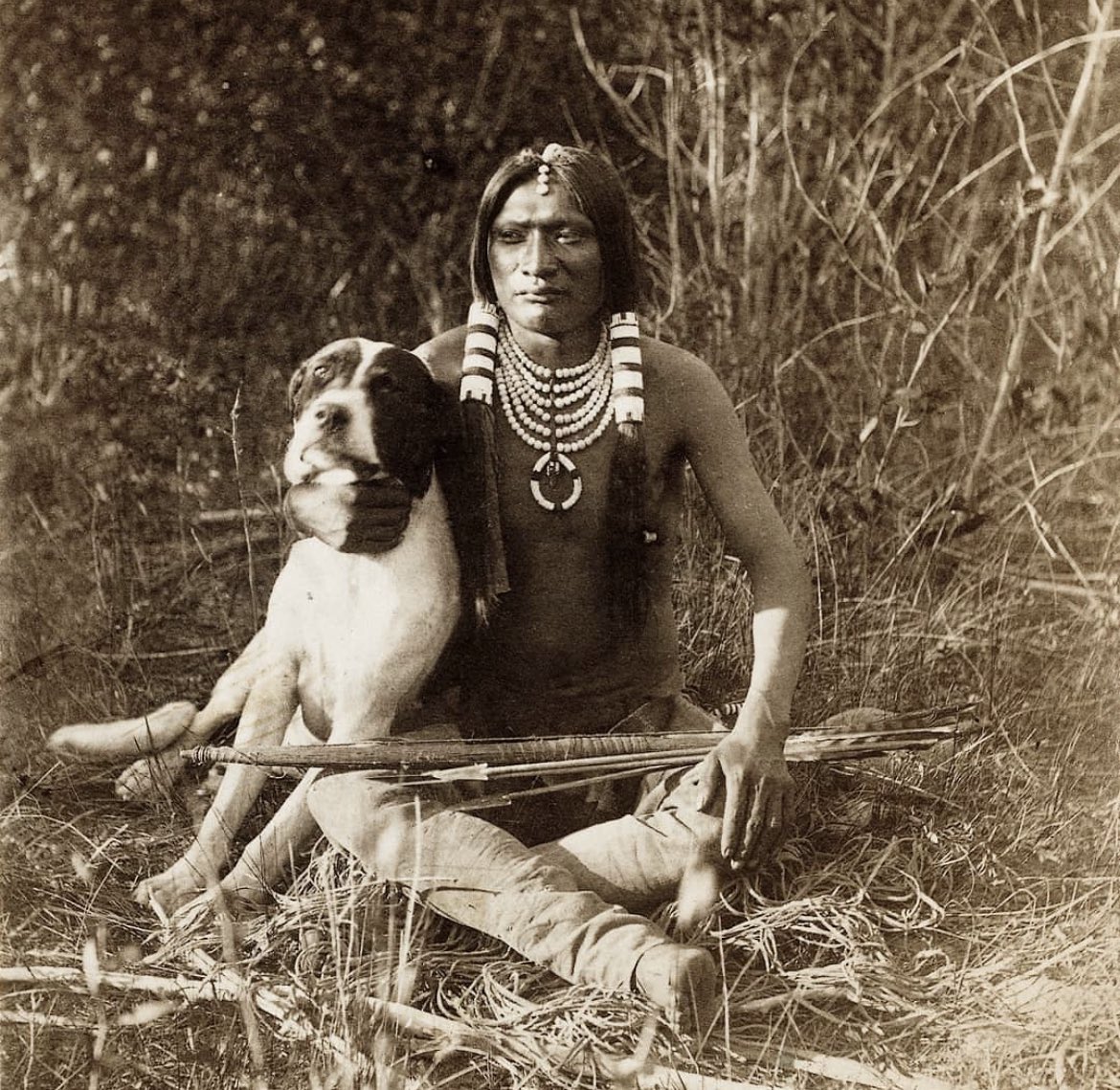
A Ute warrior and his dog in the Eastern slope of the Wasatch Mountains, Utah, 1873.
The Ute tribe lived in present-day Utah and Colorado, mainly as a hunter-gatherer society for many centuries. They made their first contact with Europeans during the early 17th century when Spanish conquistadors arrived in the region.
The Ute tribe began trading with the Spanish in the 1670s and were known for their prized deerskin. Towards the late 17th century, the Utes had acquired horses from the Spaniards, allowing them to be more mobile, covering more ground, hunting larger game, and expanding trade. Horse ownership and warrior skills became highly valued as a status symbol among the tribe.
Mormon settlers began arriving in the region during the mid-1800s, increasing tension. The situation was further exacerbated by the gold rush, which began in the summer of 1858. Prospectors and settlers began moving into the area, and as a result, most of the Ute people were forced off their lands and moved onto reservations. The name Utah is said to have been derived from the name of the Ute tribe, which translates to "people of the mountains."
Today, most people from the Ute tribe live on reservations located in Utah and Colorado. All the Ute reservations are involved in oil and gas businesses, and some even generate revenue from casinos. Nevertheless, the annual household income of the Ute people is below that of non-native people living in the same region. Unemployment is also fairly high on the reservations as well.








![Rainmaker1973's tweet photo. Blue tit singing on a cold early morning.
You can even see its song in the air.
[📷 Mikhail Kalinin] https://t.co/G4sg1D9YE3](https://pbs.twimg.com/media/F8D6TjtXQAArfvr.jpg)