Important: Apply for your Canadian visa safely online through the IRCC website—the only official source of information about Canada’s immigration programs and services.
Don’t risk using unauthorized third-party services that might scam you and provide incorrect information.
Learn how to protect yourself from scams and what to do if you are a victim of fraud: https://t.co/fb3paiDqGs
Are you a permanent resident of Canada thinking about applying to become a Canadian citizen? Here are some of our top citizenship questions, answered!
1. Am I eligible to become a Canadian citizen?
To become a Canadian citizen, you must meet the eligibility criteria, including permanent resident status, physical presence in Canada, income tax filing (if needed), and language and knowledge requirements. Learn more about eligibility: https://t.co/nqTcjx5F3I
2. How do I apply for Canadian citizenship?
If you’re eligible, you can apply online by completing the application, submitting the required documents and paying the fee. Learn more about how to apply: https://t.co/PROWotdDib
3. How long does it take to become a Canadian citizen?
Processing times vary, so check the latest estimated processing time before you apply: https://t.co/zRZJnMidMS
After you’ve submitted your application, you can check your application status using the citizenship application tracker in your IRCC account.
4. How do I prepare for the citizenship test?
If you need to take the citizenship test, visit our website to learn how the test works, how to study for it and what to expect: https://t.co/dzYbJijW6Y
After you pass your test, check out our videos about what to expect at an in-person citizenship ceremony: https://t.co/lPDJWQROWb
Borderlines Podcast #228 - How Express Entry Went Off the Rails, with @StevePaolasini
Canada’s Express Entry system was designed to rank skilled immigrants predictably and select those most likely to succeed economically. Has it instead become an unpredictable collection of category-based draws, shifting priorities and short-term policy fixes?
Steven Paolasini joins us to discuss his recent Macdonald-Laurier Institute paper, co-authored with Nino Melikidze, on how Canada’s skilled immigration system went off the rails—and how it could be rebuilt.
We discuss the transformation of Express Entry after the pandemic, historically high CRS cutoffs, the growing emphasis on French-language selection, and why highly educated and well-paid workers already established in Canada are increasingly unable to qualify. We also debate whether immigration selection should prioritize Canadian experience, earnings, education, language ability, occupational demand or broader social objectives.
In the live listener questions, we address whether criticism of French-language draws unfairly characterizes Francophone immigrants, whether applicants already working and building lives in Canada should receive priority over candidates abroad, and what should happen to cooks, fast-food workers, construction labourers and other lower-wage workers who do not fit a narrowly defined high-skills model.
https://t.co/rirPnRD2ZV
Here are the facts on the progress we’re making to restore immigration to sustainable levels. The latest data shows that as of June 2026:
• we’re on track to meet our annual targets in all permanent resident categories
• the number of students arriving in Canada is down 73% compared to June 2024
• the number of workers arriving in Canada is down 44% compared to June 2024
• the number of asylum claims made from January to June 2026 is down 68% compared to that same period in 2024
We’re also sharing more information about our immigration application inventories and application processing.
Get the latest facts and figures on Canada’s immigration system: https://t.co/UKwyslwnD1
You create your Express Entry profile.
Your CRS looks good. Then the ITA arrives.
But here comes the harder question: Can you support every claim that contributed to your ITA?
Swipe through.
#expressentry#permanentresidence#ita
Open this thread if you are looking for
- How to apply for admission in Canada
- Where to find scholarships in Canada
- How to apply for a Canadian study visa
- Free CV & SOP samples from Canadian Schools
- Canadian schools where you can pay your tuition monthly & more
Thread>>
Check out our YouTube playlist featuring the IRCC Explains video series. Get answers to common questions about Express Entry and learn more about topics such as working while studying and hiring an immigration representative—all in one place: https://t.co/jQyEgTI4y8
Red flags to watch out for when applying for a Canadian visa!
Protect yourself from visa fraud and scams by learning these crucial warning signs:
🚩 Someone pretending to be from IRCC on social media asking for your personal information
🚩 Someone demanding cash-only payments with no receipt and “guaranteed” visa approval
🚩 Visa fee payments being requested by email, phone, or bank transfer
🚩 Work recruiters providing visa documents with numerous errors or mistakes
For complete guidance on how to protect yourself from immigration fraud and scams, visit our website at: https://t.co/fb3paiDqGs
The Chief Justice has issued a Special Order designating all current and future applications challenging the constitutionality of section 101(1)(b.1) and/or section 101(1)(b.2) of the IRPA as specially managed proceedings.
NOTICE: https://t.co/ttaZ2eUDtm
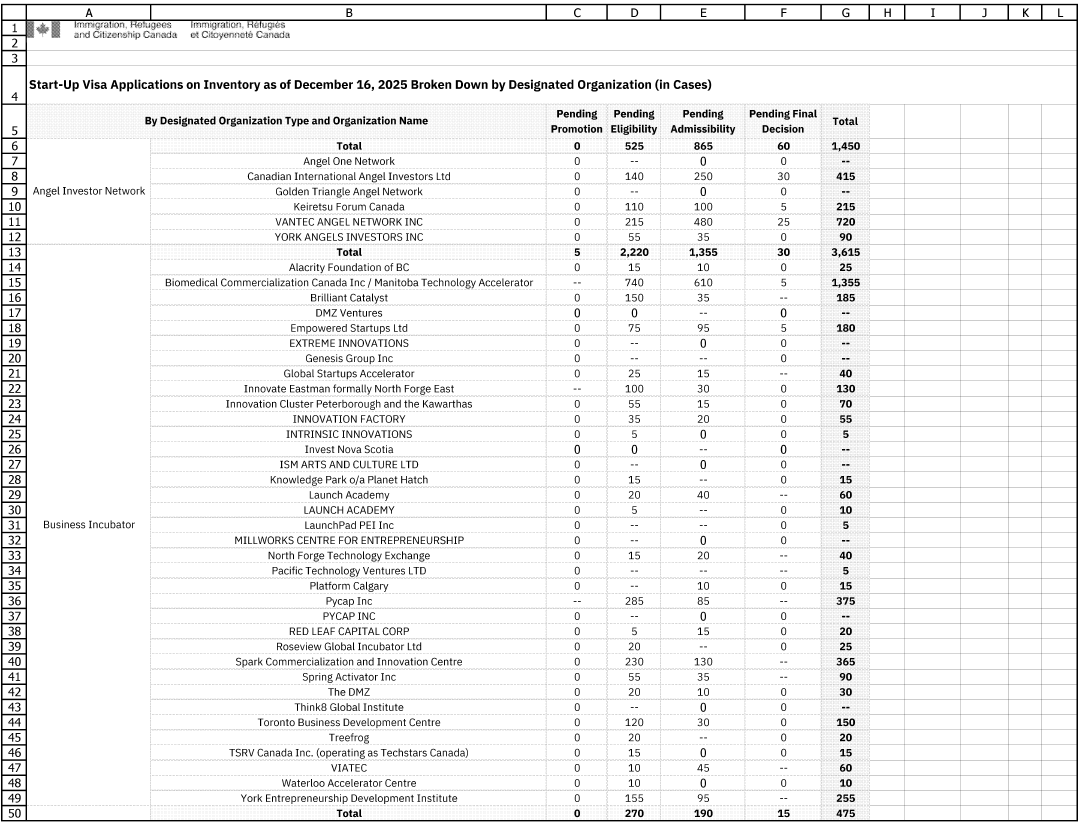
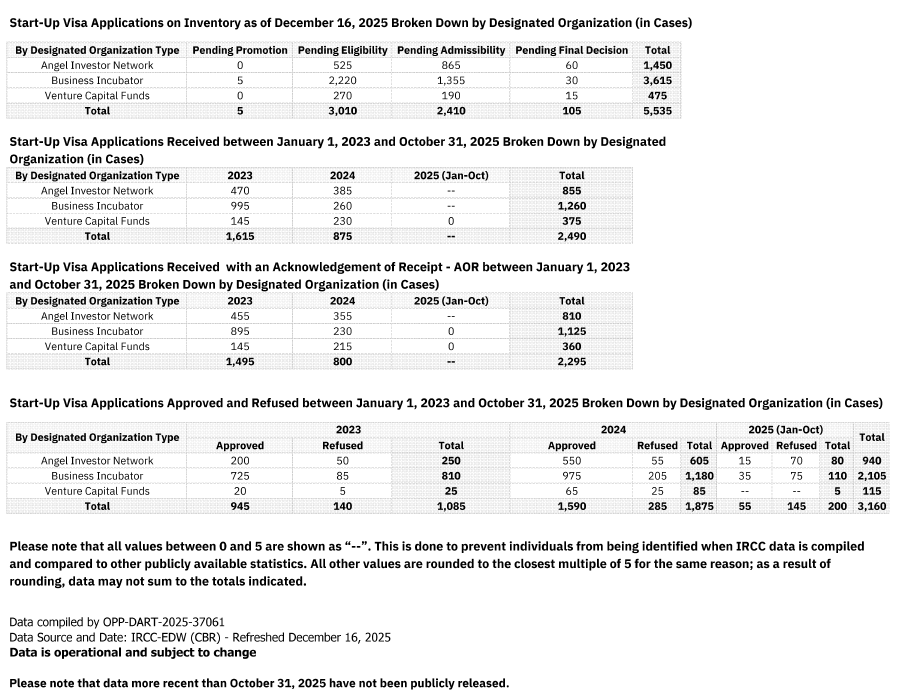
IRCC’s Start-Up Visa inventory as of December 16, 2025, excluding applications for which processing had not yet begun.
Applications supported by business incubators and eligible for priority processing appear to represent only a small share of the total inventory.
Even so, there were 1,450 pending applications supported by angel investor groups and 475 supported by venture capital funds—both priority-processing categories. With an annual admissions target of just 500 people, shared with the Self-Employed Persons Class, clearing even this portion of the inventory could take approximately four years.
Note: the 500-person target refers to admissions, while the inventory figures appear to refer to applications, so “approximately four years” may understate the actual time if applications include multiple family members.
Don’t rely on information from unofficial sources. Start with our trusted resources:
✓ Our website for official information: https://t.co/sSv2FycAjD
✓ Our Help Centre for answers to common questions: https://t.co/XoB2R425u6
✓ Our Newsroom for the latest announcements and updates: https://t.co/5jVm1y2Mpo
✓ Our YouTube channel for helpful videos: https://t.co/I4RLYCK6Pw
Scam alert!
A sponsor cannot request or receive money from a sponsored refugee.
If you're being asked to pay fees for a chance to be sponsored for resettlement in Canada, that’s a scam.
Don’t share your personal or banking information, and be cautious of anyone promising guaranteed sponsorship.
Protect yourself from immigration fraud: https://t.co/fb3paiDqGs
I really think if you have a job, are not a criminal - you should have a pathway to citizenship. Going forward - reduce the numbers, make it abundantly clear what the process will be (if any) but for people already in the "system" let them stay. Stop jerking em (all) around.
The latest data shows that the number of asylum claims made from January to June 2026 is down 68% compared to the same period in 2024. Get the facts on the progress we’re making to restore control to immigration and strengthen the integrity of our asylum system: https://t.co/LreKE2ZK8Y
One of the requirements for a stay of removal in Federal Court is that the Applicant must demonstrate that they will experience irreparable harm.
The Federal Court of Appeal has reiterated that irreparable harm must always be proven – it cannot be presumed or inferred.
Irreparable harm implies that there would be a serious likelihood of jeopardy to the Applicant's life, security or safety, or that of their family.
The harms and hardships that are the inherent consequences of removal cannot constitute irreparable harm. Such consequences include enforced separation, hardship for the family, psychological and emotional hardship, financial loss, the loss of employment, the interruption of education, and disruption to the lives built in Canada, among others.
Concerns about inadequate health care or suboptimal treatment in the Applicant’s country of citizenship do not constitute irreparable harm in the context of a stay motion. As well, a stay of removal is intended to address short-term impediments, not lifelong medical conditions.
Discrimination is not necessarily persecution nor is it irreparable harm.
Mental health issues, notably anxiety or depression, do not generally amount to irreparable harm when they are tied to an impending removal. This is the case even where the depression and/or anxiety is accompanied by suicidal ideation when these symptoms are linked to a pending removal, although there are exceptions where suicidal behaviour can rise to the level of irreparable harm.
https://t.co/dcTQkJuaqa