Engineer, Philosopher, Writer, and host of @RealAtheology. Ardent realist about everything except Theism and The Self. In my view, God and "I" are the problem.
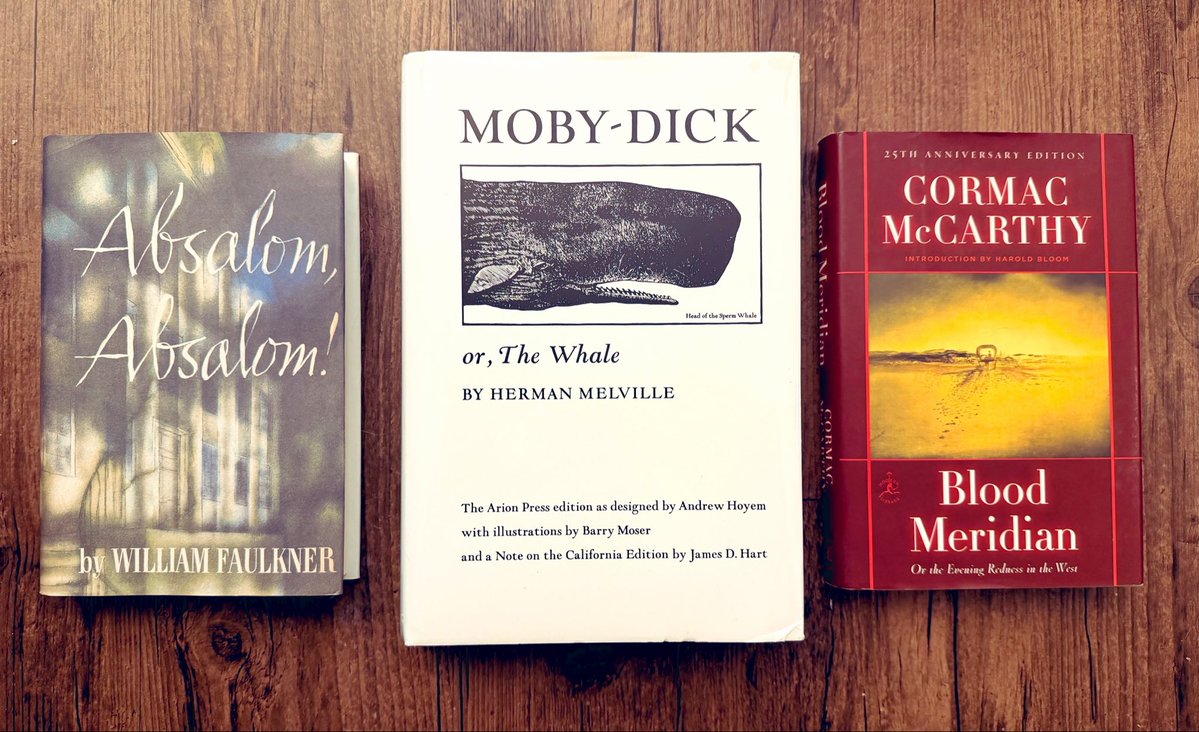
@TBrown0987 "A Farewell to Arms" is up there with "Moby Dick" and "The Sound and the Fury" for me. I think it is sublime and nearly flawless. One of the best opening paragraphs I've ever read.
What your favourite 20th century author says about you:
• Samuel Beckett: You are depressed
• Albert Camus: You are depressed
• Fyodor Dostoyevsky: You are depressed
• T.S. Eliot: You are depressed
• William Faulkner: You are depressed
• Hermann Hesse: You are depressed
• James Joyce: You are depressed
• Franz Kafka: You are depressed
• George Orwell: You are depressed
• Sylvia Plath: You are depressed
• Jean-Paul Sartre: You are depressed
• Leo Tolstoy: You are depressed
• Virginia Woolf: You are depressed
@TBrown0987 Read "Indian Camp" from "In Our Time." That is the best intro to Hemingway's terse, declarative prose style. Then read "Big Two-Hearted River" parts I & II. If you like those short stories, you'll love "The Old Man and the Sea" and "A Farewell to Arms."
https://t.co/6bykGU7XVy
But this puts other arguments of natural theology in an awkward position: are the arguments from miracles and religious experience only variations of the argument to design (teleological), or are they distinct arguments in natural theology? Will we need to modify Kant's division?
Kant famously divides natural theology into cosmological, teleological, and ontological arguments. The cosmological argument reasons from indeterminate experience, the teleological from determinate experience, and the ontological argument is purely a priori.
"You see, the terms thesis and antithesis and synthesis really come from Fichte, not Hegel. Let me explain why that matters."
"Sir, this is a @Wendys "
@sacsayhuaman69 I can't say that's an opinion I've ever encountered. Hegel's contribution is rational themes or ways of understanding: that knowledge is active and not static or that thought and meaning depend on wider communities or that thought and being are two sides of the same coin.
@sacsayhuaman69 Most secondary literature either oversimplifies Hegel's ideas until they are unrecognizably Hegelian, or stay so faithful to the dense jargon that reading Hegel's original text is actually easier than the secondary literature. Taylor finds a middling path.
@sacsayhuaman69 It is one of those books that has to be read multiple times before things really start to click. For me, the key was Charles Taylor’s “Hegel” (1975) that really helped me piece it together.