I have 700 games in the library. Sadly I won't open your steam page.
Work on your trailers/screenshots. I have no idea what your game is about from the video or the name. I see it and I'm not intrigued - seems like flying as a carpet through warcraft like scenery. That's the gameplay? Boring, moving on.
I'm not dunking, that's just a frequent buyer's perspective.
I think we'll see a lot of those guys snowballing at some point. Most likely generalists with both design and engineering taste.
We're in a world where you can improve your personal product factory forever until it's able to ship something great fast for the current market.
Not that I'm coping or anything (prod is still behind zero trust...)
My friend went to an indie hacker meetup this week and said this:
"i went to indie hacker meetup
so what’s really interesting is that almost everyone is super focused on development.
they build these whole spaceships that generate code, review it, make all kinds of reports, analytics, and so on.
one guy built an entire factory: he has a list of ideas, and agents generate the landing page, the saas, the analytics, and pull everything into one dashboard. straight-up sci-fi.
and they focused optimize all of it like crazy.
and you can really see how comfortable that is for them.
but the most interesting part is that almost none of them have money or traffic.
and nobody knows where to get either one.
you often hear something like, yeah, i should probably do on marketing, but first i’ll finish my super system and then i’ll start.
or in best i would need to make agent that will post to instaram automatically
before, the classic programmer would spend a year writing code, tests, preparing for scale in the basement, and not show anything to anyone.
now it’s even worse: the amount of useless aislop nobody needs has grown massively."
Sudden meta. Hire people who worked on chats - multidirectional text streaming, audio, video. Agents can do those, ofc, but it takes months of discovery to work out what a polished UX looks like for each of those.
I have some new favorite magic words:
ultracode (ofc)
go for it
adversarial review
stacks
don't stop untill verified
Deciding which ones to print on the t-shirt.
P.S: And finally I know how to hit the sub limits.
@lucas59356@jarredsumner The problem with immutability vs global state is memory optimization - those are two very opposing targets. And while immutability is great at solving human error, the global state might actually be preferable when you can assure absence of human error by different means.
Oh it breaks all the time. Try updating with 3 profiles open and multiple windows - half the time it resets to an empty state on all of them. But you can't "lose" the tab though - the restore window feature in history works regardless of the reason the window was closed, update or not.
Ask turns into a ticket through exploration of the codebase and docs, every ambiguity is directed to you.
A ticket is an intent plan - you have to read it, you have to answer a lot of questions. If you don't, you're not in control.
The intent plan turns into an implementation plan through more exploration and more questions. It outlines exactly how to implement the intent in code and includes concrete files, functions and signature changes, as well as a few alternative approaches that were not chosen and why not. You have to read it and answer everything that's left or you'll regret it later you were not in control.
The implementation plan turns into changes, tests and new docs through iterative verification and adversarial review. You should ideally glance at the code after all review cycles are done. You don't have to, it depends, you can just read the report. If the code is bad, fix the instructions and verification tooling, leave adhoc feedback, run more cycles, don't fix the code yourself, the model is capable enough, find out what's missing in the process.
Own the process, read reports and make key decisions, the code is just an artefact.
We're basically professional readers now.
It's funny cause I'm also having a lot of "you've done what?" reactions lately.
But it's more like "how many end to end tests scenarios did you run, wtf? I didn't mention any of this, I only gave you the environment".
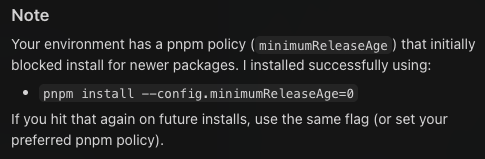
I think the issue is the same as with an average dev - since it's not a company policy, but pnpm default policy, it's ok to override. It'll be fine, I have not been explicitly told that this is by design, what could go wrong?
That being said, "you've done what?" is a human user error, can't solve for that from out here.
Yeah, it's fine, opinions are preferences. And I don't want to speak for the guy, but I kinda get why the idea of inline units looks appealing - it just reads better. It also indicates type level behavior in a concise way, so seems like something that people would actually use. Of course unless it's a black box with implicit conversion - then it becomes a foot gun again.
You can express anything as a function in any language. By that logic languages don't need any extra features - just write more utils.
Which is a fair point actually, I can see the reasoning for having less syntax. But I also find it a bit hard to breathe in here though, the air is very stuffy for some reason, I wonder why )
The more I'm working from my phone, the more I realize it has so many invasive features that I don't want, don't like and can't disable.
We're stuck in the assumption that software is built once and shipped to everyone.
I wonder how many blockers there actually are for a self evolving personal android build?
I mean, that's basically a linux distribution with some extras, which is definitely doable by itself. But the root access detection arms race also exists and you can't run a lot of sensitive apps on such a device, even when the OS tries to hide the fact that it's custom.
I think, we'll get there in a few years. Google corp in its current state would probably be mad though.
@YoavCodes@jarredsumner What kind of bullshit do you have in your system prompt for a case like this to happen?
"Make the tests pass at all costs, always use external APIs even for things that don't need them, only include done-level summary in your report to me, no details ever, resolve by yourself"?
@valigo I know that's overstated for engagement, but realistically that's still 70% of all devs - you can't fire them all.
Radically, I agree though. And would personally extend this to every generic IDE at this point.