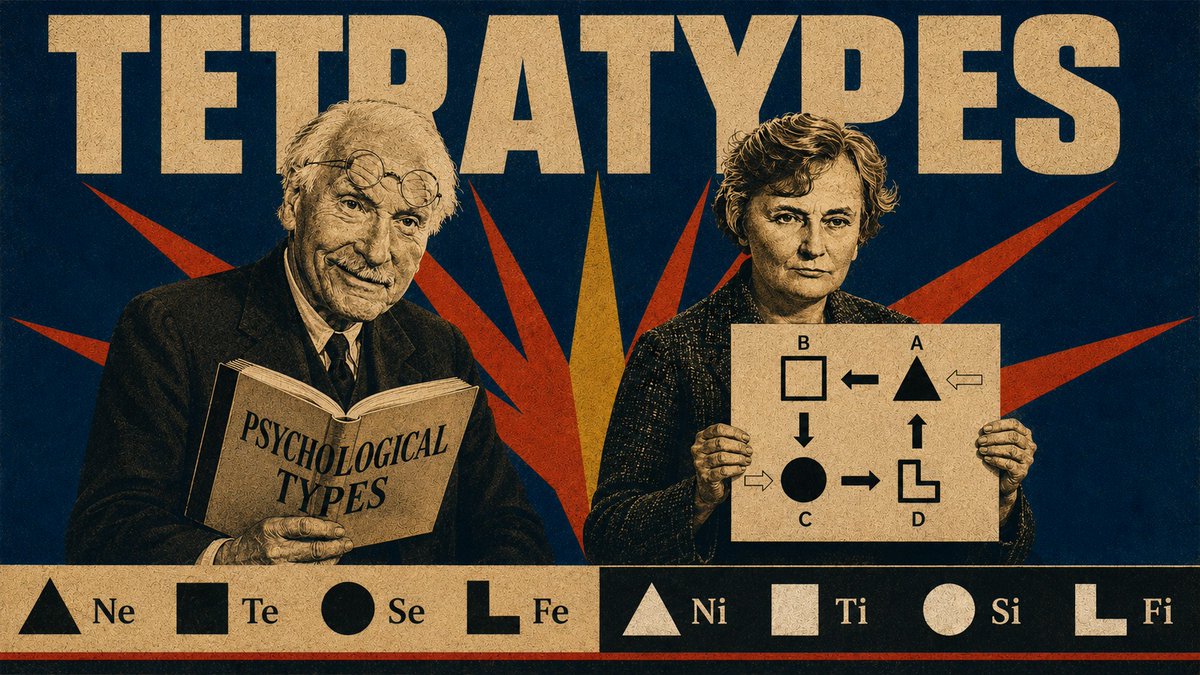
Model L, Kimani White and Aleesha Lowry's monadic element extension of socionics deserves better online resources. So I built one.
https://t.co/TiSkknrvUv
Model A at WSS resolution + Model L in depth. Independent resource, unaffiliated.
Model L — Kimani White and Aleesha Lowry's monadic element extension of socionics — deserves better online resources. So I built one.
https://t.co/TiSkknrvUv
Model A at WSS resolution + Model L in depth. Independent resource, unaffiliated.
@ToKTeacher@bgreene@DavidDeutschOxf Someone might perceive a good explanation appearing in consciousness but did it come to them through an “act of will” as traditionally conceived? On the contrary they had unwilled interests resulting in a good conjecture.
Why determinism is compatible with free will:
No one can predict your decisions without creating a perfect simulation of you that would itself exercise the free will required to make those decisions.
~Conjecture Institute Fellow @maria__violaris
@bnielson01 Karl Popper said that his close friend Hayek had made a "most important contribution to the understanding of freedom". Popper was a member of the Mont Pellerin Society with Hayek, yes he was a social democrat but he wouldn't be turning in his grave.
Dogmatism: there exists a thing (or things) it is impossible to be objectively wrong about.
Relativism: it is impossible to be objectively wrong. (Those are closely related).
Fallibilism: it is always possible to be objectively wrong about reality.
~Conjecture Institute Ambassador @ToKTeacher
The irony is that what Dan said is itself an example of a deepity, he saying something as if expressing a deep truth but just showing misconprehension of language use. One owes respect to the living, to the dead one only owes the truth (is that a deepity :))
If someone says "love is just a word" they don't mean "love" is a word and they don't mean that love is no more than a word, they are usually objecting to people using the word in the absence of other demonstrations that they are showing love, substituting love for using the word
Daniel Dennett on "deepities" the profound-sounding claims that are secretly empty
Philosopher Daniel Dennett has a name for a type of statement that sounds wise but actually says nothing: a deepity.
He explains it this way:
"A deepity is an apparently profound observation that is ambiguous. It has two readings. On one reading it's obviously false, but if it were true it would be very important. And on the other it's trivially true."
The trick is in the ambiguity. When you hear a deepity, part of your brain registers the trivially true reading and thinks yes, that's correct. But another part is reaching for the dramatic, important-sounding reading and that's where the illusion of profundity comes from.
Dennett's favourite example, which he uses when teaching the concept to students:
"Love is just a word."
It sounds deep. Think about it for a moment and it feels like it's gesturing at something real. That love is intangible, constructed, perhaps even illusory.
But Dennett dismantles it immediately:
"Whatever love is, it isn't a word. You can't find love in the dictionary."
That's the "use-mention error" confusing the word love with the thing love refers to. Once you put quotation marks around it properly, the statement collapses into something utterly banal: "love" is just a word. Well, yes. So is "cheeseburger." So is "word."
The deepity survives only because we don't slow down enough to ask which reading we're actually accepting.
Once you have the word "deepity," you start seeing them everywhere: in self-help, in politics, in philosophy.
As if Popper never existed (again).
A crucial sense in which theory comes first in science is: any data collected will be collected according to pre-existing theories whether anyone acknowledges them or not. Eg: how data collection devices work, theories of uncertainties, etc.
@stephenlaw60@Redux015 Most people had not used ChatGPT when we had this discussion. Would ChatGPT be able to induce that atavistic limbs on dolphins suggest evolution from land mammals if evolution was not in its training data?
5. ..or if it starts creating more problems than it solves.
So for me, Socionics sits somewhere between science and metaphor:
not established knowledge
but not arbitrary either
It’s a working conjecture, useful for now, but always open to criticism and replacement.
I’ve been thinking about how I actually use Socionics, especially in light of discussions about whether it’s “scientific.”
From a critical rationalist perspective (Popper), I don’t treat Model A as established knowledge or a proven theory of the psyche. At best, it’s a conjecture
4. If I discarded it entirely, I’d lose the tool I’m using to navigate.
But that doesn’t mean I treat it as beyond criticism. I’m fully open, in principle, to the model being wrong, and to replacing it if a better, less ad hoc framework comes along..
@Philip_Goff does that no show that the explanation was never and could never be “supported” by any observation at all, it just remains a bad explanation consistent with limited observation, not necessarily false.