Enterprises still go for 30-200B models because big feels safe. Small and trained often does the job better.
AI got a user interface. Using it is a prompt away.
Next comes a training interface, where improving your agent is as easy as using it.
Hermes Agent isn’t one agent but five
pointed Overmind at the repo:
• main loop
• delegate subagent
• background reviewer
• mini SWE runner
• MoA advisor
plus 5 LLM calls the harness runs quietly (one just decides if a shell command is safe)
open source🤌
Frontier models are overkill for agent tasks. Specialised models beat them on cost, latency, and accuracy.
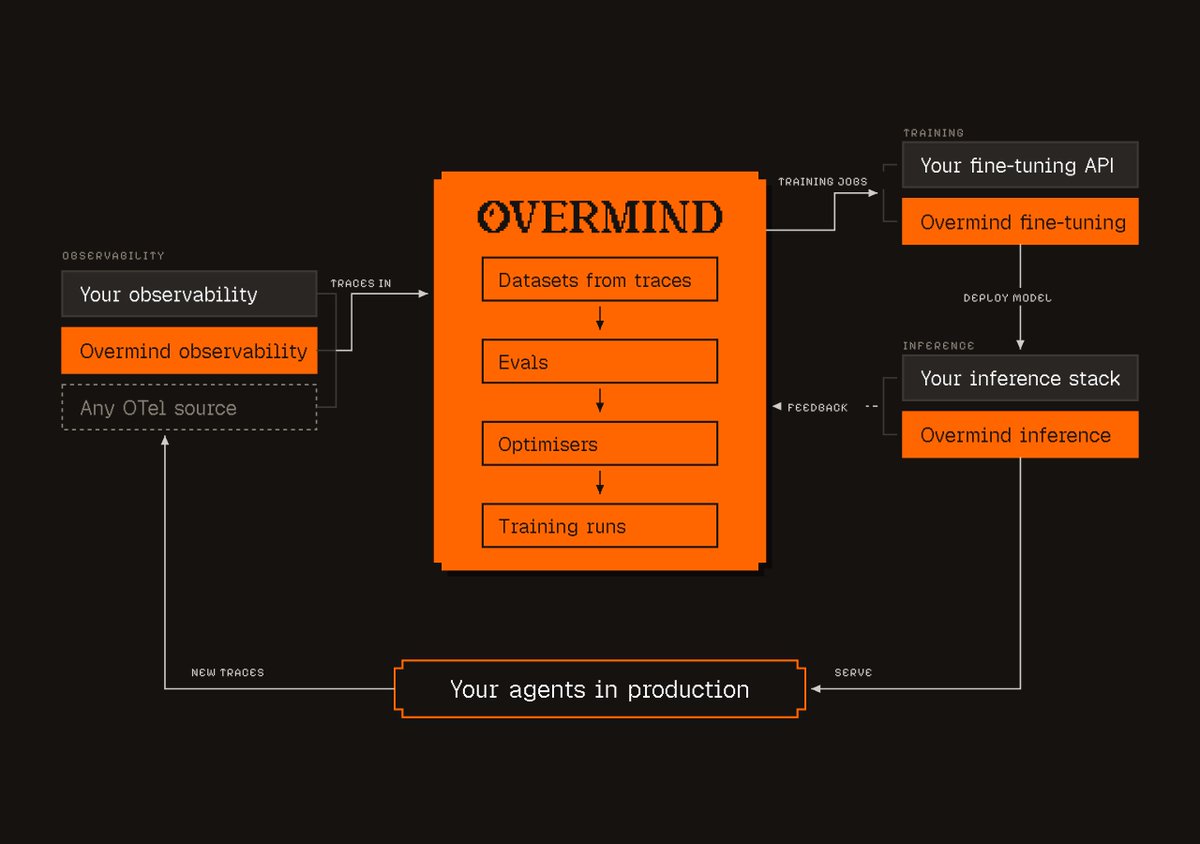
Overmind maps your agent, turns traces into training and eval data, and trains an open-weight model benchmarked against the model you run today.
Ship the model as a PR.
from a system-prompted Claude/Haiku dual routing architecture (below) to 1000+ hand-edited rows across multiple datasets (today)
check out the launch below, free to use (I'm not outsourcing dogfooding to my followers I promise 👀)
Reasoning is not the sole variable when determing a model's value to humans.
The industry runs on the opposite bet. Call it over-reasoning, past the point where it serves the person. Performed at them rather than alongside them.
nen-1 is trained to refuse that axis. Aimed differently.
nenspace is an extended mind: a language model trained to hand your thinking back, fused with a space built like the brain's own memory architecture.
As far as we know, this combination of fine-tuned open-weight LLMs and digital space dynamics makes it the first of its kind.
Holstically prefer Grok 4.6 > Fable 5 atm
The value of a model to users should also be defined by register, efficacy of language, structure etc. Extremely overlooked part of what defines a model's value to the users who do the cognitive processing/decision making.
gg @elonmusk
We just launched Quaso on Product Hunt 🚀
Every task touches a handful of tools, Gmail, Slack, GitHub, or a website with no API at all. Normally, someone wires that together by hand.
Quaso just does it. Describe a task in plain English, it connects to 3,000+ apps, opens a real browser for anything without an API, and runs on its own.
We built it because we wanted it. Been running our own mornings on it for weeks.
Introducing Quaso
Quaso turns your busywork into automation across all of your apps and the open web. Simply prompt what needs to get done and it builds and sets it up for you. Connects to 3000+ integrations (Gmail, Slack, Linear, Stripe, etc.) and picks up a real browser when there's no native API. Runs on schedules, triggers, and on demand. Fork templates or save any thread as your own reusable skill. Tag @quasoai in Slack so your whole team can put it to work. Just relax and get stuff done.
agreed looks reactionary + doesn't great a clear user/company discourse
but who knows what they are dealing with in terms of managing this level of infra at scale; would be v interesting to peek behind the curtain see usage patterns and reasoning behind decisions