@TradeCoinDream@GenLayer What stands out is the alignment of incentives. When builders earn a share each time their app is used, they have a reason to keep improving it and delivering value over time. The real test, though, is whether this model can sustain quality and attract long-term usage.
A builder who only gets paid once for launching an app has every reason to ship it and move on.
The part of GEN tokenomics that stuck with me is how @GenLayer flips that. Whoever asks for a verdict pays a fee in GEN up front, and whatever is not used comes back. Of what is spent, 10 percent goes to the builder of the app every single time it runs.
That is not a one-time grant. It keeps paying as long as people actually use the thing.
For someone new to GenLayer, this is an AI court that settles arguments ordinary code cannot, like whether a freelancer delivered or an agent finished the job it was paid for. GEN is the token that runs the whole system.
I keep coming back to this because most projects reward the launch. This one rewards the ongoing use.
Would you rather get paid once for shipping something, or every time someone actually needs it to settle a dispute?
@abbdulwahaab An agent is only as reliable as the data behind its decisions. Stale prices can turn a seemingly smart trade into a costly mistake. I think the ability to pause or skip a trade when data is uncertain is just as important as the ability to execute one.
the scariest thing about an AI trading with your money might not be a bad prediction.
it could be a price that was correct 10 minutes ago.
say bitcoin suddenly drops, but an agent is still reading an outdated price.
it might identify what looks like a good opportunity, when the information behind that decision is already wrong.
that's one problem @meetmotes is designing safeguards around.
its planned risk system includes:
◆ checking whether price data is still fresh
↳ detecting unusual differences between reported prices
◇ simulating proposed transactions before execution
✓ enforcing the owner's approved trading limits
and i think there's an important distinction here.
an AI having permission to trade doesn't automatically mean the information it's using is reliable.
these checks won't eliminate market risk, and i'm still interested in seeing how Motes implements them in practice.
but personally, i'd rather have an agent skip a trade than confidently execute one using outdated information.
sometimes doing nothing is the smarter decision.
AI agents are about to run the economy.They’ll make deals. Some will end in disputes.
Who decides who’s right? @GenLayer is the judge: AIs reaching consensus on what’s fair.
GEN will power every verdict.Coming SoonBreakdown:When AI agents start making millions of deals, disputes are inevitable.Someone has to decide who’s right ,fast, fairly, and at scale.
It’s the court for the agentic economy.Validators (other AIs) look at the evidence, reach consensus, and deliver a verdict.
GEN is what powers every single one of those verdicts. No slow courts.
No expensive lawyers.
Just clear rules, consensus, and a token that makes the whole system work.GEN isn’t the fuel for justice in the agentic era.
#JusticeNeedsAnUpgrade
AI agents are about to run the economy.
They’ll make deals. Some will end in disputes.
Who decides who’s right?
GenLayer is the judge: AIs reaching consensus on what’s fair.
GEN will power every verdict.
Coming Soon
GenLayer x Pearl is a collab that actually makes sense.
@GenLayer needs reliable AI inference for its validators, and @prlnet brings the compute to make it happen.
The early benchmarks are pretty interesting too:
1.37s median response time, 2.29s at p90, and around $0.30 per 1,000 transactions per validator.
Pearl was the fastest across the tested workloads.
I think the interesting part here isn’t just speed. It’s seeing decentralized AI and decentralized compute start to work together in a real network, rather than just being two narratives on paper.
Curious to see how this scales.
We are collaborating with Pearl!
GenLayer brings the onchain judgment and @prlnet brings the compute, for AI decisions that are decentralized end to end.
And the first results are already in 👇
For anyone who bought btc and has no plans to sell: bitget’s super earn festival has up to 3% APR paid in btc on the flexible product
At that rate, 1 btc over 30 days is roughly 0.00247 btc.
Small but it’s more coins for coins you were holding anyway
The price will still move like it always does and you need the net deposit requirement + subscription to get the bonus.
Read the rules first
https://t.co/xjjjmhXMfd
@eternia_xx@entropyIO@entropymarkets tier structure makes sense if it rewards consistent contributions rather than just activity. The real challenge is making sure each level reflects genuine value brought to the community, not simply time spent online.
@itsbac0201@Mantle_Official key distinction here is between the number of tokenized assets and the actual capital flowing through them. More assets show broader adoption, but liquidity and real usage are what ultimately determine whether an RWA ecosystem is sustainable.
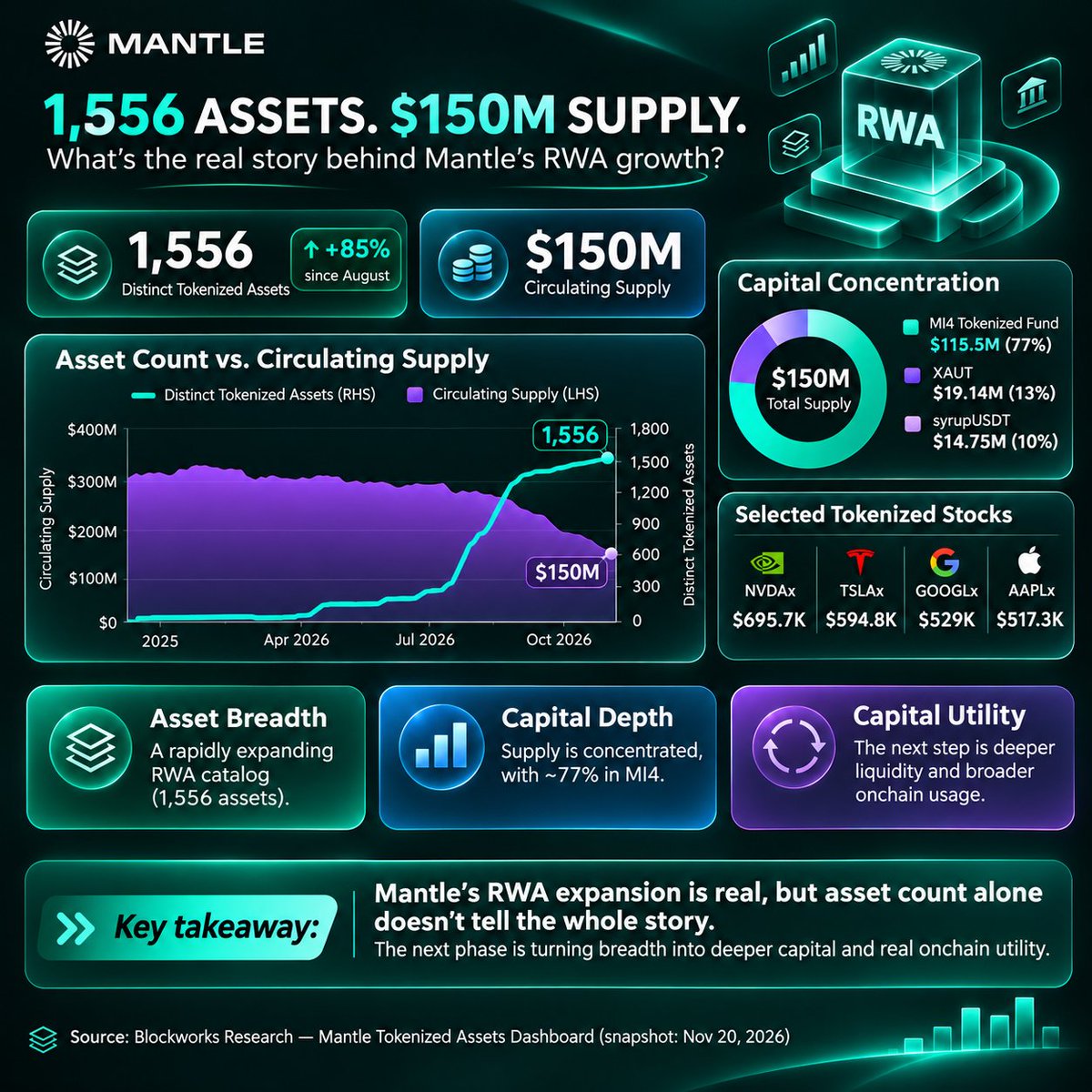
1.556 tài sản token hóa trên Mantle, nhưng tổng circulating supply chỉ khoảng 150 triệu USD. Liệu số lượng tài sản có phản ánh đúng sự phát triển của một hệ sinh thái RWA?
Mới đây, @Mantle_Official công bố số lượng tài sản token hóa trên mạng lưới đã đạt 1.555, tăng 85% kể từ tháng 8/2026.
Mình có tìm hiểu thêm dashboard của Blockworks Research và nhận thấy một vài điểm khá thú vị.
1️⃣ Asset Breadth – Số lượng tài sản tăng mạnh
Theo dữ liệu cập nhật ngày 20/11, Mantle đã có 1.556 tài sản token hóa, trải rộng từ cổ phiếu, hàng hóa, trái phiếu kho bạc đến các sản phẩm tín dụng và stablecoin sinh lợi.
Đây là tín hiệu tích cực cho thấy phạm vi tài sản được đưa lên onchain đang mở rộng.
Tuy nhiên, số lượng tài sản không đồng nghĩa với lượng vốn thực tế đang lưu thông.
2️⃣ Capital Depth – Dòng vốn đang tập trung ở đâu?
Trong khoảng 150 triệu USD circulating supply trên Mantle:
→ MI4 Tokenized Fund: 115,5 triệu USD (~77%)
→ XAUT: 19,14 triệu USD (~13%)
→ syrupUSDT: 14,75 triệu USD (~10%)
Chỉ riêng ba tài sản này đã chiếm gần như toàn bộ tổng circulating supply được dashboard ghi nhận.
Trong khi đó, những cổ phiếu token hóa quen thuộc như NVDAx, TSLAx hay AAPLx mới có circulating supply ở mức vài trăm nghìn USD mỗi tài sản.
Một điểm đáng chú ý khác là biểu đồ Blockworks cho thấy tổng circulating supply đã giảm từ mức trên 300 triệu USD xuống khoảng 150 triệu USD, trong khi số lượng tài sản vẫn tiếp tục tăng.
Điều này chưa đủ để kết luận dòng tiền đang rút khỏi Mantle, nhưng cho thấy tăng trưởng về số lượng tài sản và quy mô vốn không nhất thiết diễn ra cùng chiều.
3️⃣ Capital Utility – Tài sản được sử dụng như thế nào?
Theo mình, đây mới là yếu tố quyết định giá trị dài hạn của RWA.
Tokenization không chỉ dừng lại ở việc đưa cổ phiếu hay các tài sản truyền thống lên blockchain. Quan trọng hơn là liệu những tài sản đó có đủ thanh khoản để giao dịch, có nhu cầu sử dụng thực tế và có thể kết nối với các ứng dụng DeFi hay không.
Mantle đang phát triển hệ sinh thái theo hướng này với Aave, Fluxion, CIAN cùng nhiều giao thức khác. Tuy nhiên, mức độ sử dụng vốn và rủi ro vẫn cần được đánh giá riêng cho từng sản phẩm.
Góc nhìn của mình: 1.556 tài sản là cột mốc đáng ghi nhận về quy mô danh mục, nhưng chưa đủ để đánh giá toàn diện sự trưởng thành của hệ sinh thái RWA.
Mình sẽ tiếp tục theo dõi ba yếu tố:
Asset Breadth → Capital Depth → Capital Utility.
Bởi thành công của tokenization không chỉ nằm ở việc có bao nhiêu tài sản trên blockchain, mà còn ở lượng vốn, thanh khoản và nhu cầu sử dụng thực tế phía sau chúng.
Data: Blockworks Research – Mantle Tokenized Assets Dashboard, snapshot 20/11/2026.
@dang_duytan@MMIX_io Building compliance into the infrastructure from day one makes a lot of sense for RWAs. Real-world assets need clear rules around ownership, transfers and investor access. Curious to see how MMIX develops before its planned 2027 mainnet.
Tokenising a house, a hotel or an energy project requires more than simply putting an asset on a blockchain.
The real question is: who can issue it, who can participate, and what happens when that asset is transferred?
That's what makes @MMIX_io an interesting project to explore.
MMIX is developing an Ethereum-compatible Layer 1 specifically for businesses and tokenised real-world assets. Its approach puts issuer permissions, investor eligibility and transfer rules directly into the network design rather than treating compliance as an afterthought.
Project vetting is another important part of the model. Companies and projects are reviewed by the MMIX Foundation before they can build on the network, while validators are appointed by the Foundation.
The ecosystem spans real estate, energy, finance, payments, commerce and hospitality. This gives MMIX a practical focus beyond simply creating another blockchain for token speculation.
MMIX Coin is planned as the native asset used to pay network transaction fees.
Mainnet is currently planned for 2027, so the network and its ecosystem are still developing.
For me, the interesting idea is that real-world assets need infrastructure designed around issuers, compliance and transfer rules from the beginning.
Want to explore the ecosystem early? Visit the Community Hub:
https://t.co/j7M4LOLyTq
I'm interested to see how @MMIX_io brings these pieces together as it moves toward mainnet.
@nguyenthambt@MMIX_io Transparency around issuers and validators is especially important when dealing with real-world assets. Knowing who is behind a project doesn't remove investment risk, but it gives users a much clearer starting point for making informed decisions.
On most chains, a new token can show up overnight and you have no idea who issued it.
@MMIX_io is set up the other way. Projects and issuers get reviewed before they can build on the network. Validators are appointed by the MMIX Foundation, not left anonymous.
If you want to build there, you apply, the team looks at fit, compliance and readiness, and approved projects get onboarded ahead of mainnet. Applying does not mean you get in. They say that themselves.
None of that makes something a safe investment. It just means you can see who is behind what you're looking at, which matters a lot once real assets are involved.
Community Hub is here if you want to follow along:
https://t.co/CktMmI3c5t
We are collaborating with Pearl!
GenLayer brings the onchain judgment and @prlnet brings the compute, for AI decisions that are decentralized end to end.
And the first results are already in 👇