A US 501(c)3 nonprofit org that helps raise awareness, educate, & support research on intracranial hypotension & spinal cerebrospinal fluid (CSF) leaks.
Patient voices don’t just matter; they help drive research forward. Sign up today for the ileak registry℠ to support spinal CSF leak research at https://t.co/6vxJduGzEb
Endoscopic surgery for ventral CSF leaks has emerged as a minimally invasive alternative to classic intradural surgery. Both have pros and cons, but the alternate approach may be ideal for patients who have failed the initial surgery @spinalCSFleak https://t.co/WjjDGXIRVz
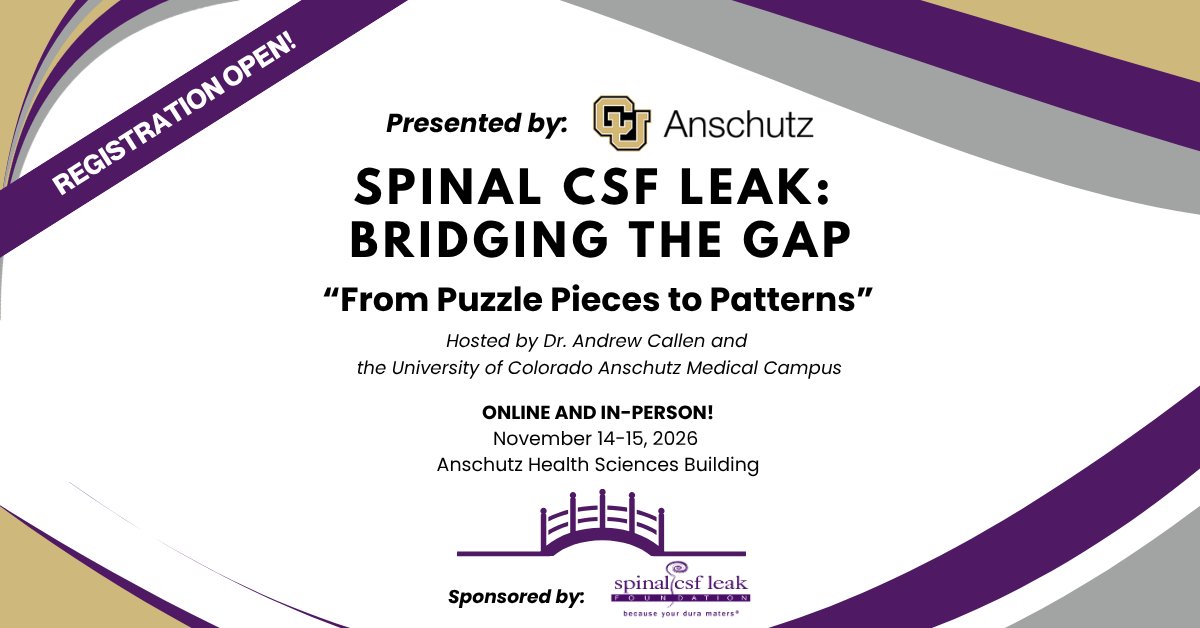
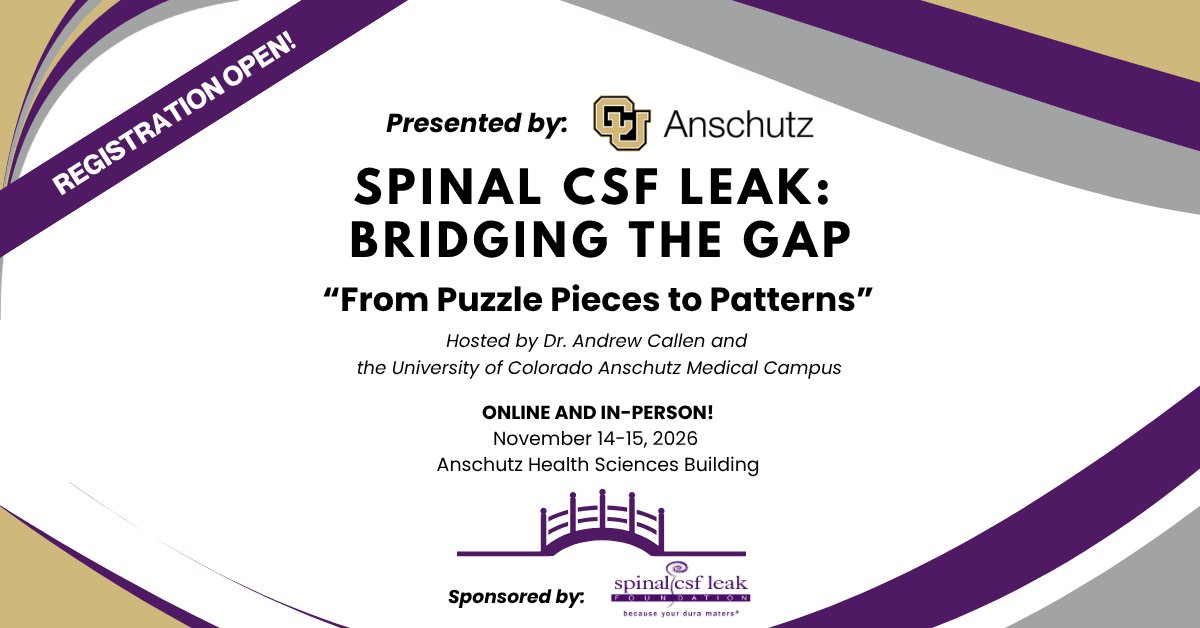
For medical professionals and patients interested in spinal CSF Leak, @issclsociety encourages you to consider attending the Bridging the Gap conference Nov 14-15, 2026 put on by @spinalCSFleak and @AndrewCallenMD
More info here:
https://t.co/gkm6UGrvpP
This conference gets better each year, and I am particularly excited to hear from our amazing lineup of patient and provider speakers this Fall. Register today!
Registration is now open for the 4th annual Spinal CSF Leak: Bridging the Gap conference, hosted by @AndrewCallenMD and @CUAnschutz, and sponsored by the Spinal CSF Leak Foundation.
For the agenda and to get tickets for the Nov 14-15 hybrid event, see: https://t.co/CvDRvO3LJ9
🚨𝐍𝐨𝐰 𝐀𝐯𝐚𝐢𝐥𝐚𝐛𝐥𝐞: 𝐖𝐞𝐛𝐢𝐧𝐚𝐫 𝐑𝐞𝐜𝐨𝐫𝐝𝐢𝐧𝐠
We extend our gratitude to Dr. @AndrewCallenMD & #DrIanCarrollMD, both valued members of our Medical Advisory Committee, for generously sharing their time, & expertise with our community.
https://t.co/7LhQLfdFSl
New in @TheAJNR :
CSF-venous fistulas usually arise from meningeal diverticula, but not always.
In this multi-center series led by @AjayMadhavanMD, we describe CVFs arising without an associated diverticulum, including fistulas arising directly from the common thecal sac.
Practical takeaway: absence of a diverticulum should not by itself end the search when the clinical/imaging picture still supports SIH.
Grateful to Ajay for leading this and to the multi-institutional group for helping define another subtle but important CVF variant.
https://t.co/Xf6l58uZWC
New in @TheAJNR :
I’ve never written a paper in quite this format before, but it came from a recurring issue I see in #spinalCSFLeak care.
For selected patients with suspected SIH, the neuroradiologist’s role may need to extend beyond the report.
The task is not just to interpret images, but to integrate the clinical story, prior imaging, myelographic technique, procedural options, and uncertainty into a coherent next step.
In a disease where the tests are imperfect and the techniques are evolving, patient-facing neuroradiology can meaningfully change care.
https://t.co/Ah5mIkT1AK
"Rare deleterious variants in FBN2 might cause type 1b spontaneous spinal CSF leak, supporting the integration of FBN2 genetic testing into clinical practice."
Thank you to the authors for ensuring that this paper is open access!
Full text version: https://t.co/HMv19pdupi
*OPEN ACCESS* In this comprehensive translation study combining human genetics, functional assays, and mouse models we showed that FBN2 mutations increase susceptibility to spontaneous CSF leaks. Science has entered our field @spinalCSFleak@issclsociety https://t.co/SIdczCBu7o
For spinal #CSF leak, gaps in awareness, delayed diagnosis, and limited data have long made it difficult to fully understand how this condition presents, how care is accessed, and what outcomes look like over time.
The @SpinalCSFLeak Foundation’s ileak registry℠ was created to help address those gaps by collecting patient-reported data directly from people living with spinal CSF leak.
Learn more and enroll: https://t.co/lbm0HyS1Xt
#SpinalCSFLeak #CSFLeak
🔍 Meningeal diverticula in patients with spontaneous intracranial hypotension may serve as an additional imaging marker to facilitate CVF diagnostic workup. Read more here (open access): https://t.co/VrqhWpab66
Proud to have collaborated with the @spinalCSFleak Foundation and a remarkable group of patient advocates on this project. Patients are the true experts on the financial, professional, and emotional costs of navigating a fragmented diagnostic journey. This study helped quantify those burdens and underscores the value of including patients as partners in research.
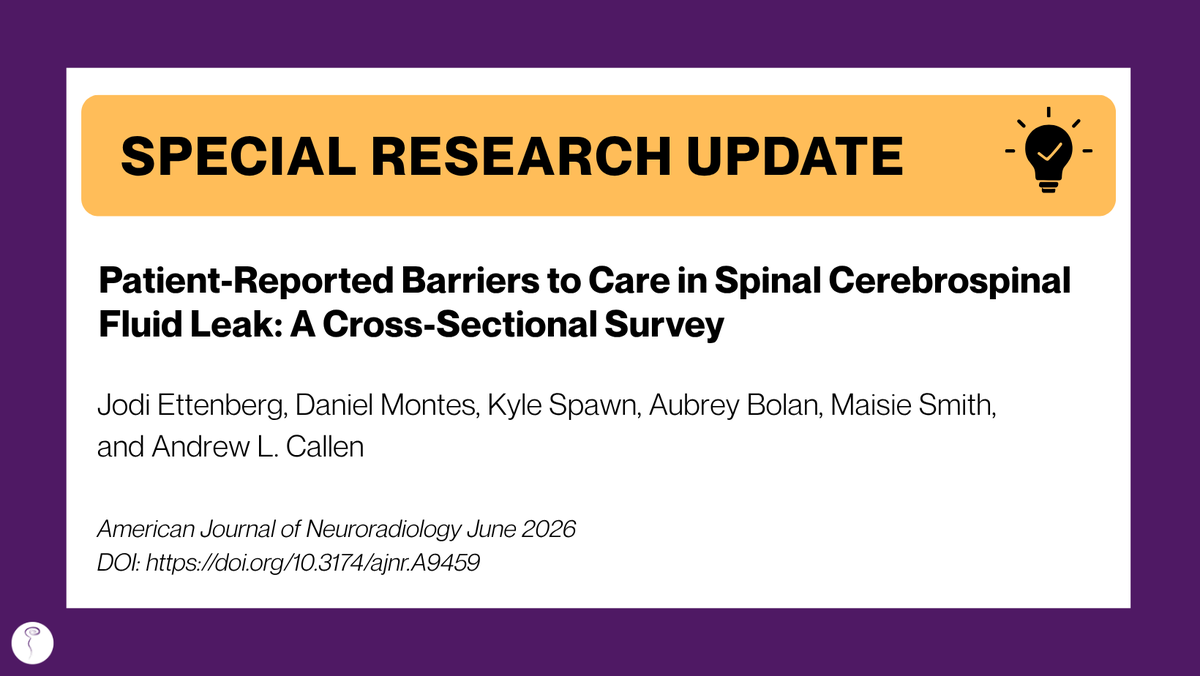
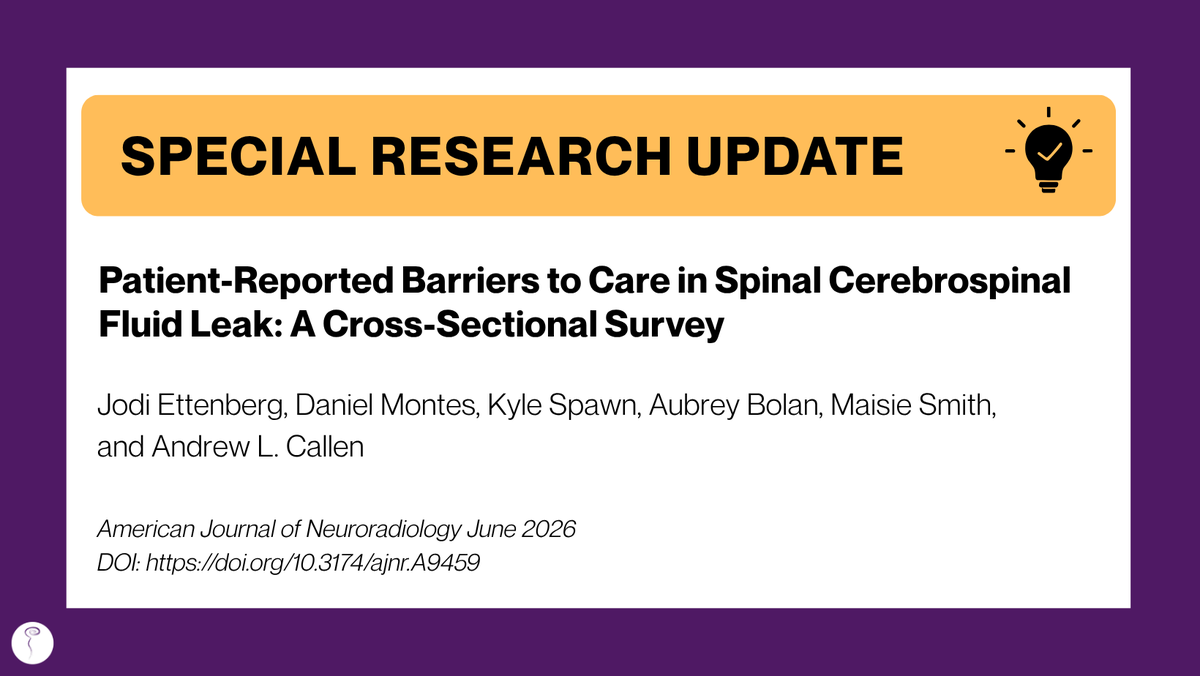
We are proud that the study is led by a patient author, our Board President Jodi Ettenberg (@legalnomads). Multiple other patients (Kyle Spawn, Aubrey Bolan, & Maisie Smith) are also co-authors.
We are grateful to contribute research on a topic so important to our community. 💜
To quantify the barriers to care spinal CSF leak patients face, the Foundation collaborated with @AndrewCallenMD and @DanielM737 on a patient survey and paper.
We are thrilled to share that it has been accepted by @TheAJNR!
Abstract here: https://t.co/UgsJV8Jl9z
This paper will be open access upon full publication; currently only the abstract is available online ahead of print.
The study results validated what we hear from patients: delayed diagnoses, misdiagnoses, financial strain, & fragmented care pathways are common.
Spinal CSF Leak: Bridging the Gap brings patients & physicians together annually to share the newest research in the field, patients' lived experience, & expert advances in spinal CSF leak diagnosis, treatment, & care.
Last year's replays are here: https://t.co/4zWLmLBqWq
Spinal CSF Leak: Bridging the Gap returns this fall!
Presented by @AndrewCallenMD & @CUAnschutz, this hybrid event sponsored by the Spinal CSF Leak Foundation will take place Nov 14-15, 2026.
Admission will remain free for patients.
We look forward to seeing you there!
As awareness grows & consensus guidelines help clinicians recognize the condition sooner, diagnosis is occurring earlier. Access to specialist care is expanding through national & international collaboration, & patient voices are being heard &validated through rigorous research.
For the final day of #leakweek, our collaborative slides with @SpinalCSFCanada, @SpinalCSFLeakAu, @csfleakuk & AHIFUGA focused on research.
To start off: recent studies reiterate that the condition significantly affects quality of life across multiple measures.
At the same time, research has continued to increase exponentially. From isolated case reports on SIH in the 1980s to a robust international research field, to PDPH & cPDPH generating substantial investigation into prevention & treatment approaches, we have cause for hope.