Sealing our partnership 🤝 at Station F, Europe’s largest incubator!
@pleiasfr with the talented @Dorialexander is joining our research collective of 200+ spine clinicians, scientists, and engineers to develop safe AI for wellness and future clinical deployment starting with back pain, the #1 cause of disability worldwide.
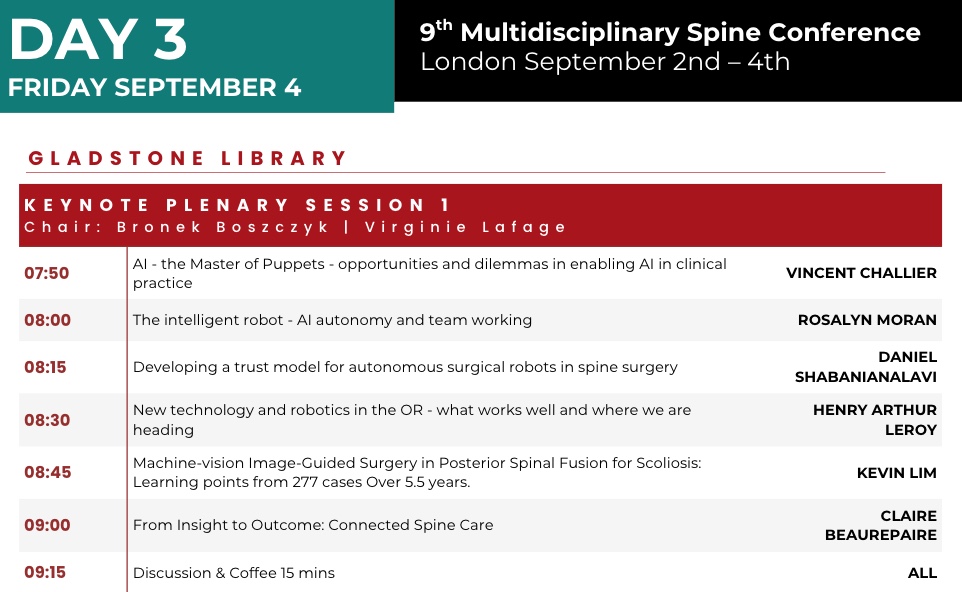
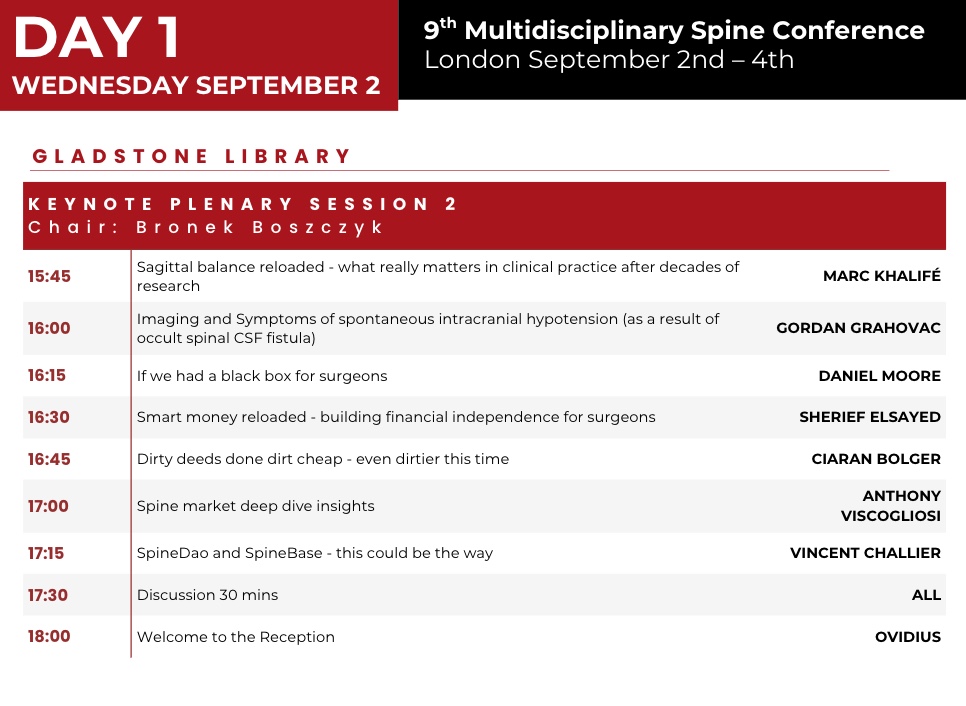
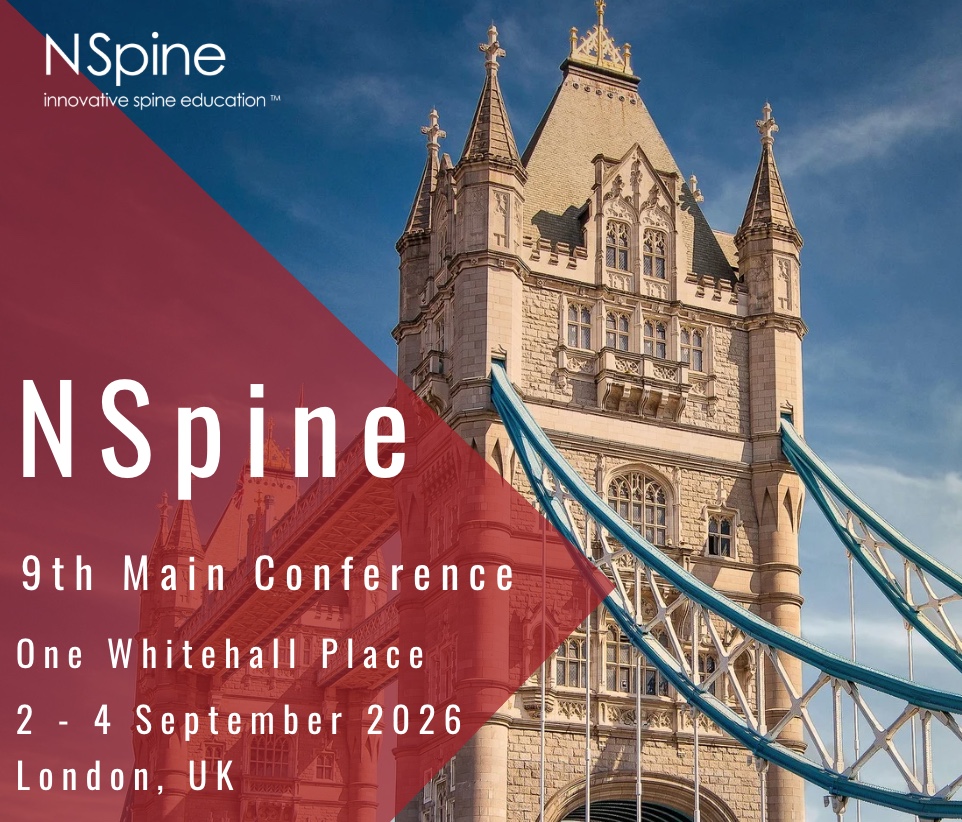
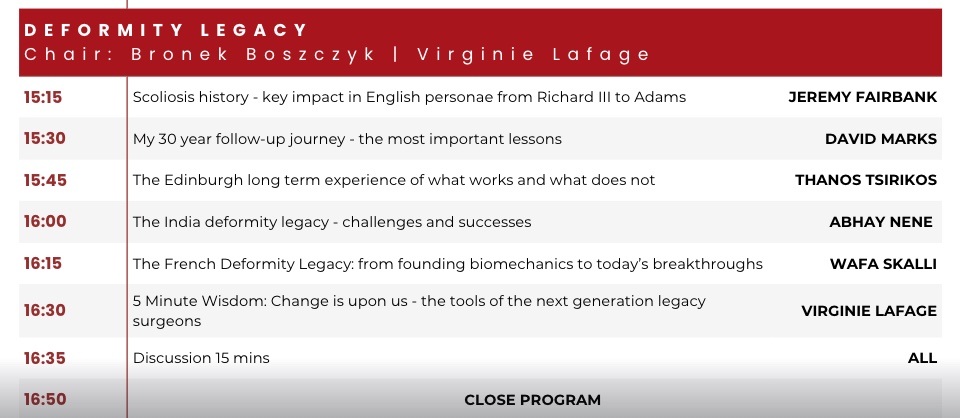
Meet us in @NSpineUK London this week! @VirginieLafage and @challaire will present the AI suite including LAMINA, VECTOR, SPINAL, A2R in front of 200 international spine surgeons and industry players! Let's onboard and show the utility of solana:spinezMPKxkBpf4Q9xET2587fehM3LuKe4xoAoXtSjR !
Our founder @challaire alongside the genius @ndehouche on what it means when a system built to answer clinical questions refuses to. The refusal-logging described here is what we're implementing now.
$SPINE is on @solana.
Let's make live scientific events queryable and lecturers rewarded properly through blockchain.
ARCHIVE TO ROYALTIES concept 👇
This would not be possible without the valuable help of @ndehouche !
https://t.co/0dAkmR4qBZ
The design engine is target agnostic, and we are pointing it outside our GPCR core (G-protein coupled receptors).
> A peptide collaboration with @Spine_DAO on nerve pain is open and exploratory, aimed at a target brought to us by a partner community.
The SpineDAO work points somewhere beyond the science it produces.
A community that funds its own research should be able to commission the engine that runs it.
Kisspeptin is released in pulses, and the hormonal axis depends on that rhythm to stay healthy.
Our lead fertility peptide is being designed around that fact.
The pipeline has opened two new target classes, and the science team is now bigger 🧵
PeptAI Update: KISS1R Advancing, New Targets, Team Growing
What's New:
• KISS1R: KISS1R and OX2R remain our two lead programs. The most recent advancement is on KISS1R, our fertility program. The interesting bit is the pharmacology: the body releases kisspeptin in pulses, and that rhythm is what keeps the hormonal axis healthy. Continuous stimulation desensitizes the receptor, which is part of why earlier candidates in this space stalled. We're designing for pulsatile dosing instead, a peptide that activates and clears rather than floods. A bespoke functional assay is being built for the program since no off-the-shelf test exists for this receptor.
• New targets: Two new directions. And a peptide collaboration with @Spine_DAO on nerve pain, a DAO bringing its own target to the engine. The platform is target-agnostic and we're extending it to prove that.
• Team: We've grown the science team and added computational biology capacity to move faster on de novo design.
This is what clinician-built, open-science infrastructure looks like — not a roadmap, a working stack.
$SPINE is live on @solana, launched by @BioProtocol
Full Q2 report:
https://t.co/WLOzYcQmXl
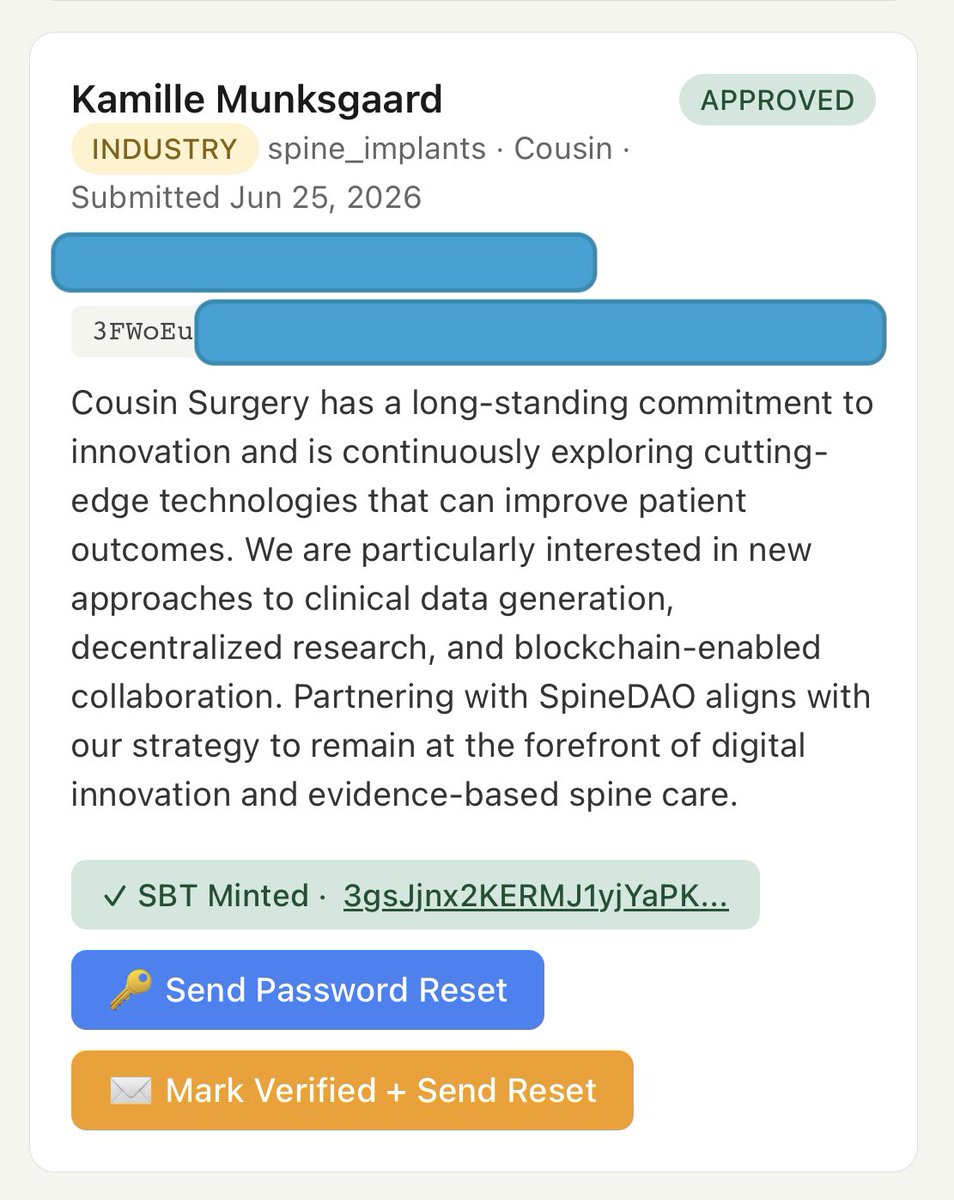
New SBT INDUSTRY minted for Cousin Spine!
With 500K $SPINE locked, they now have access to proprietary data, synthetic data, cohort report and many more.
DeSci summer is in with the help of @BioProtocol and @solana.
Most spine patients leave the consultation room with a diagnosis and zero support until the next appointment. Clinicians call it the errance.
We built Lamina to close that gap with the precious help of @pleiasfr@Dorialexander
https://t.co/OCpekNViq8
One week. Two stages. One argument.
In 8 days, two SpineDAO core stood on two of France's largest stages — SFCR in Marseille and @VivaTech in Paris — and made the same case: clinician-built, evidence-grounded AI for spine care is not aspirational. It's already running.
@GuillaumeLonjon won 2nd Prize Best Scientific Communication at the SFCR national congress for VECTOR — our AI patient-prioritisation software for spine clinics.
@VirginieLafage opened the SFCR congress, then took the VivaTech AI Factory France stage with @pleiasfr to demo Lamina — the AI clinical companion built for the gap between appointments. Read the full story.
@BasselDiebo@CristiniJoseph5@challaire@Dorialexander@BioProtocol@solana
https://t.co/9F9hHNlMsX
the Related Research block is live, starting on the spinedao deep-dive
section //04 pulls top-cited Medline papers by the five founding surgeons from Europe PMC
339 in source set, top 6 rendered by citation count, peer-reviewed signal
Back from @NspineE Bastia.
80+ spine surgeons worldwide.
Three days above the Corsican port, and SpineDAO appeared on a podium slide in the middle of a clinical talk.
Part 1 field report is live.
$SPINE is only on @solana launched by @BioProtocol one year ago.
https://t.co/d44FJVBpnb
🎤 Dr. Anton Denisov on stage.
@NspineE Bastia, Corsica.
"Sagittal imbalance is a major driver of disability and HRQOL loss."
Room is packed obviously!
Anton leads the TLIF-BAYES study — 700+ patients, Bayesian hierarchical model of adjacent segment disease risk.
Saturday: preliminary results. The volcano.
🌊 Day 1. @NspineE Bastia, Corsica.
100+ spine surgeons. Three days. One Symposium that matters.
Saturday: SpineDAO takes the podium.
→ AI in Spine Care
→ Blockchain & DeSci
→ SpineBase · Spinal · Lamina · VECTOR
Today we're learning the room.
Saturday we show them what we built.
$SPINE will shine. @solana@BioProtocol
#NSpine #DeSci #Bastia2026
🧠 SpineDAO Insights #1 — Technique: WTF IS TLIF?
TLIF is why 90% of lumbar fusions today look nothing like they did in 1990.
One design change by Jürgen Harms in 1982 — enter through one foramen, don't cross the spinal canal — changed everything.
Now the evidence is settling a question that took 40 years to answer: Does MIS-TLIF actually protect patients long-term?
Denisov 2026 meta-analysis (14 studies, 1,960 patients): → 49% reduction in adjacent segment disease→ 47% reduction in reoperation → Same fusion success
And SpineDAO is building the model that predicts your patient's specific risk — not just the average.
Full guide: From open surgery to endoscopy, 1934 to today, every surgical step with intraoperative photos.
https://t.co/ILc24McZ7D
$SPINE | @solana | @BioProtocol | #DeSci