This afternoon at Ngundu Primary School, Kalumu, Ruai Ward, Kasarani, my heart was full. ❤️
As we continued the OMANGA Care sanitary pad distribution, our talented learners blessed us with amazing performances as they prepare for the National Music Festival in Bungoma this August.
Vipaji vya watoto wetu ni hazina. Tukiwapa dignity, support na opportunity, wanaweza kufika mbali.
Kila mtoto ana ndoto. Kazi yetu ni kuhakikisha hakuna anayebaki nyuma. ❤️🔥❤️🔥
#MaMaMiradi #BilaOmangablanda #mamanairobi
Today, I looked at Rigathi Gachagua. I saw pain, but I also saw purpose.
I saw wounds, but I also saw determination.
Behind the pain stands a man who appears more committed than ever to the cause of rescuing Kenya from poor leadership, broken promises, and national despair.
The struggle continues.
Seeing someone in church today wearing a T-shirt branded with my photo and name truly humbled me. 🙏❤️
Moments like these remind me that leadership is about impact, trust, and the people who believe in the vision.
To all my supporters — thank you. I’m deeply grateful.
#MamaMiradi #MamaNairobi
Safaricom leadership is no longer running a service company. They are running a deal room.
While customers are busy begging for basic attention, the people at the top are allegedly buried in negotiations, ownership games, transaction politics and exit calculations.
The ordinary Kenyan thinks Safaricom is still a public service giant built around communication, trust and national convenience. Kumbe upstairs it is business. Pure business.
You will be shocked by the billions Safaricom top bosses are allegedly positioned to make from the sale of Safaricom.
Billions. Billions. Billions. Billions. Billions.
And that is where the story becomes bigger than dropped calls or customer complaints.
This is about a company that became part of Kenya’s daily life being treated like private merchandise by people who see customers as numbers and the network as a cash machine.
Safaricom was built on Kenyan loyalty. Mama mboga, boda boda riders, small traders, workers, students, families, hustlers and businesses made it what it is.
Kenyans gave Safaricom trust, data, deposits, transaction fees, airtime and loyalty for years.
Now the people at the top appear more interested in who buys what, who exits with what and who walks away with billions.
Ni biashara, si huduma.
The customer is no longer the centre but the deal is the centre. The Kenyan public is no longer being served but being harvested.
And when leaders of such a powerful company start thinking like brokers instead of custodians, everything else collapses. Service becomes secondary.
Complaints become noise. Network quality becomes an inconvenience. Customer care becomes theatre. The real meeting is not about Kenyans. The real meeting is about valuations, shares, commissions, exit packages and billions.
That is why Safaricom must be watched very carefully.
A company that touches nearly every Kenyan household cannot be quietly converted into a private feeding trough while customers are told to be patient.
Kenyans deserve to know what is being negotiated, who stands to benefit and why the people entrusted with running Safaricom seem more excited about deals than service.
Because at this point, one thing is becoming very clear.
Safaricom is not being managed like a public trust.
It is being traded like loot.
Safaricom leadership is no longer running a service company. They are running a deal room.
While customers are busy begging for basic attention, the people at the top are allegedly buried in negotiations, ownership games, transaction politics and exit calculations.
The ordinary Kenyan thinks Safaricom is still a public service giant built around communication, trust and national convenience. Kumbe upstairs it is business. Pure business.
You will be shocked by the billions Safaricom top bosses are allegedly positioned to make from the sale of Safaricom.
Billions. Billions. Billions. Billions. Billions.
And that is where the story becomes bigger than dropped calls or customer complaints.
This is about a company that became part of Kenya’s daily life being treated like private merchandise by people who see customers as numbers and the network as a cash machine.
Safaricom was built on Kenyan loyalty. Mama mboga, boda boda riders, small traders, workers, students, families, hustlers and businesses made it what it is.
Kenyans gave Safaricom trust, data, deposits, transaction fees, airtime and loyalty for years.
Now the people at the top appear more interested in who buys what, who exits with what and who walks away with billions.
Ni biashara, si huduma.
The customer is no longer the centre but the deal is the centre. The Kenyan public is no longer being served but being harvested.
And when leaders of such a powerful company start thinking like brokers instead of custodians, everything else collapses. Service becomes secondary.
Complaints become noise. Network quality becomes an inconvenience. Customer care becomes theatre. The real meeting is not about Kenyans. The real meeting is about valuations, shares, commissions, exit packages and billions.
That is why Safaricom must be watched very carefully.
A company that touches nearly every Kenyan household cannot be quietly converted into a private feeding trough while customers are told to be patient.
Kenyans deserve to know what is being negotiated, who stands to benefit and why the people entrusted with running Safaricom seem more excited about deals than service.
Because at this point, one thing is becoming very clear.
Safaricom is not being managed like a public trust.
It is being traded like loot.
A Nairobi lady has sued Safaricom PLC after her KSh 2,700, mistakenly sent via M-Pesa, was used to offset the recipient’s Fuliza debt.
Her reversal request was declined. She has now moved to the High Court challenging that policy as unconstitutional.
When I send money to someone, my intention is clear that I am transferring funds to THAT person. I am not entering into a contract with Safaricom to help them recover loans. I am not agreeing to become a guarantor. I am not volunteering to settle another adult’s overdraft.
How then does my money automatically clear someone else’s debt without my consent?
We must be very careful as a country not to normalise silent policies that shift financial burdens to third parties. Digital convenience should not override basic principles of fairness and property rights.
Yes, the recipient may have agreed to Fuliza terms. But I did not.And this is the core issue.
If money is mistakenly sent and reversal is denied because it has already been swallowed by a debt recovery system, then we are creating a dangerous precedent one where corporations quietly prioritise loan recovery over consumer protection.
At the very least, there should be a clear warning before completing a transaction:“The recipient has an outstanding Fuliza balance. Funds may be used to offset debt. Proceed?”
This case is bigger than 2,700 shillings. It is about how far automated financial systems can go without violating basic rights.
A Nairobi lady has sued Safaricom PLC after her KSh 2,700, mistakenly sent via M-Pesa, was used to offset the recipient’s Fuliza debt.
Her reversal request was declined. She has now moved to the High Court challenging that policy as unconstitutional.
When I send money to someone, my intention is clear that I am transferring funds to THAT person. I am not entering into a contract with Safaricom to help them recover loans. I am not agreeing to become a guarantor. I am not volunteering to settle another adult’s overdraft.
How then does my money automatically clear someone else’s debt without my consent?
We must be very careful as a country not to normalise silent policies that shift financial burdens to third parties. Digital convenience should not override basic principles of fairness and property rights.
Yes, the recipient may have agreed to Fuliza terms. But I did not.And this is the core issue.
If money is mistakenly sent and reversal is denied because it has already been swallowed by a debt recovery system, then we are creating a dangerous precedent one where corporations quietly prioritise loan recovery over consumer protection.
At the very least, there should be a clear warning before completing a transaction:“The recipient has an outstanding Fuliza balance. Funds may be used to offset debt. Proceed?”
This case is bigger than 2,700 shillings. It is about how far automated financial systems can go without violating basic rights.
@KyaloIntel I recently wrote to @Safaricom_Care concerning a case like this and how not so tech savvy their software engineers are. If they can't recover my money,then they should debit that account against mine. Good case.
This evening I had a moment of reflection…
From the day I left the village 20 years ago, carrying a torn green bag in search of greener pastures in Nairobi, because I knew there was no future for me in the village.
I remember sharing a mattress with my cousin in a mabati house in Uthiru. The anxiety of going to the shared toilets because of the state they were in. The quiet determination that somehow, life had to change.
I remember walking to Karbanet Gardens and telling the GSU officers at the gate that I wanted to see former President Moi, convinced that if only I could speak to him, he would support my university education. Of course, it wasn’t that simple. But the audacity to try? That has always been me. And I did meet him much later. Story for another day.
There were setbacks.
Being sent out of a hostel in Ngara because I couldn’t pay. Assisting at a posho mill, milling flour for people daily, yet still stealing moments between customers to read a book. Feeding the mind even when the pocket was empty.
Then I discovered Facebook. I began sharing my thoughts on governance and politics, informed by the Kenyan reality around me and the books I was reading. I was just an amateur writer with opinions and conviction.
One day, someone sent me Peter Kenneth’s number. I crafted a message explaining the value I could add to his campaign through social media. To my shock, he called me the very next day. That conversation changed the course of my life. I ended up working in his campaign.
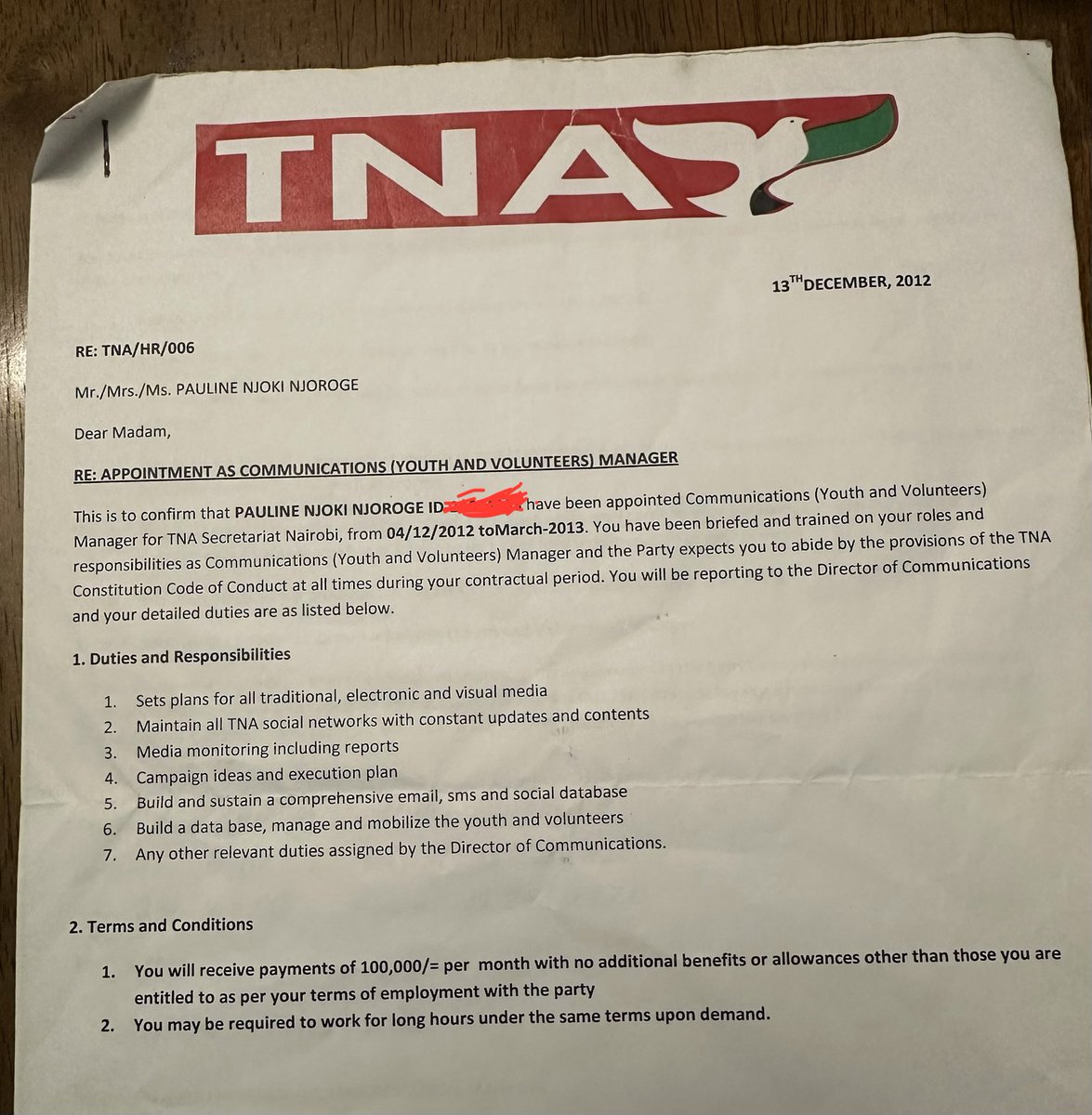
A few months later, the TNA Party leadership reached out because of my growing social media presence. I initially resisted. But they were persistent and eventually, I accepted the role of Communication Manager.
After the campaign, I found myself stranded again for a while. But by God’s grace, I landed at NEPAD Kenya. And life began unfolding in ways I could not have imagined.
From continental engagements under the African Union framework, to global missions with the Presidency, covering high-level forums such as the UN General Assembly, the Belt & Road Forum, the G7 etc.
All this while juggling work, travel and school.
A Bachelor’s degree in Mass Media and Communication. Shortly followed by a Master’s in International Studies.
It has been a long road for this village girl from Githiga. But here I am. Growing, learning, pushing boundaries.
No one promised it would be easy.
But some journeys must be walked, no matter how steep the climb.
The late Mutula Kilonzo was a good friend of mine. He always invited me to his office in town (corner house). He was a good time keeper. An appointment for 8:00am was strictly 8:00am. One day I got stuck in traffic and arrived some minutes past the time he had told me to see him. You know what, immediately I stepped at the reception, he rang the receptionist (I can’t remember the name) but she was common to me because I frequented the office. They spoke for a few seconds and the lady turned to me and said “Mheshimiwa (then nominated MP) says he asked to you be here at 8:30am and you have arrived at 8:55am. So he says he won’t see you and that next time you keep time”. He was that strict. In his diary, he had names of the people he had given appointments. On the wall, was a screen projecting the CCTV footage showing those coming in and those leaving. He saw everyone who arrived at the office reception and immediately confirmed with the diary if one had arrived on time, late or no appointment. I liked his style of doing things. He once invited me to his rural home in Utangwa in Mbooni. A beautiful house it was. He told me a lot of things that would later change my attitude toward people and how to live life. “Philip, you are one of the few journalists I trust and that’s why I have driven with you all the way from Nairobi to Utangwa, my rural home. I hope you enjoyed the road trip”… he said. Later I the day we passed through Susu Centre in Machakos town where I left him and proceeded to Nairobi with his driver”… may he continue RIP.