photogragpher and a geek. Im a big fan of @dhewlett i suffer panic attacks fibro arthritis and I’m carer to my lovely son. #right2grow#cannabisISmedicine
A craftsman the Glasgow guilds turned away changed the world on a Sunday walk. 🏴🇬🇧
May 1765. James Watt, a Scottish instrument-mender, was crossing Glasgow Green.
A broken steam engine had nagged him for 2 years: it threw away most of its heat.
Halfway across the grass, the answer came. Condense the steam separately, keep the cylinder hot.
His engines went on to power Britain's mills and mines. Today the world measures power in his name. The watt.
No palace. A bench, a broken model, and a Sunday walk.
We put the names back, free, for anyone who wants them.
Want to learn more? https://t.co/kfMKMUQrmn
If you can afford to, help us teach thousands their own history: https://t.co/rih7iKwnvf
Be part of us. ☝️🇬🇧
Be Proud Of Us. 🙏🇬🇧
A man in 1835 was digging a duck pond and accidentally uncovered a 70-foot tunnel made of 2,000 sq ft of mosaic made from 4.6 million shells (mussels, cockles, whelks, limpets, oysters, scallops).
It's the Shell Grotto in Margate, Kent, England.
This artifact is an Egyptian knitted sock dating back to the period between 1000-1200 AD (medieval/Islamic era). It is one of the oldest surviving examples in the world of knitting made using the "trueknitting" technique (with two or more needles). Discovered in Egypt 🇪🇬 (many similar fragments come from excavations in the ancient city of Fustat, now Cairo).
It is made entirely of cotton, a plant fiber typical of Egyptian and Islamic textile production of the period. It features abstract geometric patterns and decorative bands in white and blue. To obtain the different shades of blue on the cotton yarn, a natural pigment derived from indigo was used.
The sock was worked in the round (probably starting from the toe upward) with a very high stitch density, demonstrating the refined craftsmanship of the craftsmen of the time. The heel was often inserted separately so that it could be easily mended or replaced once worn from contact with sandals.
#drthehistories
On this day in 1497, a blacksmith and a country lawyer led an army of 15,000 furious Cornishmen on a 250 mile march to overthrow the king of England.
It started with a tax. Henry VII wanted money to fight a war against the Scots and the pretender Perkin Warbeck up on the northern border. To pay for it he raised taxes on everyone, including the people of Cornwall, who lived about as far from Scotland as you could get in England and wanted nothing to do with that war. To them it was an outrage. Why should poor tin miners and farmers bleed money for a fight on the opposite end of the country?
Two men gave the anger a shape. Michael Joseph, a blacksmith known as Michael An Gof, which means "the smith" in Cornish, and Thomas Flamank, a lawyer who argued the tax was illegal. Together they raised a host of ordinary men, picked up support along the way, and marched east. By the time they neared London they were said to number around 15,000.
But they had a fatal weakness. They were commoners with bills and bows. They had almost no cavalry and almost no cannon, and many lost their nerve and drifted home as the reality of facing a royal army set in. Henry, meanwhile, pulled together a force more than 20,000 strong and let the rebels exhaust themselves marching.
On June 17th the two sides met around Deptford Bridge on the edge of the city, at Blackheath. The Cornish held the bridge for a while with their archers, but the king's troops crossed elsewhere, surrounded them, and broke them. Around a thousand or more rebels were killed. An Gof tried to flee and was caught.
The leaders were dragged to Tyburn and sentenced to be hanged, drawn, and quartered, the most brutal death the law allowed. Before he died, An Gof said he would have "a name perpetual and a fame permanent and immortal." It sounds like bravado from a beaten man.
Except he was right. More than five hundred years later, in Cornwall, he is remembered as a folk hero. There are memorials in his name. People still tell his story. The blacksmith got the immortality he promised himself on the scaffold.
By law, she did not exist. 🇬🇧
So she rewrote the law. ✍️🏴
In 1836, a married woman in England could not own, could not sue, could not sign. Even her children were not hers.
Her name was Caroline Norton. A poet, and Sheridan's granddaughter.
When her marriage collapsed, her husband took their 3 sons and kept every pound sterling she earned by her pen. The law gave a father absolute custody. It left her one thing it could not confiscate. Her voice.
Pamphlet by pamphlet, she put the law itself on trial. The Custody of Infants Act 1839. The Matrimonial Causes Act 1857. By 1882, a married woman finally owned what was hers. Her arguments were inside those laws.
She wrote, to the Queen: "I do not ask for my rights. I have no rights. I have only wrongs."
The law said this woman did not exist. The statute book carries her fingerprints anyway.
Britain's freedoms were so often written by the very people denied them. We put their names back, free, for anyone who wants the truth.
If you can afford to support our mission: https://t.co/rih7iKwVkN
Be part of us. ☝️🇬🇧
Be Proud Of Us. 🙏🇬🇧
Almost 1850 BC, the vast Labyrinth at Hawara was constructed. It was described as a vast 3000 chamber maze. In 450 BC, Herodotus visited the site and described it as far more impressive than even the pyramids.
The Labyrinth of Hawara is one of the most intriguing lost monuments of the ancient world. Built during the reign of Pharaoh Amenemhat III around 1850 BC, it stood beside his pyramid at Hawara in Egypt's Fayum region.
The Greek historian Herodotus visited the site around 450 BC and wrote that it contained 12 roofed courts and 3,000 chambers, half above ground and half below. He claimed that the labyrinth surpassed even the pyramids in scale and complexity. Herodotus was not permitted to enter the underground rooms, which Egyptian priests reportedly said contained the tombs of kings and sacred crocodiles.
Another ancient writer, Strabo, described the structure centuries later, suggesting that at least part of it was still standing during the Roman era. By then, however, it had already begun to deteriorate.
Most of the stone was quarried away over the centuries, leaving little visible today. In the 1880s, British archaeologist Flinders Petrie excavated the site and identified the foundations of the massive complex, confirming that an enormous building had once stood there.
Modern geophysical surveys conducted near Hawara have detected large subsurface anomalies beneath the sands, leading some researchers to speculate that significant portions of the labyrinth's foundations, or possibly additional structures, may still lie buried. Although the legendary 3,000-room maze has never been rediscovered intact, the site remains one of archaeology's most tantalizing mysteries.
📷 : Interpretation of the Egyptian Labyrinth—original by Athanasius Kircher 1670 CE, as described by Herodotus.
#archaeohistories
You were told Britain was cut off from the world until the Romans came. 🏴🇬🇧
This boat proves it wrong. 🛶🔎
In 1992, road workers in Dover cut into a riverbank and found her. 9 metres of oak, stitched with yew, waiting in the silt for 3,500 years.
Around 1,500 BC, British boatbuilders on the Kent coast launched a vessel built to take the English Channel. Oak planks shaped with bronze tools. Sewn together with yew withies, the way our shoemakers still stitch leather. The seams sealed with moss and beeswax.
She worked the crossing. British tin went south. Continental bronze came north. Bronze Age Britain was trading with Europe in its own boats, before anyone in Italy had built a city called Rome.
Then she was lost in the silt of the Dour river-mouth, where the modern town of Dover now sits on top of her. In September 1992, workers digging the new A20 found her. The yew stitching still intact. The moss and wax still sealing the seams.
Britain's oldest sewn-plank seagoing vessel. Launched from a British shore, year after year, before Stonehenge was finished.
You were told the British were isolated until the Romans came. They were crossing the Channel in their own boats 1,500 years earlier. Never primitive. Never alone.
We tell the parts of our history that get left out, free, for anyone who wants them.
Want to learn more? Visit: https://t.co/yqBkIIMf1I
If you can afford to support our mission: https://t.co/rih7iKwnvf 🙏
Be part of us. ☝️🇬🇧
Be Proud Of Us. 🙏🇬🇧
This is the one I am most proud of. Thank you. I could not have done it without you. 🇬🇧
Every story we have ever told now comes with a free lesson. Plan, sources, quiz, printable worksheet. KS2 to A-Level. Free for every child in Britain, and the world, for ever.
A generation is taught to be ashamed of this country.
This hands them the truth instead.
👉 https://t.co/kfMKMUQrmn 👈
If you can afford to support our mission:
https://t.co/rih7iKwnvf 🙏🇬🇧
You were told the Anglo-Saxons were barbarians. 🏴🇬🇧
They were not.
They made gold-work as fine as anything continental Europe produced in the 7th century.
5 kilograms of it. Buried in a Staffordshire field for 1,300 years.
In July 2009 a man named Terry Herbert went detecting on a working farm. He swept his detector across a ploughed field. And the headphones screamed.
Gold.
The largest Anglo-Saxon gold hoard ever found.
4,000 pieces. 5 kilograms of gold. 1.4 kilograms of silver.
⚔️ Almost all military fittings. Sword pommels. Helmet cheek-pieces. Shield mounts. Inlaid with 5,000 garnets. Garnets traded from as far as India.
Filigree gold-work so fine modern goldsmiths have not been able to match it.
🔥 All of it deliberately broken. Sword pommels twisted off. Helmet pieces folded over. Crosses bent and crushed.
The hoard is from the 7th century. The high Anglo-Saxon kingdom of Mercia. Stripped from the bodies of defeated enemies in a battle history did not write down. Or stripped from royal armour given as offerings before a campaign. Nobody knows which.
But the broken gold sat in a Staffordshire field for 1,300 years. Until a metal detectorist swept across it.
🏛️ The Mercian kings have been forgotten. The battle that ended their warriors has no name. But the gold they wore was worked by British hands. And it is as fine as any gold-work of its century in Europe.
🇬🇧 You were told the Anglo-Saxons were barbarians...
They were not.
They were among the most accomplished goldsmiths of their age.
━━━━━━━━━━━━━━
The gold waited 1,300 years to be found.
The hands that worked it were British.
Our work is made in Britain, for Britain.
Help us find the rest. 👇🙏
👉 https://t.co/rih7iKwnvf 👈
Be part of us. ☝️🇬🇧
Be Proud Of Us. 🙏🇬🇧
How gorgeous is this? Cruising my narrowboat along a London canal and these swans and their cygnets paddling alongside me. The cutest thing. (Apologies for dodgy camerawork as trying to steer my boat at the same time)
On a hillside this summer, a man will pay good money to take the coat off a sheep, then watch that coat earn him almost nothing at all.
This is the wool trade now. A thing his great grandfather built a life on, worn down to a chore he runs at a loss.
So look at the maths square in the face. It costs him around two pounds to shear one ewe. The fleece that comes off her, even now, in the best year for a decade, brings back about a pound and a half if she is a fine crossbred. If she is a hill sheep, a Welsh Mountain or a Swaledale, he might get thirty pence for the whole fleece. British Wool says the price would have to nearly double again just to cover the shearing.
So every sheep he clips, he loses on. And he has to clip every one.
A sheep left in her fleece overheats, cannot walk right, and gets eaten alive by maggots. The wool has to come off, for her sake, whatever it is worth. He pays, quite literally, for the privilege of being kind to his own animals.
Now feel the weight of what we have let go.
Wool once made this country rich. Whole towns were built on the back of it, and the great wool churches still standing across the Cotswolds were paid for with it. To this day the Lord Speaker of the House of Lords sits on a woolsack, set there centuries ago so nobody in the room would forget where England's wealth came from.
A fleece was worth fourteen pounds a kilo in the 1950s. The wool cheque, in his father's day, paid the rent for the year.
Today it will not cover the diesel to deliver it.
And so, in farmyards across the country, men who would rather not are quietly burning the fleeces off their own sheep, because a fire is cheaper than the trip to the depot. A material so fine that a kingdom was built on it, going up in smoke in the yard because nobody will pay a pound for it.
And what did we reach for instead. Plastic. Most of our clothes are now spun from oil, polyester and acrylic and nylon, shedding tiny threads into the sea with every wash, into the fish, into our own blood. It will not rot for generations.
So here we stand. A fibre that grows back every spring on nothing but grass and rain, that warms a child and then feeds the soil when its work is done, burning unwanted in a field.
While we dress ourselves, head to foot, in the very oil it was meant to spare us.
The sheep on that hill is still growing the finest coat in the world. We simply stopped being worthy of it.
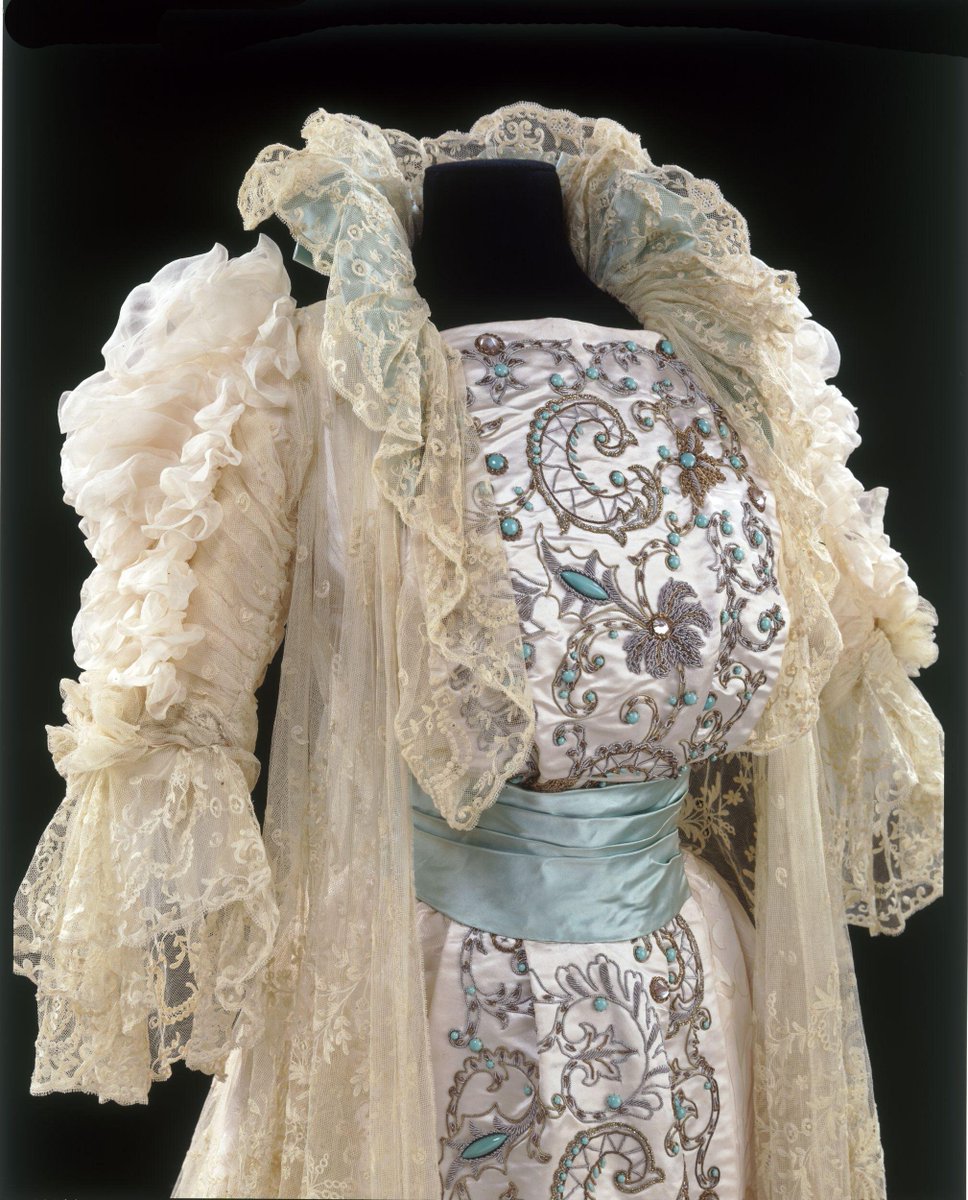
London
Hunt & Roskell
156 New Bond St.
Tiara, c.1855
Tiara in three pieces. Silver &gold, set with diamonds &converts to a brooch or on tortoise-shell comb-mounts.
Mary Selina Charlotte Portman,wife of William Henry Berkeley, 2nd Viscount Portman.
@britishmuseum#jewellery
"Kiedy Vincent van Gogh zmarł w 1890 roku, mając zaledwie 37 lat, zostawił po sobie życie pełne niepowodzeń, kilka znoszonych ubrań i obrazy, których prawie nikt nie chciał kupować.
Sześć miesięcy później zmarł jego brat Theo — jedyny człowiek, który wspierał go do samego końca.
Wydawało się, że wszystko gaśnie.
Zostało małe dziecko, setki listów i ogromna liczba obrazów, których świat jeszcze nie rozumiał.
Wtedy na scenę weszła Jo van Gogh-Bonger, młoda wdowa po Theo.
Miała 28 lat, syna do wychowania, świeżą żałobę i żadnego obowiązku, by zajmować się artystycznym dziedzictwem szwagra.
Wielu uważało, że te płótna nie mają większej wartości.
Ona jednak zrozumiała coś, czego inni nie widzieli: za tymi gorączkowymi pociągnięciami pędzla i intensywnymi kolorami krył się geniusz, którego epoka nie potrafiła jeszcze usłyszeć.
Zaczęła od listów Vincenta i Theo.
Porządkowała je, tłumaczyła, przygotowywała do publikacji.
To właśnie w tej korespondencji odsłaniała się dusza Vincenta — jego wrażliwość, samotność, wewnętrzne poszukiwania, ból i światło.
Te listy zmieniły wszystko.
Pokazały, że za łatką „szalonego malarza od słoneczników” stał poeta, myśliciel i człowiek, który czuł więcej, niż potrafił unieść.
Potem Jo zajęła się obrazami.
Organizowała wystawy, pisała do krytyków, kontaktowała się z galeriami i muzeami.
Nie zgadzała się sprzedawać prac za bezcen, nawet wtedy, gdy brakowało pieniędzy.
Starannie decydowała, kiedy sprzedać obraz, komu i w jakim celu.
Nie tylko chroniła dorobek Vincenta.
Cierpliwie uczyła publiczność, jak na niego patrzeć.
Najpierw Berlin, potem Paryż, później Holandia…
Wystawa po wystawie, recenzja po recenzji, krok po kroku budowała reputację Van Gogha.
To nie była romantyczna legenda o wierze w artystę.
To była przemyślana strategia: wytrwałość, intuicja i konsekwencja.
Gdy zarzucano jej, że przecenia Vincenta, nie wdawała się w wielkie spory.
Odpowiadała jego obrazami.
Kiedy zmarła w 1925 roku, Vincent van Gogh był już uznawany za jednego z najważniejszych artystów swojego stulecia.
A rodzinna kolekcja, która później stała się fundamentem Muzeum Van Gogha w Amsterdamie, istnieje w dużej mierze dzięki niej.
Jo van Gogh-Bonger nigdy nie trzymała pędzla jak malarka.
Ale to ona pokazała Vincenta światu.
To ona pomogła przemienić niedocenionego artystę w uniwersalny symbol ludzkiej wrażliwości i twórczości.
Bez niej Van Gogh mógłby zniknąć w cieniu.
Dzięki niej stał się wieczny."
za Przytulność
Recent repair work at a school in Chelmsford has opened a doorway into Tudor history.
Workers repairing a historic ha-ha — a sunken landscape wall — at New Hall School uncovered the entrance to previously unknown tunnels believed to date back to the reign of King Henry VIII.
The school stands on the site of the former Palace of Beaulieu, once owned by Sir Thomas Boleyn, father of Anne Boleyn, before Henry VIII acquired it in 1517 and transformed it into one of his early royal palaces.
Inside the tunnels, finds include pottery, bones, glass bottles, glass fragments, and pieces of lead. Selected artefacts are now expected to be examined and displayed.