This should be on the front page of every newspaper in America.
Trump’s DOJ just shut down a federal investigation into a coal company owned by Sen. Jim Justice, one of his closest allies, after it racked up tens of thousands of alleged violations for dumping dangerous chemicals into our waterways. A veteran federal prosecutor with 24 years on the job said he had never seen anything like it.
The man who killed the case was Todd Blanche, Trump’s former personal defense lawyer and current Acting Attorney General. This is the same guy who just gave Trump, his family, and his companies permanent immunity from IRS audits. Now Trump wants the Senate to make Blanche’s appointment permanent too.
Equal justice under law was never supposed to come with exceptions for the President’s friends.
The pattern isn’t subtle: protect Trump’s friends, prosecute his critics, and get rewarded with more power. That is corruption, plain and simple. Todd Blanche must not be confirmed.
https://t.co/95K8zIySPz
This would be a scandal that would have ended any other presidency.
Qatar gave a $400 million Boeing 747 to the Pentagon. Trump calls it a “free” gift. It is not free. The Air Force just spent months retrofitting it with secure communications, missile defense, and electromagnetic shielding.
The cost of that work is classified.
Estimates say north of a billion.
The number is enormous, and you are paying it.
Now the part they bury.
Under the memorandum signed by the Pentagon and Qatar, ownership of the plane transfers to Trump’s presidential library foundation when he leaves office. His own son says it will sit in the lobby of a future Trump hotel.
So follow the chain.
A foreign government hands a luxury jet to a sitting president. American taxpayers rebuild it from the inside out. Then Trump takes it home.
A gift you use for four years and then keep is still a gift. The Constitution bars foreign gifts to a president without the consent of Congress. This one never got that consent.
We are paying a fortune to gift wrap a luxury jet that ends up in his private collection.
Grift in plain sight.
https://t.co/RqGjdCjV6n
@FreddyLA7@WheelsUp Freddy is a national hero. Please get this man and his friends hooked up on a flight to Canada. I promise you the PR you get from helping him will be worth it.
A Japanese immunologist spent 20 years proving that the chemicals trees release into the air walk into your bloodstream, hunt down your stress hormones, and arm your immune system in ways no therapist or pharmaceutical has ever matched, and most of the data has been sitting in Japanese medical journals for two decades waiting to be translated.
His name is Qing Li.
He is a clinical professor at Nippon Medical School in Tokyo and the president of the Japanese Society of Forest Medicine. The Japanese government has been funding his research since 2004, and the body of work he has produced is the reason forest bathing is now an officially prescribed clinical therapy in Japan and Korea.
The story actually starts in 1982, when the Japanese Ministry of Agriculture, Forestry and Fisheries coined the term shinrin-yoku to describe the practice of slow, mindful walking in a forest. They did it for a practical reason.
Japan was urbanizing fast, stress-related illness was climbing, and the country had thousands of square kilometers of forest sitting unused. The idea was to give people a reason to walk into the trees... They had no idea what was actually happening to the human body during those walks until Qing Li ran the first proper experiment in 2005.
He took twelve healthy adult men on a three-day, two-night trip to a forest park. They walked for a few hours each day. Nothing strenuous. No prescribed routes or breathing exercises. They simply walked slowly through the trees, breathing the air, looking at the forest.
Li drew blood and urine samples before the trip, on the second day, on the third day, on day seven after returning home, and again on day thirty.
The numbers that came back from the lab were not what anyone expected.
The activity of a specific type of immune cell called the natural killer cell, which is the cell your body uses to hunt down cancer cells and virus-infected cells before they can spread, had jumped by roughly 50 percent during the forest trip. The actual number of natural killer cells circulating in the bloodstream had increased significantly.
Three different anti-cancer proteins that those cells produce, called perforin, granzymes, and granulysin, had all risen sharply. And the effect did not disappear when the men went home. The immune boost was still measurable on day seven and was still partially present on day thirty.
Two hours a day in a forest had upgraded the immune system for a full month.
Li ran the same experiment with women a year later and found nearly identical results. Then he ran it with a control group who took a three-day trip through an urban area with the same amount of walking, the same hotel quality, and the same diet.
The urban group showed no measurable change in natural killer cell activity at all. The forest was doing the work, not the vacation.
The mechanism turned out to be a class of airborne molecules called phytoncides. Trees produce these compounds to defend themselves against insects, bacteria, and fungi. Pine, cedar, oak, and cypress trees release them in particularly large amounts, especially in warmer weather and after rainfall.
When you walk through a forest, you are inhaling those molecules into your lungs and absorbing them through your skin, and once inside your body they appear to directly stimulate the production and activity of the very immune cells Li was measuring in his lab.
Roughly 50 percent of the health benefit of a forest walk, according to Li's data, comes from the chemistry of the air itself. The other half comes from what the forest is doing to your nervous system.
This is where it stops being only about the immune system and starts being about stress.
A separate Japanese research team measured cortisol, the body's main stress hormone, in 84 participants across 35 different forest sites. They drew samples before and after a 30-minute walk in each forest and compared them to control walks in matched urban environments. The cortisol levels of the people who walked in the forest were lower than the cortisol levels of the people who walked in the city by a significant margin. Their heart rates were lower. Their blood pressure was lower.
The activity of their parasympathetic nervous system, which is the part responsible for rest and recovery, had gone up. The activity of their sympathetic nervous system, which is the part that drives fight or flight, had gone down.
Then a researcher at the University of Michigan named MaryCarol Hunter ran the cleanest version of this experiment ever done. She recruited participants from a city and told them to take a nature pill three times a week for eight weeks.
They were free to choose the time, the place, and the duration of the nature experience, as long as it was outside, in daylight, and free of phones, conversations, and aerobic exercise. They sent her saliva samples before and after each session so she could measure cortisol changes accurately and rule out the normal daily drop in stress hormones that happens to everyone.
The result was that participants experienced a 21.3 percent drop in cortisol per hour spent in nature, with the biggest payoff happening between minutes 20 and 30 of the walk.
After that, the cortisol kept dropping, but more slowly. The threshold dose for measurable stress relief was just 20 minutes outside in something that looked and felt like nature.
What none of this means is that nature is a substitute for therapy or for medication when someone genuinely needs them. Therapy treats different things than a walk does, and Li himself has been careful in interviews to call forest bathing a complementary intervention rather than a replacement for clinical care.
But what the research has settled is that the human body has a physiological response to being among trees that operates on the same biological systems modern medicine is trying to reach with drugs and clinical protocols, and that response is fast, measurable, and free.
The strangest part of Li's work is the implication he keeps repeating in interviews. The average person now spends more than 90 percent of their life indoors. Their cortisol stays elevated. Their natural killer cells stay sluggish.
Their parasympathetic nervous system rarely gets a chance to take over. The system that was tuned by millions of years of life under a canopy of trees is being asked to run permanently inside a box made of drywall and screens.
Your body has not forgotten what it is supposed to do in a forest. It is waiting for you to walk into one.
A brand new bridge between Detroit and Canada is finished and ready to open. It would speed up traffic for millions of trucks, cut delays for American businesses, and help the auto industry that employs people in every state. There is just one problem.
Donald Trump won’t let it open.
Here is why.
The family that owns the old bridge stands to lose business when the new one opens. So in January, they gave one million dollars to a pro-Trump super PAC.
Weeks later they met with Trump’s Commerce Secretary.
He called Trump.
Hours after that, Trump announced he would block the new bridge. The opening was set for June 12. It got canceled the day before. The bridge sits there finished and empty.
Now here is the part that should make every taxpayer angry.
Canada paid for the entire bridge.
Every dollar. And the United States already owns half of it for free. Trump is holding up a bridge we got for nothing, to protect a donor who wrote him a check, while picking a fight with our closest ally and biggest trading partner.
This is corruption in plain sight.
A billionaire pays, and the President delivers. American workers and businesses pay the price.
Open the bridge. A government should work for the people, not for whoever writes the biggest check.
https://t.co/9o9Gz9UrBo
The humiliating Iran deal requires the U.S. to come up with a $300 billion reparations payment to Iran. That's more than Iran's entire GDP.
Trump says taxpayers won't pay for it.
1/ So I compiled a helpful list.
Elon Musk donated $277 million to elect Trump.
Trump let him gut the IRS.
Elon’s SpaceX took a $1.9 billion tax break that they believed wouldn’t be allowed if the IRS audited them.
Your reminder that billionaire and corporate PAC donations are bribes.
https://t.co/FrgK2iiaqE
#BREAKING: Legendary #Maddow: “It was supposed to open Friday, it is not open because Trump says he does not want it open. When this bridge does open some day, if Trump ever lets it open, you should know that there is a competing bridge a little way down the river, a privately-owned very old very congested toll bridge that will likely LOSE some of its traffic…because of competition. It will lose some of its traffic to this pretty, brand new bridge that has just been built. The family that operates the competing old bridge, earlier this year, made a $1 million donation to Donald Trump’s super pac. In short order, a member of that family then got an in person meeting with Trump’s Commerce Secretary Howard Lutnick. The White House and the pac say that was just a coincidence…but after the million dollar donation, he gets this meeting, and then the SAME day of the meeting, Howard Lutnick calls President Donald Trump and then Trump suddenly discovers new supposedly trade-related reasons why he’s now suddenly against this bridge, even though previously he has been for it.” 🤦♀️
There is a very common playbook leaders use when they fear they are going to lose an election. I break down how President Trump is following that authoritarian playbook.
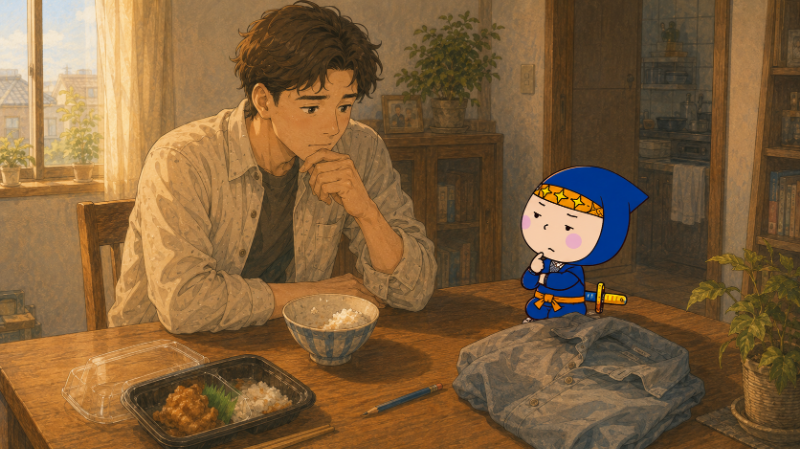
To my friends learning Japanese,
There is a Japanese word your textbook will translate as “waste.”
That translation is not wrong.
It is just too poor to understand the word.
Mottainai.
A child leaves rice in the bowl.
Mottainai.
Someone throws away a shirt that still has years left in it.
Mottainai.
A convenience store meal expires without anyone opening it.
Mottainai.
A pencil is broken, but still long enough to write with.
Mottainai.
A person has talent, but never uses it.
Mottainai.
It is not just waste.
It is regret.
It is respect.
It is the feeling that something still had value,
and we gave up on it too early.
The feeling is close to:
“That deserved better.”
Most languages have words for throwing things away.
Japan has a word for the sadness of letting value disappear.