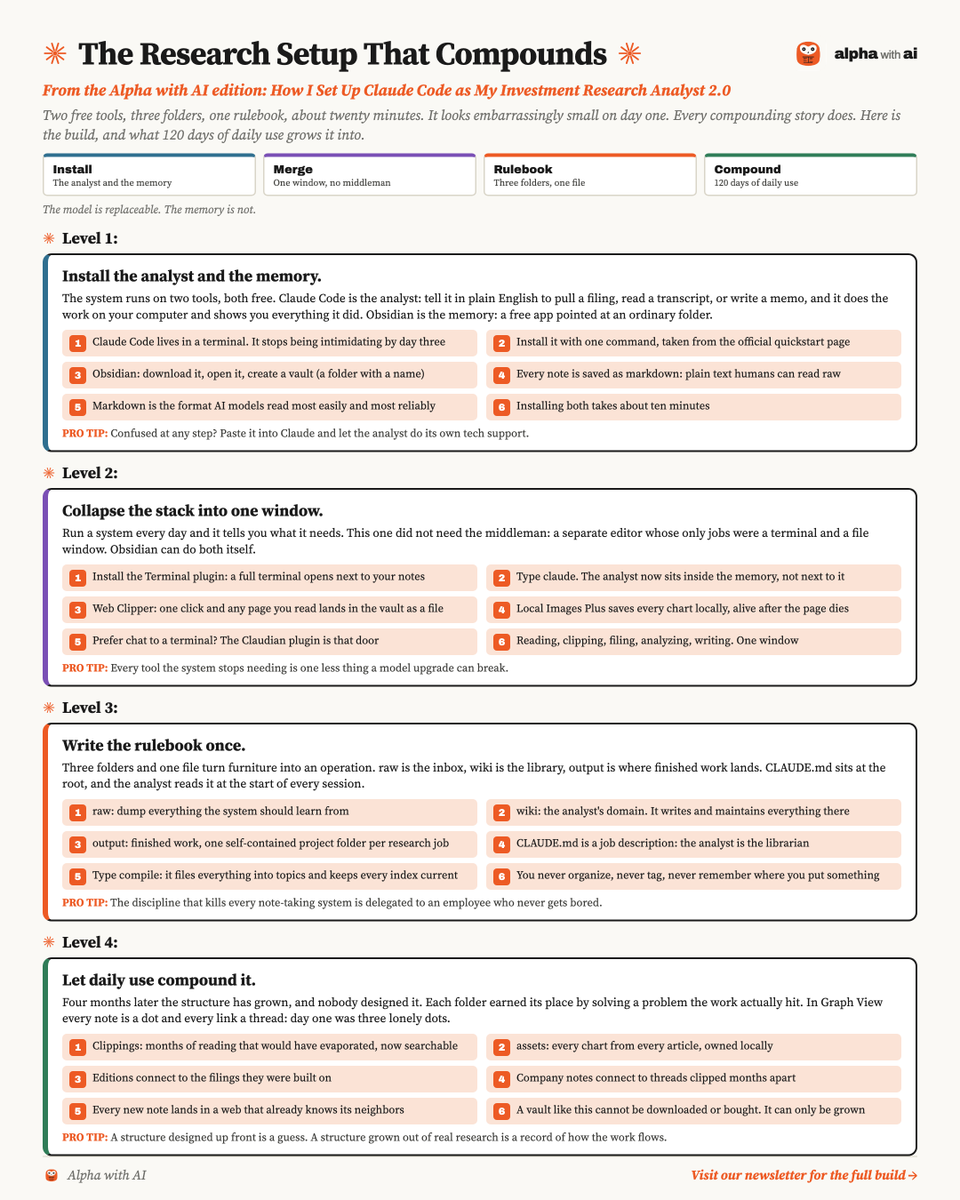
The creator of Claude Code deletes his own instructions with every model release.
This article applies the same discipline to your finance skills: https://t.co/TEqaJo3TqX
I wrote a stock-analysis prompt last November. Six hundred words of it. Role, inputs, computation steps, output format, rules for missing data.
In June I went back to it and it could not help me. It knew everything about the problem I had in November and nothing about the one in front of me.
Here is the line from the piece that names the difference:
"My November prompt had none of this reasoning. It had my instructions, frozen. This had thinking, because I handed it questions instead of commands."
That is the whole difference. A prompt is a solved problem written down. Hand it a problem nobody has solved yet and it has nothing to give you.
What replaced it is five moves, and they only work in order. State the problem as questions, not instructions. Ask for the data plan before any analysis. Files, not memory. Code computes, the model interprets. Rules written down before you see the verdict.
The tool gets built last, out of whatever solved the problem.
The card above is all five on one page. The full session is here:
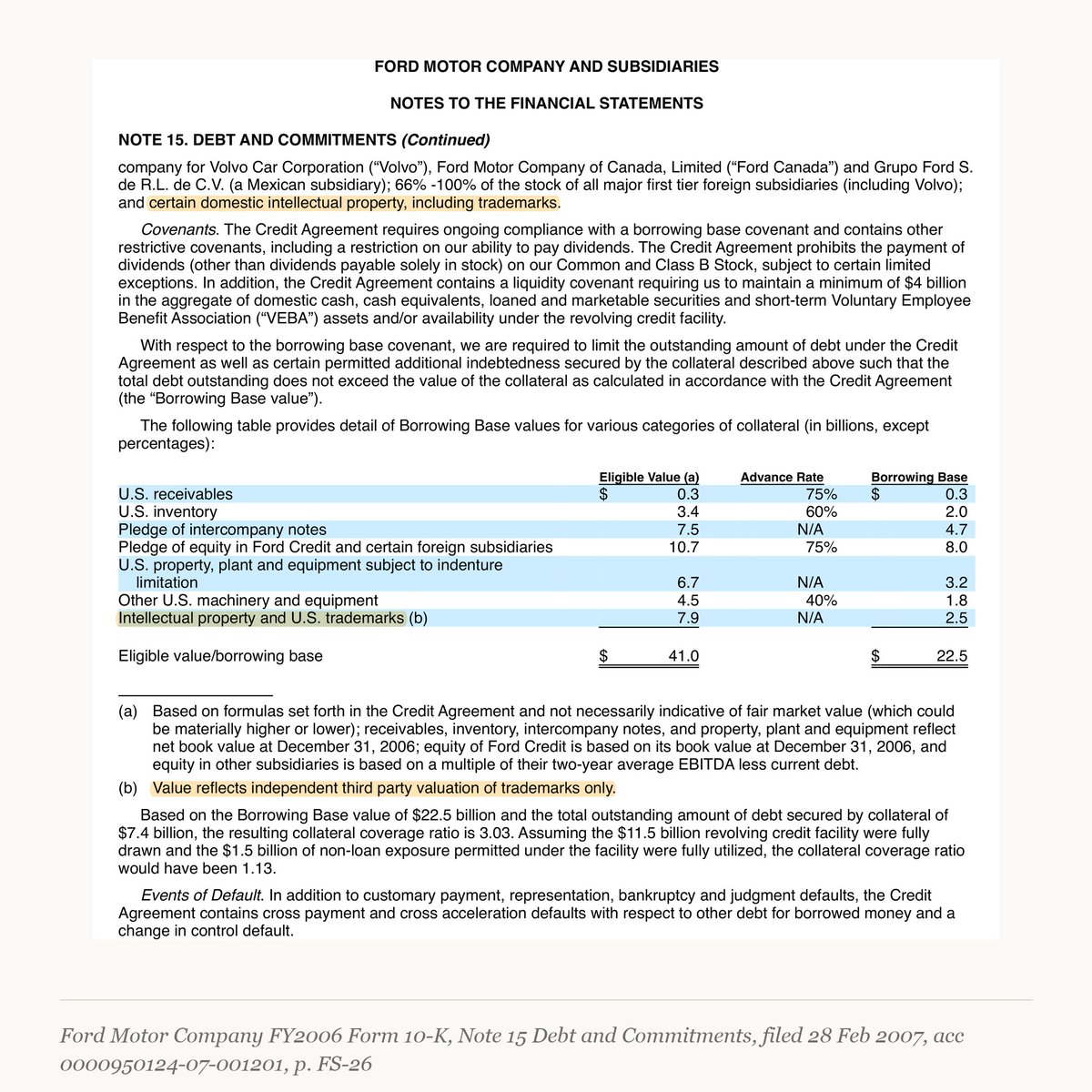
In December 2006 Ford borrowed against almost everything it owned, and its annual report for that year sets out what the lenders took.
The factories. The US receivables. The inventory. The stock of the main US subsidiaries. Most of the stock of the foreign ones, Volvo included. And one more line that is easy to read straight past: certain domestic intellectual property, including trademarks.
Then the filing prints a table putting a value on each piece.
US receivables, 0.3 billion dollars. Inventory, 3.4 billion. Machinery and equipment outside the plants already pledged, 4.5 billion.
Intellectual property and US trademarks, 7.9 billion, with a footnote saying the figure reflects an independent third party valuation of trademarks only.
The badge was carried at more than the machines.
Two things to hold on to before that becomes a story. A secured borrowing is not a distress signal by itself. Healthy companies run secured facilities, and the same table at a company with no funding need would read as ordinary housekeeping. And these are lenders' formulas rather than market prices, which the filing says itself in footnote (a).
What the table is actually good for is a number that a balance sheet will almost never show you. A company generally cannot put a value on a brand it built itself, so Ford's brand does not appear as an asset in its own accounts. It took a bank asking for collateral to get a figure for it into a public document.
A 2009 paper in the New England Journal of Medicine. Haynes and colleagues, with Atul Gawande as the senior author.
Eight hospitals took a 19-item surgical checklist into their operating theatres. The paper reports the death rate at 1.5 percent before the checklist and 0.8 percent after. Inpatient complications, 11.0 percent before and 7.0 percent after. 3,733 patients in the first group and 3,955 in the second.
None of the 19 items was new information. Surgeons already knew to confirm the patient's name and which side of the body they were operating on.
What the list removed was the discretion to skip a step on a day when you feel sure.
That is the part I took. Every company write-up I publish runs the same questions in the same order, and the section listing what the work could not do is not optional.
This is not because the questions are extremely clever but because, on the business that l already like, that section is the exact one I might skip on.
Counterpoint Research, 12 August 2026. US smartphone sales fell 5 percent year on year in the second quarter, and the damage was not spread evenly.
The four largest brands were down 4 percent between them. Everyone else was down 45 percent.
The mechanism named in the report is memory pricing. Rising RAM demand from data centre operators pushed component costs up, and that lands hardest at the bottom of the range where the margins are thinnest.
Sub-100-dollar sales fell 64 percent. The 200 to 299 dollar band grew nearly 200 percent, largely because one brand raised prices into it.
An AI infrastructure story arriving as a phone price.
The Gulf's biggest food delivery company does not own the software it runs on. It rents it from its parent, and Uber is buying the parent. https://t.co/CKrpUJzexB
The fatal red flags usually wear the prettiest numbers. That is exactly why they get missed.
Here is how I get AI to catch them, from the filings alone, without letting a majority vote bury the one finding that matters.
Any screener hands you red flags all day. Not one of them tells you which flag will actually wipe you out.
That is the whole job, and it is the one thing AI can finally help with. https://t.co/NyuKJUp94r
7/ What to steal from this:
1. OpenRouter free models are live RIGHT NOW, grab them before the window closes
2. MoE models (like Nemotron) give you large model capability at small model cost
3. Local models eliminate API dependency entirely
Gold’s 12-year jolt ⚡
After a 55% YTD surge, gold just saw its worst 2-day drop since 2012.
Spot gold: ↓6.3% Tuesday, now under $4,080/oz
Citi cuts view → “Neutral”
Overbought levels triggered massive technical selling
The “debasement trade” cools, retail crowds thin, but long-term drivers remain:
💰 Central bank buying
📉 Fiscal deficit fears
🌍 Geopolitical hedging
Consolidation ≠ Collapse.
Gold’s story isn’t over, it’s just resetting.
#gold #investing #markets #macroeconomics #commodities
India’s Renewable Reality Check 🌱
Starting April 2026, solar and wind producers will face stricter grid compliance, nearly the same discipline as coal plants.
Those who miss supply schedules could lose up to 48% of their revenue, according to CERC.
Why this matters:
⚡ Renewables now form nearly 17.5% of India’s power mix (Apr–Aug FY26).
⚡ Unpredictable weather is forcing tighter control on generation schedules.
⚡ Developers will need better forecasting, hybrid designs, and storage systems, raising project costs and power tariffs.
💡 For investors, this shift marks a key inflection point.
The winners won’t just be renewable producers. they’ll be the enablers of reliability:
•Battery storage manufacturers
•Forecasting and grid-tech providers
•Developers with hybrid portfolios and better data infrastructure
Meanwhile, smaller standalone renewable firms may face margin pressure, financing challenges, and valuation stress until they adapt to tighter norms.
India’s energy transition is still on but the next phase belongs to companies that can turn green power into dependable power.
India’s Renewable Reality Check 🌱
Starting April 2026, solar and wind producers will face stricter grid compliance, nearly the same discipline as coal plants.
Those who miss supply schedules could lose up to 48% of their revenue, according to CERC.