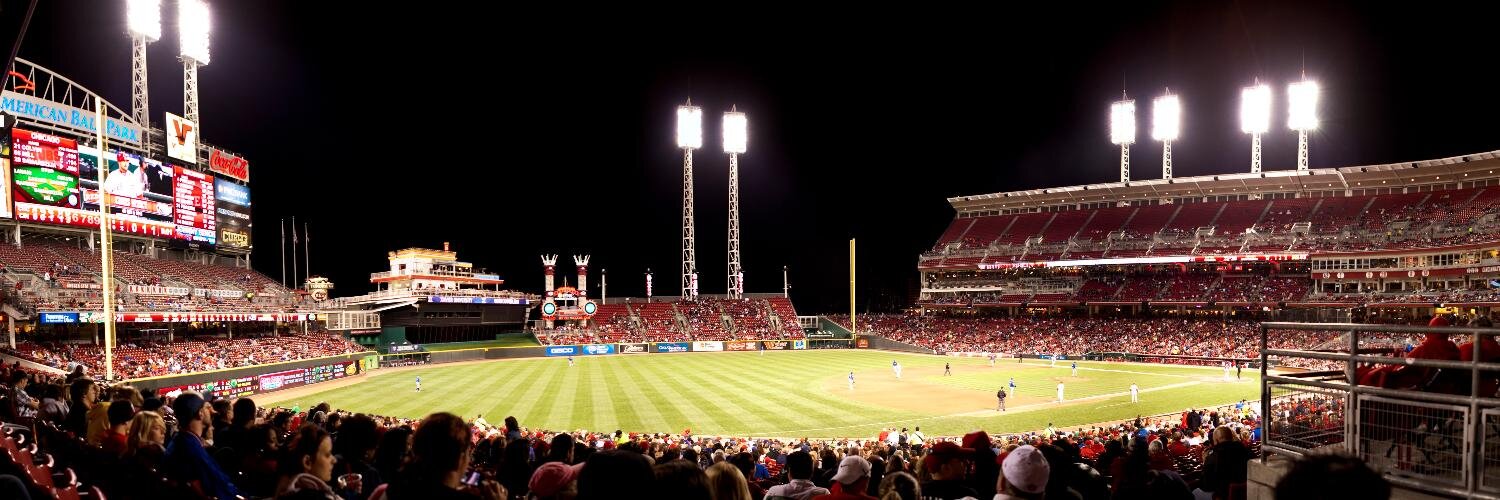
Elly De La Cruz made his big league debut three years ago tonight.
That day - and the walkoff win that night over the Dodgers - felt significant. Elly's debut and what appeared to be a nice stockpile of young players made it seem like years of waiting for the Reds contend were finally going to payoff. Maybe not immediately, but sometime in the not-so distant future. Certainly by the middle of the decade.
Since then, the Reds are 246-243. A winning percentage of .503. The Reds don't seem dramatically better than they did 489 games ago. The familiar early-summer themes of "not sure if they're buyers or sellers" have become an annual thing. The number of foundational pieces and truly established players remains startingly small.
When the Reds chose to be really bad in 2022, there was lots of chatter from the front office about the desire to eliminate peaks and valleys moving forward.
It seems as if that mission has been accomplished.
Remember when the Reds traded Raisel Iglesias (157 saves ago) and got Noe Ramirez and Leo Rivas in return? And then the Reds cut Ramirez before he ever pitched for them and Rivas left as a minor league free agent?
Looking at the lineup today, Terry Francona spoke about how good Friedl has been against today’s Braves starting pitcher. With Friedl in, McLain is out today.
This assumes static behavior beyond the mandated floor and cap. But it shows that even with 8% payroll inflation from '26 to '27, MLB's proposal comes close to maintaining the overall player wage bill. Solid starting point.
Using FG Roster Resource $$, the 30 MLB teams are spending $5.46b on '26 payroll. If every team now spending < proposed floor ($171m) spends up to it, that teams spending > $245m in '26 cut back to that cap, and every team $171 < x < $245 is unaffected, it adds to $5.895b.
Using FG Roster Resource $$, the 30 MLB teams are spending $5.46b on '26 payroll. If every team now spending < proposed floor ($171m) spends up to it, that teams spending > $245m in '26 cut back to that cap, and every team $171 < x < $245 is unaffected, it adds to $5.895b.
Public (fan) opinion would swing heavily against the union unless they could show this framework would reduce the wage bill overall. The players run the risk of looking greedy and standing in the way of fundamental change in the direction of fairness.
MLBPA interim executive director Bruce Meyer statement on MLB's cap proposal:
"The last time the owners made such an explicit push for a cap—over 30 years ago—it led to the longest work stoppage in MLB history. For generations, our members have fought against cap systems..."
@bengallmanbros Yes, the cheap (and incompetent) organizations will still put themselves at a disadvantage. But the motivation to hoard prospects to cut costs will be somewhat lessened.
Closing the MLB payroll gap won’t solve everything. It’s silly to suggest that. Some clubs are smarter and more modern than others. Cheapskates will still put themselves at a disadvantage. But, likewise, to say the enormous payroll disparity doesn’t matter is equally ridiculous.
Fan voices don’t matter, but I think a large number would get behind this framework with enthusiasm. A higher floor, lower ceiling and shared local media revenue would go a long way to leveling the field. Out-of-date and incompetent organizations would have one less excuse.
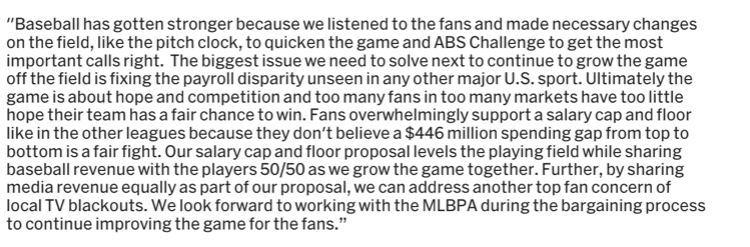
In its opening economic proposal to the players, MLB owners revealed some of the details of a hard salary cap.
In 2027, they’re proposing a salary cap of $245.3M and a floor of $171.2M with a 50-50 split of revenues.
More details (free to read):
https://t.co/C4DuxQI6Vv
It's jarring to hear national broadcasters say a hitter (N. Lowe) has improved because he pulls more balls in the air. Runs counter to the drumbeat orthodoxy preached by Reds announcers that “good hitting” is slapping the other way.
If the Reds go on to lose this game, and if we’re honest with each other, they probably will, you do not blame it on the starting pitcher. A guy who shouldn’t even be in their rotation anyway gave them 5 serviceable innings. You can’t plan to win games 1-0 in MLB and survive. At some point, the front office has to be held accountable for not putting together a full and competitive roster. Bottom line, there are not enough professional at bats on this roster.
Francona’s out of date managing is a headwind for the team’s success. The Reds’ front office won’t intervene in part because their own commitment to modern baseball is half-hearted at best. This roster isn’t good enough to sacrifice increments on the altar of obsolete thinking.