The pivotal Spree Commerce 5.4 release is out: a 10x faster REST API, a TypeScript SDK, a Next.js eCommerce storefront, and built-in AI tooling: https://t.co/Xdg7OjiVOI
Prototype today. Go live within days.
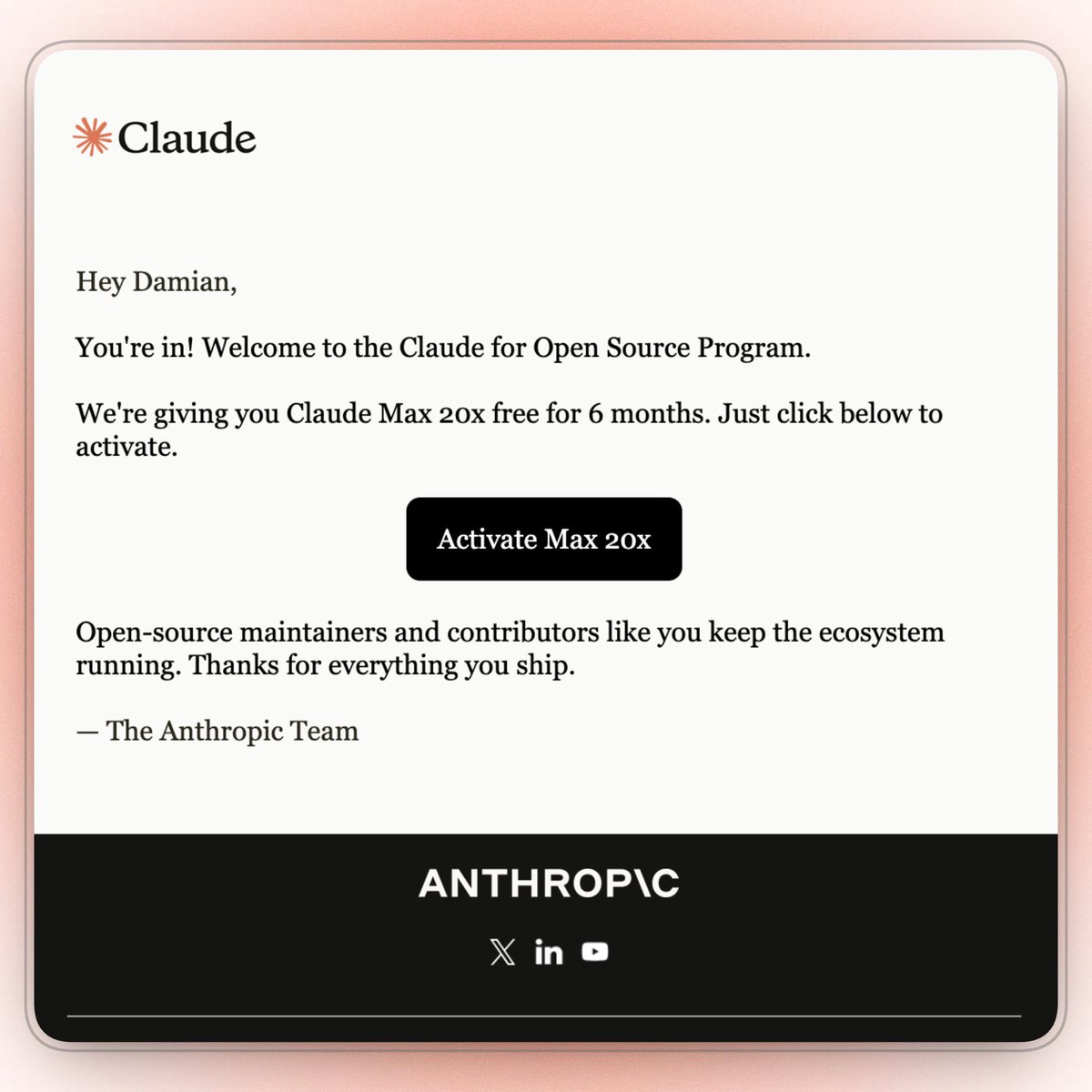
Congrats to @damianlegawiec and the entire team. Some context to their achievement below.
THE DEVELOPER STORY:
A production-grade REST API with a TypeScript SDK and a Next.js eCommerce storefront ship as a single, deployable stack:
✅ TypeScript storefront teams fork the starter and ship within days.
✅ Mobile teams generate Swift or Kotlin clients from the OpenAPI spec.
✅ SaaS platforms call the REST API from whatever backend they already run.
THE BUSINESS STORY:
Launch cross-border eCommerce, multi-vendor marketplaces, and B2B commerce with a smaller team, shorter time to market, and a fraction of the upfront investment that custom builds demanded a few years ago.
WHY IT MATTERS:
82% of developers evaluate new tools based on how quickly they can get a working prototype running.
This latest Spree release lowers that barrier to near zero: one-command scaffolding, AI-native development with AGENTS.md, and multi-architecture Docker images.
What can you build with Spree Commerce 5?
✅ Multi-store and cross-border commerce
✅ Multi-vendor marketplaces
✅ B2B wholesale portals
✅ Multi-tenant platforms
Spree Commerce Enterprise Edition adds marketplace automations, advanced B2B, multi-tenancy, and enterprise security and support.
Check out Spree Commerce 5.4:
https://t.co/Xdg7OjiVOI
Try Spree for free:
npx create-spree-app@latest my-store
#ecommerce #opensource #headlesscommerce #nextjs #b2bcommerce
Selling across EUR countries? €109 in Germany. €99 in France. €89 in Spain. Same product. Same currency. Different country.
A brand selling across the EU asked last week how to do this on one storefront. Without multiple stores and admin panels.
Cross-border pricing in EUR rarely means one price fits every country.
Why?
a) Shipping absorption. "Free shipping" in Germany costs more than in Spain. The same product quietly carries the price difference.
b) VAT-inclusive display rounding. Germany 19%, France 20%, Spain 21%, Italy 22%.
c) Local competitive pricing. Markets and direct rivals set the benchmark per country. Brands match locally rather than impose one global figure.
d) Pricing power. Eurostat tracks consumer price levels across 36 European countries every year. Denmark sits 43% above the EU average. Bulgaria sits 40% below.
The right number for the same SKU across markets is rarely identical.
Right?
So how do you charge different EUR prices in different countries without running a separate store per country?
Spree Commerce has everything you need and more:
1) Markets: regions with their own currency, languages, payment methods, shipping rules.
2) Price Lists: an override layer that swaps the base price for shoppers in a given market.
3) Wholesale: stack a Market rule with a Customer Group rule for regional wholesale tiers.
4) Volume rules: per-market quantity tiers on the same Price List.
A wholesale buyer logged in from Germany sees the Germany wholesale price.
The same retail buyer from France sees the France retail catalog and price.
No plugins. Not duct-taped add-ons. First-party features.
For brands already selling in EUR across multiple eurozone markets, adding per-country pricing is a configuration change, not a re-platforming project.
One catalog. Multiple countries. Multiple customer segments.
Check it out: https://t.co/F3xLf5qTwJ
#ecommerce #opensource #headless #b2b #crossborder
DoorDash, Ticketmaster, Faire, StockX, Zillow, Depop. Marketplaces you know. All run Next.js storefronts. Now you can have a stack like that for free.
We documented what each of them is doing extremely well in a blog post: https://t.co/EsgicNJ41g
And so can you with Spree Commerce open source natively supporting multi-vendor marketplace builds with a Next.js storefront on top.
Each one of those platforms took millions of dollars and months, if not years, to build.
Custom-built frontends. Custom integrations with the commerce backend. Custom payment-splitting logic. Engineering teams large enough to keep all of it shipping.
Maisonette is a well documented case. They run a curated childrenswear marketplace with 65,000 products from hundreds of brands and raised $15 million in 2019.
The 2018 build required Mirakl (six-figure annual subscription plus a GMV cut) for vendor orchestration, a custom Next.js storefront, a custom payment-splitting integration, and the engineers to wire it all together.
Months of work. Seven figures before the first product page went live. That was 2018.
In 2026, you can have what they all have on Spree Commerce, for a fraction of the cost, in weeks instead of months or years.
Multi-vendor marketplace module: vendor onboarding, dashboards, commission management.
Stripe Connect and Adyen for Platforms: automated split payments, escrow, payouts.
Open-source Next.js eCommerce storefront on GitHub: Next.js 16, React 19, TypeScript 5, free.
One-command install scaffolds backend and storefront in minutes.
Headless REST API with OpenAPI 3.0: any frontend, any device, any agent.
Fork the storefront. Connect your payment processor. Go live with a working marketplace in days. Not months. Not a year.
The Next.js storefront experience that took DoorDash, Faire, and StockX millions to build is now a free starting point for everyone who comes next.
That is the part that deserves attention.
#ecommerce #opensource #marketplace #nextjs #headless
Interesting talk this week with @piotrkulpinski , the founder of @ossalternative, a community-driven directory of open source alternatives to SaaS tools.
OpenAlternative traction tells a story:
- 100,000 unique visitors in its first week
- #1 on Hacker News
- Crossed 1M unique visitors in 2025
That's a forward-looking signal.
Self-hosted open source is having its moment.
A few names you'll find on the site:
🤖 @n8n_io : AI-powered automation toolset.
🔍 @meilisearch : fast search engine for websites and apps
🌐 @hoppscotch_io : lightweight API client for testing endpoints on the fly
🤝 @twentycrm: open source CRM for contacts, deals, and collaboration
🛍️ @spreecommerce: headless eCommerce with REST API, TypeScript SDK, and Next.js storefront (integrated with Meilisearch, by the way)
Why does this matter?
Piotr said it better than I can, so I'll paraphrase him in three beats:
1️⃣ Transparency - it's open to humans and agents
2️⃣ Community - a pool of developers using and contributing
3️⃣ Freedom
👉 no vendor lock-in
👉 no dependence on one company's roadmap,
👉 full control over your own infrastructure and data
That last one lands hardest for anyone who's ever been deplatformed, repriced, or regulated.
Spree Commerce is built for exactly this moment.
Open source and free to self-host anywhere.
- Headless by default with a full REST API and OpenAPI 3.0 spec.
- TypeScript SDK and a Next.js storefront ready to fork.
- Bundled documentation in every Spree Commerce install.
- AGENTS.md file maintained by the Spree Commerce team.
Here's the quiet revolution part.
AI coding agents love open source.
Why?
- They can read every line of source code.
- Full documentation is local and indexable.
- No API gates, no paywalls, no rate limits on what they can learn.
- Years of community tutorials, GitHub issues, and public forums already live in their training.
On a proprietary SaaS platform, the agent reasons from the outside in: outdated docs, blog posts, marketing pages, and whatever scraps the public API exposes.
With Spree Commerce, the agent reads the codebase.
Different level playing field.
Whether you're building:
- a B2B wholesale portal,
- a multi-vendor marketplace,
- a multi-tenant SaaS dealer network,
- or a regulated commerce operation where the data has to stay yours
...self-hosted open source is no longer the compromise option.
It's the strategic one.
Open source is the new stack. Again.
Try Spree Commerce for free.
One command install:
npx create-spree-app@latest my-store
#ecommerce #opensource #headless #selfhosted #openalternative
If you're selling through Local Resellers, you must realize they are drowning in eCommerce busywork. Instead of selling your products. But there's a fix.
This applies whether you sell through yoga studios, auto repair shops, local dealers, or franchisees.
They're clicking around online stores all day.
Managing inventory they don't understand.
Shipping boxes. Handling returns. Chasing down orders.
Meanwhile, what they actually want to do is teach, fix, sell and serve as many local customers as they can.
You need to give them their time back. Streamline any eCommerce operations by centralizing them with a multi-tenant eCommerce platform.
Shopify is great for single stores.
But when you need to host hundreds of reseller storefronts - each with their own branding and customer base - while you maintain control, it’s pretty much impossible.
So I just made a video breaking down exactly how to solve this with a multi-tenant eCommerce platform running on Spree Commerce.
In this video, we cover:
👉 What multi-tenant ecommerce actually means
👉 How to allow resellers to focus on customers while you handle operations
👉 And how to get started without building everything from scratch
GoDaddy runs 10,000+ stores on Spree Commerce.
Your reseller network is probably smaller.
But the platform is the same.
The B2B businesses that win reseller ecosystems will be the ones that let a yoga studio owner keep teaching yoga. A car mechanic keep fixing cars. Keep a local dealer talking to as many customers as they can.
So consider empowering hundreds of your resellers with their own, easy-to-use, hands-off online store.
Host thousands of stores from a single multi-tenant eCommerce platform running on Spree Commerce.
Manage them all from a single admin dashboard.
This is the biggest growth hack a dealership business could unlock.
Learn more about multi-tenant eCommerce here: https://t.co/YGuyi3M8od
#ecommerce #opensource #multitenant #whitelabel #saas
API + MCP + CLI combo is the new UI. Everything is #headless now. Everything is just infra for AI.
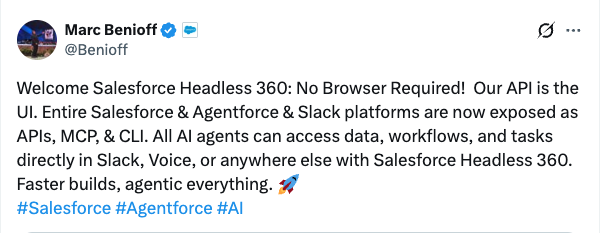
Marc Benioff announced Salesforce Headless 360 this week: all services exposed as APIs, MCP, and CLI. No browser required.
@grinich said it bluntly: "death of UI."
For 70 years we designed computer interfaces for humans. Now, the primary user of most enterprise software is about to be an agent.
But who cares? UI was means to an end, anyway.
Turns out some people care a lot. Software investors mostly.
When every platform exposes itself as an API, MCP, and CLI, feature depth stops being a moat. A small team with a sharp prompt and the right scaffolding can replicate a lot of enterprise software in weeks. Billions of dollars of R&D, sitting in an API surface that any agent can read and any competitor can clone.
You get agentic reach. You lose UI as a defensibility layer. Right?
Not in eCommerce, though.
OpenAI killed Instant Checkout. Stripe, Shopify, and PayPal all pulled support.
Why?
eCommerce is "complicated" - solving complex, mission-critical business problems across many domains?
eCommerce (and business in general) is not a read-only query. It is money flows, inventory, tax, fulfillment, refunds, fraud, and regulatory edge cases across dozens of countries.
Agents still need trusted commerce infrastructure underneath. Now more than ever.
Which is where headless commerce gets interesting again.
Spree Commerce has been building toward this moment.
- Open source - full agent visibility.
- Headless by default.
- A REST API with OpenAPI 3.0 that passes all six agentic commerce protocols.
- Full product docs bundled locally with every install.
- Dedicated MCP server for the docs.
- CLI for humans and agents.
- AGENTS.md coding rules included.
The platforms that win the next five years will not compete on admin UI.
They will compete on how cleanly an agent can drive them.
That is shipping today with Spree Commerce: https://t.co/mjPyKl1GJM
Open source is The Thing. Again.
Try Spree for free with a single #CLI command:
npx create-spree-app@latest my-store
This takes you through an interactive setup:
1) Choose Full-stack (Backend + Next.js Storefront) or Backend only
2) Optionally load sample data (products, categories, images)
Once complete, your store is running at http://localhost:3000/admin
#ecommerce #opensource #AI #headlesscommerce #MCP
35% of the a16z Top 100 marketplaces run on Next.js storefronts. We've just open sourced a template you can use for free to go live within days.
Fork it: https://t.co/TG2Wz6pQRy
Live: https://t.co/9h5G2hhAmt
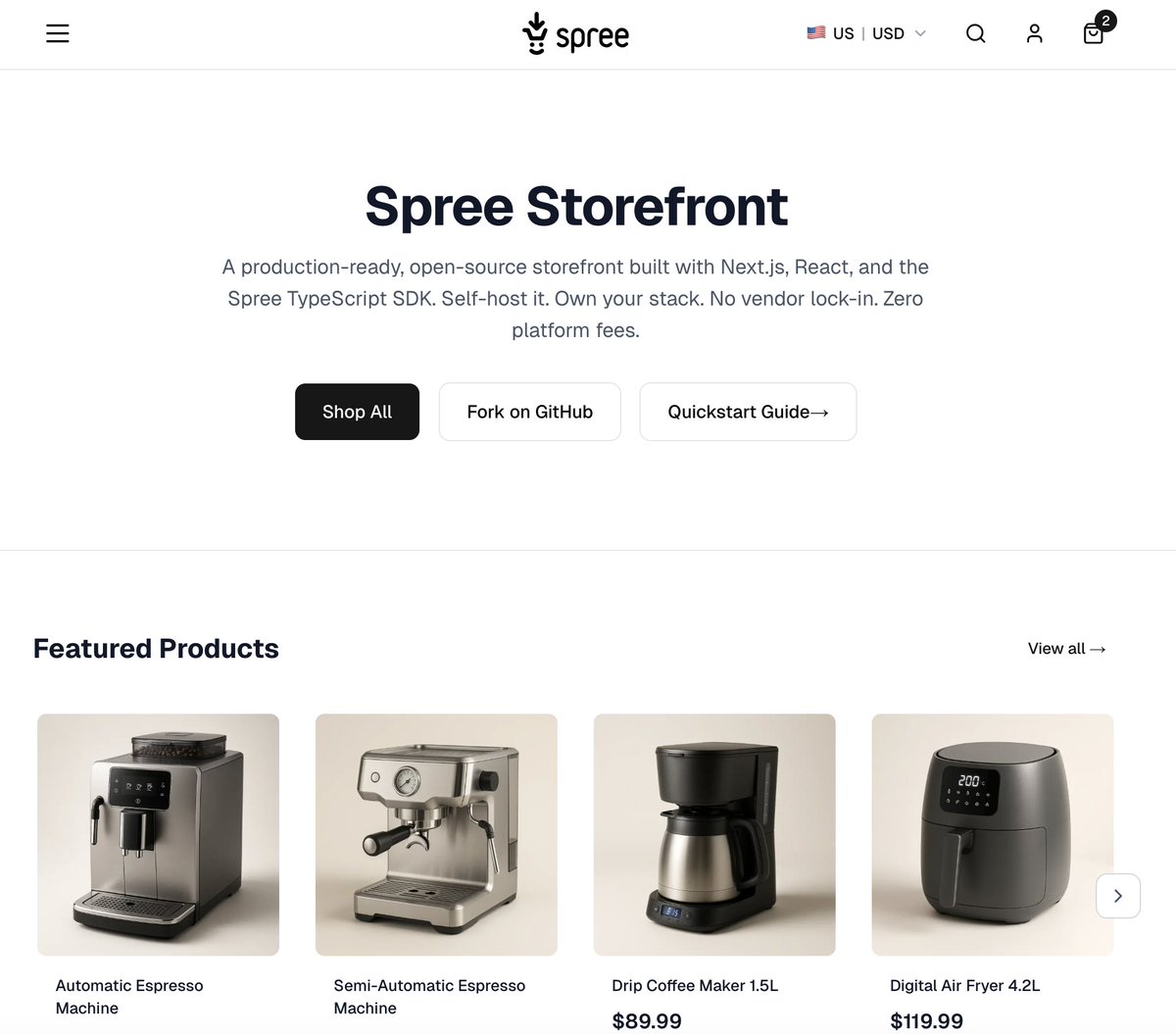
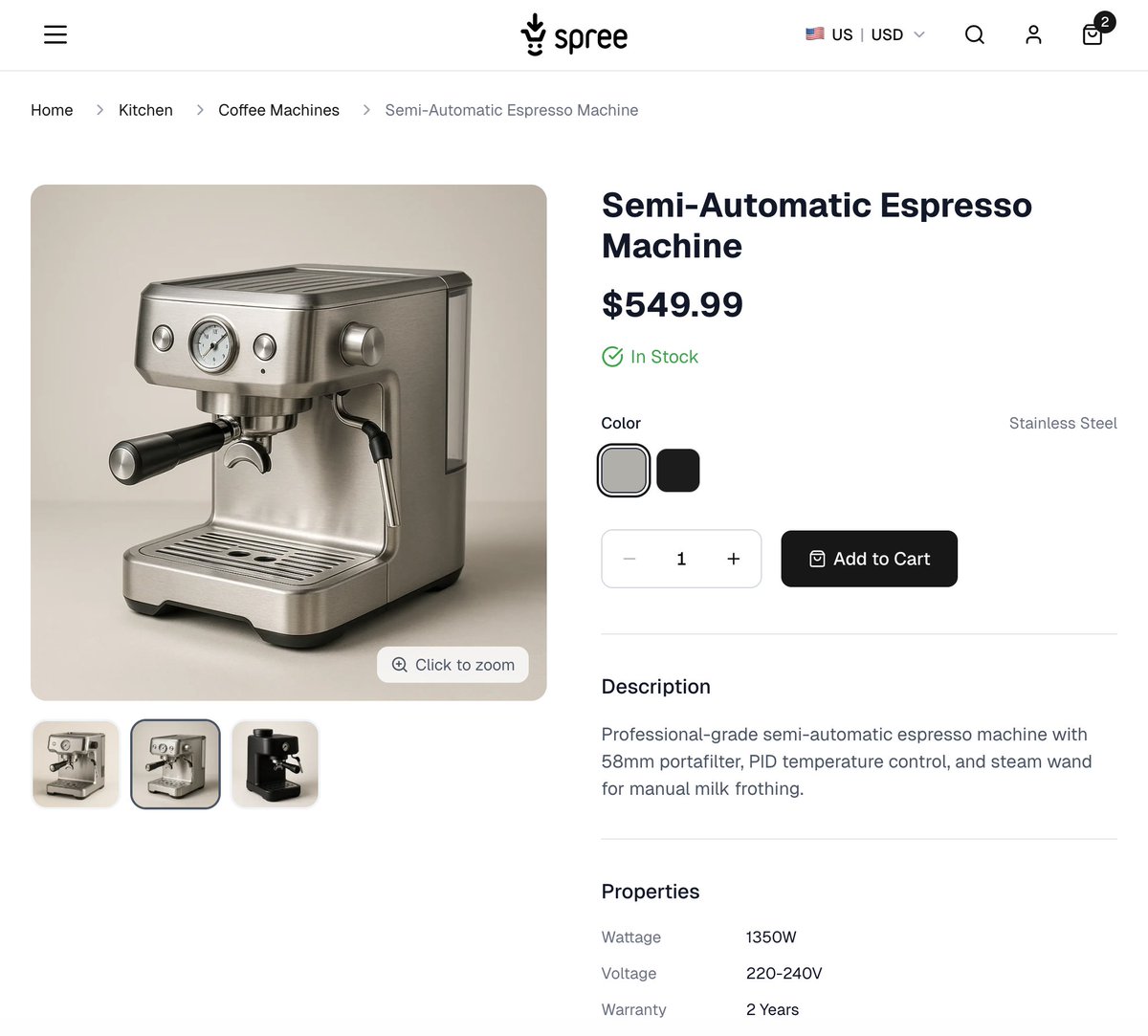
It's a production-ready Next.js storefront.
Not a demo. Not a "starter kit" you spend weeks customizing. A real storefront with everything you need to go live.
- One-page checkout.
- Guest and authenticated customer flows.
- Coupons, gift cards, store credit.
- Faceted product search powered by Meilisearch.
- Multi-shipment support.
- Native Stripe with Apple Pay and Google Pay.
- GTM with GA4 eCommerce tracking.
- Transactional emails.
- SEO with structured data and OpenGraph.
All of it ships when you fork the repo.
Cross-border commerce works from day one. Country, currency, and language switching built into the URL structure via Spree Markets. No third-party localization plugins. No separate storefronts per region.
Swap Stripe for Adyen or any other payment provider easily.
The developer experience is where it gets interesting.
Next.js 16, React 19, TypeScript, Tailwind CSS 4.
The demo scores 90+ on Lighthouse / Google PageSpeed with perfect accessibility and SEO scores.
Maisonette runs a curated childrenswear marketplace on this exact stack: Spree Commerce backend + Next.js storefront. Over 65,000 products, hundreds of vendors.
What cost them $15M to build from scratch since 2018 is now a fork and a weekend of customization.
That shift matters.
- Install Spree Commerce with a single command.
- Fork the storefront.
- Get a working commerce application in minutes.
For enterprise requirements like building a fully automated and scalable marketplace, let's talk.
Try Spree for free:
npx create-spree-app@latest my-store
#ecommerce #opensource #nextjs #headlesscommerce #marketplace #typescript #react
@spreecommerce 5.4 is out! This release turns Spree into a language-agnostic commerce platform.
Here's what shipped:
A brand new REST API designed for building headless storefronts - 10x faster than the previous one, with improved security (built-in rate limiting, idempotency, publishable keys) and Stripe-like developer experience.
A fully typed TypeScript SDK to make it easy and predictable for developers to work with. No more guessing at API shapes.
Next.js Storefront — Production-ready starter kit powered by the new API and SDK. Not a demo — an actual starting point for real builds with excellent performance and SEO, with multi-region support and Stripe payments.
Payment Sessions API — Thin wrappers for @stripe , @Adyen , @PayPal , and other payment providers. PCI-compliant, supports credit cards, off-site payments, bank transfers, wallets, and buy-now-pay-later methods, and webhooks.
Full-text search with @meilisearch provider by default. 100k SKUs? Millions of SKUs? Not a problem, excellent performance plus great search experience (also with faceted search and recommendations) available out of the box.
Multi-language and multi-region. Every market can have its own currency, payment methods, shipping rules, and translated content.
New Spree CLI for super-fast project setup and management. Try it now:
npx create-spree-app@latest my-store
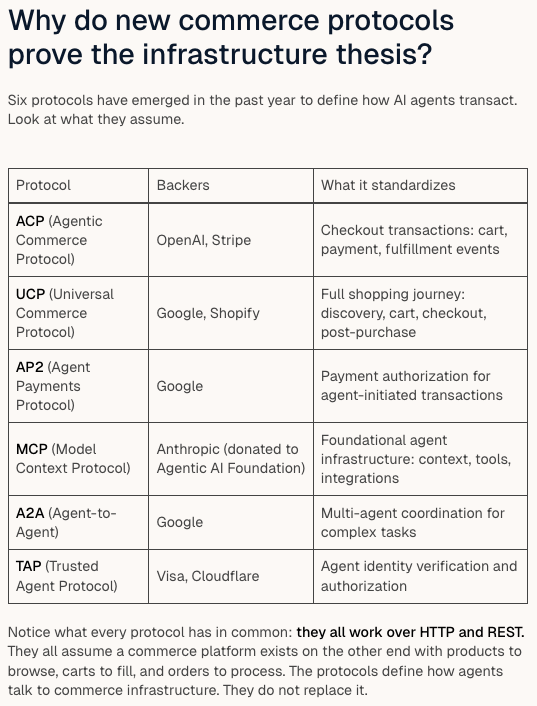
6 agentic commerce protocols in the past 12 months have one pattern in common: ACP from OpenAI & Stripe, UCP from Google & Shopify, TAP from Visa, MCP from Anthropic, A2A + AP2 from Google.
Every single one assumes a commerce platform exists underneath.
They define how agents talk to commerce. They do not replace it.
That's not a niche pattern. That's the foundation of the next economy being built in the open, right now.
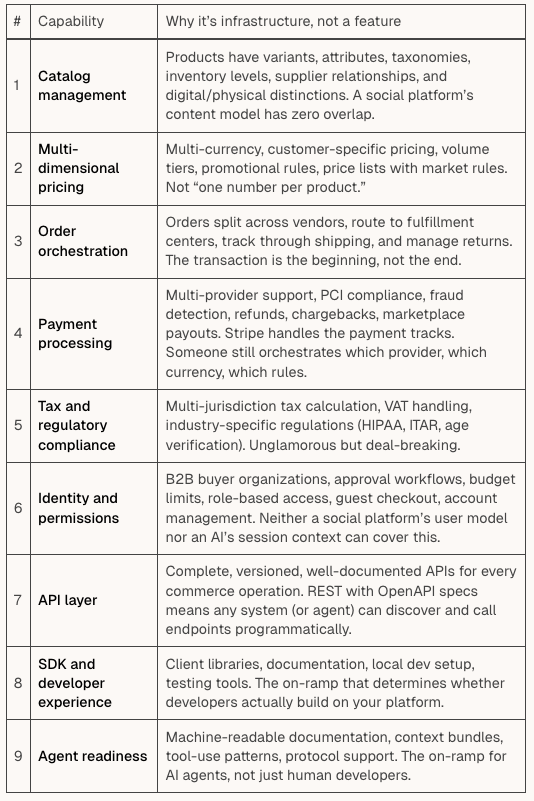
AI agents can recommend products, compare prices, and answer buying questions. But they cannot manage catalogs, orchestrate multi-gateway payments, calculate taxes across jurisdictions, or handle returns.
Commerce is not a feature you bolt onto a chatbot. It's an infrastructure layer with nine interlocking capabilities that took decades to build.
This is the Stripe parallel. Stripe defined how apps talk to payment infrastructure. These protocols are defining how agents talk to commerce infrastructure.
The protocol layer creates massive value, but only because the infrastructure beneath it already exists.
The platforms with complete REST APIs and machine-readable documentation are natively compatible with every protocol in this space.
The ones relying on GraphQL-only interfaces or admin-panel-only workflows are architecturally excluded.
Spree provides that layer: open-source, API-first, and purpose-built for the agentic commerce era. Complete REST API with OpenAPI 3.0 spec, AGENTS.md for AI context, MCP server, and every commerce operation accessible programmatically.
Features get replicated. Infrastructure gets adopted.
Here's the full breakdown on the Spree blog, including what AI agents actually need from commerce infrastructure and why OpenAI couldn't build it with $13 billion: https://t.co/ABOD2dFDTF
#ecommerce #opensource #ai #agenticcommerce #headlesscommerce #composablecommerce #api
UPDATE about a month later:
- ChatGPT’s Instant Checkout went live with 12 (twelve) Shopify merchants
- As of March 2026, Instant Checkout is no more
- Forrester's analyst said she was "shocked at the promises versus reality."
- Take away: Commerce isn't a feature you bolt onto a chat window or a social feed. It's infrastructure.
#eCommerce Meta tried it. Google tried it 3 times. Twitter, Pinterest, Snapchat, TikTok. Now OpenAI tried it too. All failed. Why?
Every big tech company in the last decade has attempted to own the the shopping experience and checkout. Every single one failed. Here's why.
Meta — 5 years, billions invested, forced merchants onto native checkout, then abandoned it entirely in 2025.
Google — Shopping Express, Buy on Google, Shopping app. Three attempts, three kills.
Twitter, Pinterest, Snapchat — remember buy buttons? Pinterest had 10,000 merchants. Major retailers saw fewer than 10 purchases per day.
TikTok Shop — spending billions and still fighting fulfillment disasters and seller backlash.
Then OpenAI. No sales tax system. No fraud detection. 4% merchant fee stacked on top of existing processing costs.
Out of millions of Shopify stores, about 12 integrated with ChatGPT's Instant Checkout before the feature was killed.
Forrester's analyst said she was "shocked at the promises versus reality."
The market's reaction was instant. The day the news broke, Expedia surged 12%. Booking Holdings gained 8%.
Wall Street was saying: AI commerce disintermediation was overblown.
The pattern is always the same.
Whoever processes the payment becomes the merchant of record. That's the prize that drives repeat business and data ownership. But it also means owning refunds, fraud, tax compliance, customer service.
Commerce is a full-time business.
Big tech wanted the data and the business. But not the complexity.
Commerce isn't a feature you bolt onto a chat window or a social feed. It's infrastructure.
And infrastructure demands a dedicated commerce engine — like Spree.
A deep dive into every failure — with the latest OpenAI fallout — in this blog post: https://t.co/4giq3Z7CEn
#opensource #marketplace #agenticcommerce
OpenAI Just Blinked: Nobody Seems to Want to Shop or Sell Inside ChatGPT. Here's why...
Just 6 months after announcing OpenAI's vision of customers buying anything directly inside a chatbot, the company is quietly retreating — routing purchases through integrated retailers instead.
Customers wouldn't buy - they were just browsing.
Only ~12 (twelve) merchants out of millions on Shopify went live.
OpenAI hadn't even built sales tax collection as of February 2026.
We've built commerce & marketplace infrastructure at Spree for 15 years, and none of this surprises us. Here's the part the coverage is missing:
Not every product can support an AI middleman. Chatbot or marketplace, the category math is the same.
It's all mapped it out in the carousel:
1) AI takes all: insurance, SaaS, travel, cars. High margins, complex comparisons. Brokers and classifieds — your days are numbered.
2) AI discovers: gifts, fashion, beauty, home decor. Great discovery engine. But the transaction still lives on the commerce platform.
3) AI too late: groceries, staples, replenishment. Amazon and Walmart already own this. There's no discovery moment for AI to insert itself into.
4) AI too expensive: electronics, appliances, commodity hardware. A 4% AI tax on a $15 HDMI cable? The math doesn't work.
The real question was never "Is AI shopping the future?"
It was always "Which products can afford it?"
OpenAI tried to own the full checkout — inventory, tax, fraud, payments, shipping, returns — and hit a wall on the basics.
Commerce is infrastructure, not a chat feature.
The next wave won't be chatbots replacing storefronts.
It'll be AI-powered marketplaces built on flexible, open infrastructure — where the merchant controls the integration, the data, and the economics.
If you're running the margin math on your own categories, we'd love to hear what you're seeing.
Save this for your next platform strategy discussion.
#ecommerce #opensource #agenticcommerce #marketplace #ai
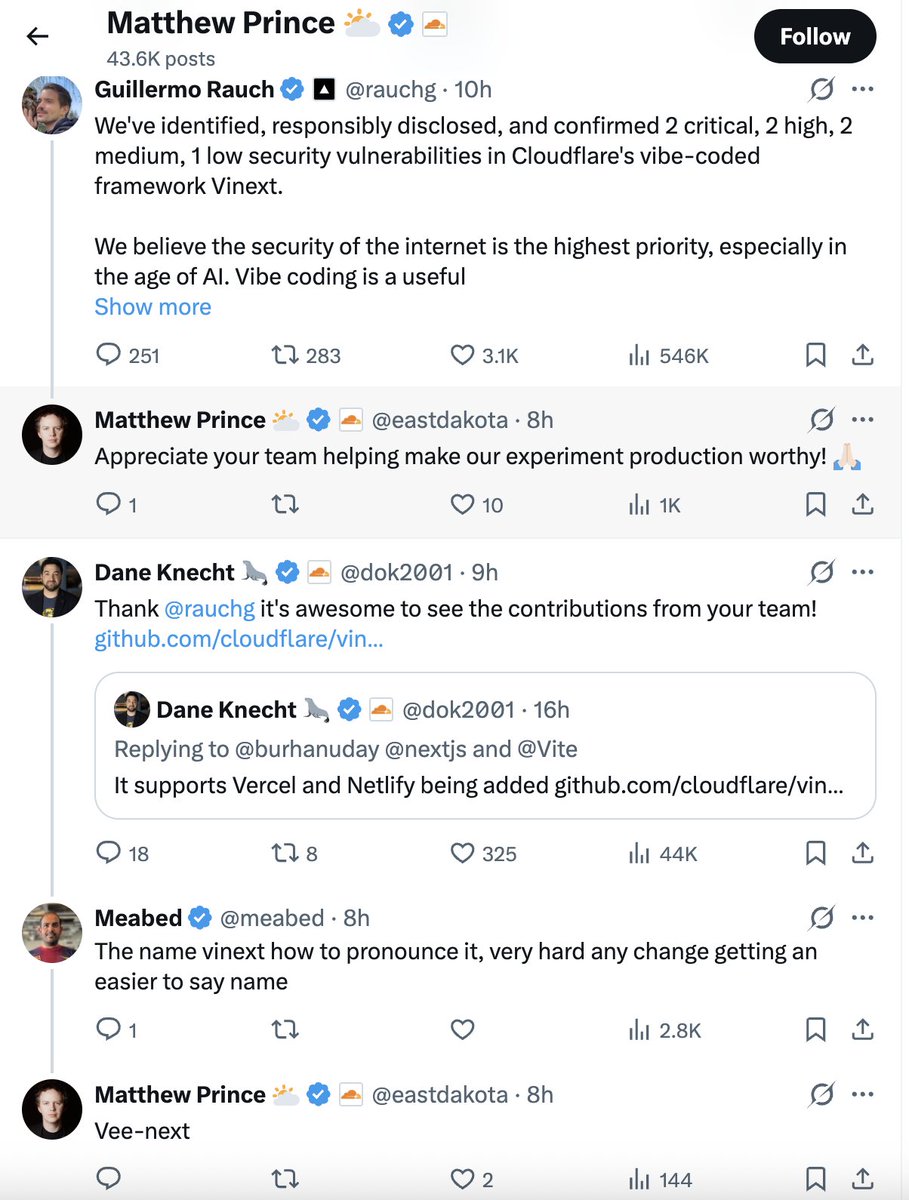
In case you've missed the drama: Next.j vs vinext. Vercel vs Cloudflare. Winners: Claude and all the frontend dev teams paying $$$ for Vercel hosting.
Here's what happened:
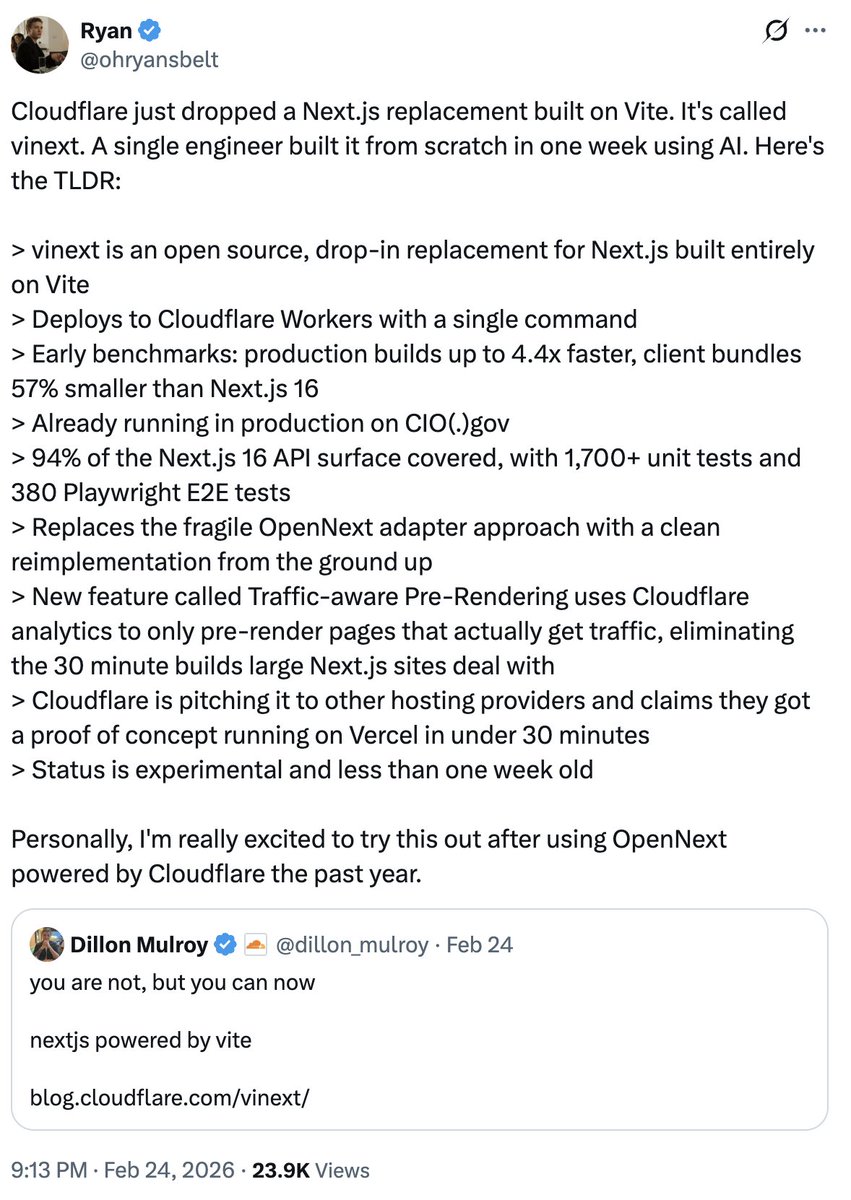
Cloudflare just dropped vinext, an open-source replacement for Next.js - the leading frontend dev framework used by the likes of Nike, TikTok, Hulu, Notion, Target.
One engineer. One week. Built with AI.
Already running in production on https://t.co/AcWT9kf5Po.
The benchmarks are hard to ignore - 4.4x faster production builds, 57% smaller client bundles, and 94% of the Next.js 16 API surface covered out of the gate.
Vercel's founder Guillermo Rauch fired back immediately - first with a "Migrate to Vercel from Cloudflare" marketing page, then by disclosing seven security vulnerabilities in vinext, including two critical ones.
It's a full-blown infrastructure war now.
Here's the context that makes this matter:
Next.js became the industry standard for frontend development.
But Next.js and Vercel are deeply intertwined.
The framework is open-source, but the deployment experience is optimized for Vercel's platform. That created a soft vendor lock-in that's been quietly frustrating frontend teams for years.
And Vercel isn't cheap.
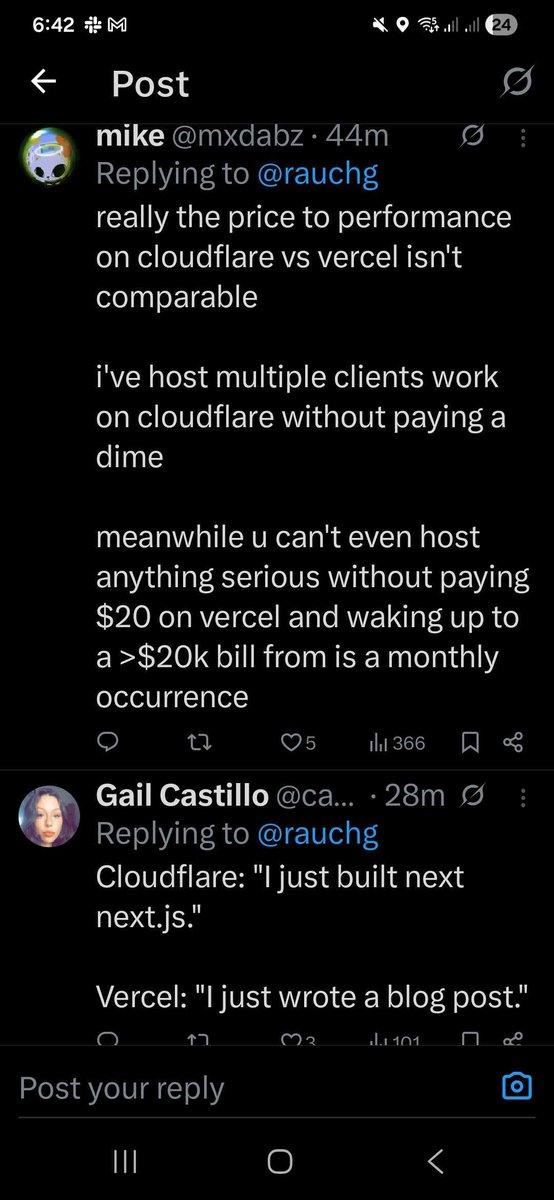
Developers openly talk about waking up to surprise $20K+ monthly bills.
Meanwhile, Cloudflare offers comparable hosting for free or near-free.
As one commenter put it: the price-to-performance gap isn't even comparable.
What vinext signals is bigger than one framework.
It means the era of frontend hosting monopolies may be ending.
Competition is coming - and it's coming fast, built by single engineers using AI tools like Claude.
Will vinext dethrone Next.js?
Too early to say. It's experimental and less than a week old.
But the pressure it puts on Vercel to compete on price, openness, and developer freedom? That's already real.
Every frontend team benefits when there's genuine competition in the hosting layer.
Lower prices.
More deployment options.
Less lock-in.
The framework wars are back, and this time the developers might actually win.
One thing you can be sure of - Spree will support any TypeScript frontend through its high-performance API and SDKs.
Whether you're building with Next.js today using our pre-built starter kit, or exploring vinext, Nuxt, SvelteKit, or whatever comes next - Spree's headless architecture means your commerce backend just works.
Pick your framework.
Pick your hosting provider.
Your storefront connects to the same battle-tested engine underneath.
That's what an API-first, open-source eCommerce platform should give you: freedom to choose your stack without re-platforming your business.
If you're building a storefront on any modern frontend framework - or rethinking your commerce stack in light of all this - let's connect.
#ecommerce #opensource #nextjs #vercel #cloudflare #vinext #frontend #headlesscommerce #webdev
The dirty secret of SaaS eCommerce: the moment your business model evolves, you're either migrating or duct-taping.
Most B2B companies think adding a D2C channel means building a second store.
It doesn't — unless your platform forces it.
A manufacturer wants to sell direct to consumers alongside their wholesale accounts.
A distributor wants to open a branded storefront without disrupting the B2B portal their buyers depend on.
On most platforms, that's two separate instances, two product catalogs, two checkout flows, and twice the infrastructure cost.
On Spree, it's one platform. Multiple stores.
All your products, customers, orders under one roof.
Your B2B buyers still log in and see their negotiated prices. Your D2C customers get the consumer-grade experience they expect.
Same product catalog. (Different price lists, shipping costs and so on.)
Same order engine.
Same team managing it all.
B2B wholesale? Native.
D2C storefront? Native.
Multi-store across both? Native.
Not plugins. Not duct-taped add-ons. First-party modules that compose together on a single open-source foundation.
The businesses winning right now aren't the ones choosing between B2B and D2C — they're the ones running both without doubling their infrastructure.
If you're exploring how to add D2C to your B2B operation (or the other way around), let's connect — we'd love to hear what you're building.
We recorded a short video walkthrough and wrote a couple of deep dives on this:
1) Why B2B companies are adding D2C on the same platform: https://t.co/qtEzQ60G1G
2) Multi-store eCommerce — how B2B businesses are expanding into B2C without doubling their infrastructure: https://t.co/yWqMsMIUvd
#ecommerce #opensource #B2B #D2C #multistore #composablecommerce #headlesscommerce #digitaltransformation
"We've outgrown our eCommerce platform." We hear this from enterprise teams every time we speak.
And it's never about traffic or SKU count.
It's about business complexity.
They need B2B with customer-specific pricing, approval workflows, and gated storefronts.
They need a marketplace with automated vendor onboarding.
They need multi-tenant white-label stores for their distribution network.
They need multi-region with localized tax, currency, and shipping rules.
And every SaaS platform tells them the same thing: "There's a plugin for that."
So they evaluate Shopify Plus. BigCommerce Enterprise. And they realize every complex requirement means another third-party app.
Someone else's code.
Someone else's roadmap.
Someone else's breaking change on a Friday afternoon.
That's not enterprise-grade. That's a house of cards with a monthly invoice.
We built Spree Commerce Enterprise Edition for exactly these projects.
B2B wholesale with buyer organizations and price lists? Native.
Multi-vendor marketplace with automated vendor sync? Native.
Multi-tenant SaaS with hundreds of independent stores? Native.
Multi-store, multi-region, multi-currency? Native.
First-party modules. Same team. Same codebase. Same enterprise support.
And here's what changes everything: you can combine them.
Marketplace + multi-tenant white-label stores for your top vendors.
B2B wholesale + DTC on the same platform.
Franchise network + international expansion with localized pricing and payment methods.
One product catalog. One order engine. One admin dashboard.
No re-platforming when the business evolves.
Deploy on your infrastructure. Own your data. Security aligned with SOC 2 Type 2 and ISO/IEC 27001. And a dedicated go-live process with the Spree engineers who built the platform.
If you're scoping a new enterprise commerce project, we recorded a video walkthrough and wrote a deep dive on exactly how this works: https://t.co/jY2AgRMASb
Let's connect — We'd love to hear what you're building.
#enterprise #ecommerce #opensource #B2B #marketplace #API #composablecommerce #headless
Kleenex. Post-it Note. Band-Aid. Google. Velcro. And now... Claude.
Some products become so dominant they replace the entire category name.
We don't search the internet — we Google it. We don't use adhesive bandages — we reach for a Band-Aid.
These are called proprietary eponyms — when a single brand becomes shorthand for every product like it.
Claude became synonymous with AI-aided coding in just over a year.
And we've gone all in on making Spree Commerce the most AI-friendly open-source ecommerce platform out there.
Here's what we've shipped:
🔹 A comprehensive https://t.co/bPl6m5QATd in the Spree repo that AI coding agents read automatically — teaching them Spree's architecture, conventions, and best practices so the code they generate is clean, idiomatic, and upgrade-safe.
🔹 A Documentation MCP Server that gives AI tools like Claude Code direct access to the entire Spree documentation. One URL, 30 seconds to set up.
Why does this matter?
Because AI-assisted development isn't just about speed — it's about building on a solid foundation without accumulating tech debt.
When your AI agent understands Spree's event system, dependency injection, and serialization patterns, it writes code the way a senior Spree developer would.
That means faster delivery, smoother upgrades, and fewer code review cycles.
The result: dramatically shorter time-to-value for every Spree project.
Deep dive blog post: https://t.co/eFRIADrM0o
If that's what you're looking for your eCommerce business, let me know and let's jump on a call to discuss.
#SpreeCommerce #AI #Claude #OpenSource #Ecommerce #DeveloperTools #MCP #AIAssistedDevelopment