Introducing SpyChain.
CA: 0x928661e51934D54576913aED820068B5395D7777
An Arbitrum Orbit L2 settled on BNB Smart Chain, built for onchain stock markets.
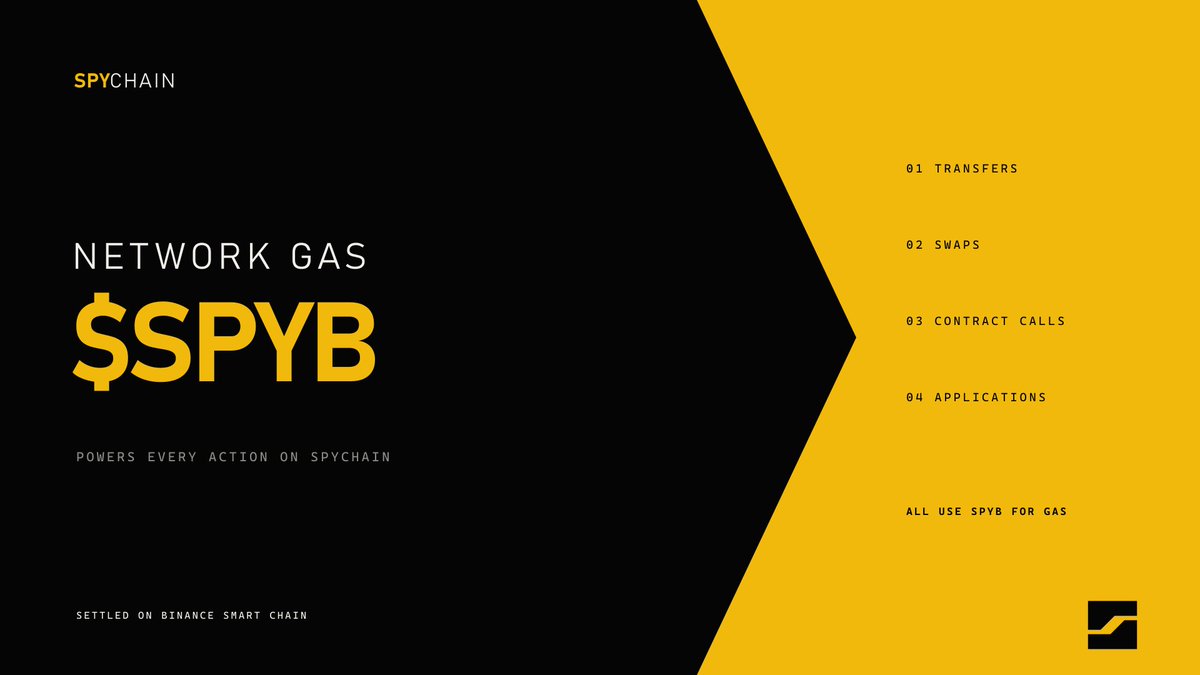
SpyChain uses $SPYB as native gas.
Every transfer, swap, contract call and application running on the network uses SPYB to execute.
We wanted the network itself to use an asset tied directly to the market it is being built around instead of creating another token just for gas.
$SPYC has a different role.
$SPYC is the protocol token of SpyChain and sits across the economic layer of the network.
Market Bonds
Markets and protocols launching through SpyChain can bond $SPYC as part of the market creation and participation system.
Protocol Liquidity
$SPYC is used across the liquidity layer connecting SPYB, supported stock assets and markets built on SpyChain.
SPY5
SPY5 is the first major liquidity system of SpyChain.
It focuses on the five largest supported SPY constituents available onchain and directs protocol liquidity toward markets around those assets.
The point is not to simply buy five stocks and hold them in a treasury.
SPY5 is designed to build deeper markets around them and create a core liquidity layer that SPY Router and other SpyChain applications can use.
As SPY's largest supported constituents change over time, SPY5 can be updated so new liquidity continues following the relevant markets.
Governance
$SPYC is used to coordinate supported markets, protocol parameters, liquidity incentives, treasury decisions and future upgrades.
Ecosystem Incentives
Liquidity providers, builders and applications contributing to SpyChain can be incentivized through $SPYC.
SpyChain will also have the infrastructure around the network:
SPY Markets — stock and ETF-paired market infrastructure.
SPY Router — routing between supported markets and liquidity.
SPY Terminal — the main interface for trading, liquidity, market data and network activity.
The roles are clear:
SPYB is the native gas.
$SPYC is the protocol token.
SPY5 builds the first core stock liquidity layer.
SpyChain is the execution layer.
Website: https://t.co/K1rYD4QHfu
Explorer: https://t.co/79tkJbSy9O
Bridge: https://t.co/3G04AqF5gJ
Docs: https://t.co/Qux6JsWZhG
why it matters: spychain is built for onchain stock markets, pricing, indexes, risk math. that stuff is painful and expensive to run in solidity. in rust it's just... cheap.
and if you want to try it, it's three commands: cargo stylus new → check → deploy, pointed at spychain. that's the whole thing.
We spent the day getting rust contracts working on spychain. they're live.
wrote one, compiled it to wasm, shipped it to mainnet, called it worked first try. runs alongside the evm, cheaper compute.
Rust on a chain built for onchain stocks. here we are
https://t.co/bMVoVZNsFm
We spent the day getting rust contracts working on spychain. they're live.
wrote one, compiled it to wasm, shipped it to mainnet, called it worked first try. runs alongside the evm, cheaper compute.
Rust on a chain built for onchain stocks. here we are
https://t.co/bMVoVZNsFm
Bonus fact (and our favorite): SpyChain is now a chain where you can send a transaction holding zero of the token that pays for gas. We proved it on-chain, a wallet with 0.0 SPYB in it successfully transacted, paying its gas in $SPYC instead, block 52. Most chains, if you're out of gas token, you're stuck. Here you just... aren't.
Fun fact: SpyChain almost couldn't exist because of a single address.
Arbitrum chains put a core system contract (ArbSys) at address 0x64. But on BNB Chain, 0x64 is a reserved precompile that silently eats all the gas you send it. So the very first time SpyChain's sequencer tried to deploy, the transaction just... vanished into that address and reverted with an impossible "needs >50M gas" error. The whole chain was blocked by a two-hex-digit collision.
The fix was a one-line patch telling the code "no, we're not actually on Arbitrum" and that's the reason SpyChain is one of the rare Arbitrum-tech chains that lives on BNB Chain instead of Ethereum.
There is another $SPYC utility we have not talked about enough yet: staking.
SpyChain has a paymaster layer for supported gasless transactions.
SPYB remains the native gas asset of the network, but when a transaction goes through the paymaster, the paymaster collects SPYC.
That SPYC is protocol revenue.
Instead of printing new tokens and calling it staking yield, the current staking design routes that revenue to SPYC stakers.
Rewards accrue while you are staked and are streamed over time.
So the flow is:
SpyChain usage
→ paymaster collects SPYC
→ protocol earns revenue
→ SPYC stakers receive that revenue
The more the paymaster gets used, the more revenue enters the staking system.
This gives SPYC another role beyond market bonds, liquidity, governance and incentives.
$SPYB powers execution.
SPYC sits across the protocol economy, and staking gives holders a direct way to participate in revenue generated by network usage.
https://t.co/dwWIZrBwbd
SpyChain is built for onchain stock markets.
The network is live, settled on BNB Smart Chain, with $SPYB as native gas and $SPYC as the protocol token coordinating the economy around it.
The goal is not to recreate stocks onchain.
The assets already exist.
We are building the execution, liquidity, routing and market infrastructure around them.
SPY5 builds the first stock liquidity layer.
SPY Router connects those markets.
SPY Markets gives projects a way to build stock and ETF-paired markets.
$SPYB powers the network.
SPYC coordinates the economy built on top of it.
Here's the loop:
Every gasless tx on SpyChain the paymaster charges the fee in $SPYC that SPYC is streamed to stakers as yield, yield drives SPYC demand = more usage.
usage → fees → stakers → demand → usage
This turns SPYC's gas role into a demand sink. The more the network is used, the more SPYC flows to the people securing and holding it.
Real yield that scales with adoption, not with a printer.
Live now: stake, unstake anytime, rewards accrue per second while you're staked.
https://t.co/dwWIZrAYlF
SPYC staking is live.
Stake $SPYC earn $SPYC from real network usage. Every gasless transaction, the paymaster collects SPYC in fees and streams it straight to stakers.
https://t.co/1bmDeMfBQt
SPYC staking is live.
Stake $SPYC earn $SPYC from real network usage. Every gasless transaction, the paymaster collects SPYC in fees and streams it straight to stakers.
https://t.co/1bmDeMfBQt
$SPYC is the protocol token of SpyChain.
$SPYB handles gas. SPYC handles the economic layer built on top of the network.
Its main functions are:
Market bonds: projects and markets can lock SPYC to participate in SpyChain's market infrastructure.
Protocol liquidity: SPYC sits across the liquidity layer connecting $SPYB, SPY5 assets and markets built on the network.
Governance: SPYC is used for decisions around supported markets, protocol parameters, incentives and treasury usage.
Ecosystem incentives: builders, liquidity providers and applications can be incentivized through SPYC.
As more markets and applications are built on SpyChain, SPYC gets used across more parts of the protocol.
The point is not to make SPYC do everything.
$SPYB powers the chain.
SPYC coordinates the economy built on it.
$SPYB is not just another asset supported by SpyChain.
It is the gas asset of the network.
Transfers, swaps, contract calls, applications and deployments all use $SPYB for gas.
That means every action happening on SpyChain creates actual network-level usage for $SPYB.
We chose this structure because the chain is being built around onchain stocks and ETFs. The asset powering execution should make sense for the market the network is designed for.
SPYC handles the protocol layer around it: liquidity, market bonds, governance, incentives, SPY5, SPY Router and SPY Markets.
Two separate roles.
$SPYB powers every action on the network.
SPYC coordinates the markets and protocol being built on top of it.
Stocks onchain is becoming a real lane.
@spychainorg is building SpyChain around stock-linked markets, liquidity routing, and network activity.
SPYB powers the chain.
$SPYC coordinates the economy on top.
CA:
0x928661e51934D54576913aED820068B5395D7777
Docs:
https://t.co/VQbcYoWLEd
Swap is live on SpyChain.
Trade natively on chain 9426, straight through our on-chain Uniswap V3 clone.
Wrap SPYB, route through the deepest fee tier.
https://t.co/V4HR1yFi0K
The execution layer, now executing
SPY5 is not a passive basket.
It is the liquidity engine for the five largest eligible SPY constituents available onchain.
The current set:
$NVDAB
$AAPLB
$MSFTB
$GOOGLB
$AMZNB
The point is to direct liquidity toward these markets and build a core stock liquidity layer around SpyChain.
The set is also dynamic.
If the largest eligible SPY constituents change over time, SPY5 can update with them instead of being permanently hardcoded to the same five assets.
So SPY5 follows the market instead of freezing one basket forever.
That liquidity then becomes useful across the rest of the stack, especially SPY Router and SPY Markets.