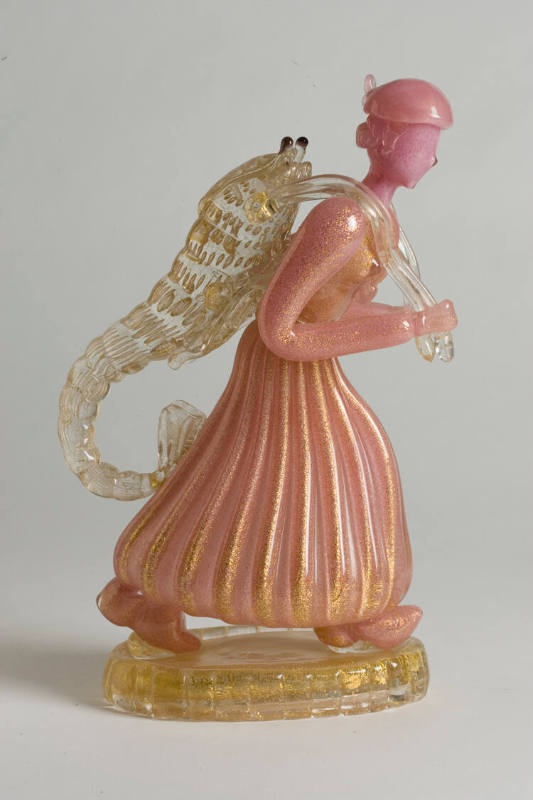
Woman With Shrimp by Ercole Barovier (Italian, 1889-1974), 1930s (approximate). Medium: Blown and solid-worked glass; gold-toned metallic particle effects. Collection: Chrysler Museum of Art, Norfolk.
Produced when Art Deco aesthetics were at their peak, this figure is completely devoid of facial features; instead, the focus is on the fluidity of the form and the material itself. The woman carries a large shrimp on her back.
The long, pleated dress she wears is shaped from a dense pink glass paste. Metallic (gold-toned) particles are trapped inside -- using a technique similar to avventurina, though I couldn't fully confirm this -- which creates a metallic shimmer on the surface.
I want to talk about the artist. Ercole Barovier wasn't actually a traditional glassblowing master, but a designer with a medical background. After his studies, he joined the family business and took over management in 1926. He approached the workbench not with the muscle memory of a craftsman, but with the analytical intelligence of a researcher.
While other masters of the period repeated centuries-old recipes, Barovier tried vastly different techniques. He experimented with metal oxides in his laboratory, developing numerous unique formulas such as "hot coloring without fusion" (colorazione a caldo senza fusione).