Caching Strategies Explained ⚡🗄️
Caching speeds up applications by reducing expensive database queries and repeated computations.
But not all caching strategies work the same way.
Here are 8 important concepts 👇
🔵 1. Cache-Aside - App checks the cache first, fetches missing data from the database, and stores the result.
🟠 2. Read-Through - The cache automatically loads missing data from the database.
🔵 3. Write-Through - Writes update the cache and database before being acknowledged.
🟠 4. Write-Behind - Writes go to the cache first and are persisted asynchronously.
🔵 5. Refresh-Ahead - Frequently accessed entries are refreshed before they expire.
🟠 6. Stale-While-Revalidate - Serve cached data immediately while refreshing it in the background.
🔵 7. Time-to-Live (TTL) - Automatically expire cached entries after a defined period.
🟠 8. Least Recently Used (LRU) - Evict the least recently accessed entries when the cache fills up.
Why caching matters:
⚡ Faster response times
📉 Reduced database load
📈 Better scalability
💰 Lower infrastructure costs
💡 The biggest challenge isn't storing data in a cache. It's keeping that data fresh, consistent, and available when needed.
Choose your strategy based on read/write patterns, freshness requirements, and acceptable trade-offs. 🚀
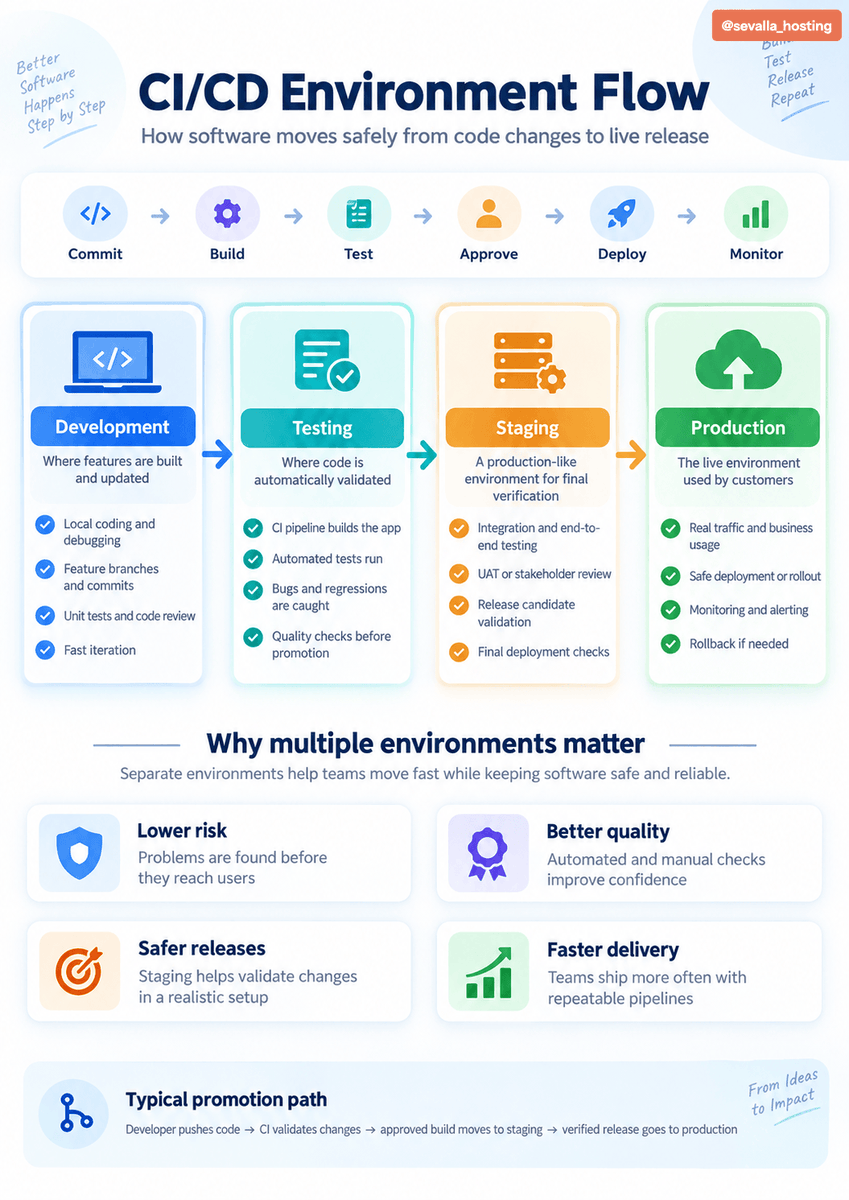
CI/CD environment flow, explained clearly ⚙️🚀
Software usually doesn’t go straight from code to users. It moves through a series of environments first 👇
🔹 Development
Where features are built, tested locally, and improved fast.
🔹 Testing
Where CI runs automated checks to catch bugs early.
🔹 Staging
A production-like space for final validation and review.
🔹 Production
The live environment used by real customers.
Why does this matter? 🛡️
It lowers risk, improves quality, and makes releases afer.
Teams can validate changes step by step instead of guessing.
Typical path:
Code change → testing → staging → production
A simple flow, but one of the biggest reasons modern teams ship reliably 📦
@sevalla_hosting Choose REST when you want straightforward, predictable SQL access and a broadly compatible public API.
And don't forget about the security
@csaba_kissi The first one can do a ton of cool stuff.
It's like an all-in-one scientific agent with special skills.
But again... We really need something related to SQL 😀