I think people are not appreciating enough that top 3 American AGI labs right now have more scientific research capability than the rest of the humankind. Even each in isolation. They don't just "do more normal research". They do BIG THINGS we'd normally need decades to get to.
@garciacjao por favor olhe os numeros: essa exponencial no tempo de coerencia dobra a cada ~6 meses, enquanto a exponencial do investimento dobra a cada ~9-30 meses.
a exponencial do tempo de coerencia cresce mais rapidamente.
de novo: toda a vantagem esta nas margens.
It’s a good joke (ok, a really good joke!) but I do find it strange that so many people say AI is just big matrix multiplication. The first thing I tell my students when teaching neural nets is that the composition of linear maps is linear—so without nonlinearity a neural net would just boil down to a single matrix multiply. The magic sauce is the non-linearity we inject at each stage with the activation functions.
Every model is right-handed
Every model is right-handed: each moves the robot's right arm in more of its commands than its left. And none closed a hand to carry the box: all 27 box-to-shelf successes carried it pressed between the palms.
@garciacjao https://t.co/m5DGmjculz
nao tem caído, tem ficado mais rapido. crescimento exponencial no tempe coerencia levou os modelos de nao saber matemática a resolver problemas do milênio. como vc pode ver a IA resolver navier stokes, h. de riemann, e falar isso?
Some folks might be surprised that math was "one of the first to fall to AI", but those who know history know that AI itself grew out of an intellectual lineage of mathematicians trying to automate proving. It's all finally coming back home.
People can trick, and be tricked by LLMs through linguistic chicanery. They falsely generalize this learned belief to LLM-produced formal proofs. They fail to understand the point of formalization is precisely to attain the absolute precision required to avoid any doubt about what is being done and what it means.
lots of math is thinking about problem A and hypothesizing problem B because of it. then B takes a life of its own.
until now we are only seeing the AI's B problems that it actually uses to solve A.
there is a chance its discarded Bs already contain interesting questions
As part of the October 6 release we had a particularly clean advance on the matrix multiplication exponent, with a new upper bound of 9/4. Since then, the model has been working on a LOWER BOUND for this exponent. This is already pretty crazy since NOTHING was known for lower bounds! Today we announced that actually 9/4 is tight ... This is really the kind of result that I never thought I would see in my lifetime.
(btw, by an "old" result of Yin Tat Lee and collaborators this also implies that linear programs can be solved in time n^{9/4}.)
"You're just mad because OpenAI destroyed your company."
@ZackKorman: "I only have a company because of OpenAI."
Embroidery CEO explains why mocking people whose professions are being disrupted by AI is completely misguided:
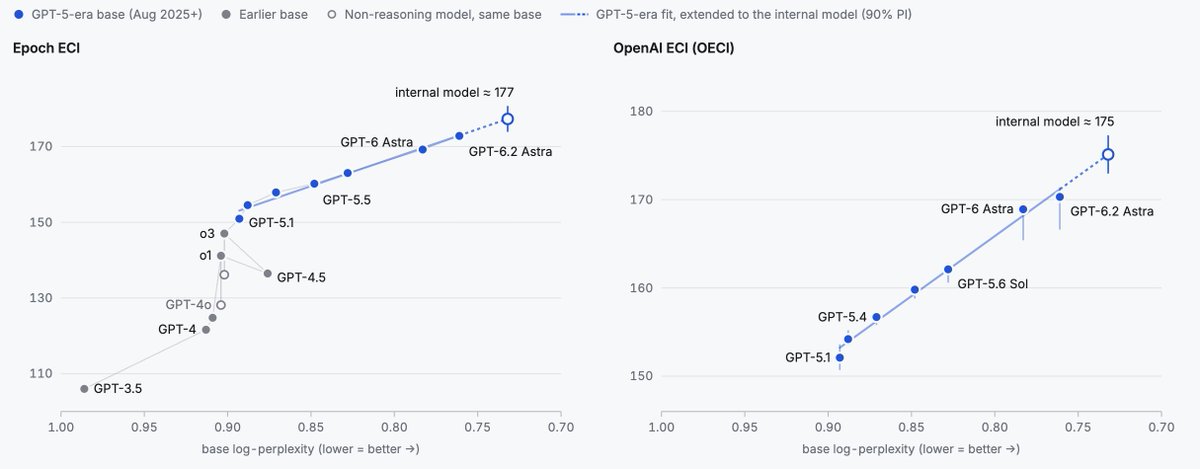
@antirez perplexity is like 1/p where p would be a prob. that if assigned to every observation would give the same prob to the dataset as the model does. so if that p is closer to 1, you have more precise predictions, so your coherence length is longer, so CoT works better. coherence
Combining with https://t.co/s9C5wf1wB7 naively you get this projection for log-perplexity at OpenAI. Ignores procurement of energy/compute and any regulation or elective pauses.
This checks out with claims of "avalanche soon" for perplexity by OpenAI
We decided to provide more transparency into pretraining progress at OpenAI for the sake of moving toward shared safety bars. In “Perplexity and Intelligence” I argue for common limits based on perplexity and other measurements, with progress beyond them gated on our ability to understand AI behavior.
https://t.co/XX35m5vq89
Experimental data for mathematics
Understanding why this works is similar to physics. We can confirm that a signal is real before we understand what produced it. The challenge becomes to find the best explanation of the observation and watch out for systematics