You cannot regulate your way to growth. You cannot tax your way to prosperity. And you cannot build a stronger economy by making life harder for the people who create jobs.
Here are five things that have to change.
One day after the U.S. signed a deal with the Islamic Republic، the regime in Iran, handed Parastoo Ahmadi 74 lashes for singing on YouTube.
They call America the Great Satan. And then they flew to the table and signed a deal with the «Devil«. But a woman’s voice scared them more than any superpower ever could.
A regime that whips women for showing their hair and singing, there’s not a normal government.
This is called apartheid against women.
Milton Friedman on the public school system:
“What we have is a monopoly, and like every monopoly, it’s producing a low-quality product at a very high cost.”
“The way to improve that is to have competition—to make it possible for parents to have a choice of the schools their children attend.”
When 46 individuals capture over half of all BEE mining deals, the grand illusion of economic transformation is completely shattered.
This is not empowerment. It is institutionalised kleptocracy disguised as social justice.
The BEE has functioned as a closed loop syndicate for a tiny, politically connected elite.
In South Africa, you do not achieve success through operational excellence, mineral innovation, or capital efficiency. You achieve it through proximity to the ruling party's deployment committee.
Forty-six ANC cadres get unimaginably wealthy by simply signing their names on ownership certificates, while the actual miners and surrounding communities continue to live in absolute squalor.
Global capital and serious mining houses look at South Africa and see an uninvestable landscape. They are forced to hand over massive equity chunks to non-productive political cronies just for the permission to build.
Instead of investing profits back into advanced machinery, geological exploration, and stable logistics, billions are siphoned off into luxury estates and foreign bank accounts.
When a regime treats its national resources as a private treasury for a selected few, it has surrendered all moral legitimacy to govern.
Renewables carry an endless price tag to replace the entire fleet every 10 to 25 years in an endlessly repeating loop.
The cost is incalculable, and it will no longer involve the same opportune subsidies to maintain this perpetual wagon train on the trail to a landfill near you. Every turbine standing today will need to be decommissioned and replaced at least once before 2050. Without a cost-effective way to recycle fibre-reinforced polymers, the majority of these massive blades are destined for eternity—buried forever in graveyards.
China, Europe, and the US account for the vast majority of this waste, creating a mountainous industrial heartache that many Net Zero models simply haven't priced in.
Research modeling the waste stream indicates that the burden will not be distributed evenly. The three largest contributors account for the vast majority of decommissioned blade material: China (40% of global blade waste), Europe (25%) and the US (16%).
A study led by Professor Peter Majewski from the University of South Australia confirms that tens of thousands of wind turbine blades could end up in landfill by the end of the decade.
In his findings published in AIMS Energy, Professor Majewski argues that a self-regulated market will not solve the issue fast enough. He suggests forcing manufacturers to take responsibility for the blades at their end-of-life stage, and wind farm operators should provide pre-funded disposal solutions during the initial planning approval process.
The green energy 'miracle' is a massive unfolding crisis.
Elon Musk:”You get taxed on what you earn, you get taxed on what you buy, and you get taxed on what you own. And what does it get spent on? A bunch of stuff you don’t even agree with.
That’s why we need to reduce the size of government, spend less money and let the people keep a lot more of their hard-earned money.”
In 1968, while teenage Red Guards beat their professors to death with clubs in Beijing courtyards, Jean-Paul Sartre sat in Paris calling Mao's Cultural Revolution a model of revolutionary democracy. The most celebrated intellectual in France looked at a country burning its own libraries and saw liberation. He sold the Maoist newspaper La Cause du Peuple on French street corners himself, holding it aloft like a sacrament.
Consider what he was endorsing. Between 1966 and 1976, the Cultural Revolution killed somewhere between 500,000 and two million people. Schools shut down across the entire country. Students dragged teachers onto stages, hung placards around their necks, forced them to kneel on broken glass, then murdered them. The historian Bian Zhongyun, vice-principal of a girls' school in Beijing, died on August 5, 1966, beaten by her own students with nail-studded clubs. Sartre called this the people governing themselves.
You should understand why a man this intelligent got it this wrong. Sartre believed knowledge served power, that truth was whatever the revolution required, that the individual existed to be dissolved into the collective will. So when Mao abolished the distinction between teacher and student, between expert and mob, Sartre cheered. He had spent decades arguing that bourgeois reason was a class weapon. Here was a regime taking him at his word and clubbing the reasoners to death.
This is what economic illiteracy buys you. A university, a price, a contract, and a peasant's grain stockpile all carry knowledge that no central planner can seize or replicate. Mises explained the calculation problem in 1920. Hayek explained dispersed knowledge in 1945. Sartre had access to both and chose the dunce cap of the collective instead, then handed out its propaganda on the Rue de Rennes.
He died in 1980, mourned by 50,000 followers, never having retracted a word about Mao. The professors of Beijing got no such funeral. They got a ditch, and a philosopher in Paris explaining that their murder was freedom.
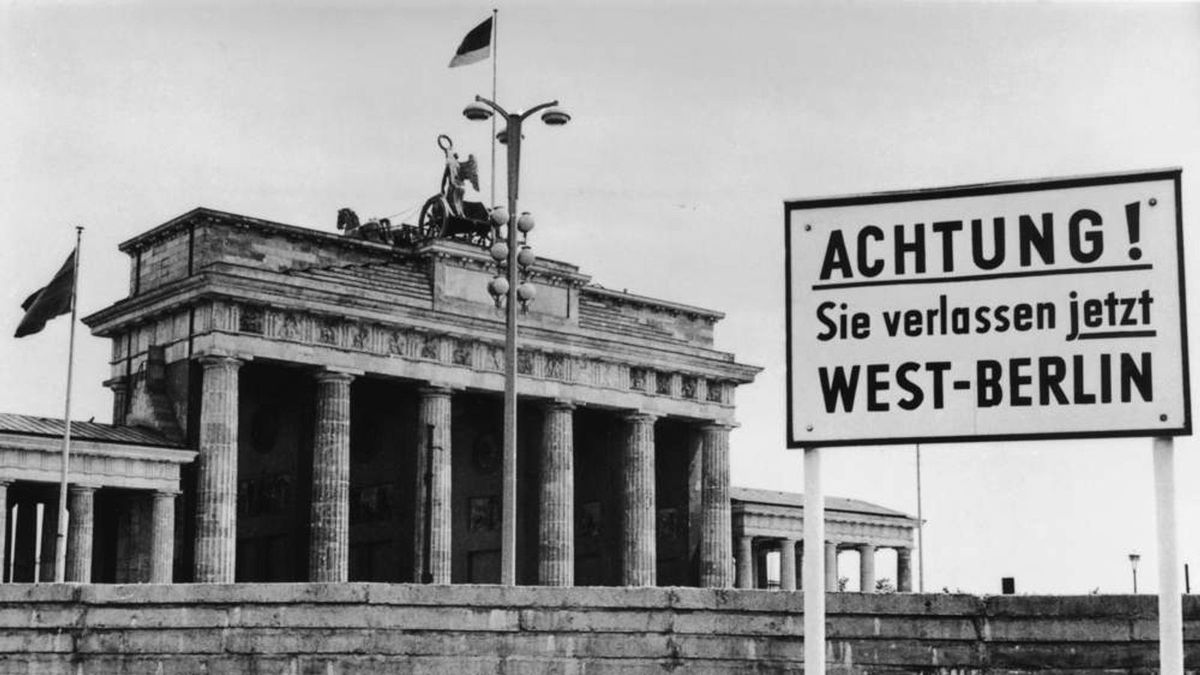
The Berlin Wall was built to trap East German citizens inside their supposed workers' paradise, not to keep enemies out. East German authorities erected it in 1961 because their system had already failed: when you need barbed wire and machine guns to prevent people from leaving, you've admitted as much.
By 1961, over 2.7 million East Germans had fled to the West through Berlin. The exodus included doctors, engineers, skilled workers, and intellectuals. Brain drain doesn't begin to capture the hemorrhaging. The East German economy was collapsing as productive people voted with their feet against socialism. Walter Ulbricht's government faced a choice: reform the system or build a prison. They chose the prison.
You can see the same pattern everywhere socialism takes hold. Cuba builds rafts. North Koreans risk execution to cross the DMZ. Venezuelans walk thousands of miles to escape Maduro's paradise. The pattern never changes because the economics never change. When the state controls production, innovation dies. When bureaucrats set prices, shortages multiply. When politicians promise equality, they deliver poverty equally.
The Wall stood for 28 years as the perfect symbol of socialism in practice. Guards shot 140 people trying to escape between 1961 and 1989. Each death proved the same point: people will risk everything to escape centralized planning. They will climb walls, dig tunnels, and hide in car trunks to reach free markets.
Ludwig von Mises warned in 1922 that socialist calculation was impossible without market prices. Every socialist experiment since has required walls, gulags, or killing fields to function. The Berlin Wall was just socialism being honest about what it really takes to make paradise work.
@tarathinks@ME_Beaumont A journalist should report the names to her editor and police or take legal action. It should not be about you becoming the story or taking it to social media for attention as a victim. Journalism is suffering from this non-professional ‘all about me’ approach.
Wind and solar are not viable as the world's primary energy source, not without endless backup from the dense baseload power of hydrocarbons.
Because renewable components face a strict 20-year operating life, we have inadvertently created an economic monster: a continuous loop of decommissioning, ransacking rare earth mines, and rebuilding the entire global fleet just to maintain the status quo - a material dead end.
Without fossil fuels to power the underlying mining, manufacturing and transport infrastructure, these wind and solar systems wouldn't even exist. Once installed, their intermittent energy cannot be integrated on a national scale without a completely new, parallel global power grid—an infrastructure sinkhole estimated to cost $21 trillion.
This massive building spree was only enabled by generous, ongoing subsidies from compliant governments, drawn into the vortex by a carefully engineered narrative of guilt over human progress. That narrative has struck home. Today, the Western nations that bought into it are in visible economic decline, with heavy industry vanishing and productive jobs being hollowed out.
Wind and solar gained traction as a boutique alternative based on the naive premise that because wind and sunlight are 'free', the infrastructure to capture them must be too. In reality, they are intensely material-heavy, placing unprecedented pressure on mining capabilities for ever-diminishing metals and rare earths.
To put the scale of this replacement loop into perspective, the global fleet represents the equivalent of 1.3 billion wind turbine units and 7 to 8 billion solar panels—all ticking down toward a 20-year shelf life.
According to McKinsey estimates, the total net-zero transition is currently costing an estimated $9.2 trillion every year, projecting to a staggering $275 trillion by 2050—the equivalent of two full years of global GDP. Yet, after 37 years of this non-stop narrative, hydrocarbons still provide roughly 81% of the world's primary energy.
We are chasing butterflies at the expense of industrial sovereignty. Was it only about rising globalism? Already, communities are pushing back, seeking to ban massive turbine blade graveyards and toxic solar panel e-waste from local landfill sites.
Ultimately, an energy strategy detached from physical and economic reality is destined to fail, leaving these imperfect technologies scattered as rusted wreckage across once-pristine landscapes and coastal horizons.
Without reliable energy, a modern world simply wouldn't exist.
Image: We should not take the majesty of these natural landscapes for granted.
The Socialist myth is that governments can promise more & more, and take more & more, but that we can still keep our freedom. The truth is that if government does everything for you, it will take everything from you - first your money, then your dignity, & finally your freedom.
IRR Head of Policy Research Dr Anthea Jeffery unpacks the dangers of the PIE Amendment Bill, in its incremental erosion of property rights and what this means for attracting investment, boosting growth and creating employment.
Over time, it has become increasingly apparent that criminal syndicates and other organised groups are using the PIE Act to seize land or buildings and pack them full of unlawful occupiers, from whom rent and other payments are then extracted, writes Dr Anthea Jeffery.
Read more @BizNewsCOM: https://t.co/W2ukFR0MY2
Applebaum: What binds Russia, China, Iran and North Korea is not religion or ideology.
China is communist, Russia nationalist, Iran theocratic. What binds them is fear of liberal language: rights, rule of law, separation of powers and independent courts. 1/
Milton Friedman on how real reform happens:
“You can’t reform any institution from inside because people don’t act against their own interest.”
“The only way you reform institutions is by competition from the outside.”
🇿🇦 Read and weep... its about time the truth starts coming out...‼️
"I am a contractor and I worked at the Medupi Power Station. I wish to add a few comments...
"The working staff get the last day of each month off as well as half the previous day for pay day.
"General workers arrive between eight and nine and start working on the new substations by ten.
"Lunch starts at about 11:30 and finishes about 14:00
They leave at about 15:30
"These are the general workers pulling in new cables, moving panels etc.
"So very little real work gets done because of the short working hours.
"I was working in a substation. The air conditioning system was not working because the controller is the wrong type. It has taken four months to find a replacement. It was 40 degrees in the substation
"The two main chimneys at Medupi have been built facing the wrong direction. They are 180 degrees the wrong way round. This means the pipework will all have to be changed. The efficiency of the blowers will be affected as the pipework is incorrect.
"The management of staff is a mess. The staff sit and look at you if you ask them to do anything. They know that if they don’t like what you are asking, they can on strike and they have done it. So nobody messes with them.
"The engineer who signed off the building of the chimneys the wrong way round has disappeared. There was insufficient management oversight. The wrong air conditioning unit in the substation was also due to lack of management.
LUNCH
"Apparently the “kitchen” or food contract is run by the local ANC mayor or leader.
The workers are guaranteed a hot lunch every day.
There is a central kitchen and mess.
"Thus a worker who is an hour away from the kitchen, is transported in a little bus. His lunch hour only starts when he picks up the plate to be served.
"So an hour lunch break lasts 2 or 3 hours in some sections.
"When the workforce was on strike the lunch providers were paid full value – not just the profit section even though they were not supplying any meals.
"The lunch contract has come up for review many times and every time the same person is awarded the contract despite better or other bids."
Now this is just lunch.... Imagine the rest ?
A boy from Pretoria, South Africa, has become the world's first trillionaire, but with an American citizenship and an American portfolio.
His success is a mirror that reflects South Africa's absolute failure.
Elon Musk's historic milestone proves that wealth, progress, and monumental breakthroughs are created through merit, relentless innovation, and visionary execution.
They are not created through bureaucratic gatekeeping, red tape, and ideological obsession. South African politicians hate him because his mere existence exposes their profound failure to build anything of lasting value.
Elon Musk's story is the absolute opposite of the South African story.
Had the environment allowed it, he could have built SpaceX in South Africa. Decades ago, the country possessed a first world military space and missile infrastructure.
Instead of being nurtured into a global commercial aerospace hub, it was dismantled and collapsed under decades of ANC mismanagement, state capture, and political patronage.
We cannot even talk about Elon Musk freely investing his billions back into South Africa. Despite being born in Pretoria, race based economic policies and restrictive BEE ownership mandates have historically locked out global builders who refuse to bend to political dictation.
The South African story has become a tragic tale of what could have been, tainted by toxic governance, race politics, and destructive economics.