SQV3 exists for exactly this reason.
We are not here to make markets look more predictable than they are. We are here to interrogate the signal, kill the weak ideas, stress the good ones, and build only what survives contact with reality.
Just a little less theatre, a little more evidence, a little less confidence, a little more edge.
Today, we open source the Panoptic v2 codebase.
Panoptic v2 is a ground-up rebuild of v1, introducing a modular risk engine designed to support institutional-scale derivatives markets.
As DeFi becomes integrated with the global financial system, its primitives must evolve. DeFi has solved lending and trading. What's still missing is the risk management layer: the ability to hedge and and manage positions at the portfolio level instead of inside isolated financial silos.
Panoptic v2 introduces a unified margin and risk engine for DeFi, which means options, lending, and AMM liquidity can all operate inside the same collateral system. With Panoptic v2, DeFi gets the infrastructure that sophisticated institutional users and derivatives markets need.
Here's a brief overview of several powerful new features incorporated into Panoptic v2:
1) A modular RiskEngine layer.
Different RiskEngine.sol contracts will be released for different asset classes. Think of this like Uniswap v3 fee tiers, but for risk parameters. Low-risk pairs like stablecoin-stablecoin receive FX-level margining, blue-chip pairs use Reg-T style margining, and memecoins require fully collateralized options.
2) Loans, native to Panoptic.
While building v2 we discovered something interesting: loans are an edge case of perpetual options. This means we were able to build a fully-featured credit layer by minimally extending the capabilities of our options clearing process. This allows us to offer cross-margining between options and loans, leading to a significant unlock in capital efficiency and capital protection for both borrowers and lenders.
3) Flash minting.
Similar to flash loans, flash minting allows complex multi-leg strategies to be composed into a single atomic transaction. Temporary insolvency during execution is allowed as long as the account is solvent at the end of the transaction. This enables complex strategies like volatility spreads, delta-neutral hedges, and arbitrage to be executed atomically without requiring large upfront capital.
4) An integrated Vault infrastructure.
Panoptic v2 introduces an integrated vault infrastructure. While self-directed traders can still interact directly with the core contracts, most users will likely access Panoptic through managed strategies and structured product offerings. Strategies available at launch will include passive liquidity provisioning vaults (ie. lend to traders and market makers), a covered call vault, and a gamma scalping vault. The goal is to make vaults the primary way for users to get exposure to volatility.
5) A publicly available SDK.
A comprehensive SDK has also been open sourced under MIT license. The SDK also make public proof of concept applications like a liquidator bot, a reverse gamma scalping bot, and a hedging bot. The goal is to lower the barrier for algorithmic trading on Panoptic and enable a thriving ecosystem of bots, market makers, and automated strategists.
Panoptic v1 was the result of several years of research into how to make onchain options viable on Eth Mainnet. Panoptic v2 is the next step in that journey: it demonstrates how options markets, lending markets, and liquidity provisioning can be unified into a single system.
With the release of the Panoptic v2 codebase, we are opening this infrastructure to the broader developer community. Builders can now create vaults, trading interfaces, structured products, and entirely new financial primitives on top of Panoptic’s modular risk engine.
Our goal is simple: make options and volatility markets a core primitive of DeFi.
The codebase, SDK, and documentation are now publicly available. We’re excited to see what the ecosystem builds next!
Smart contracts: https://t.co/zQQPsNxsYT
SDK: https://t.co/FvqoahJdqu
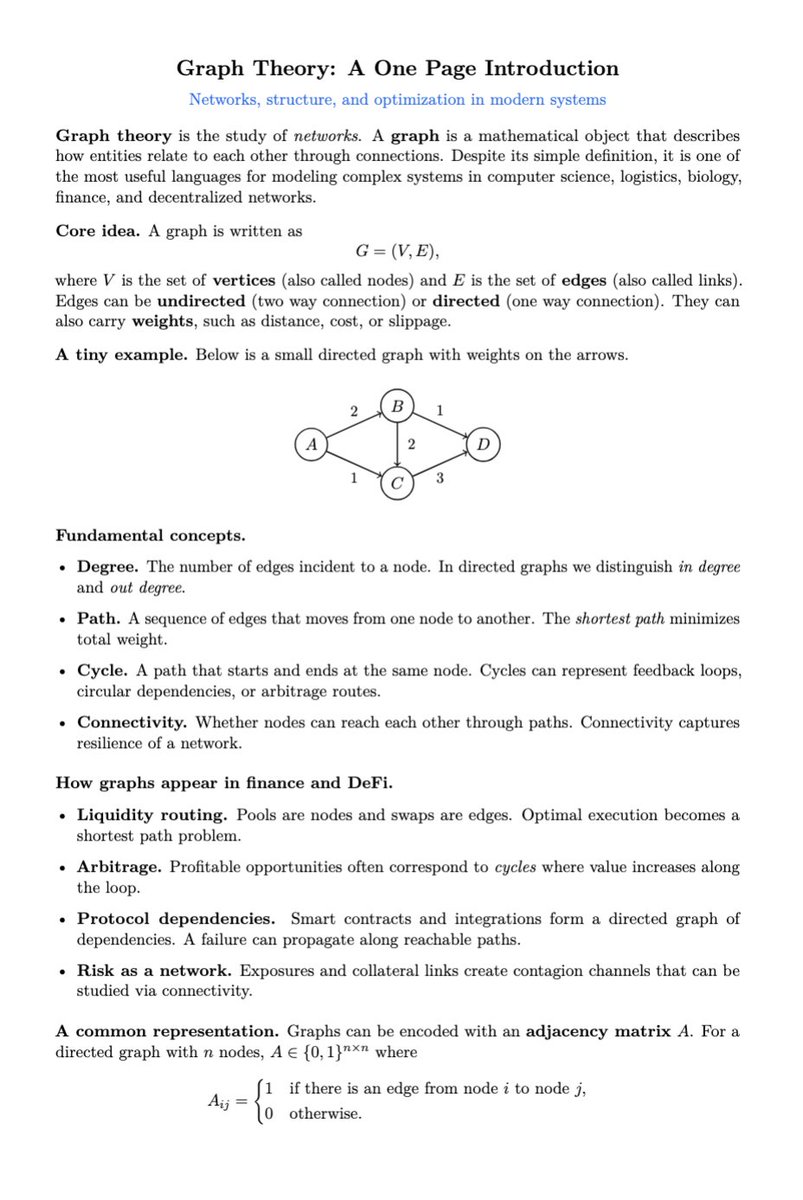
Few weeks ago I started exploring Graph Theory.
At first it felt like a pure math topic: vertices, edges, shortest paths…
--> Then I realized: this is literally how you model markets.
In crypto and DeFi, everything is a graph:
- Pools are nodes, swaps are edges, routing is path optimization.
- Arbitrage becomes “find a cycle”.
- Risk becomes “how shocks travel through a network”.
I’m just getting started, but I’m already seeing how powerful this is for:
• understanding liquidity structure
• spotting inefficiencies
• modeling cross protocol dependencies
• designing smarter strategies
I love when math becomes a lens to see markets more clearly.
If you’ve worked with graphs in trading or DeFi, I’d love to hear what you used it for.
#GraphTheory #CryptoQuant #DeFiResearch #Quant #Finance #Crypto
What is one of the most valuable upgrades you can make in finance or in science?
Most people try to value assets in isolation.
That is almost always the wrong starting point.
In physics, you do not study a particle in isolation.
--> You study the field it lives in, the forces acting on it, and the constraints of the system.
A particle’s behavior is an emergent property of the system around it.
Finance works the same way.
An asset is not an object.
It is a node in a network of balance sheets, incentives, regulations, and feedback loops.
Prices emerge from interactions, not from isolated fundamentals.
This is why reductionist thinking fails in both fields.
You cannot understand turbulence by studying a single molecule and you cannot understand a market by valuing a single asset.
The smartest thinkers in finance eventually stop asking: ‘’What is this worth?”
and start asking: “What system is this part of, and how does the system behave under stress?”
#QuantFinance #Finance #AssetValuation #Physics
I'm always asked the following question: What does being a quant in crypto actually feel like?
First, I thought crypto TVL meant retail adoption.
Well, I was wrong.
You can look at a protocol with 30M to 300M TVL and think it is a crowd of normal users. Then you actually do the research (i.e., pulling blockchain data) and realize it is often a small set of whales. No retail...
--> That one fact changes everything: risk, stickiness, governance dynamics, even what the product should optimize for.
Second, another reality: a surprising number of people in crypto still do not know what a quant is, or what the scope even covers.
Historically, it's true that the space rewarded hype and narrative more than quantitative rigor.
--> But it is shifting: Institutions are coming in, and the market cannot mature without data-driven decision-making.
Third, the emotionally hard part is the constant iteration cycle with clients.
Founders are building in motion, so clarity comes late (sometimes, very late).
--> That means constant changes in direction, scope, and priorities.
Fourth, when it comes to satisfaction with the work, I know I’m doing a good job when the work is driven by solid data, the client is satisfied with the outcome, and I’m improving along the way. I mean, the space is evolving so quickly that it's impossible to miss learning opportunities.
That’s what the job feels like: less about predicting prices, more about bringing innovation, creative models, and mathematical structure.
#Crypto #QuantitativeFinance #DeFi #RiskManagement #DataDriven #FinanceCareers
DeFi options are not failing. They are evolving into something TradFi never had.
A common narrative is that on-chain options “never took off” because volumes are small compared to CeFi.
Well....That framing misses the point.
--> In TradFi, options matured after spot, futures, and credit markets stabilized.
--> In DeFi, options are being asked to do something harder: price risk in a system where liquidity is fragmented, collateral is composable, and settlement is continuous.
That is why DeFi options didn’t converge on a single model.
We now see multiple architectures co-existing:
- vaults that turn volatility into systematic yield,
- orderbooks that recreate familiar institutional workflows,
- auction systems that reduce MEV and net portfolio risk,
- perpetual, oracle-free designs that eliminate expiry fragmentation entirely.
What looks like fragmentation is actually something I would call specialization.
The real shift is this:
- Options in DeFi are moving from speculation tools to infrastructure.
- They hedge AMMs against impermanent loss.
- They protect lending markets from liquidation cascades.
- They allow DAO treasuries to survive drawdowns without panic selling.
In a world where TradFi uses options to express market beliefs, DeFi is starting to use options to stabilize systems.
That is why this market is smaller in notional terms but larger in implications.
The question is no longer “why are DeFi options small?” It is “what happens when every protocol embeds them by default?”
So yeah, what happens?
#Options #Crypto #Derivatives #CryptoOptions #DeFiProtocols #Blockchain #QuantFinance
I’ve written 122 pieces of research and this is what you should do when you write one (not in order)
1. Always pick topics you enjoy otherwise you won’t be able to explore and browse all the books and the internet to learn and write about it.
2. Always start research with context. Anything has a context even your emotional baggage so give your research some too. It can be as simple as market research in the intro. So please don’t just start with your overtrained and overfitted model…
3. REFERENCES.
I think it’s pretty self-explanatory. 99% of your research is from other research so be nice and put the references in there. The world will thank you.
4. Before writing research. You need to do research on your voice tone. Don’t steal it. You’re unique, embrace it and maximise it but in a formal way. Ask your friends and your family if you can’t find your voice. Sometimes they know more about us than we do.
5. Always ask yourself the question: what do I want to deliver with this research and focus on bettering that message. (Most people get lost in the process or diverge and include too much info because they forgot why they were there in the first place)
6. Please start with the outline or the so/called table of content. You need to have the vision to get there otherwise what’s the point.
7. Don’t use ‘I think’ too much or maybe only in the conclusion. You need facts backed by data and references. I think this is what you should do.
8. A lot of words hurt the eye. Everyone is ADHD-ed. Learn how to create diagrams and visuals that illustrate some of the important sections of research. People will love you more.
9. This is a gem: use context engineering. This is life-changing. Google it.
10. My favourite: adress the micro and macro of the topic. Every topic has a bigger picture and a zoomed in picture.
Something’s unclear? Need an example?
#QuantFinance #QuantResearch #Research #Writing #Lessons
For anyone who still doesn't know: crypto is dead.
Welcome to Quant Sunday’s Chronicles.
--> In the past two weeks:
- I have been diving deep into a new perpetuals model that I believe it has real potential to reshape how we think about trading and risk.
- creating a hedging system for a vault
- backtesting some very and very and very interesting covered calls
- Also the more I explore the intersection of TradFi and crypto, the more I see strong parallels between physics and finance, especially in pricing assets
- A sad reality check I keep running into: many people in crypto still do not know the heck they are doing...
- We run a Python script on different high TVL protocols, and what can I say: crypto has no retail now; it is pretty much dead and for many reasons....So yeah, TVL can look strong when in reality it is just being concentrated in a small number of high-value wallets (multiple 7 and 8-figure wallets)
What I am building next?
Something exciting: I am preparing a four-week paid and first-ever-heard of quantitative crypto course, launching in the second trimester and what the course will cover:
• The evolution of money and the shift to digital currencies
• Derivatives in crypto: options and perpetuals across CEX and DEX venues
• A practical overview of DeFi: DEXes, yield protocols, and key mechanics
• Blockchain architectures, execution constraints, and fee structures
• Tokens as assets and how tokenization works in practice
• Bridging traditional quantitative finance with crypto finance and more!
Who it is for: Quants, traders who want to transition into crypto, or just people who have a financial background and are bored with TradFi :)
#Quant #QuantFinance #Course #Lessons #Crypto #TradFi #Learning
There’s an illusion of the quant superiority that people don’t talk about. I fell into this trap too.
Well many believe quant edge equals complexity: more signals, deeper math, fancier models etc and etc.
Crypto taught me the opposite.
We once built a volatility model packed with cross-venue flows, order book signals, and derived factors.
And guess what the backtests were just flawless until the ‘fronttest’ wasn’t.
Live markets were chaos.
Data gaps, latency, liquidity shifts the model couldn’t adapt fast enough, and when it failed, debugging it was harder than building it.
The model that actually survived production?
A two-parameter volatility estimator with adaptive outlier rejection.
Not impressive on a slide but was working pretty well in the market.
—> The real edge was subtraction: just fewer, assumptions, fewer failure modes and faster reactions.
I guess in some way we can say that resilience always beats fragility.
The smartest model isn’t indeed the most complex.
All in all?
A model that keeps functioning under stress is more valuable than one that collapses under stress, no matter how elegant or advanced the math is.
Have you been in a situation where you had to choose the simple approach to deal with something?
#Quant #QuantFinance #Simplicity #lifelesson #Mathlesson
Never thought I’d see the day: implied volatility… for a DEX. TradFi spent 50 years pricing volatility. DeFi just did it with an AMM.
Implied volatility (IV) has always been a cornerstone of derivatives markets. It reflects the market’s expectation of future uncertainty and underpins pricing and risk management.
--> TradFi: IV is extracted from option prices with models like Black–Scholes. It is the forward-looking input that makes observed prices consistent.
--> Crypto CEXs: On platforms like Deribit, BTC and ETH options embed IV in the same way, giving us the “fear gauge” of crypto markets.
--> DEXs and Uniswap v3: This is where concentrated liquidity changes everything. Liquidity provision (LPing) is not just market making as we know. It is actually equivalent to selling options. In fact:
- Ranges act like strikes
- LPs are short gamma
- Fees resemble option premium (collected block by block)
- No expiry!
With Panoptic, we designed a method to compute implied volatility (mathematically proved!) directly from Uniswap v3 liquidity. For the first time, a volatility surface can be drawn natively on-chain.
The question is: should implied volatility in DeFi be treated only as a risk measure, or will concentrated liquidity and on-chain IV become the foundation of entirely new markets?
Curious what angles or comparisons you’d want to see: Deribit IV, VIX, the proof, or something else?
#QuantFinance #DeFi #Uniswap #Panoptic #Web3 #Crypto #Volatility #Derivatives #ImpliedVolatility #RiskManagement #OnChain
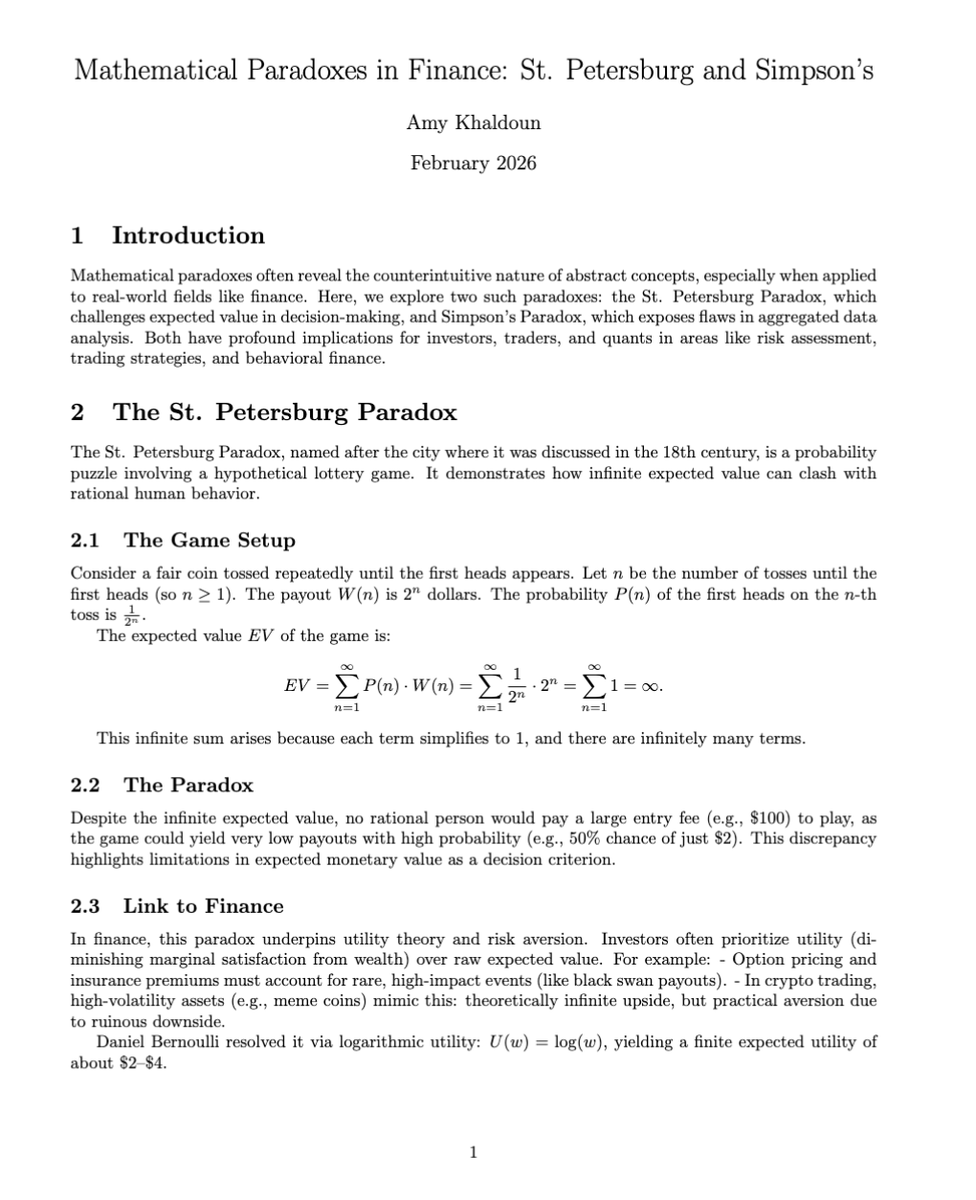
I got bored and started looking at some mathematical paradoxes that are linked to finance 👇
I've always felt like financial mathematics is logical... until you start diving into these brain-twisters:
--> St. Petersburg Paradox: A coin-flip game with infinite expected value but you'd never pay big to play. Why? It exposes risk aversion in investing. In crypto, it's like chasing 'moonshot' tokens: endless upside on paper, but real fear of ruin.
--> Simpson's Paradox: Trends flip when you aggregate data! E.g., Fund A kills it in bull markets at 90 percent success, Fund B in bears at 89 percent but combined, B wins at 81 percent versus A's 50 percent. very very deadly for trading algos or DeFi yields if you ignore confounders.
But hey, these aren't just geeky riddles or whatsoever, they're like 'portfolio savers'. (always good to have them in mind)
What's your wildest finance paradox story? Drop it below!
hashtag#QuantFinance hashtag#Crypto hashtag#MathParadox hashtag#DataScience hashtag#BehavioralEcon
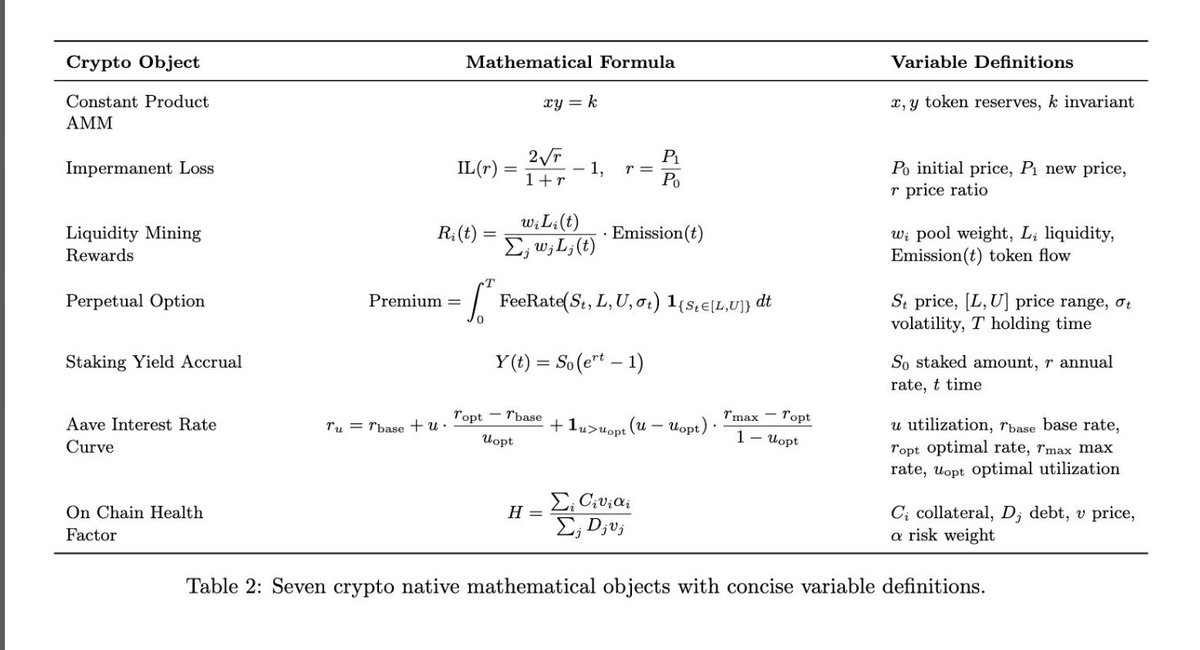
There are mathematical objects that exist in crypto, and nowhere else in TradFi. Here are seven of them 👇
1. Automated Market Makers (AMMs): The formula that replaced the order book. This is how Uniswap and many decentralised exchanges price assets; pure math as a market maker. Is is a live equation balancing assets 24/7. Here, every swap solves a nonlinear optimization problem in real time.
2. Impermanent Loss Function (IL): Measures loss relative to holding when providing liquidity in AMMs. In fact, when you LP (i.e., when you provide liquidity), you’re not earning yield; you’re selling volatility. This formula measures exactly how much you lose when prices move.
3. Liquidity Mining Rewards: The math behind token emissions, distributing governance power by code, not committees. This is a time-dependent proportional allocation functional that interacts with on-chain game theory (miners, LPs, arbitrageurs).
4. Perpetual Option Payoff: An infinite-time option. Instead of expiring, it accrues yield forever (block by block in the blockchain). Welcome to perpetual volatility exposure.
5. Staking Yield Accrual: Your validator rewards grow continuously, like compound interest, but backed by consensus security, not debt.
6. Aave Interest Rate Curve: A self-regulating interest rate. Rates rise automatically when liquidity gets scarce. In TradFi, rates are exogenous (set by banks or markets); in DeFi, they’re endogenous and continuously determined on-chain by liquidity utilisation. This acts as a feedback control curve, dynamically stabilising liquidity by penalising over-borrowing.
7. On-Chain Health Factor (H): This is a live solvency metric controlling liquidations in DeFi lending (Aave, Compound, etc.). No margin calls, no brokers. When H<1, liquidation triggers instantly: by code, not humans.
--> Is it just me or it seems like TradFi built models around markets and Crypto builds markets around models?
#DeFi #QuantFinance #CryptoMarkets #AMM #Volatility #Options #RiskModeling #OnChainMath #Uniswap #CryptoQuant #DeFiInnovation #Crypto #TradFi
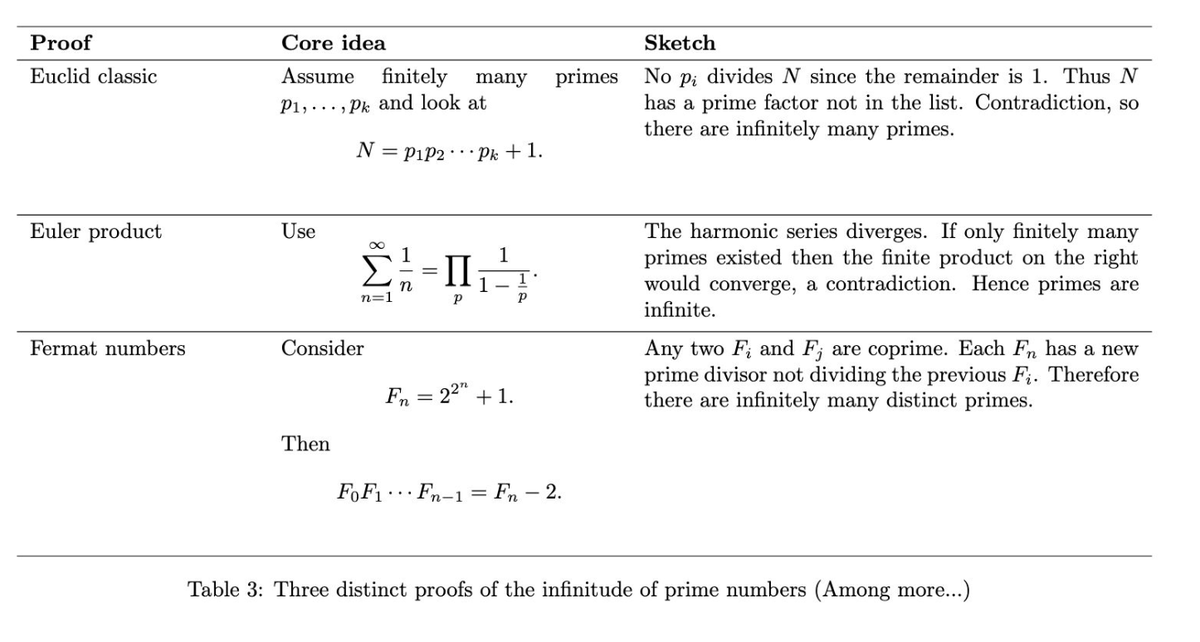
I spent 10 years doing "high-level" mathematics. Here are seven things I learned 👇
1. There’s more than one way to reach what you want: Take the famous theorem on the infinity of prime numbers. I’ve seen seven different proofs of it. There’s comfort in that. So yeah...There isn’t just one path to truth. (or madness..)
2. Everything relies on assumptions: To get from A to B, a certain ‘A’ must first be assumed. It sounds obvious until you delve into quantitative finance and realize how models rely on “ideal” assumptions, such as normal distributions, efficient and frictionless markets, and stationarity. None of these truly exists. Yet, the models remain incredibly powerful. (Why though??)
3. Sometimes application beats theory: I used to obsess over every theorem and proof before trying to apply them. Now, I start with the simplest example and work my way backward to the theory. Understanding grows faster when you build before you analyze.
4. Rigor is a form of success: I’ve seen brilliant projects fail because they lacked rigor and structure. You can have the best ideas in the world, but if you don’t know how to approach and communicate them clearly, they’ll remain just that...ideas. (This is not stupid, I swear!)
5. Thinking slowly is thinking deeply: We live in a world obsessed with speed. Everything has to happen now. Mathematics taught me the opposite: to slow down when facing complexity. Clarity doesn’t come from rushing; it comes from reasoning. (Cure your ADHD)
6. Abstraction is a superpower: The subject that nearly broke me: topology. Also became one of my favorites. It forced me to think beyond form and intuition. Now, when I face problems in crypto or even life itself, I remind myself: nothing can beat topology. (Sounds a bit cheesy, sorry)
7. You can’t rush insight: Some ideas only reveal themselves after days of silence, frustration, and rethinking first principles. Math humbles you into patience. (I’m still impatient, but I’m working on it.)
What about you? What’s your top lesson?
#Mathematics #Lessons #QuantFinance #Crypto #DeepThinking #MathematicalThinking #Quant
DeFi options are quietly becoming one of the most important primitives for institutional crypto.
They are no longer experimental side products. They are an infrastructure layer.
One options layer can connect the biggest DeFi verticals:
-> AMMs hedge impermanent loss
-> Lending markets hedge liquidation risk
-> Vaults structure yield
-> DAO treasuries hedge downside and generate income
-> Fixed income and RWAs manage rate risk
For DAO treasuries, this is a big shift from reactive token sales to proactive protection and systematic yield.
As institutions integrate crypto, they will demand hedging, transparency, and predictable risk.
Options are how DeFi grows up.
Do you think there is a new financial instrument that could push DeFi into its next phase of maturity?
#Quant #Derivatives #Options #DeFi #Crypto #QuantFinance
What if I told you that quants caused the 2008 crisis?
Not politicians. Not bankers. Not traders.
Quants.
Models built by brilliant people: physicists, mathematicians, and engineers.
They priced risk so elegantly that everyone stopped questioning them.
Gaussian copulas, Value-at-Risk models, credit correlation... All neat, logical, and mathematically consistent.
They were applied to structured credit products: mortgage-backed securities (MBS), collateralized debt obligations (CDOs), and credit default swaps (CDS). The models assumed housing prices didn’t fall everywhere at once, that correlation was stable, and that diversification would absorb the shock.
--> Except the market isn’t all neat, logical, and mathematically consistent.
The real world doesn’t follow normal distributions, and correlation doesn’t stay fixed when fear hits. But the models said the probability of system-wide failure was “five sigma”.
"Practically impossible"
Then 2008 happened.
--> The lesson?
It wasn’t math that failed. It was how math was used.
In fact, when models become gospel instead of guidance, even good quants can build systemic risk.
But today, as we build new financial primitives in DeFi and crypto, the same temptation is back: to model complexity away instead of understanding it.
Let’s not make the same mistake twice. (Otherwise I'll be unemployed...)
Trigger warning: this is one aspect of the crisis. Obvisouly, it is a multi-faceted issue 🙄
#QuantFinance #RiskManagement #Crypto #DeFi #Finance #Innovation #DataScience #2008Crisis
7. You can’t rush insight: Some ideas only reveal themselves after days of silence, frustration, and rethinking first principles. Math humbles you into patience. (I’m still impatient, but I’m working on it.) What about you? What’s your top lesson?
6. Abstraction is a superpower: The subject that nearly broke me: topology, also became one of my favorites. It forced me to think beyond form and intuition. Now when I face problems in crypto or just life, I remind myself: nothing can beat topology. (Sounds cheesy,sorry)