Most people hear leverage and think gambling. The Kelly criterion says the opposite: there is a specific amount of leverage that grows wealth fastest over time. Too little leaves growth on the table. Too much compounds to zero.
Kelly sizing is simple in theory: optimal leverage = expected return / volatility squared. High volatility means low optimal leverage. That is why Bitcoin's number is only about 1.33x, while listed equities sit near 1.5-2x.
Berkshire has run at roughly 1.6x for decades on the same principle. Ed Thorp built Princeton/Newport on it. It stayed institutional because holding a stable target takes constant work, and financing was priced by what it costs to be short.
The math is unforgiving. Volatility drag grows with the square of leverage, so doubling leverage quadruples the drag. That is why 2x Bitcoin trails spot over long horizons, and 3x gets eroded to zero.
The numbers make it concrete. Over the past decade $1 in 3x Bitcoin went to zero. $1 at 1.33x grew to about $506. $1 in spot grew to about $281. Same asset, same decade. The only difference is the size of the leverage.
So why did this stay with institutions? Two reasons. First, the target moves every day, so someone has to rebalance constantly. Second, leverage was priced by shorts: perp funding, swaps, hedging desks. That cost eats the holder alive.
2Factor splits Bitcoin into two parts. cbBTC-Sr is the senior, yield-bearing side, protected by a buffer of junior capital. cbBTC-Jr is the junior: 1.33x leveraged cbBTC, never liquidated, built to be held for years, not days.
The trick is where the leverage comes from. Jr borrows $0.33 of senior capital per $1 of equity, so its cost is roughly a third of the senior yield, anchored to treasury yields plus a risk premium, not to perp funding.
That changes the economics completely. 2Factor says it cuts the all-in cost of a leveraged position by about 75% versus the old route. Leverage stops being a day trade and becomes something a buy-and-hold investor can actually hold.
Compare that to leveraged ETFs. About $250B sits in them, paying an estimated $10B a year in financing above the risk-free rate. Only about a third of single-stock LETFs ever beat holding the stock. No crypto LETF has ever beaten spot.
My honest take: this is a no-brainer only if you already believe Bitcoin drifts up over years. 1.33x still amplifies losses, and in a bear it gives ground. In choppy sideways markets it can even lag spot for a while. That is the price of the extra growth.
First Bitcoin, then stocks. 2Factor launched the same structure for Coinbase tokenized stocks on Base. Same problem, same fix: moderate, Kelly-sized leverage you can hold.
join here link: https://t.co/uivryy8vP1
Most entertainment projects have a gap between the people who create them and the audience that actually supports them.
That's what @IPXExchange is trying to fix changing how we see the relationship between creators and their fans.
Here are some things worth paying attention to:
- Real use cases: creators, fans, brands, and entertainment businesses in one place
- IP tokenization: films, music, podcasts, and games turned into tokens, so projects can raise capital and build a community around the work
- Multiple revenue channels: CreatorX, BrandX, CultureX, LIVEX, PODX, IPX Studios
- One marketplace: sponsorships, memberships, distribution, monetization
no juggling ten tools
- Built on Base: on-chain, USDC settlement.
The part I keep coming back to: the network effect. More creators bring more fans. More fans bring brands. And every successful project makes the whole thing stronger.
It's not about tokenizing assets. It's about connecting the entire creator economy and making IP something anyone can access and build on
This week, @YOM_Official takes a closer look at the newest report from Matthew Ball and what its insights could mean for the future of gamingand for YOM’s direction.
Just wrapped the docs on @Pact_Swap and Coinweb and yeah, this isn’t surface-level stuff.
Pact Swap is building real cross-chain liquidity rails.
Coinweb is solving interoperability at scale.
Not hype actual infrastructure, clean architecture, and serious engineering behind it.
Definitely worth the deep dive.
It’s not just about the tech it’s about reach
While legacy cloud gaming stays locked inside centralized data centers,
@YOM_Official is going borderless with nano nodes across the globe
Geography stops being a barrier
Gaming stops being regional
Global play actually becomes real
Most cloud gaming narratives focus on players.
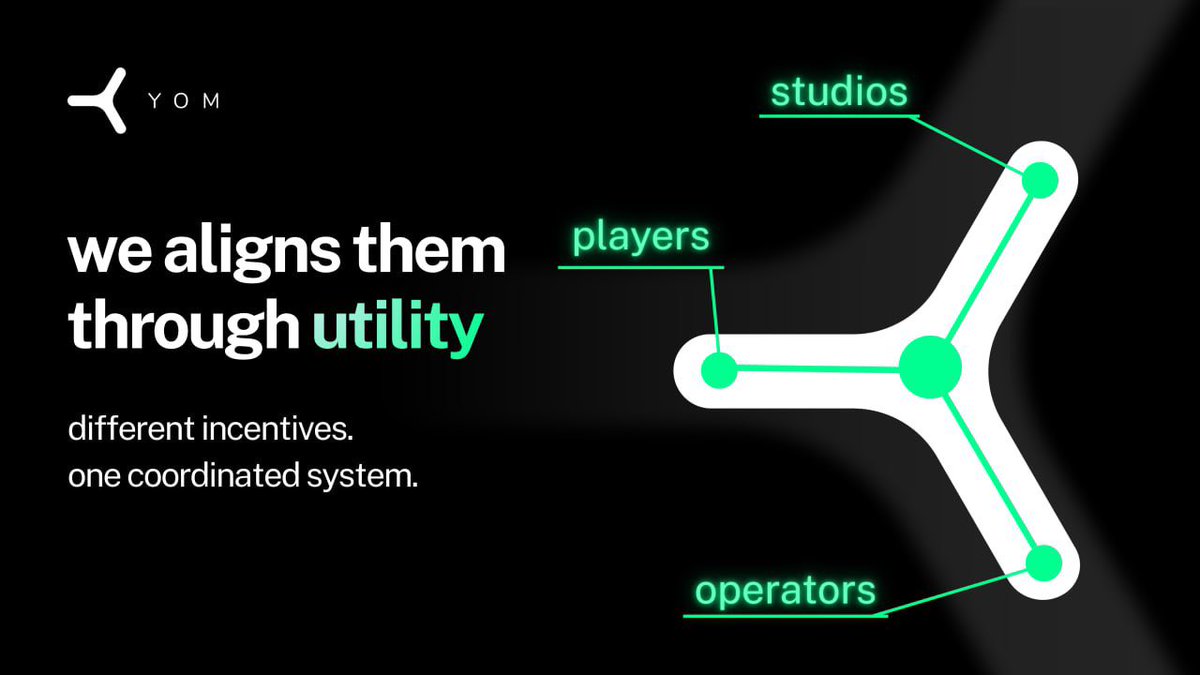
But @YOM_Official is building for the full stack developers, operators, and regional infrastructure, not just end users.
That ecosystem-first mindset is what actually enables global scale,
not just global access.
We just launched PitchChain a test L1 experimenting with sports data, digital identity, fan access, and real-time coordination… fully onchain.
Powered by the @canopynetwork testnet launchpad.
https://t.co/JYbRTGmxVm
Stadium lights on.
Big games loading.
Pure blockchain momentum 🔥
Game on. Who’s stepping onto the field?
YOM isn’t chasing hype they’re laying the rails for the future of gaming.
From winning the Fibonacci Competition
To securing $3M funding backed by Avalanche Foundation and Borderless Capital,
the signal is clear: this isn’t noise it’s momentum.
A decentralized cloud gaming network
Powered by DePIN
Turning idle GPUs into real, global infrastructure
That’s not a product.
That’s a foundation layer.
This is how Web3 gaming scales
This is how digital ownership becomes tangible
This is how communities stop being users and start being stakeholders
Early stage.
Heavy build mode.
Conviction getting stronger.
Still bullish on @YOM_Official
The robotics wave is exploding billions flowing into humanoids and physical AI but access is still gated. Private deals. Closed rooms. No liquidity. By the time retail enters, the real upside is already extracted.
@xmaquina is changing that model.
With $DEUS and its onchain capital market (RCM), robotics exposure moves from opaque negotiations to open infrastructure:
transparent pricing, open participation, and real market-driven conviction all onchain.
This isn’t hype-cycle investing.
It’s foundational infrastructure.
Not “investing in robotics” as a narrative but turning robotics into a real, liquid, investable sector.
From closed elite access → open capital markets.
At @letsCatapult revenue share isn’t a one-time referral gimmick — it’s a compounding model.
You don’t earn once.
You earn as long as activity exists.
→ Traders keep trading → income keeps flowing
→ Volume grows → your progression grows
→ Fee share up to 45%
→ Start earning from just $1 volume
This isn’t short-term hype economics.
This is behavior-based income + long-term alignment.
Small start.
Scalable system.
Compounding incentives.
Build once. Earn continuously
Lock in https://t.co/1FEMjAgJn9