A form similar to present form 121 earlier (15g/15h) where partners can file a declaration requesting firm to exempt them from tds, stating tat given partner's income is below exemption limit ! should be enabled to resolve this compliance trap!!!
The situation in most Small Partnership Firms due to #194T is like this:
1. TDS of 10% being deducted on per partner having 20001 to 10 Lakh Business Income.
2. Majority of these partners are having personal income <= 12 lakh.
3. Most of them will take refund of this TDS deducted.
This is causing working capital blockage of TDS for 3-6 months.
Either the TDS rate needs to be reduced, or it needs to go away entirely.
#incomeTax
Taxation of the Carbon Credits: More Than Just "Green PR"
As we move into 2026, India's carbon market is shifting from "voluntary CSR" to a regulated compliance economy. For businesses, this means Carbon Credits are no longer just a green badge—they are a financial asset with specific tax consequences.
In 2026, the trade is driven by two main engines:
Compliance Buyers: Large emitters in steel, cement, and power must now stay under government-mandated caps. If they exceed their limit, they must buy credits to avoid heavy penalties.
Voluntary Buyers: Global tech giants (like Google and Microsoft) are buying millions in "Biochar" and "Carbon Capture" credits from Indian projects to hit their Net Zero 2030 targets.
Guide to Section 115BBG
The taxation of Carbon Credits in India is governed by a "Special Code" that overrides general tax rules. Here are the 4 non-negotiables for your FY 2025-26 filings:
1. The Concessional Rate (10%)
Income from the transfer of carbon credits is taxed at a flat 10% (plus surcharge and 4% cess). This is significantly lower than the standard 25-30% corporate tax rate.
2. The "Gross Basis" Rule (Section 115BBG(2))
This is where many businesses get caught off guard. You pay tax on the Gross Sale Proceeds.
No Deductions: You cannot subtract the cost of setting up the solar plant, consultancy fees, or brokerage.
No Indexation: Even if the credits were held long-term, inflation adjustment is not allowed.
3. The Definition Trap (UNFCCC Validation)
The 10% rate strictly applies to credits validated by the United Nations Framework on Climate Change (UNFCCC).
Professional Tip: If you are selling "Voluntary Credits" (e.g., Verra or Gold Standard), there is a significant legal debate. Some argue they should be treated as Capital Receipts (Tax-Free based on Madras HC rulings), while others treat them as Business Income (30%). Documentation is key here.
4. GST Implications
Currently, the transfer of Carbon Credits is treated as a supply of "goods" (intangible) and typically attracts 18% GST on the sale value (unless it's an export of services, which is zero-rated).
Example
If a domestic company sells 5,000 credits for ₹50 Lakhs:
Taxable Amount: ₹50,00,000 (Gross)
Base Tax (10%): ₹5,00,000
Cess (4%): ₹20,000
Total Tax: ₹5,20,000 (Effective Rate: 10.4%) (Note: Surcharge applies if total income exceeds ₹1 Cr).
#CarbonTax #IncomeTax #Section115BBG #Sustainability #NetZero #GreenFinance #DirectTax
⚖️ Key principles affirmed:
TRC ≠ automatic exemption. Substance matters more than form.
GAAR (General Anti-Avoidance Rules) overrides treaty benefits when abuse is evident.
India will pierce through treaty shopping if entities are shells.
📊 Ramifications:
Foreign investors can no longer rely on Mauritius/Singapore routes without genuine substance.
Past deals may face scrutiny; compliance costs will rise.
Government revenue could see a boost, but investor sentiment may be tested.
Sets precedent: India’s courts will prioritize substance over form in tax matters.
However CBDT has assured that cases will not be reopened based for similar instances. This response seeks to reassure investors as well as invested entities who are anxious that the SC ruling might lead to increased scruitiny of past deals routed via Mauritius, Singapore etc.
Conclusion: This ruling strengthens India’s anti-avoidance framework, curbs treaty abuse, and signals that aggressive tax planning won’t be tolerated. It’s a landmark moment that could reshape how venture capital, private equity, and multinational exits are structured in India.
#SupremeCourt #TigerGlobal #Flipkart #TaxLaw #FDI #IndiaEconomy #GAAR #DTAA
Supreme Court’s Tiger Global ruling: A watershed in India’s tax jurisprudence
In Jan 2026, the Supreme Court held that Tiger Global’s $1.6B capital gains from its Flipkart exit are taxable in India, despite the India–Mauritius DTAA.
Why this matters:
Historically, the India–Mauritius treaty exempted capital gains in India if the investor was a Mauritius resident. Since Mauritius doesn’t levy capital gains tax, this made such gains effectively tax-free.
Tiger Global routed its Flipkart investment through Mauritius entities and produced a Tax Residency Certificate (TRC) to claim exemption.
The SC rejected this, ruling the structure was a sham arrangement with no commercial substance, designed solely for tax avoidance.
@akhilpachori Hello sir, with due respect to ur analysis shared, the entire cost can be treated as capital loss only if sale consideration is treated as zero. Will provisions of sec 50D trigger here, where it says fmv on date of transfer is deemed sale consideration.
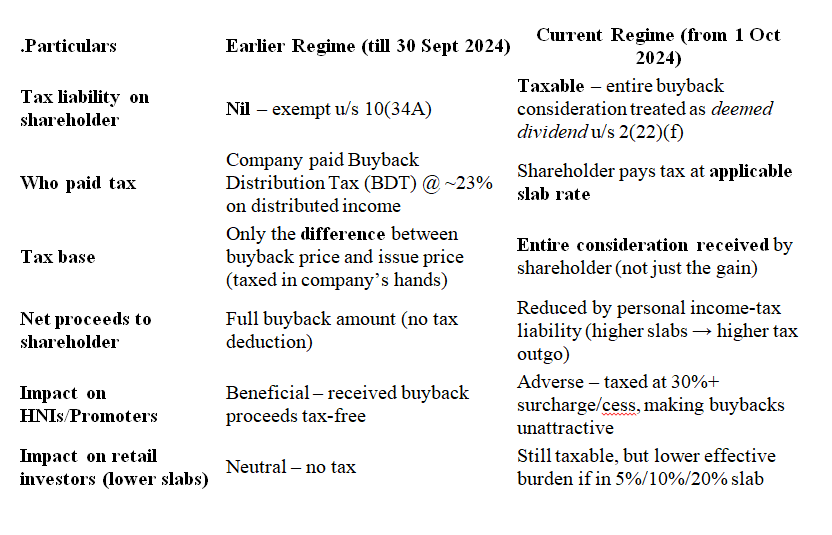
Tax Alert – Buyback = Deemed Dividend
With the amendment to Section 2(22), any consideration received on buyback of shares is now treated as deemed dividend in the hands of shareholders vide insertion of clause (f) in section 2(22).
Earlier: Company paid Buyback Tax u/s 115QA, shareholders exempt 🔹 Now: Shareholders taxed at slab rates, company not liable
Impact: Buybacks lose tax-efficiency, promoters & HNIs rethink participation
#TaxUpdate #IncomeTax #Buyback #DeemedDividend
With this we may see ticket prices double for indian movies from 12 to 15 usd to 25-30 usd.
Indian diaspora in US may cut bck on theatre visits and wait for streaming releases instead.
This may result in US becoming a direct stream market rather than a theatrical market!!
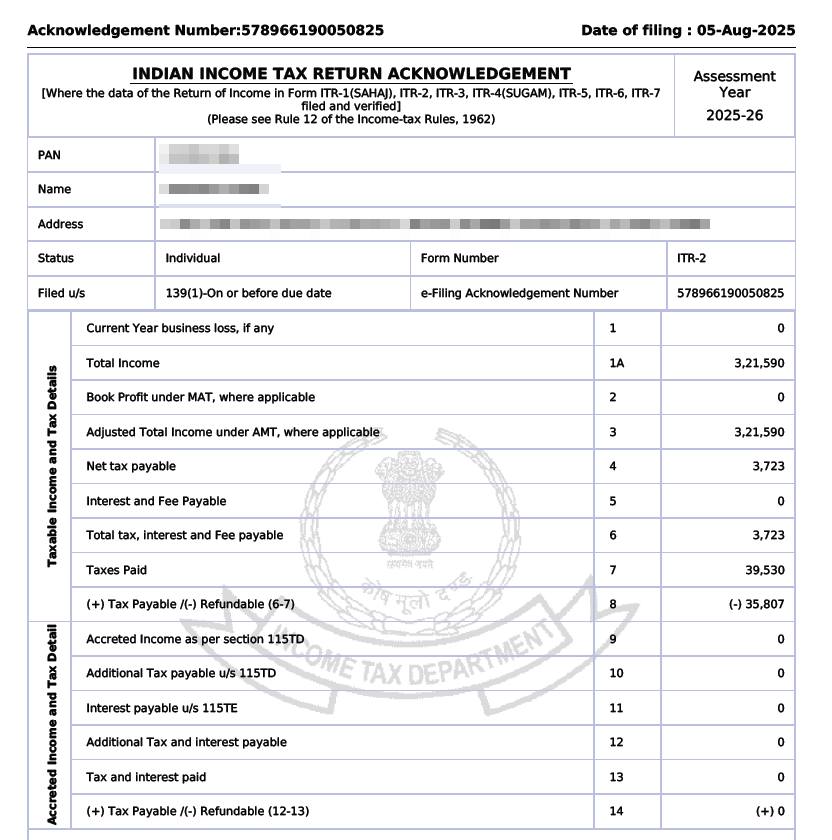
As per Section 288B of the Income-tax Act, 1961, the amount of refund should be rounded off to the nearest multiple of ten rupees.
However, it is observed that for ITR refunds of AY 2025-26, the final refund is not rounded off.
For example, ₹35,807 is not rounded to ₹35,810. This appears to be happening across all cases.
Request to clarify @IncomeTaxIndia. Example acknowledgment attached.
#incometaxfiling #incometax #ITRfiling #refund
@Anuana10 Hi shwetha, you ve raised a valid point! The payment to gst dept on behalf of seller can be split into 2 scenarios
1] fr invoices uploaded by seller - itc allwd
2] fr invoices not uploaded by seller
Fr second scenario, we need to await legal precedents to arrive at a conclusion
Net advance tax collection has decreased by 2%.
In addition to global uncertainty, one reason for this decline is the tax department's lack of responsiveness and punctuality.
For example, the CII (Cost Inflation Index) has not yet been released for FY 2025-26, leaving many taxpayers waiting to calculate their advance tax.
It seems there is a lack of accountability from @IncomeTaxIndia, as even the major ITR (Income Tax Return) forms have not been released!
The Finance Minister @nsitharamanoffc should urge the department to release ITRs & CII nos & to expedite these processes.
@Anuana10@GST_Council Hi mam, since the order is deficient in nature u can place a request to annul the order via rectification under sec 161.
Further u can also challenge the order via appeal under 107