IT Prof, inclined towards Econ,Social ,Political,Geographical &Cultural Welfare of Bharat,Gen-Sec Center For India Studies -Kuwait (Think Tank Organisation)
Someone has tried to present Indian states today based on median age and ruling party/alliance.
This is a new narrative for me. Basically India's GenZ is supporting the BJP more than anyone else. The younger the median age, the more chances of supporting the BJP!
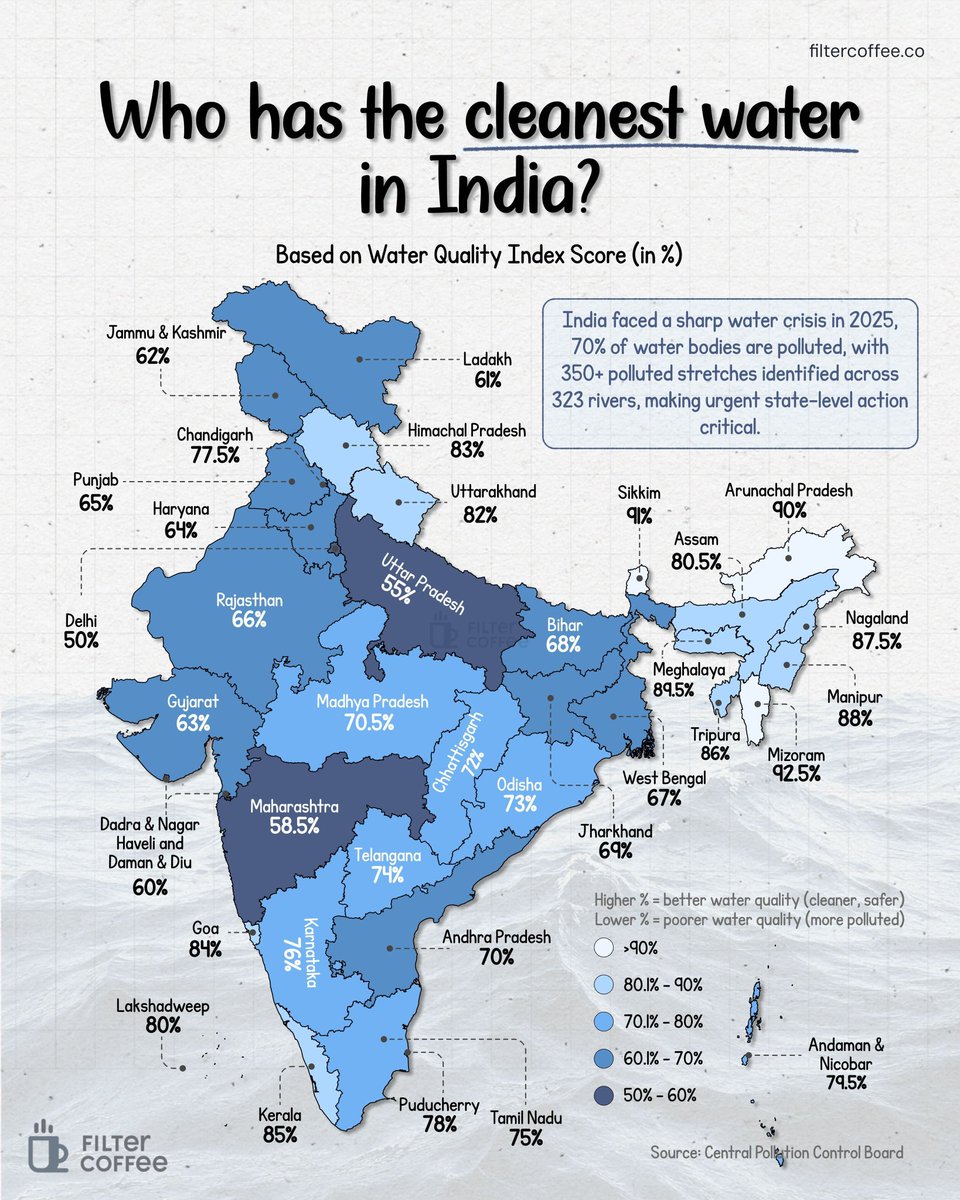
Who has the cleanest water in India?
Sikkim leads at 91%, followed by Mizoram (92.5%) and Arunachal Pradesh (90%)
At the bottom is Delhi with just 50%, UP at 55%, Maharashtra at 58.5%
The Central Pollution Control Board flags 70% of India's water bodies as polluted, with 350+ polluted stretches across 323 rivers
(Source: CPCB / FilterCoffee)
🚀 PL-15E: The Billion $ mistake by 🇨🇳 China & 🇵🇰 Pakistan, which India took full advantage of, leading to the extended range of the Astra 🙂🇮🇳
#OperationSindoor
Must Watch!🔥
📙EDUCATION IN ANCIENT INDIA
A Child Learns Brahmi, 250 BC
The mounds along the Yamuna, near Haryana–UP border, have been yielding ancient clues. Among them a few terracotta plaques show kids learning to read and write Brahmi. This 🧵 begins with the first. Found near village Sugh.
📙WHERE IS SUGH?
- West bank of the Yamuna.
- Twenty-five km northwest of Saharanpur
- Fifty km northeast of Kurukshetra
- Sugh is likely Shrugna of Panini's Ashtadhyayi
📙DETAILS ABOUT THIS TERRACOTTA ITEM?
1⃣A boy squats on the ground. On his lap rests a takhti, a wooden writing board with a hole at the top for hanging (also called Paati, Palaka, लेखानपट्ट etc in Indian languages, still seen in modern era rural India).
2⃣Four lines of letters cover the takhti. Each line repeats the same letters.
3⃣These are the Brahmi vowels—the barakhadi:
𑀅 𑀆 𑀇 𑀈 𑀉 𑀊 𑀏 𑀐 𑀑 𑀒 𑀅𑀁 𑀅𑀂
अ आ इ ई उ ऊ ए ऐ ओ औ अँ अं
a ā i ī u ū e ai o au aṃ ah
4⃣The boy’s finger traces the letters. He is learning to read.
5⃣Some letters are worn; the right edge more so. Repeated lines and computers help recover the text.
6⃣Along the frame border are small symbols—śrīvatsa, lotus, etc. These match early Vaishnava art. This is likely a Hindu boy at his lessons.
7⃣Note the 12 letters per line. These are "Dvadashakshari" in Hindu traditions. Example devotionals such as ॐ नमो भगवते वासुदेवाय also 12 syllables.
8⃣This terracotta item was made in a mould. This makes it likely that the same mould was used to make many copies for wide distribution. This must have been popular item to produce in ancient India.
9⃣The shape of the letters belongs to the time of Ashoka. Paleographers date it between 300–200 BC. Thermoluminescence tests agree. When site was dug, coins found with and above this item date to 300–100 BC, corroborating the date.
📙WHAT DOES IT IMPLY?
1⃣By 250 BC, children in India were learning to read
2⃣Tools of learning do not spread overnight. Centuries are needed. A version of Brahmi existed and was popular long before Ashoka cut his edicts in stone.
3⃣Letters were being written on surfaces such as wood before 200 BC (beyond rock and brass)
4⃣The artisan carefully and accurately imprinted lines of Brahmi letters in the mould that made this terracotta piece. Implies artisan class was literate.
5⃣Many Indian kids still begin learning the alphabet with vowels equivalent, such as "अ आ इ ई उ ऊ", with their moms and grandmoms. Indian traditions have a very long history.
📙WHERE IS THIS, WHAT'S NEXT?
1⃣See this item in the National Museum, Delhi.
2⃣Almost all discoveries from Sugh remain unpublished. This ancient "kid learning" terracotta item has variants, all found near Yamuna, now in small museums in north India.
3⃣In a future 🧵, we shall meet an ancient terracotta piece that shows a girl writing Brahmi about 200 BC, now stored at Jhajjar Gurukul museum (Haryana).
Scientific significance of Devvrat Mahesh Rekhe’s 50-day Dandakrama recitation (Thread)
This remarkable achievement provides rare real-world data for cognitive science, memory research, auditory processing, and human information retention.
Let's explore
1/18
A series of volcanic activity across the globe has internet abuzz.
Did you know there is an archaeological site near Pune -
1. Which is 14 lakh years old,
2. Where traces of human settlement and Acheulean tools were discovered
3. Where artefacts were found covered in volcanic ash which belonged to the eruption of Supervolcano Toba in Indonesia.
4. The last such eruption took place 74,000 years ago.
Do you know the name of this site? (Hint lies in our name)
Bonus fact: There are multiple such sites across India.
Genetic analysis proved that Mr. Li Dan, who kept spreading Buddhism in northern China 1400 years ago, is an ancient Indian descendant.
His tomb in northern China contained both Chinese and Indian elements, which is a gem of cultural exchanges on the Silk Road.🤝🤝