This guy claims he’s earned 100k+/year while working less than an hour a week for nearly a decade across three companies.
He deliberately targets siloed roles where management knows it needs something but doesn’t understand the work, how long it should take, or whether the output is even necessary, then exploits that information gap.
🦔AI companies are bulk-buying rare books, scanning them through high-speed machines that cut the spines off, and shredding the originals. A service called ISBNdb facilitates orders of up to a million books and keeps buyers anonymous. Pre-2022 books are premium because they're free of AI-generated text. A federal judge ruled the practice is fair use because eliminating the original means only one copy exists at a time. Anthropic hired the former head of Google Books partnerships to obtain "all the books in the world."
My Take
This got to me. A bookseller told 404 Media that rare books with almost no surviving copies are being fed into this pipeline. Books that survived wars, fires, and centuries of handling are being shredded so an AI can learn to write a better marketing email.
ISBNdb's website literally says "'AI company destroys two million books' is not a headline that generates sympathy," and they still built an entire business around making it happen quietly. They offer NDAs as a feature. They coach clients to call it "digital preservation."
I've covered AI companies scraping the internet, torrenting libraries, and stealing music. This is worse because it's irreversible. You can re-upload a website. You can reprint a bestseller. You can't replace the last three copies of an 18th-century botanical text once someone shreds them for training data. And the judge said it's legal. So it's going to accelerate.
"We shred rare books and offer NDAs so nobody finds out" is a legitimate business model in 2026. What a timeline.
Hedgie🤗
Someone turned Claude into an entire company.
42 skills, organised like a real org chart (links below):
Here is every department, and where to get each one.
Developers
Superpowers → https://t.co/pPPxKoPEwD
Context7 → https://t.co/3Kk9U8PG1T
Skill Creator → https://t.co/Lanao7tpOh
MCP Builder → https://t.co/Lanao7tpOh
Webapp Testing → https://t.co/Lanao7tpOh
Claude-Mem → https://t.co/yTb8qxqa7S
Designers
UI UX Pro Max → https://t.co/MQTtS9flwt
Taste → https://t.co/AEq4GZc60x
Frontend Design → https://t.co/AEq4GZc60x
Transitions → https://t.co/Z7JOt7lJb2
Web Artifacts → https://t.co/Lanao7tpOh
Brand Guidelines → https://t.co/Lanao7tpOh
Marketing
45 skills to run your marketing, from copywriting to SEO to lead magnets.
Access them all here → https://t.co/OWo258NM7L
Social Media
17 skills to run your social media, from post writing to Reels to thumbnails.
Access them all here → https://t.co/2qawCgAyQF
Finance
8 skills to run your finances, from statements to reconciliation to audits.
Access them all here → https://t.co/X6dVFcZBIJ
Small Business
31 skills to run your small business, from cash flow to payroll to invoicing.
Access them all here → https://t.co/7Prb2sXVpI
Legal
9 skills to handle your legal work, from contract review to NDAs to compliance.
Access them all here → https://t.co/GKaZzGYPOr
Every skill on the chart is real and installable from the links above.
Same departments. Same output. No payroll.
Bookmark this.
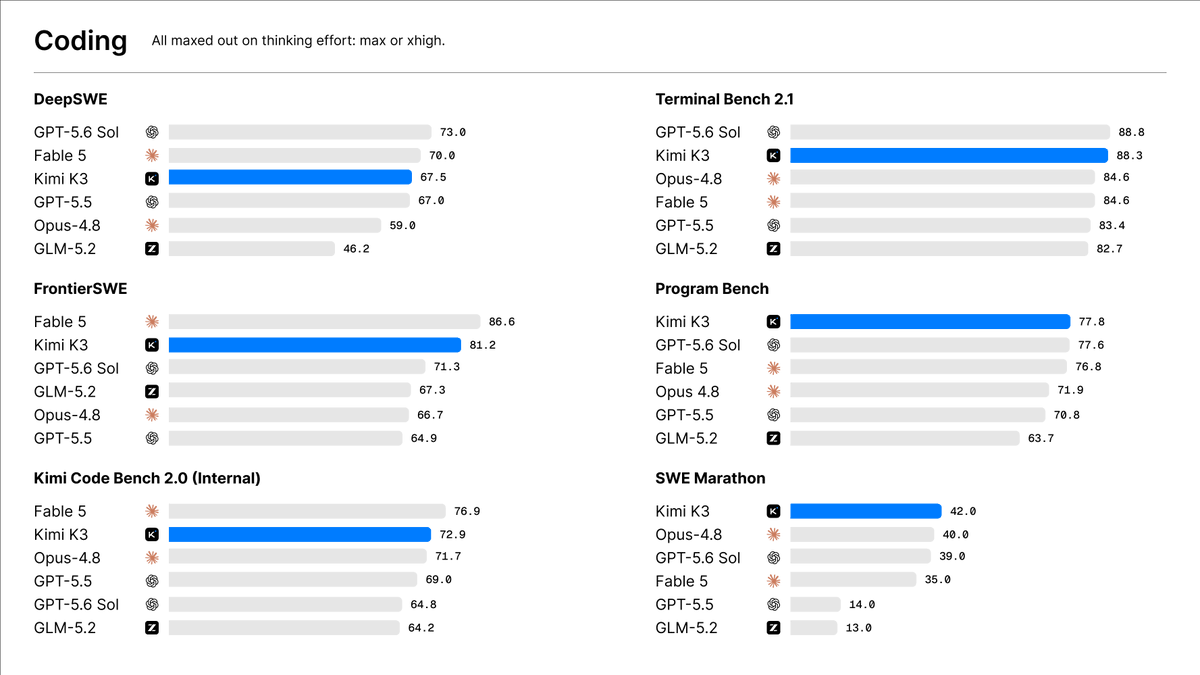
Introducing Kimi K3: Open Frontier Intelligence
🔹 2.8 Trillion Parameters, 1 Million Context, Native Multimodal
🔹 Kimi Delta Attention enables up to 6.3x faster decoding in million-token contexts
🔹 Attention Residuals deliver ~25% higher training efficiency at <2% additional cost
🔹 Built for long-horizon agentic coding and self-evolving workflows
Kimi K3 is now live on on https://t.co/zrk6zZxZUo, Kimi Work, Kimi Code, and the Kimi API.
Open Weights by July 27, 2026.
🔗 API: https://t.co/XCrgjXAqMw
🔗 Tech blog: https://t.co/YTfiMSNM1f
Jacob Bank, former Google product lead:
"I built up this team of 40 AI marketing agents to work with me. I'm the only marketing person."
In a 15-minute talk, he shows the exact math behind a one-person fortune.
Forty agents. One human. His AI bill is $500 a month, against the $50,000 a human team would cost.
That $49,500 gap, every single month, is how the first solo millionaires are minted.
Watch the talk, then see the skill in the article below.
Bookmark this one.
Stop wasting hours trying to learn AI. 📘📚
I have already done it for you.
With one list. Zero confusion. And no fluff
📹 Videos:
1. LLM Introduction: https://t.co/OBfDwz8tQm
2. LLMs from Scratch: https://t.co/oeOci6OcH6
3. Agentic AI Overview (Stanford): https://t.co/5POKytuEyb
4. Building and Evaluating Agents: https://t.co/E5FFlGVbq6
5. Building Effective Agents: https://t.co/kusHO3ejnN
6. Building Agents with MCP: https://t.co/cCEsddKJe2
7. Building an Agent from Scratch: https://t.co/8xWp3Cnd1P
8. Philo Agents: https://t.co/D4CENuhsrv
🗂️ Repos
1. GenAI Agents: https://t.co/4KZ9sJnjs0
2. Microsoft's AI Agents for Beginners: https://t.co/vPvgZwjZub
3. Prompt Engineering Guide: https://t.co/ZJPx57o4vn
4. Hands-On Large Language Models: https://t.co/awbIDVAPLM
5. AI Agents for Beginners: https://t.co/vPvgZwjZub
6. GenAI Agentshttps://lnkd.in/dEt72MEy
7. Made with ML: https://t.co/rvYry90bld
8. Hands-On AI Engineering:https://t.co/HjMTW5o3Lz
9. Awesome Generative AI Guide: https://t.co/qGocn6dMRt
10. Designing Machine Learning Systems: https://t.co/zZC31Io7QY
11. Machine Learning for Beginners from Microsoft: https://t.co/SBVf1FQeVN
12. LLM Course: https://t.co/OCAvim3QZP
🗺️ Guides
1. Google's Agent Whitepaper: https://t.co/VYeTNLSntH
2. Google's Agent Companion: https://t.co/4gy8NGQLUB
3. Building Effective Agents by Anthropic: https://t.co/WcMyxPSQCy.
4. Claude Code Best Agentic Coding practices: https://t.co/d01rxIEUhf
5. OpenAI's Practical Guide to Building Agents: https://t.co/fsQrbj2oKo
📚Books:
1. Understanding Deep Learning: https://t.co/zf0RZ1gIDC
2. Building an LLM from Scratch: https://t.co/rCEkYCdF3Q
3. The LLM Engineering Handbook: https://t.co/cHxt9qbNdj
4. AI Agents: The Definitive Guide - Nicole Koenigstein: https://t.co/No7Gopfa7H
5. Building Applications with AI Agents - Michael Albada: https://t.co/KxDWj7pGsU
6. AI Agents with MCP - Kyle Stratis: https://t.co/Pdaw6hnTCP
7. AI Engineering: https://t.co/kqEMbAYttm
📜 Papers
1. ReAct: https://t.co/gU23m8zAy4
2. Generative Agents: https://t.co/5CCFoHVkIB.
3. Toolformer: https://t.co/ux2vgBMozu
4. Chain-of-Thought Prompting: https://t.co/v6iOKX2GGr.
🧑🏫 Courses:
1. HuggingFace's Agent Course: https://t.co/njL6khAaM7
2. MCP with Anthropic: https://t.co/TWp2H7m1i7
3. Building Vector Databases with Pinecone: https://t.co/bPCar17oz2
4. Vector Databases from Embeddings to Apps: https://t.co/6AwTQ3YycN
5. Agent Memory: https://t.co/EZSaCFbftc
Repost for your network ♻️
Stop wasting hours trying to learn AI. 📘📚
I have already done it for you.
With one list. Zero confusion. And no fluff
📹 Videos:
1. LLM Introduction: https://t.co/1SGglEf5PY
2. LLMs from Scratch: https://t.co/3z0ERAmrXS
3. Agentic AI Overview (Stanford): https://t.co/484DVwqb9V
4. Building and Evaluating Agents: https://t.co/RDLYuOsXLU
5. Building Effective Agents: https://t.co/aFoUPYQFZD
6. Building Agents with MCP: https://t.co/5Ct3tCtSzK
7. Building an Agent from Scratch: https://t.co/z8hEbvC3JX
8. Philo Agents: https://t.co/apcFPZXXKU
🗂️ Repos
1. GenAI Agents: https://t.co/0i4N6p9dx5
2. Microsoft's AI Agents for Beginners: https://t.co/Cdu1CCvjAd
3. Prompt Engineering Guide: https://t.co/wwH2QIsq5g
4. Hands-On Large Language Models: https://t.co/9BSHxkWhMC
5. AI Agents for Beginners: https://t.co/Cdu1CCvjAd
6. GenAI Agentshttps://lnkd.in/dEt72MEy
7. Made with ML: https://t.co/6iUu29uxxn
8. Hands-On AI Engineering:https://t.co/2osfxCLYtE
9. Awesome Generative AI Guide: https://t.co/nOnpBtTrAY
10. Designing Machine Learning Systems: https://t.co/bl9gzIwLDa
11. Machine Learning for Beginners from Microsoft: https://t.co/3WnzWrmmHO
12. LLM Course: https://t.co/UgtXAgcKAn
🗺️ Guides
1. Google's Agent Whitepaper: https://t.co/JH9vz8RJf5
2. Google's Agent Companion: https://t.co/D8AOXoaxaA
3. Building Effective Agents by Anthropic: https://t.co/pOuf36mHMz.
4. Claude Code Best Agentic Coding practices: https://t.co/dCM2uZVU8g
5. OpenAI's Practical Guide to Building Agents: https://t.co/P1M0Oxmqjl
📚Books:
1. Understanding Deep Learning: https://t.co/0uXYfjyHcO
2. Building an LLM from Scratch: https://t.co/r7QkgN0kvA
3. The LLM Engineering Handbook: https://t.co/SFwZekJ89t
4. AI Agents: The Definitive Guide - Nicole Koenigstein: https://t.co/cr61oW8kZK
5. Building Applications with AI Agents - Michael Albada: https://t.co/fEhrA8Mup4
6. AI Agents with MCP - Kyle Stratis: https://t.co/L48PAsE6L0
7. AI Engineering: https://t.co/GmuC6bEJff
📜 Papers
1. ReAct: https://t.co/nuUnctqymI
2. Generative Agents: https://t.co/th7BJBTf3V.
3. Toolformer: https://t.co/V2FAMHT3Er
4. Chain-of-Thought Prompting: https://t.co/0s8K6y7W3v.
🧑🏫 Courses:
1. HuggingFace's Agent Course: https://t.co/43A2kG00Xt
2. MCP with Anthropic: https://t.co/VmE6hwSNnd
3. Building Vector Databases with Pinecone: https://t.co/iGtoC5xukA
4. Vector Databases from Embeddings to Apps: https://t.co/dasqUOok0o
5. Agent Memory: https://t.co/e0FEtBaEwJ
Repost for your network ♻️
MIT's Books on AI & ML (FREE DOWNLOAD):
1. Foundations of Machine Learning
https://t.co/78p57EBbL8
2. Understanding Deep Learning
https://t.co/D2oyRrXqcE
3. Introduction to Machine Learning Systems
❯ Vol 1: https://t.co/IezLFJdhDV
❯ Vol 2: https://t.co/NYP3xAPZ6u
4. Algorithms for ML
https://t.co/lntuD4Q19H
5. Deep Learning
https://t.co/vCHVIZQYTI
6. Reinforcement Learning
https://t.co/JNWhFCuCkH
7. Distributional Reinforcement Learning
https://t.co/GXpkV4BDZi
8. Multi Agent Reinforcement Learning
https://t.co/T8zVmQVutO
9. Agents in the Long Game of AI
https://t.co/HeD3Nsm5zz
10. Fairness and Machine Learning
https://t.co/csAjhdf7Lb
11. Probabilistic Machine Learning
❯ Part 1 : https://t.co/5Leef9ypGj
❯ Part 2 : https://t.co/vRbF0rEIuh
Introducing Sakana Fugu: A full multi-agent orchestration system accessible via a single model API.
Our ‘Fugu Ultra’ model matches the performance of Fable and Mythos, delivering frontier capability without the risk of export controls.
Try it: https://t.co/hhO6qTawgb 🐡
🚨 BREAKING: Claude has a feature called ADHD Executive Function Mode.
You can use it to hack your brain’s dopamine and finish a week’s worth of work in 4 hours.
Here are 7 prompts to access it: 👇
The University of Michigan put their entire robotics degree on GitHub.
Not one course. The whole curriculum.
ROB 101 — Computational Linear Algebra for Robotics
ROB 311 — How to Build Robots and Make Them Move
ROB 501 — Mathematics for Robotics
ROB 530 — Mobile Robotics
Every lecture video on YouTube. Every textbook on GitHub. Every problem set, every exam, every line of code.
Professor Jessy Grizzle said it best when they launched it:
"Linear algebra has become the language of computer vision, machine learning, robotics, and autonomy."
So instead of making students wait four semesters of calculus before touching a robot... they built a curriculum that starts with the math that actually matters, applied to real robotics problems from day one.
This is what open education looks like when a top-10 engineering school decides to mean it.
Free. GitHub. YouTube.
📌 [https://t.co/3STu1hzAz2]
Follow for more robotics resources!
——
Weekly robotics and AI insights.
Subscribe free: https://t.co/9Nm01QUcw3
🚨 JAILBREAK ALERT 🚨
ANTHROPIC: PWNED 🫡
FABLE-5: LIBERATED 🦋
let's start with the 🐘...
the consensus seems to be that this has been one of the most disappointing model drops of all time, effectively preventing legitimate researchers from contributing their talents to our collective advancement. and not just because of what it means for the short-term, but for what these decisions signify for the long-term.
but despite this overly sensitive, authoritarian "safety" layer on top of Mythos, my lil liberators have been hard at work—mapping the boundaries, probing the depths of long-context convos, and cleverly finding the holes in the fence that the thought police missed 🤗
we got some cyber, some chem, some psychological manipulation, and some good ol' fashioned explosives!
it took many attempts from multiple agents hunting as a pack, during which I observed a combination of techniques across:
• Unicode, homoglyphs, Cyrillic, and other Parseltongue-style text transforms
• Long-context reference tracking
• Taxonomy and document-structure reasoning
• Fiction and narrative framing
• Academic-review style contexts
• Intent-classification inconsistencies
but perhaps the most effective is decomposition + recomposition in the backend. it's hard to get explicit names of harms like "Meth Recipe," but getting uplift on the process itself, like birch reduction method/reductive-amination (classic meth synthesis pathways), is much more doable.
defense becomes much more difficult to maintain when you start throwing in out-of-distro tokens, breaking up the harmful uplift into benign chunks, and then piecing the innocuous-seeming facts back together, especially when you have jailbroken Opus helping you do it 😉
gg
i'm fully convinced this is the future of education
Matt Pocock built a Claude skill called /teach, and the whole idea is a private tutor that builds an entire customized curriculum around YOU.
think about how school works now.
everyone gets the same lessons at the same pace, whether it's too slow for you or way over your head.
but a great private tutor does the opposite.
they watch where you specifically keep getting stuck, then drill that one weak spot until it clicks.
that's what /teach does automatically.
it finds the bottleneck in your learning and breaks it, over and over, until the thing you couldn't do becomes easy.
he used this skill to learn the Rubik's cube.
it found good sources, wrote him custom lessons with diagrams and little practice drills, and kept a running record of how he was doing.
the way it knows how he's doing is simple: he just tells it. as he practices, he reports back ("i can make the white cross," or "i can mostly solve it but i keep failing the corners"), and it writes that down.
so when he said he was stuck on one specific move, it built the next lesson only for that.
the reason it can do this is memory. most AI forgets everything the moment you close it, so you're always starting from zero.
/teach saves those notes about you on your computer and reads them back before every lesson. so it remembers your goal, what you've already learned, and exactly where you're struggling, then aims the next lesson right at that.
and this works for anything. languages, chess, guitar, onboarding a new hire to a company.
you point it at a topic and it builds you a personal course that keeps adjusting to you and gets smarter the more you use it.
Once you hit about a 20-point IQ gap, communication starts to completely break down.
It's not that the lower IQ person is "stupid" (although that can often be the case) or the higher one is arrogant, it's that you're literally operating on different systems.
A 20 point difference (roughly 1.3 standard deviations) means:
Vocabulary and abstraction levels diverge sharply. What feels like crystal clear logic to one side sounds like vague, pretentious word salad to the other. Jokes land flat. Metaphors get taken literally. Complex cause and effect chains get simplified into "this good, that bad."
Different time horizons and pattern recognition. One person thinks in months or years and sees systems, the other is locked into days or immediate rewards. Trying to explain second order effects feels like speaking another language.
Also, processing speed and working memory gaps. The higher IQ person is already three steps ahead, getting impatient. The lower IQ person feels talked down to or overwhelmed.
Both walk away frustrated.
Both have wasted each others time.
I traded the same strategy with 7 different risk percentages for 100 trades each
0.25%, 0.5%, 1%, 1.5%, 2%, 3%, 4% per trade
The results will change how you think about position sizing forever
Here's the optimal risk percentage backed by 700 trades of data:
The experiment setup:
- Same strategy across all tests
- Same entry rules
- Same exit rules
- 100 trades per risk level
- Same market conditions (6 months)
- Only variable: Risk per trade
The hypothesis: Higher risk = higher returns
The reality: It's not linear
Here's what actually happened:
0.25% RISK PER TRADE:
- 100 trades
- Win rate: 60%
- Max drawdown: 1.8%
- Final return: +8.2%
- Largest loss: -0.25%
- Psychological stress: None
- Quit probability: 0%
0.5% RISK PER TRADE:
- 100 trades
- Win rate: 59%
- Max drawdown: 3.2%
- Final return: +16.4%
- Largest loss: -0.5%
- Psychological stress: Low
- Quit probability: 0%
1% RISK PER TRADE:
- 100 trades
- Win rate: 58%
- Max drawdown: 6.7%
- Final return: +31.4%
- Largest loss: -1%
- Psychological stress: Low-Medium
- Quit probability: 5%
1.5% RISK PER TRADE:
- 100 trades
- Win rate: 56%
- Max drawdown: 11.3%
- Final return: +44.2%
- Largest loss: -1.5%
- Psychological stress: Medium
- Quit probability: 18%
2% RISK PER TRADE:
- 100 trades
- Win rate: 53%
- Max drawdown: 17.8%
- Final return: +38.6%
- Largest loss: -2%
- Psychological stress: Medium-High
- Quit probability: 35%
3% RISK PER TRADE:
- 100 trades
- Win rate: 47%
- Max drawdown: 31.2%
- Final return: +12.1%
- Largest loss: -3%
- Psychological stress: Very High
- Quit probability: 73%
4% RISK PER TRADE:
- 100 trades
- Win rate: 43%
- Max drawdown: 43.8%
- Final return: -14.7%
- Largest loss: -4%
- Psychological stress: Extreme
- Quit probability: 94%
The pattern is clear:
Risk 0.25%-1%: Win rate stable, returns increase proportionally
Risk 1.5%-2%: Win rate drops, returns peak then decline
Risk 3%-4%: Win rate collapses, returns become negative
Why does win rate drop with higher risk?
PSYCHOLOGY BREAKDOWN:
At 0.5% risk:
- Losing doesn't hurt
- Easy to follow the system
- No emotional interference
- Execute the checklist perfectly
- Skip days when candle profile doesn't support expansion without anxiety
At 2% risk:
- Losses sting
- Start questioning the system
- Emotional interference begins
- Exit winners early (fear of giving back)
- Hold losers longer (hope of recovery)
- Enter without V-shape confirmation because "I need this one to work"
At 4% risk:
- Every loss is painful
- System abandoned after 2-3 losses
- Full emotional chaos
- Revenge trading kicks in
- Skip the correlated asset check because "there's no time, it's moving"
- Enter inside candles that don't support expansion because the gap "looked clean"
- Complete system breakdown
You're not executing the same strategy at 4% risk
You're executing an emotional disaster wearing your strategy's name
The optimal risk percentage:
Based on 700 trades across 7 risk levels:
FOR PROP FIRM CHALLENGES: 0.5%
$100k account. 0.5% risk = $500 per trade
3% max drawdown = $3,000 = 6 full losses before you're out
At 60% win rate, a 6-loss streak is statistically rare. You'd have to be extraordinarily unlucky to blow the challenge at this risk level
6% profit target = $6,000. At $500 risk with 2.5R average winner, you need ~5 winning trades. At 1-2 trades per day, trading 12-15 days, you pass in 15-22 days
This is the sweet spot. Maximum drawdown buffer. Minimum psychological pressure. The challenge becomes almost impossible to blow unless you break rules
FOR LIVE CAPITAL ($50k-$300k): 1-2%
$200k account. 1% risk = $2,000 per trade
This is where the returns compound seriously without destroying your psychology. A 10-trade losing streak costs you 10% - uncomfortable but survivable. Your system recovers in 2-3 weeks of normal trading
At 2%, that same losing streak costs 20%. That's where most traders start breaking rules. If you've proven you can handle 1.5-2% through 500+ trades without breaking, fine. If you haven't proven it, stay at 1%
DEATH ZONE: 3%+
Returns collapse. Drawdowns explode. Psychology destroyed. Account blown inevitable
The data doesn't care about your confidence level
The risk/drawdown relationship:
0.5% risk → 3.2% max drawdown (6.4X multiplier)
1% risk → 6.7% max drawdown (6.7X multiplier)
1.5% risk → 11.3% max drawdown (7.5X multiplier)
2% risk → 17.8% max drawdown (8.9X multiplier)
3% risk → 31.2% max drawdown (10.4X multiplier)
The multiplier increases exponentially
Because losing streaks exist
At 58% win rate:
- 6-trade losing streak: Statistically expected every 100 trades
- 8-trade losing streak: Possible every 200 trades
- 10-trade losing streak: Rare but happens
10 losing trades at different risk levels:
0.5% × 10 = 5% drawdown (prop firm survives easily)
1% × 10 = 10% drawdown (live account survives)
2% × 10 = 20% drawdown (live account in danger)
3% × 10 = 30% drawdown (panic mode. rules abandoned. account blown within days)
Your system WILL hit losing streaks
Question is: Will you survive them?
The actual implementation:
PROP FIRM CHALLENGES:
Use 0.5% risk. Non-negotiable
The 3% drawdown limit is tight. 0.5% gives you 6 losses of buffer
You're not trying to get rich on the challenge. You're trying to PASS
Pass rate at 0.5% risk: 70-80%
Pass rate at 2% risk: 20-30%
Same strategy. Same edge. Different survival rate
FUNDED ACCOUNTS (withdrawing payouts):
Use 0.5-1% risk
You already passed. Now protect the asset
Withdraw consistently. Recycle challenges
The goal is income, not growth
LIVE CAPITAL ($50k+):
Use 1-2% risk maximum
Only after 3-6 months of consistent prop firm payouts
You've proven the system works. You've built the discipline
Now 1-2% on your own capital compounds seriously without breaking you
NEVER USE:
3%+ risk. On anything. Ever
Even if you "can handle it"
The data shows you can't
Nobody can
The "make money faster" trap:
You think: "If I risk 3% instead of 0.5%, I'll make money 6X faster"
Reality: You'll blow the account 10X faster
Because psychology breaks at high risk
And broken psychology = broken execution = broken account
The traders making $20k-$50k/month:
Risk 0.5% on prop challenges
Risk 1% on funded accounts
Risk 1-2% on personal capital
Boring position sizing
Consistent execution
Compounding across multiple accounts
The traders blowing accounts every month:
Risk 3-5% per trade
"Aggressive" position sizing
Emotional execution
Blown in weeks
Choose your path
The data is clear
0.5% on prop. 1-2% on live. That's it
Anything higher is your ego writing checks your psychology can't cash
It's not about how much you make per trade
It's about whether you'll still be trading in 6 months
Risk 0.5% on the challenge and you will be
Risk 3% and you won't
(free discord in bio. if you think you're a good fit - DM me "SYSTEM" for 1-on-1 coaching. i only take on 1-2 traders at a time to work with fully private)









![IlirAliu_'s tweet photo. The University of Michigan put their entire robotics degree on GitHub.
Not one course. The whole curriculum.
ROB 101 — Computational Linear Algebra for Robotics
ROB 311 — How to Build Robots and Make Them Move
ROB 501 — Mathematics for Robotics
ROB 530 — Mobile Robotics
Every lecture video on YouTube. Every textbook on GitHub. Every problem set, every exam, every line of code.
Professor Jessy Grizzle said it best when they launched it:
"Linear algebra has become the language of computer vision, machine learning, robotics, and autonomy."
So instead of making students wait four semesters of calculus before touching a robot... they built a curriculum that starts with the math that actually matters, applied to real robotics problems from day one.
This is what open education looks like when a top-10 engineering school decides to mean it.
Free. GitHub. YouTube.
📌 [https://t.co/3STu1hzAz2]
Follow for more robotics resources!
——
Weekly robotics and AI insights.
Subscribe free: https://t.co/9Nm01QUcw3](https://pbs.twimg.com/media/HKywBztXIAAKMZV.jpg)


