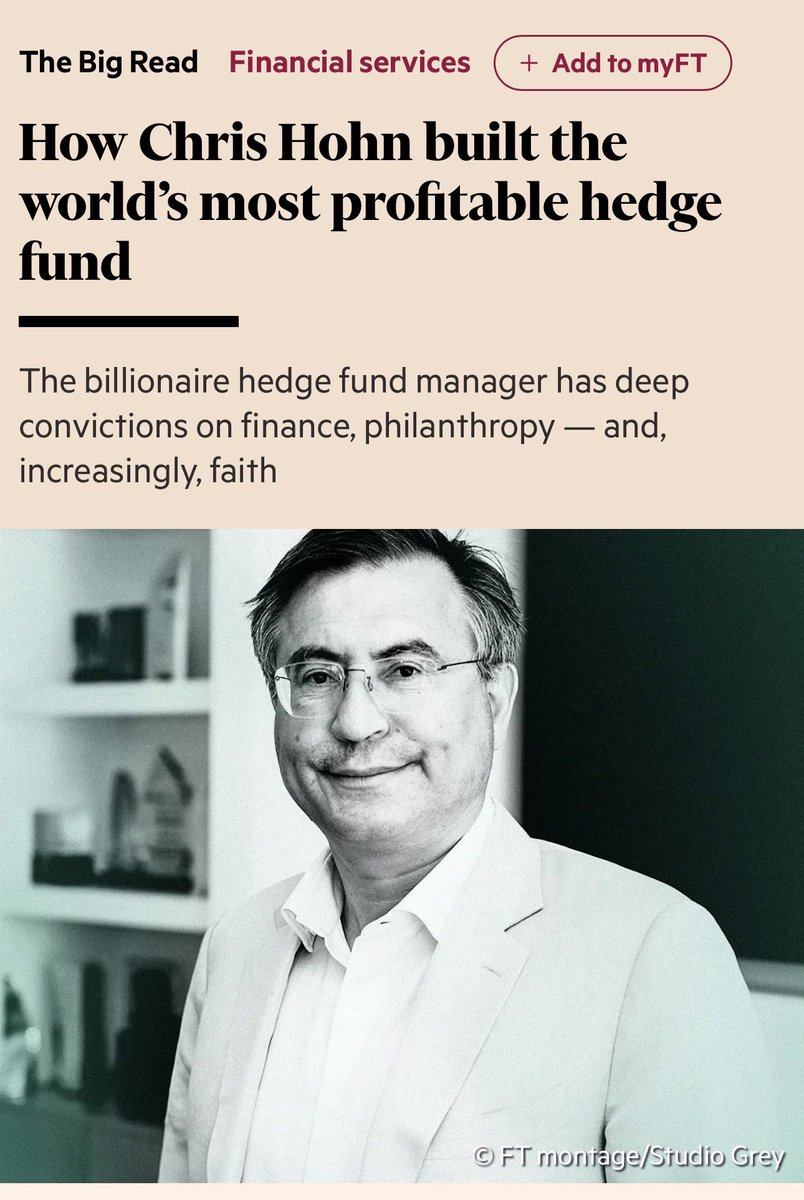
Chris Hohn did a 90-minute sit-down with Nicolai Tangen and then dropped an investor letter the FT got hold of last week.
You’d think the guy who printed a record $18.9B last year would be doing victory laps. Instead he’s quietly rewiring his whole portfolio.
My favorite takes from both:
1.The most important thing in investing isn’t growth. It’s barriers to entry. Growth without a moat is the airline industry: 5% volume growth for 100 years and basically zero cumulative profit.
2.There are only about 200 companies on earth he considers high-quality and investable. His fund holds 15.
3.Average holding period: 8 years. Some positions 13. “You have to hold the company forever, because the stock market may be at very bad prices when you want to sell.”
4.His real test for a moat: can the company price above inflation? A 20% margin business that prices 1% above inflation grows profits 5% faster than revenue. Forever. Almost no companies can do this.
5. Industries he won’t touch: banks, autos, retail, insurance, tobacco, asset managers, fossil fuel utilities, airlines, wireless telecom, media, advertising. On banks: “sooner or later someone without a lot of intelligence comes to run them, and then it can be toxic.”
6.On AI generally: call centers go bankrupt. Indian outsourcing coders are next. But for everyone else, AI lowers costs and raises productivity. Companies with real moats become MORE valuable.
7. Here’s the punchline. The FT got hold of his investor letter. He cut his Microsoft stake from 10% of the fund to 1%. Roughly $8B sold. He’d held it since 2017 through a 400% rally. His reason: AI could disrupt Office and Azure faster than the market thinks.
8.He moved that capital into Alphabet. Doubled it from 3% to 5%. Now his largest tech position. The world’s best quality investor sold Microsoft and bought Google because he thinks Google’s moat is more durable in an AI world. Not the consensus trade.
9.The underlying thesis: “AI eats software.” If AI agents do the work humans used to pay per-seat SaaS licenses for, the whole SaaS model gets re-rated. Oracle, Adobe, Salesforce all ~40% off highs. Microsoft 25% off. Market is starting to agree.
10.When to sell? Not when something gets expensive. When conviction drops. Valuation is one variable, conviction is the other. What kills you isn’t being wrong, it’s permanent loss of capital.
11.He admits hardcore activism doesn’t work anymore. Too much of the shareholder base is passive index funds. And even when activism wins, you usually win in a bad business. “The business always wins.”
12.Counterintuitive take: there are more good companies in public markets than in private equity. The best businesses are too big for PE to buy. And when public companies sell something to PE, they’re selling the assets they want to get rid of.
13.On intuition: “thinking without thinking.” Pattern recognition from 20 years of reps. It’s how he sniffed out Wirecard while the German establishment was defending it. “Most investors trust authority too much.”
14.He basically stopped shorting. “You’re going to be eventually right but not be able to fund the losses.” The first guy to short Wirecard had to cover 19 years before it hit zero. Buffett told him he and Charlie studied shorting and concluded it was too hard.
15.He gives almost everything away. ~$500M a year. $10 prevents an unwanted pregnancy in Africa. $40 saves a child from severe malnutrition. $50 prevents permanent blindness.
16.Tangen asks: advice to young people? Hohn, who runs the world’s most profitable hedge fund: “Go on a spiritual path.” The guy who made $18.9B last year ends the interview saying only purpose and meaning matter.
The headline: the world’s best quality investor just sold his biggest tech compounder because he thinks AI is breaking the moat. Quietly, with conviction, on an 8-year horizon, while everyone else is still buying the AI winners of 2023.
GCCs Can Lift India's Boat
1. Job Seekers: High-value jobs matching HQ; 24L employed; 46% Fortune 500; 3X by 2030
2. Policymakers: GCCs $100B, sunrise (IT $150B, sunset); GOAL: 55% GCCs @ AI risk; invest in frontier skills; Capture 100%, we don’t have another decade
INSIGHTS:
Talent Meets Opportunity
a. What Is GCC: Global Capability Centers (GCCs) operate as wholly-owned subsidiaries of MNCs. Unlike IT industry, where you are a contract labour, in a GCC, you are a part of the parent MNC.
b. The IP, the mandate, global product ownership, high-conviction engineering and R&D, institutional knowledge & strategy – you own it. What you own, you can transform. Skills and capabilities compound over time.
c. Under India’s transfer pricing mechanism, GCCs run profitable operations even though they work for the parent, generate forex revenues ($98.4B in FY26), pay taxes, and create jobs (23.6 lakh jobs currently).
d. FY26: Over 46% of Fortune 500 companies already operate a GCC in India. Total 2,117 GCCs as of now. Examples: BMW, Walmart, Marriott, Delta Airlines, Lufthansa, Chevron, Carlsberg, McDonald’s, Sanofi, Bosch, Goldman Sachs, Anthropic.
India Leads the World
Zinnov global consultancy teamed up with a Harvard professor to classify the nature of work in GCCs as follows:
Commodities: Standardized, repeatable tasks
Procedures: Complex but established process execution
Grey Hair: Problem-solving, requiring deep skills
Rocket Science: Cutting-edge R&D skills for tech disruption
INDIA GCC PORTFOLIO FY26:
Rocket Science: 7.0%
Grey Hair: 38.1%
Procedures: 37.2%
Commodities: 17.7%
This distribution is similar to the level of frontier work happening at the company’s headquarters. It means local Indian talent is competing with the world’s best.
India’s “Commodities” work share (low-level work) is far below other non-HQ GCC locations. It means, in terms of skills, India is hugely outperforming other GCC countries like Philippines, Hungary, Brazil, Poland, Mexico, Malaysia, Romania, and Vietnam.
Explosive Growth Potential
a. As of FY26, six cities host 92% of all GCCs in India: Bengaluru, Hyderabad, Delhi-NCR, Pune, Mumbai, Chennai. GCCs are now expanding footprint to Tier 2 cities as well.
b. 88 Mega GCCs currently employ over 5,000 employees each, making 4% of the total GCC count in India. In the next 4 years, 230 Mega GCCs are expected, which means 3X growth by 2030.
c. GCCs pay premium price for top talent, enabling them to lead innovation and contribute to the parent company’s transformation. “Grey Hair” and “Rocket Science” jobs constitute 45% of total in India – matching HQs.
Aggressive Policy Initiative
a. Almost 55% of the current GCC portfolios in India (“Commodities” and “Procedures”) are facing displacement pressure from AI. AI natives are already biting away at these functions.
b. India needs a targeted policy to invest in the development of frontier capabilities and deepen its “Grey Hair” and “Rocket Science” talent pool.
India has a few AI/ML Centers of Excellence (CoEs). Many more state-of-the-art CoEs are required to support high-end AI upskilling of millions of Indian engineers, both experienced and fresh graduates.
c. Considering the scale of India’s engineering, PhD, and professional talent, India’s goal should be to “monopolize” GCCs and grab maximum global market share.
Indian industry is de-motivated for any kind of long horizon investments. But with GCCs, only the government has to motivate itself.
We don’t have another decade.
@arabicatrader
[No Paywall] Watch Samit Vartak, CIO at SageOne Advisors uncover historical smallcap cycles with signs of current one bottoming out.
In this insightful session, Samit covers:
- Smallcap cycles: Worst seems behind with good setup for an outsized returns (avg. 64% upside within a year).
- Seasonality: How Jan-Feb is the worst period while April-May been the best for small caps.
- Resilience: Relative strength versus large caps in recent fall.
- Valuation: At 25th Percentile on P-BV basis, highly lucrative (similar to COVID bottom).
- Potential themes to participate for upcoming bull market.
Given the doom & gloom around small caps, IIC is offering free access to this session.
Link in the comment.
"Five sure-shot ways to attract Luck
1) Say Yes to opportunities to meet people from different professions
2) Put yourself in situations where you can display your potential
3) Start writing daily to gain clarity
4) Get out of your comfort zone
5) Be willing to give your 100%"
After years of experience in equity market, I fine-tuned my strategy-
1) No trading (traded till 2015).
2) Zero investment in loss making businesses.
3) 96-97% of the total funds are invested in eleven undervalued businesses. All investments are based on fundamental analysis.
4) All the invested companies are profitable, generate cash flows, and pay dividends.
5) Very low churn ratio. On an average 10-15% per annum.
6) I don’t buy any shares in FOMO or sell in panic.
7) Zero debt.
8) I always keep emergency funds.
Compounding with very less stress.🙏🙏
New episode: "How Elon Works"
This episode covers the insanely valuable company-building principles of Elon Musk
A few notes from the episode:
1. The mission comes first.
2. Retreat is not an option.
3. A maniacal sense of urgency is our operating principle.
4. Product design should be driven by engineers.
5. You should not separate engineering from product design.
6. Having separate design and production departments is bullshit. Keep everything together and feedback immediate.
7. The leader should be on the front lines. You should be a battlefield general.
8. "If they see the general out on the battlefield, the troops are going to be motivated. Wherever Napoleon was, that's where his armies would do best."
9. Apply The Algorithm constantly. (1) Question every requirement. (2) Delete any part of the process you can. (3) Simplify and optimize. (4) Accelerate cycle time. (5) Automate.
10. Repetition is persuasive. "I became a broken record on the algorithm. I think it's helpful to say it to an annoying degree."
11. You should go ultra-hardcore on deletion and simplification.
12. Camaraderie is dangerous. It makes it hard for people to challenge each other’s work. (Refer to point #1)
13. Never ask your troops to do something you wouldn’t do.
14. Hire for attitude. Skills can be taught. Attitude changes require a brain transplant.
15. Good attitude = A desire to work maniacally hard.
16. The only rules are the ones dictated by the laws of physics. Everything else is a recommendation.
17. Keep your entire company committed to a common goal.
18. If things aren’t going well, throw away the existing design, start from first principles, question every requirement based on fundamental physics.
19. Find the limit. You want to delete as much as possible and you can’t do that unless you find the limit.
20. If you aren’t adding back at least 10% of the things you deleted, then you didn’t delete enough.
21. Maintain control. Avoid joint ventures. Eliminate middlemen.
22. Have a relentless dedication to questioning every requirement.
23. No work about work, just work.
24. Go to the problem. Get on the plane. Fly to the source. Go to the exact location in the factory. Go to the problem and stay there until it's resolved.
25. The best part is no part.
26. Be wired for war.
27. Do not fear losing. It hurts the first 50 times but then you’ll be able to play with less emotion. You will take more risks.
28. Stay heads down focused on doing useful things for civilization.
29. When something is important and has to be done quickly, have meetings every 24 hours to run the algorithm and check on the previous days progress. You'll be shocked at how fast this speeds things up.
30. Life needs to be interesting and edgy.
31. Delete, delete, delete, delete.
There are 100 more ideas in the episode. I hope you listen to it. 30 years of Elon’s career + 60 hours of reading and research and me just absolutely ripping through idea after idea at 2x speed for 90 minutes.
It will be hard to find a better use of time.
He has lived through 30 years of booms and busts.
He built his reputation on common sense investing.
He is the CIO of BugleRock Capital.
His core principle is disarmingly simple:
Do not be bothered by how much money someone else has made.
His philosophy is contrarian yet timeless:
It is more important to be consistently good than to be the best.
Focus on what you can control.
Buy quality businesses at reasonable prices.
Let compounding do the heavy lifting.
His four “don’ts” that protect capital:
• Do not buy measurably weak or deteriorating businesses.
• Do not back managers who hurt minority shareholders.
• Do not pay exorbitant valuations.
• Do not chase other people’s returns.
His discipline shows in the process:
Position sizing with clear guardrails.
Liquidity first, so clients are never stuck.
3 to 5 year lens, bought in tranches, sold with rules.
Cash is residual, not a forecast.
Ideas can come from anywhere.
Only one filter matters in the end.
Does it fit the mandate and the price you are paying?
This is not about the next hot tip.
It is about temperament, governance, and patience.
About losing less when it matters, so you can compound more when it counts.
If there has to be a north star for long-term investors, it is @EASundaram simple rulebook.
Consistent. Principled. Unmoved by noise.
Watch the full conversation only on The India Opportunity Show. Link in comments.
So...this is a chart of primary energy (not electricity) using the substitution method (notice the y-axis is still in TWh).
Electricity comprises 27% of China's energy mix and wind/solar/hydro are 32% of generation, so they naturally appear small on a chart like this. 🧵
10 year NSE sector performance (2016-25 YTD)
Leadership keeps rotating, sectors that underperform often come back strongly in the next cycle
Interesting data⏬
src : ET Wealth




![IIC_Conference's tweet photo. [No Paywall] Watch Samit Vartak, CIO at SageOne Advisors uncover historical smallcap cycles with signs of current one bottoming out.
In this insightful session, Samit covers:
- Smallcap cycles: Worst seems behind with good setup for an outsized returns (avg. 64% upside within a year).
- Seasonality: How Jan-Feb is the worst period while April-May been the best for small caps.
- Resilience: Relative strength versus large caps in recent fall.
- Valuation: At 25th Percentile on P-BV basis, highly lucrative (similar to COVID bottom).
- Potential themes to participate for upcoming bull market.
Given the doom & gloom around small caps, IIC is offering free access to this session.
Link in the comment.](https://pbs.twimg.com/media/HEo6Kupa0AEr9Dg.jpg)


