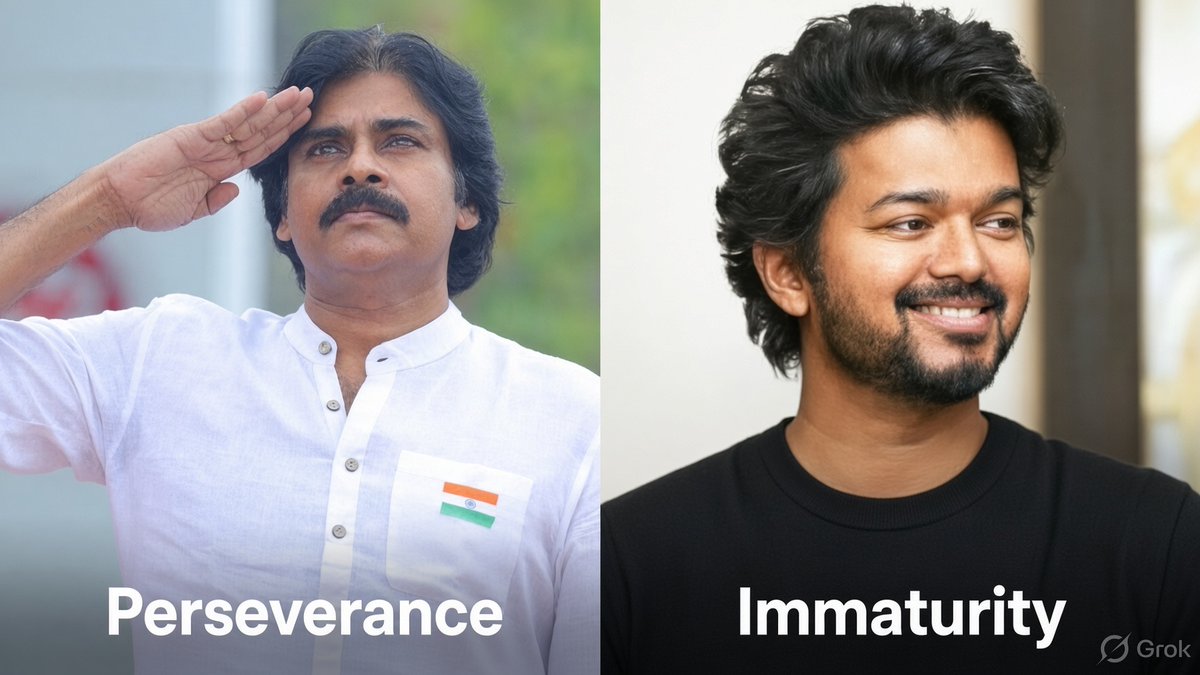
THE DIFFERENCE BETWEEN Getting to POWER overnight AND EARNING LEADERSHIP - TVK Vijay’s Overnight Mandate in Tamil nadu and Pawan Kalyan’s Decade of Political Struggle
Winning an election and knowing how to govern are two different things. An electoral victory gives a leader the authority to occupy an office. What that leader does with the authority is what eventually defines his leadership.
The political journeys of Tamil Nadu Chief Minister C. Joseph Vijay and Andhra Pradesh Deputy Chief Minister Pawan Kalyan comes for an interesting comparison as Vijay’s governance is turning to be a disaster .
Both had the ability to attract large crowds and connect with people. But the paths they travelled towards political power were fundamentally different. Pawan Kalyan’s concern for society and public life did not begin with politics or cinema. Even as a teenager, long before entering the film industry, he displayed an inclination towards social responsibility, public welfare and standing up for voiceless . His entry into politics was an extension of convictions he had carried for years, shaped by personal experiences, ideological commitment and a desire to bring about change. For him, politics is a means to serve.
Vijay, on the other hand, entered electoral politics after establishing himself as a major film star, with the ambition of translating his popularity into political authority.
Vijay founded Tamilaga Vettri Kazhagam (TVK) in 2024 and, within two years, achieved a remarkable electoral breakthrough. His party emerged as the single-largest party in 2026 Tamil Nadu Assembly elections with 108 seats, and he became Chief Minister with the support of allies. It was a historic result, particularly in a state where traditional political forces have ruled for decades.
Pawan Kalyan’s journey began much earlier. He founded Jana Sena in March 2014, but it’s hard fought long battle still even though he is deputy chief minister now . The 2019 elections were a major setback. Yet, he refused to walk away.
What followed was not a retreat from public life but a prolonged period of political struggle. He continued raising issues concerning farmers, fishermen, Uddanam’s kidney disease crisis, illegal sand mining, Amaravati farmers, the Visakhapatnam Steel Plant and the problems faced by ordinary people. He stood with people on issues even when there was no electoral reward or political office to gain.
More importantly, he chose to rebuild rather than give up. He worked to keep his cadre together, strengthen the party and expand its political relevance. He undertook the Varahi Yatra, travelled across the state and continued confronting the government on issues he believed affected the public.
Perhaps the most significant part of his journey was his willingness to put a larger political objective ahead of his immediate personal and party interests. He pursued an alliance with the TDP and BJP to prevent the division of anti-incumbency votes, accepted a considerably smaller share of seats than many within his own party had expected, and stood by his decision despite criticism. His support for Chandrababu Naidu during a politically difficult period in 2023 further demonstrated the risks he was willing to take.
In 2024, Jana Sena won all 21 Assembly and both Lok Sabha seats it contested as part of the NDA alliance. Pawan Kalyan won from Pithapuram and became Deputy Chief Minister.
That decade of struggle matters. It included political uncertainty, public criticism, electoral disappointment and wide range of toughest tasks Pawan Kalyan went on to face head on . He did not walk away when the results went against him. That is an important part of political leadership which an electoral victory, however spectacular, cannot demonstrate on its own.
THE CHALLENGE AFTER THE ELECTION
Vijay’s electoral achievement should not be diminished. But the real test of his leadership has begun after becoming Chief Minister.
His government has initiated measures relating to women’s welfare, public services, liquor regulation and anti-corruption. At the same time, there are many questions about administrative judgement, political discipline and institutional stability.
Take the September 2026 decision to exempt the Public (Law and Order) Department from the Right to Information Act. The government withdrew the order within hours after it faced widespread criticism. Reversing a questionable decision is welcome. But why was such an important decision taken without properly considering its implications for transparency in the first place?
There have also been incidents involving ruling-party representatives, including inappropriate messages sent to a woman district collector and an assault involving a Deputy Speaker. A party that promised a different political culture must also ensure that its own elected representatives follow higher standards of conduct.
Concerns over law and order, reported prison and custody escapes, political instability and the government’s legislative position have added to the woes . Many questions have emerged over agricultural loan-waiver commitments, the handling of the Mekedatu water dispute and reported data-security concerns at Guidance Tamil Nadu.
The Thiruparankundram Karthigai Deepam controversy is particularly very serious. Following the Supreme Court’s direction concerning the lighting of the ceremonial lamp at Deepathoon, the subsequent failure to implement the direction led to further judicial intervention. Yesterday , the Supreme Court made serious observations about the conduct of officials, referred to administrative chaos and indicated a prima facie case of wilful disobedience, initiating contempt-related proceedings.
This is not simply a dispute over a religious practice. It raises a fundamental question about whether the executive will respect the directions of the judiciary. A government is free to pursue legal remedies, but it cannot treat compliance with court orders as a matter of political choice.
This is also where Pawan Kalyan’s ideological position becomes relevant. He has consistently spoken about the preservation of Sanatana Dharma, the protection of Hindu religious traditions and the need to respect the sentiments of devotees. Importantly, his public position is not merely about expressing religious identity; it is about recognising that cultural and religious traditions deserve dignity and protection within the constitutional framework.
As a political leader holding constitutional office, Pawan Kalyan's approach reflects an important principle: faith should not be dismissed, devotees should not feel that their traditions are being disregarded, and the rule of law must remain paramount. Protecting religious traditions and respecting constitutional institutions are not contradictory responsibilities.
It would be unfair to judge an entire five-year government on six months of administration. Vijay has a historic mandate and must be given the opportunity to govern. But that can’t be excuse for massive failures in first 6 months . The early months of any government reveal much about the quality of its decision-making and the discipline of its administration.
WHAT PAWAN KALYAN HAS CHOSEN TO FOCUS ON
Pawan Kalyan’s work in Andhra Pradesh is in a different area of governance. His responsibilities cover Panchayat Raj, Rural Development, Rural Water Supply, Forests and Environment. These portfolios are pursuing activities that are visible daily. They are dealing with problems that people encounter in their villages every day.
The work undertaken through Palle Panduga and other rural development initiatives gives an indication of the scale of that effort.
The simultaneous Gram Sabhas conducted across 13,326 Gram Panchayats in August 2024 helped identify approximately ₹4,500 crore worth of development works. Palle Panduga 1.0 reported around 4,000 kilometres of CC roads, more than one lakh farm ponds, 22,500 Mini Gokulams and 15,000 livestock water troughs.
Palle Panduga 2.0, launched in November 2025, covered 53,382 proposed works across the same 13,326 Gram Panchayats, with an estimated outlay of ₹6,787 crore.
In September 2026, the government announced Palle Panduga 3.0 with an outlay of ₹11,085 crore. Its targets include 9,500 kilometres of BT roads, 6,000 kilometres of CC roads, 22,000 Mini Gokulams, horticulture across 50,000 acres and 1,000 kilometres of Magic Drains. These are programme targets, and their success must ultimately be judged by completed works and their quality.
There are other important interventions. Adavi Thalli Bata aims to improve connectivity to remote tribal habitations. More than 10,000 departmental employees received promotions. Andhra Pradesh also moved from 24th position to first in the reported 2026 Rashtriya Gram Swaraj Abhiyan assessment. Magic Drains and Swachh Rathas are part of a wider effort to improve village sanitation.
What makes this approach worth examining is its attention to the less visible parts of governance. A road to a remote village, a farm pond, a drinking-water facility for cattle or a proper drainage system may not make for a spectacular political announcement. But for the family that depends on it, the difference is immediate and real.
Pawan Kalyan has also pushed officials to survey village infrastructure, Panchayat lands and community assets. The larger question is how these assets can be protected, maintained and made financially sustainable. Rural development cannot end with the construction of roads and buildings. Pawan Kalyan is making sure how Local bodies must also become capable of managing their resources and meeting their own needs.
There is still considerable work ahead. The real measure will be the quality of execution and whether these improvements continue long after the announcements and political attention have passed.
THE IMPORTANCE OF COALITION DHARMA
Another aspect of Pawan Kalyan’s political journey is the way he has approached coalition politics.
Jana Sena’s performance in the 2024 elections gave Pawan considerable political standing within the NDA. He nevertheless accepted the responsibility of Deputy Chief Minister in a government headed by N. Chandrababu Naidu.
Coalition politics requires give and take. It calls for patience, negotiation and an understanding that political objectives sometimes have to be pursued through collective arrangements. Accepting a role within a coalition and making that arrangement work is also a form of political maturity.
This is what can be described as Coalition Dharma. It does not mean giving up one’s political identity. It means recognising the larger responsibility of governing together.
There is a deeper philosophical point here. In the Indian understanding of public life, Adhikara and Yogyata are not the same. Adhikara is authority; Yogyata is the ability and preparedness to exercise that authority responsibly.
The Bhagavad Gita’s teaching, कर्मण्येवाधिकारस्ते मा फलेषु कदाचन, places the emphasis on duty rather than reward. Pawan’s decade in politics reflects Tapas in that sense: continuing the effort despite defeat and the absence of immediate rewards. His decision to work within a coalition also reflects the willingness to place a larger objective above personal ambition.
But political struggle cannot be the only measure of a leader. Once in office, performance becomes the test. Pawan must ensure that the work undertaken by his departments produces lasting results, just as Vijay must demonstrate that his electoral success can translate into effective administration.
THE FINAL DISTINCTION
There is no reason to deny Vijay the credit for an extraordinary electoral achievement. He has changed the political landscape of Tamil Nadu and has an opportunity to build a lasting political legacy. But his immature decisions are exhibiting that winning an election is not enough .
Pawan Kalyan’s journey offers a different lesson. He built a party, faced defeat, stayed in public life, changed his strategy, built alliances and eventually entered https://t.co/Mx8NtNWuQC he took responsibility to make sure that the political struggle of those ten years results in lasting improvements for the people.
The difference is not about cinema or celebrity. It is about the experience that comes from years of political work, the ability to withstand setbacks, the judgement required to make strategic decisions and the discipline needed to govern which Pawan Kalyan mastered in his journey
Vijay received a historic mandate. Pawan Kalyan spent a decade earning his political place. Vijay now has to prove that popularity can sustain governance; while Pawan Kalyan proved that perseverance can deliver lasting change.
An election can give a leader power. It takes years of commitment, sound judgement and public service to earn the credibility that should come with it.
Power may arrive overnight. Leadership must be earned every day.
What @ysjagan did in Tirupathi is what @actorvijay is doing in Tamil Nadu - Sai deepak
"Non-Hindus as temple trustees."
Dear @jsaideepak Please take up the case of Ghee adulteration as well.
Not a single Tamilian SUPERSTAR came forward to support Lord Murugan, while PM Narendra Modi Ji and Pawan Kalyan stood up in support of Hindu devotees. It's a wake up call for every Tamil Hindu
𝐓𝐡𝐞 𝐥𝐢𝐠𝐡𝐭 𝐨𝐟 𝐃𝐡𝐚𝐫𝐦𝐚 𝐜𝐚𝐧 𝐧𝐞𝐯𝐞𝐫 𝐛𝐞 𝐝𝐢𝐦𝐢𝐧𝐢𝐬𝐡𝐞𝐝; 𝐭𝐫𝐮𝐭𝐡 𝐚𝐧𝐝 𝐟𝐚𝐢𝐭𝐡 𝐰𝐢𝐥𝐥 𝐚𝐥𝐰𝐚𝐲𝐬 𝐟𝐢𝐧𝐝 𝐭𝐡𝐞𝐢𝐫 𝐰𝐚𝐲.
வெற்றிவேல் முருகனுக்கு அரோகரா!
We wholeheartedly welcome the Hon’ble Supreme Court's intervention in upholding the sanctity of religious traditions and directing the lighting of Karthigai Deepam at the Deepathoon atop Thiruparankundram Hill. This is a moment of joy and reassurance for Lord Murugan's devotees and a significant step towards safeguarding our age-old traditions.
Our temples are the soul of our ancient civilisation, carrying forward generations of faith, devotion and sacred traditions. Protecting their sanctity, preserving their age-old customs and respecting the sentiments and rights of devotees are collective responsibilities. No tradition rooted in faith should be denied the respect it deserves.
This is a moment of faith, a victory for Lord Murugan's devotees and a reminder that the rights of worshippers and the sanctity of our traditions deserve respect.
My sincere appreciation to Advocate @jsaideepak Avl. for his relentless legal pursuit, compelling arguments and steadfast commitment to protecting Sanatana Dharma and the religious rights of devotees.
அரோகரா! அரோகரா! வெற்றிவேல் முருகனுக்கு அரோகரா!
#Thiruparankundram #Murugan #KarthigaiDeepam
Appointing Non Practicing Hindus to TTD By YS Jagan against Rules 🤡
Same is being done by Joseph Vijay by appointing a non Practicing Hindus to Murugan Temple Board as Trustee, against Rules 🤡
YCP & TVK are same. They mock Hindu traditions wilfully, knowing fully aware
VIDEO | Karthigai Deepam row: Locals welcome CRPF personnel with flower petals as they arrive in Madurai to take up security duties at Thiruparankundram Hill.
(Full video available on PTI Videos - https://t.co/d8jp61yd2p)
Thirupparankundram is the First of the Six Abodes of Lord Murugan (Kartikeya). The practice of lighting lamps atop the hill during the Tamil month of Karthigai is an ancient tradition of Hindus. It is sad and ironic that today the Hindus in Bharat have to seek judicial interventions to practice their faith and perform their rituals. If, even after winning a decisive legal battle, devotees cannot perform a simple, peaceful ritual on their own property, then where, in their own country, shall they truly find constitutional justice?
In short and simple, let all the Hindus in Bharat understand this - The bitter truth is - The Chennai High Court affirmed our right to light the Deepathoon - first by a single judge, then upheld by a higher bench. Legally, the battle was won. Yet, practically, we were forced to adjust.
Ask yourself - Can any religious festival be moved a week late? Can a holy day's celebration be shifted to a different time? No. Because the sanctity of religious time and the integrity of every religious calendar is non-negotiable.
Yet, for Sanatana Dharma, the moment—the sacred Karthigai Deepam—was stolen, vanished forever. Why? Because Hindus can be taken for granted. Sometimes it's the governments, sometimes it’s the executive, sometimes it’s the NGOs, sometimes it’s a random pseudo intellectual groups – but every time, it is Hindus who accept the loss and adjust. We secured the right, but lost the ritual. This repeated, systemic denial is why a time has come to demand more than just court victories - We need the Sanatana Dharma Raksha Board where devotees actively manage their own temples and religious affairs.
Mockery of Hindu traditions and rituals has become a norm for certain groups. Do they dare to do the same for other religious events?
Does Article 25 become an optional right instead of a fundamental right to the Hindus? Can a Police Commissioner or a District Magistrate unilaterally nullify a specific High Court Directive? If the High Court confirmed the Deepam lighting was a "harmless religious act" on legally owned land, who decides that this practice constitutes a threat to "communal harmony," and by what legal mechanism? How come HR&CE Department consistently and repeatedly act against the interests of Hindu devotees and their temple's traditions, and how do these officials evade serious accountability?
Hindus should observe the collective spirit and solidarity shown by practitioners of Abrahamic religions (religions of Arabian origin) when religious issues arise. They overcome their ethnic, regional, and linguistic differences for the sake of their faith.
As long as Hindus remain divided by caste, regional, and linguistic barriers, the mockery, insults, and abuses against the Hindu religion and its practices shall continue. If Hindus in our nation don't unite under a common minimum program with the collective spirit of Hindu Dharma (or Aram in Tamil), this spirit will be lost.
I hope for a day when every Hindu from Kashmir to Kanyakumari and Kamakhya to Dwarka wakes up to the humiliation Hindus face in their own land.
#Tiruparakundaram
#SanatanaDharmaRakshaBoard