Please just at least talk to warli artists and understand their artistic language before throwing out "warli" work using AI while actual warlis struggle to survive and hold on to their culture and traditions.
It's just disgusting and shameless behaviour.
Nepal one of the few countries which managed to reverse the deforestation, 3 out 4 cars are electric and doesn't even contribute 0.1% of global carbon emissions but ofc they have to suffer the consequences of climate change..
I genuinely don’t understand how we are supposed to casually process that a glacier literally collapsed in Nepal, erasing 19 bridges and killing over 600 people, because the planet is too hot. And instead of stopping it, billionaires are building more data centres. It is completely psychotic.
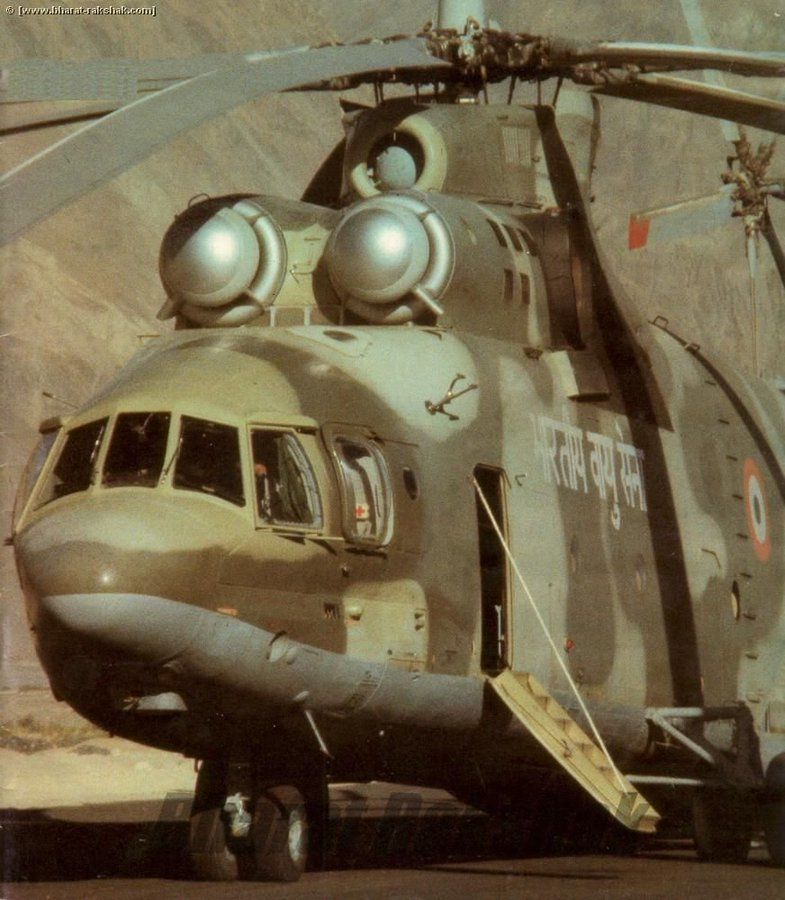
My rants on Kargil would be incomplete without the Mi-26, and particularly without one extraordinary sortie flown on the night of 26 May 1999. The air campaign was only hours old.
By that evening, Srinagar faced a shortage of the 57 mm rockets required by its armed Mi-17s. Replacement stocks were available at Adampur and Pathankot, but they had to be moved into the Kashmir Valley without delay.
The task fell to No. 126 Helicopter Flight at Chandigarh, then operating the IAF’s only heavy-lift helicopter. On paper, the Flight had four Mi-26s. In practice, it had only one aircraft available.
Two Mi-26s were aircraft on ground. A third had gone to Russia for a major overhaul, with three members of the crew also away. The available flying establishment was equally thin.
Squadron Leader Jang Veer Singh Guron was qualified for operations on the Mi-26 by day, but was not current for night flying. Another pilot was new to the unit and had completed only his day conversion. The incoming Commanding Officer was not current on type. The available flight engineer had only recently completed his initial training, while the electronic operator had limited experience on the aircraft.
Guron himself had been on leave in Lucknow when Group Captain H.P.S. Natt, then at Western Air Command, called and instructed him to return immediately. He reported at Chandigarh barely two or three days before Operation Safed Sagar began.
Nor was the Flight’s sole available Mi-26 fully healthy. The helicopter had separate transducers for indicating the main-rotor RPM and the high-pressure compressor RPM. Two were required. Only one was serviceable.
This meant that, during a sortie, the crew could monitor one of the two parameters, but not both. It was a deficiency they had agreed to operate with. The transport fleet was already heavily committed, and there were loads for which no lighter helicopter was an adequate substitute.
On 26 May, Guron returned to Chandigarh and then routed through Adampur and Pathankot to collect the rockets. He reached Pathankot at approximately 1400 hours.
Loading ammunition into the cavernous hold of the Mi-26 was a slow process. By the time the load had been secured and the helicopter was ready to depart, daylight had gone. The aircraft was also loaded beyond its rated capacity.
The situation confronting Guron was therefore stark. He was to fly an overloaded Mi-26 into the Kashmir Valley at night, without being current for night operations, in an aircraft in which one of the two vital RPM indications could not be monitored.
Group Captain Natt gave him the clearance to proceed. The normal helicopter route towards Srinagar wound through the valleys. It was also considerably longer. With the aircraft carrying an excessive load, fuel had become the governing consideration.
The alternative was a direct route across the mountains and over the Banihal Pass. It saved distance and fuel, but exchanged the relative security of the valley route for a high crossing of Banihal in darkness.
The expression “dark night” has a specific meaning in military aviation. A night with less than a quarter moon is classified as a dark night. The weather on 26 May was clear, but there was little natural illumination.
Guron chose the direct route.
The heavily laden Mi-26 climbed towards Banihal and crossed the pass in the darkness. On the outward flight, the high-pressure compressor RPM indication was unavailable. The crew continued across the mountains and brought the aircraft into Srinagar late that night. The 57 mm rockets had arrived. During the return flight, the main-rotor RPM gauge also failed.
Later, the Mi-26 carried a 14-tonne BEML tractor whose dimensions almost matched the helicopter’s loading ramp. With the aircraft overheating and responding poorly in the valleys, Guron executed a roller landing at Udhampur to bring it down without striking the tail rotor.
It transported a P-18/19 surveillance radar underslung into Kargil, despite the unit having little experience of such an operation at those altitudes.
On another mission, two Army trucks filled with communications equipment were driven directly into the Mi-26 at Palam and flown north. A delay on the ground consumed precious fuel, and the warning came on fifteen minutes short of Chandigarh. The aircraft landed, refuelled and continued to Srinagar that evening.
After approximately thirty hours of intense flying, the Mi-26 itself became unserviceable.
The sortie over Banihal remained exceptional even within that remarkable sequence. Guron received an AOC-in-C Commendation.
The fighters and armed helicopters naturally dominate accounts of Operation Safed Sagar. But their effort rested upon a much larger machinery of ammunition, fuel, radars, communications equipment and engineer plant being moved forward, often at the edge of what the available aircraft and crews could manage.
Late on 26 May 1999, the IAF’s only available Mi-26 crossed Banihal in darkness carrying an overloaded consignment of 57 mm rockets.
It fired none of them. Its task was to ensure that the helicopters at Srinagar still could. That is why the Mi-26 belongs in the Kargil story.
#IAFHistory @IAF_MCC
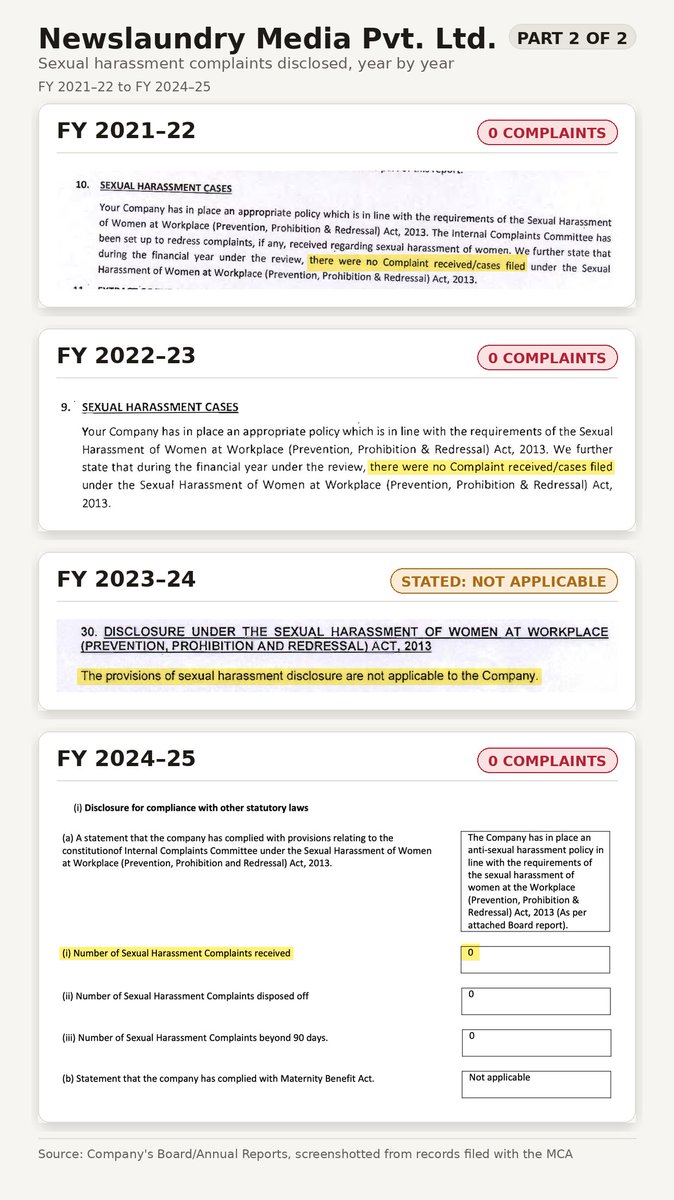
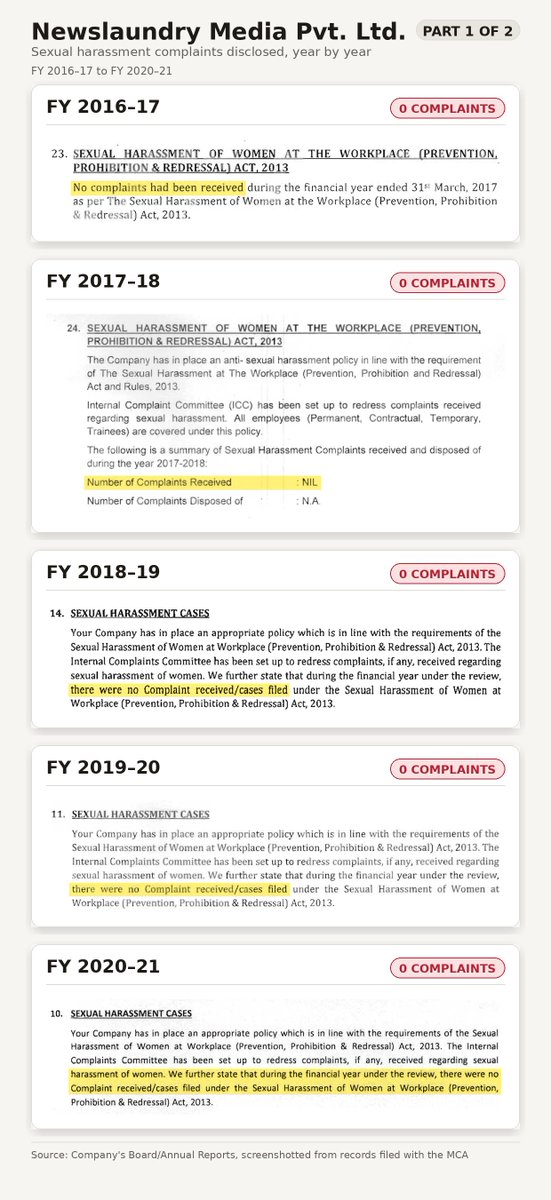
Newslaundry claims it received and acted on 4 sexual harassment complaints since 2017. But year after year, their company records state that they have received 0 complaints.
In fact in 2024, it reported that POSH disclosures aren't applicable to them.
Let's be very clear - the men who claim to share our ideology and have defended rapists & been unjust to victims, we are being humiliated because of YOU MEN IN POWER. You are the reason the ideology is being shat on today. The men who have brought shame upon the house must answer
You see how the big boys club defend their peers, write columns saying who-knows, stand up for a man who is so blatantly wrong on every level and has admitted to it. I just want women across the board to see it, know it, register it, always be aware of it and never forget it.
This has taken me years to write. I'm supposed to be "grateful" for the opportunities @ThePrintIndia gave me. It was also so very, very toxic.
The whole newsroom has always been on tenterhooks, about what one man thinks.
Someone recently told me he's "banned" friendships in the office — no one is supposed to talk to each other beyond work. Even in my time there, I watched editors bend themselves to appease his whims, at the cost of everyone else.
Forget about guidance and mentorship, they have never want any collegiality.
During the pandemic, they generously hired cabs to ferry us into work. The same man devised his own ways to "keep the virus out": pointing standing fans at the windows, banning shoes in the office.
Then there was the time they pushed me out after sending me to the Northeast, applied a big list of impossible conditions, told me not to do a story because I was "inexperienced" and didn't know anything about the region. It became the first story I reported after I quit: https://t.co/dbw0Hn6yxd
Later, I learned they'd hired someone specifically to keep tabs on "productivity".
We're told to be grateful for the chance — it's Delhi, these are editors with decades behind them. But work is extracted from us while we're made to feel like parasites for wanting anything back. Respect at your workplace isn't a big ask.