Tiruppur vs Surat
Both are roughly ₹68,000 crore textile machines, and they share almost nothing.
Tiruppur:
- 28,000 units, 8 lakh workers.
- Cotton from a field, knitted into finished shirts.
- More than half of India's knitwear exports, all sold in USD
Surat:
- 650,000 looms, 15 lakh workers.
- Polyester from a refinery, woven into 30 million metres of cloth/day.
- 2 of every 5 metres of man-made fabric India makes.
But Surat never makes the shirt. It sells the cloth to saree shops from Patna to Chennai, and gets paid in rupees.
Same turnover, opposite currencies.
@ChristinMP_@krishnabgowda Hope all areas will be covered without exception. Also , food outlets are the ones who manage crowd on the pavements obstructing passage. Those to be addressed too.
Elon Musk literally sat down for a 45-minute talk with Y Combinator that explains how to build world-changing companies better than any business school on earth. This is the advice he gave a room full of young founders:
1. Don't try to build something great. Try to build something useful.
Everyone obsesses over greatness. Musk says that's the wrong target. "I didn't originally think I would build something great. I wanted to try to build something useful. I didn't think I would build anything particularly great. Seemed unlikely, but I wanted to at least try." Aim for useful first. Greatness, if it comes, is a byproduct.
2. When you can't get in the front door, build your own door.
Before Musk started his first company, he tried to get a job at Netscape. "I sent my resume into Netscape and nobody responded. I tried hanging out in the lobby to see if I could bump into someone, but I was too shy to talk to anyone. So I'm like, this is ridiculous, I'll just write software myself." He didn't set out to be a founder. He became one because no one would hire him.
3. He slept in the office and showered at the YMCA.
The origin of his first company was not glamorous. "We couldn't even afford a place to stay. The office was 500 bucks a month, so we just slept in the office and showered at the YMCA." He couldn't afford proper internet either, so he drilled a hole through the office floor and ran a cable to the internet provider downstairs. That was the founder of the future richest man on earth.
4. Keep the chips on the table.
When Musk sold his first company, he received a $20 million cheque. His bank balance went from $10,000 to $20 million overnight. Most people would have stopped. He put almost all of it straight back into his next company. "I kept the chips on the table." He did the same thing decades later, over and over. He hates money sitting idle. Money is fuel for the next mission.
5. Start with the mission, then work backwards to make it a business.
Musk didn't start SpaceX to make money. He went on the NASA website to find out when humans were going to Mars, and there was no plan. So he decided to build one. "There had been no prior example of a rocket startup succeeding. A small chance of success is better than no chance of success." The mission came first. The business model came later.
6. He started SpaceX expecting to fail.
He is brutally honest about the odds. "SpaceX started in mid-2002 expecting to fail. Probably 90% chance of failing. When recruiting people, I said, we're probably going to die, but small chance we might not die." The first three launches failed. The fourth one worked with no money left. "If the fourth launch hadn't worked, it would have been curtains. We made it by the skin of our teeth."
7. Break every problem down to physics.
This is the core of how Musk thinks. "First principles means break things down to the fundamental elements that are most likely to be true, then reason up from there, as opposed to reasoning by analogy." His example is rockets. Everyone priced them based on what old rockets cost. Musk asked what a rocket is actually made of, priced the raw metals, and found the materials were only 1-2% of the historical price. The rest was inefficiency he could attack.
8. When told something takes 24 months, break it down and do it in six.
Last year xAI needed a giant computer to train its AI. Suppliers said it would take 18 to 24 months. "It's like, well, we need to get that done in six months or we won't be competitive." So he broke it into parts. Needed a building, so he found an old factory. Needed power, so he rented generators. Needed cooling, so he rented a quarter of America's mobile cooling capacity. He slept in the data centre and ran cabling himself. It got done.
9. Watch your ego-to-ability ratio.
Musk's single sharpest piece of advice for young founders is about staying honest with yourself. "A major failure mode is when your ego-to-ability ratio gets too high. Then you break the feedback loop to reality." Keep the ego small, internalise responsibility for everything, and stay ruthlessly connected to what's actually true. "You want to close the loop on reality hard. That's a super big deal."
10. Chase work, not glory.
His closing philosophy ties it all together. "It's so hard to be useful. The area under the curve of total utility is how useful you've been to your fellow human beings times how many people. If you aspire to do true work, your probability of success is much higher. Don't aspire to glory, aspire to work."
He was ridiculed for years. The press called him "internet guy attempting to build a rocket company." He agreed it sounded absurd. He did it anyway, because a small chance of doing something useful beat no chance at all.
Here's the thing though....
Musk became the most followed founder alive because everything he does happens in public. The launches, the failures, the talks like this one. The companies made him powerful. The personal brand made his every word travel around the world before he finishes saying it.
We build massive distribution and grow personal brands on X and beyond without our clients lifting a finger.
If you're a founder or VC looking for that kind of exposure, book a call below.
We average 1.5M views a week.
https://t.co/UoXuYlkBQq
@venkinesis Very important point Venky. Issue is folks underestimate intensity and heavy lifting that farming needs ; and someone else will do the job while they doom scroll on sm.
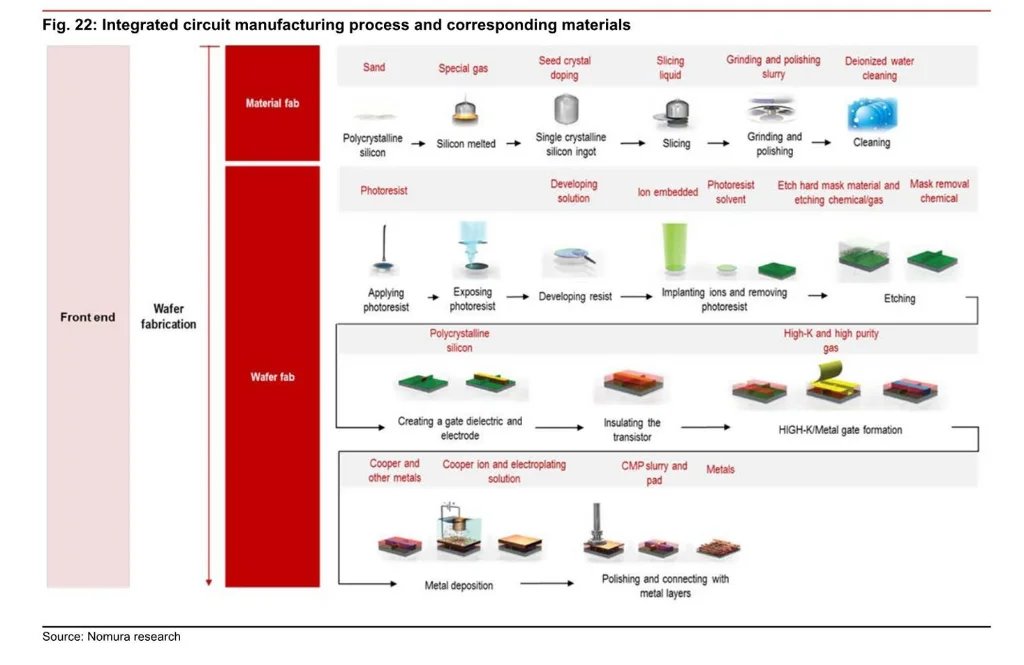
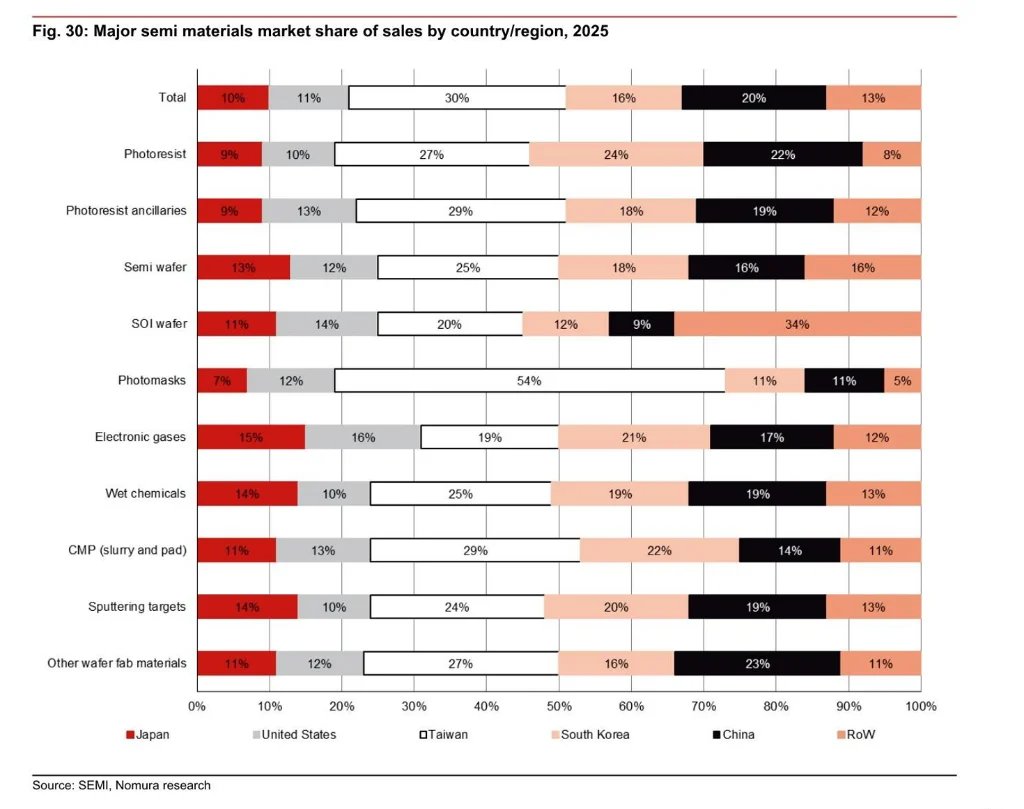
Nomura report : You're not deep enough in the AI Semiconductor stack yet. You're fishing with the crowd.
Buying GPU, CPU or foundry are a crowded trade now. Nomura released the map to the depths. Here's the rundown: You'll surely want to bookmark this
Investment implications run much deeper than GPU demand. For decades, chip performance gains came from one lever: shrink the transistor. At 3nm and below, that lever is breaking.
> New growth model: three pillars: 3D transistors (GAA evolving to stacked cFET), backside power delivery (separating power and signal networks, reducing IR drop), and materials substitution. The capex ramp starts 2026. Mass production hits 2027.
> Photolithography: High-NA EUV tools cost $400M each and require metal-oxide photoresists that run $10,000–$40,000/gallon. Current EUV resists cost $5,000/gallon. That's a 2–8x unit price step-up in a material most investors have never heard of. This is before high-NA even hits mass production (2029).
> Advanced packaging: SoIC hybrid bonding replaces microbumps with direct Cu-to-Cu connections, taking AI chip bandwidth from 200 GB/s to 1 TB/s. It requires nanometer-level wafer flatness, meaning CMP steps increase from 45–55 to 55–70 per chip (20–30% jump). BESI is positioned as the dominant equipment supplier here.
> Glass substrates: Glass-core substrates replace ABF organic substrates for large, high-power AI chips. Lower CTE, better flatness, lower signal loss. Broadcom adopts first for switch ASICs in 2027. Intel follows. The bottleneck is TGV (Through-Glass Via) formation - laser drilling, etching, metal fill, planarization. Companies with proprietary TGV process IP (LPKF, E&E) are entering this supply chain now.
> Photonics: Indium phosphide supply stays tight 2025–2027 due to export controls and yield constraints. The alternative is photonic SOI wafers: 25% the cost of InP, scalable for CPO. Soitec owns ~70% of global photonic SOI share. Demand enters rapid growth by 2027.
> Silicon wafers: Three technology waves (backside power delivery, wafer-bonded NAND, photonic SOI) stack onto baseline demand growth of 5%, adding 4–6 percentage points annually. Total 12-inch silicon wafer demand approaches 10% growth p.a. Supply cannot keep pace. Gap opens in 2027 Pricing power returns to GlobalWafers, Shin-Etsu, SUMCO.
> TSMC the amplifier: $70B capex in 2027 alone. 26 advanced fabs globally. Increasing localized procurement across lithography consumables, CMP, specialty gases, wafers, and packaging materials. Regional suppliers certified now see disproportionate order flow.
Which layer of this supply chain do you think is most mispriced right now - equipment, materials, substrates, or optical?
2026 is ramp setup, 2027 is the inflection, 2028–2030 is full adoption. Best investment can be made by knowing which player is essential for which phase.
Repost this. Most people following the AI trade are one layer too shallow. Your followers will thank you.
TURN BIOLOGY INTO AN ENGINEERING PROBLEM
@finkd (Mark Zuckerberg) and Priscilla Chan, co-founders of the Chan Zuckerberg Initiative (@czbiohub), interviewed by Alessio Fanelli and @swyx (Latent Space)
Summary: Zuckerberg and Chan are making science the main focus of CZI's next decade, and the bet is that the intersection of frontier AI and frontier biology is where they can have the biggest impact. The strategy is to build the tools, data, and models so other scientists can cure, prevent, and manage all disease, with Biohub operating its own labs rather than handing out grants. The provocation: how fast we get there depends more on the pace of AI than on biology itself.
1. Build The Institution. Most philanthropy hands money out as grants and waits; Biohub hires the scientists and runs the labs itself. Zuckerberg's read is that tool-building needs a 10-to-15-year runway and hundreds of millions of dollars, a shape that individual NIH-style grants rarely fund. So CZI operates its own institutes, building custom microscopes and a large compute cluster in-house. When the gap is long-horizon infrastructure, build it yourself.
2. Fund The Underserved Stage. The federal government dwarfs everyone through NIH, but it funds many individual investigators doing small-grant science. CZI deliberately targets the hole that pattern leaves: long-runway tool development. Major advances tend to follow new instruments, the telescope for astronomy and the microscope for biology. Fund the stage no one else will.
3. Put People In One Room. The most overlooked move is physical: sit biologists and AI engineers next to each other, including across rival institutions. Zuckerberg saw it at Meta and again at Biohub, where teams that were stuck made progress once they were co-located. The first Biohub linked Stanford, UCSF, and Berkeley and produced collaboration that wasn't happening before. It looks obvious in hindsight, but it was a real experiment, and it is step zero of the whole model.
4. Frontier AI Meets Frontier Biology. AlphaFold was a frontier AI lab using a data set other scientists had generated over decades. Biohub's idea is to run both frontiers at once and design the biology tools specifically to collect the data the models need. That integration beats letting AI researchers do their best with whatever biological data happens to exist. The tools and the models get built for each other.
5. Generate Data To Train The Model. This inverts how science usually works: classically you build a data set so you can study it, here you build it so you can train a model that creates more advances. The Human Cell Atlas, 125 million cells over 10 years, looked unglamorous and won no one a tenure-track paper, then became the training data for today's models. Chan's line: these data sets are not going to get created by themselves. In a world that believes in fast AI progress, more biology should be done this way.
6. Slow Then Fast. Seed the field and it compounds. CZI funded roughly 25% of the cell atlas data and the rest of the field contributed the other 75%. The first single-cell work took 10 years; the billion-cell project now takes months at a fraction of the cost. Progress comes in spurts, each new dimension slow at first and then fast.
7. Biology As Engineering. The aim is to move biology from discovery science, where you get lucky or get clever and find a hack, toward engineering, where you know how the system works and what happens when one part breaks. Biology has far too many dimensions to hold in a human brain. Large language models are what make that complexity tractable, and Chan says this would not have been possible 5 years ago.
8. Put The AI Person In Charge. Biohub brought in the Evolutionary Scale team behind the ESM protein models, with Alex Rives set to run the overall program. Handing an AI researcher the top job, rather than a biologist, is a deliberate signal of how fundamental they think the AI work is. They pair world-leading AI researchers with leading biologists and built one of the first large compute clusters for biological research. The org chart tells you which input they expect to compound.
9. The Cure Is An AI Timeline. CZI set a goal of curing all disease by the end of the century; biologists call it ambitious and AI people call it unambitious. Zuckerberg's view is that whether it takes 10, 20, or 40 years is more a function of the pace of AI development than of the biology. There is plenty of hard biology to do, but the clock is set by the faster-moving input. Bet your timeline on that.
10. N-Of-1 Medicine. The future they describe is precision care that models your specific genetics, exposures, and cellular behavior. Today, treating depression is empirical: try an antidepressant, wait months, and find out if it worked while the patient suffers. Variants of unknown significance leave families to panic or not panic with no real answer. Model a variant's actual impact on cells and you replace guessing with prediction.
11. The Wet Lab Stays Ground Truth. Zuckerberg pushes back on the idea that models will soon run experiments without a lab at all. The model generates hypotheses, scientists apply taste on which ones to test, and the results feed back in. Today scientists chase singles and doubles because grant money is tight and they need a hit, so a good model lets them swing at riskier ideas.
12. Doctors Become Healers Again. As AI gets excellent at detection, reading skin lesions and retinal scans better than people, the doctor's job moves toward care, compassion, and the trust that gets patients to follow through. The health system shifts from treating people once they show up sick to catching problems early, like a mutation before it metastasizes. Zuckerberg is careful about the literal mission: the goal is to catch most things early enough to keep them manageable, even if people still get the start of a sickness.
@gokulr Thanks for this. Much needed reframing as building products as well as explaining the problem domain getting steeper. Heavy lifting by model is key to cover all dimensions .
#TechItOut | As climate change and food security concerns grow, researchers and start-ups are exploring new ways to produce nutritious food in challenging environments. In this story, we look at how an Egyptian biotech company is combining artificial intelligence with duckweed cultivation to grow high-protein crops in desert regions using hydroponics and brackish water. The report explores how AI-powered monitoring systems are helping optimise plant growth, reduce waste and improve yields, while testing whether technology can make food production more resilient in regions with limited arable land
@niki0292 brings you more
@NayakSatya_SG According to its report, the area under five major invasive alien species is estimated to be 2,68,100 hectares. Lantana camara was found in 1,85,000 ha, Prosopis juliflora (56,000 ha), Acacia mearnsii (wattle, 22,400 ha), Senna spectabilis (2,400 ha), and Opuntia sp. (2,300 ha).