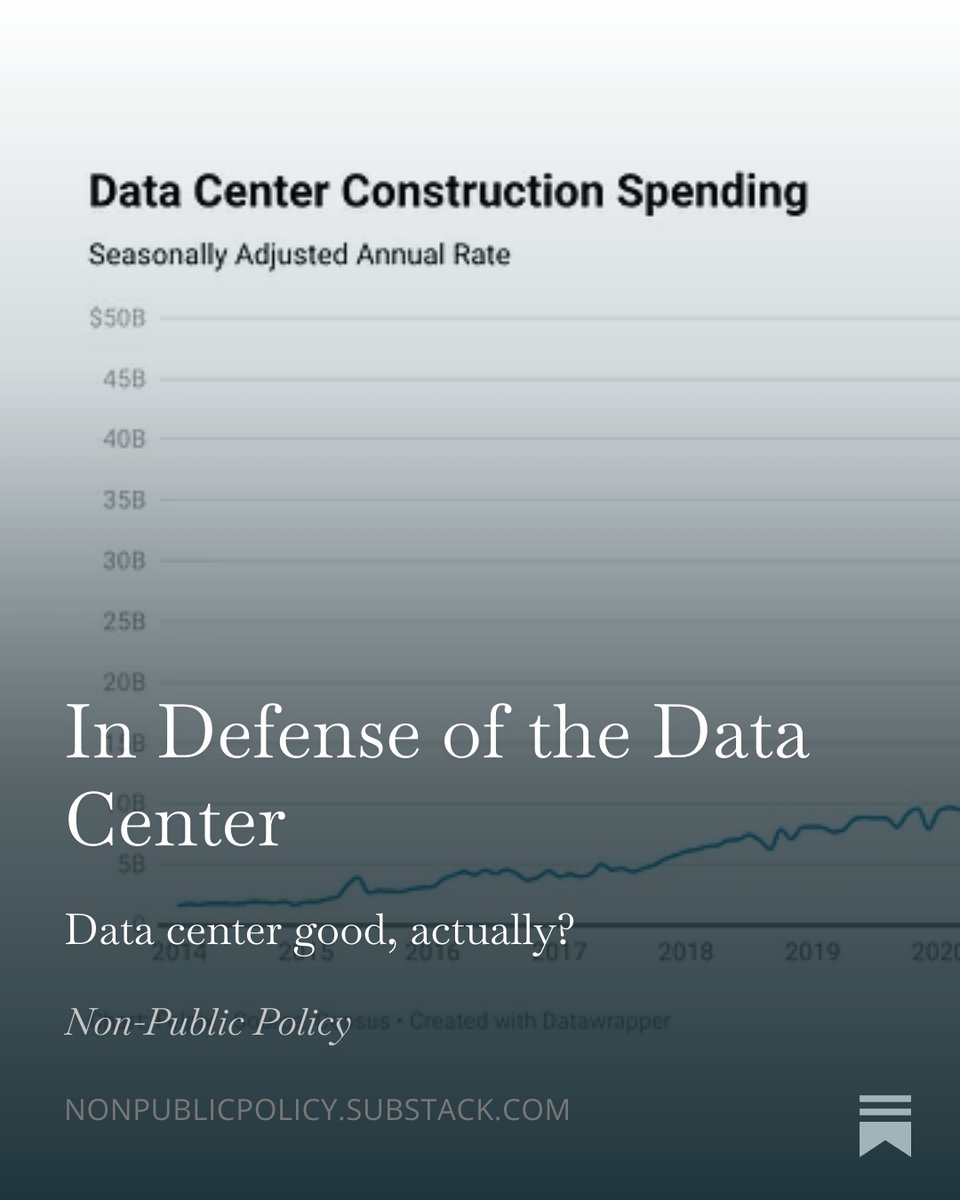
america uses 15x more water on its lawns than it does on all of its data centers
driving a gas car is 10x the per capita electricity consumption of all u.s. data centers
in defense of the data center on substack
For 20 years, a $6 knob that takes one hour to 3D print has been grounding Black Hawk helicopters four times a month, and the contractor responsible won't sell us the part or the IP rights to fix it ourselves.
So instead, American taxpayers have been paying $40,000 every single time to replace the entire system, multiplied by four times a month, for two decades.
That is NOT a procurement problem, that is a shakedown, and it is exactly why right to repair has to be in this year's NDAA.
BambuStudio has been violating PrusaSlicer AGPL license since their fork, with the same networking binary black box in question today. Why are they willing to burn the goodwill over it?
There's something most have sensed but never seen it all in one place, the five-law framework China built between 2017 and 2023 ⤵️
So maybe their hand is forced as their "network" is too valuable already? Each law on its own, interesting, okay... Read them together, and add any Chinese company with big reach to the mix you get the complete picture.
1) National Intelligence Law (2017)
All organizations and citizens must "support, assist, and cooperate" with intelligence work. The same law makes it illegal to disclose that cooperation happened. Cooperation is mandatory, and silence about it is mandatory too.
2) Cryptography Law (2020)
Commercial encryption must be state-approved and state-reviewed. When authorities request it, companies must provide decryption keys or plaintext. The state on both sides of that equation is the same one.
3) Data Security Law (2021)
Article 2 gives the state extraterritorial reach over data that touches Chinese national security or public interests. So EU/US data hosting does nothing to make it safe, because jurisdiction follows the company, not the server location.
4) Counter-Espionage Law revision (2023)
The general definition of espionage was expanded to cover "documents, data, materials, or items related to national security and interests." Industrial data is one of the intended targets since the revision.
5) Network Product Security Vulnerability regulation (2021)
Any company or researcher that discovers a software vulnerability must report it to MIIT within 48 hours. From there it flows to CNNVD (China National Vulnerability Database of Information Security), operated by the 13th Bureau of the Ministry of State Security. Microsoft's threat intelligence team documented Chinese state-hacker zero-day usage rising after this took effect. Shows the willingness to use the “tools” China built.
Together they describe a system with no neutral exits. Cooperation is required, encryption is real but the spare keys live at the ministry, jurisdiction follows the company across borders, industrial data is in scope, and discovered vulnerabilities flow to an intelligence agency 😬
3D printing became strategic for China in 2020 and joined the “Made in China 2025” plan soon after. Why does 3D printing matter so much? 1/x
Florida Man doesn’t ask for permission.
He just straps on a jet-propelled hoverboard, hooks up his dog to a jet ski, and goes for a Sunday cruise like it’s completely normal.
This is why the rest of the country will never understand us.
Peak Florida. Never change.
WHOA...
10 million wire grill brushers were just recalled. (3 million were recalled last month).
I did not anticipate this when we made the Smarter Scrubber to address the problem.
We just caught up on production. If you'd like a chain mail grill scrubber that's made in America check out
https://t.co/7FNq6F9xbE
Well. I think I have a new favorite movie. #projecthailmary was a fantastic adoption of the book, specifically Rocky! He was so great! Thank you to everyone who helped make such a unique and wonderful story come to life! @andyweirauthor@RyanGosling
@TeamTwiizers That's wrong. GrapheneOS users can currently use around 9/10 banking apps because most haven't adopted attestation to ban using alternate operating systems. Unified Attestation will encourage broader banning of arbitrary operating systems. It will hurt GrapheneOS and others.
I crunched some numbers for my own curiosity. I have roof-top solar, and it's great. However, it seems like some people have unreasonable ideas about running the grid on 100% renewables. Since I now have real-world data from one year of solar production, I did the math...
I won't bury the lede too much: there is an interesting "15/15" rule. That is, you'd need 15x the "nameplate production" in solar, and 15 days of storage if you want to be fully off-grid with no outages. Caveat: this is assuming mid-latitude USA. Further north would be worse, further south better, so this should be a good average.
To be a bit more specific about what "15x production" means. Suppose you use 30kWh per day. If the sun were directly above you 24 hours per day (spoiler, it isn't) and there were never clouds and solar panels were 100% efficient, you'd need 1250W of panels. In the real world, you'd need 15x that amount, or ~19kW.
Needless to say, if you scaled that up to the entire United States, it would be fantastically expensive. My napkin math says ~$1400/MWh LCOE, or 10x more expensive than nuclear.
Can you, the people, “vote your way out of this?”
Honestly, not if you get your news from these folks.
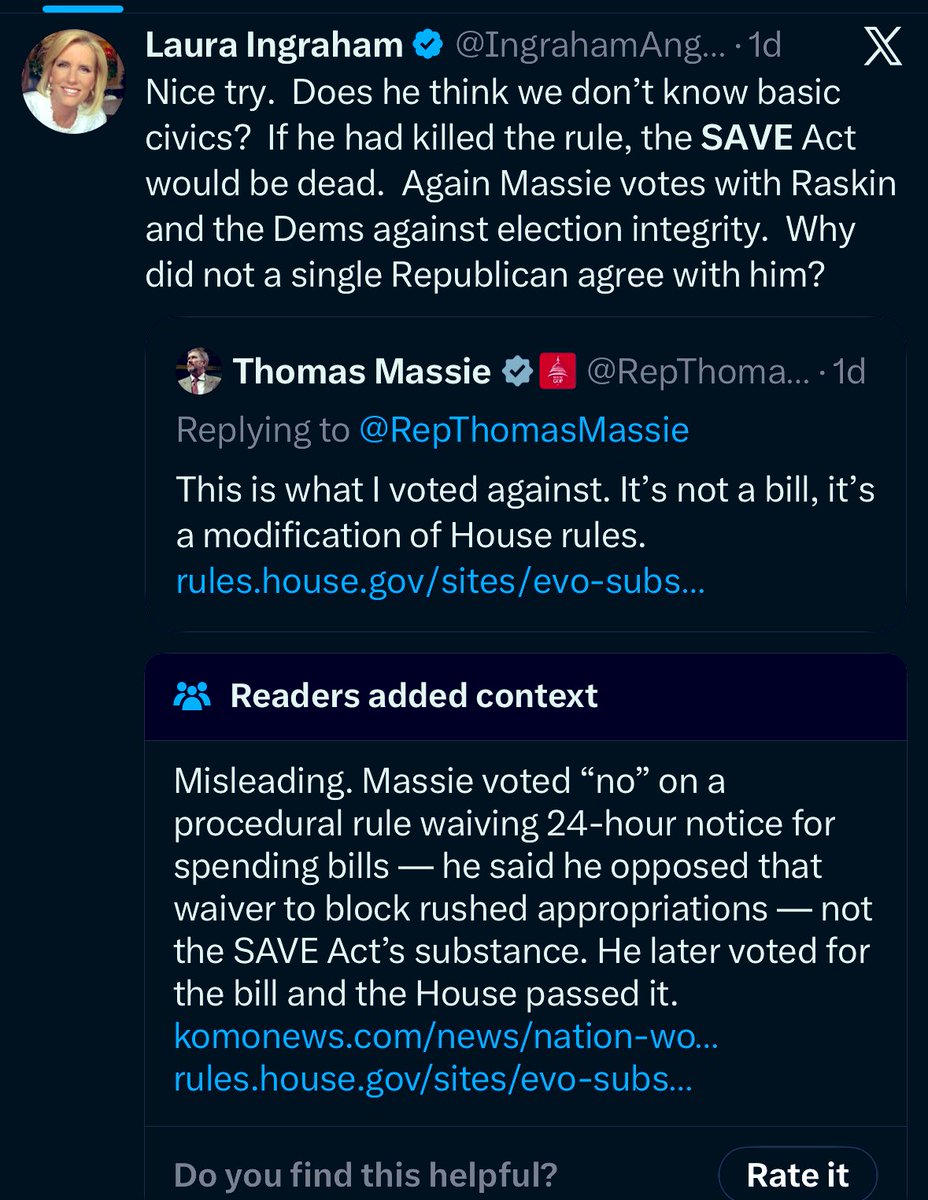
The swamp has tricks for deceiving the public, and most even work on congressmen. Here’s an example of how Laura and Greg played along as happy tools of the swamp.
Please ask yourself why your own congressman has never talked about this. He either hasn’t gotten this far in the game (80% chance), or he likes the way the swamp obscures what’s going on (10% chance), or he dislikes the system but the price he’d pay for telling you is too high (10% chance). If a congressman sees this post and wants to debate me, I accept!
The House has rules we adopt at the beginning of each Congress. Honestly we should just use those - some go all the way back to Thomas Jefferson. Some are like Robert’s Rules of Order which branched from House rules a century ago. But we have a rules committee that modifies the rules every week. I served on the rules committee for two years. When I was on the committee, I refused to vote for rules changes if the purpose was to mislead or obscure. Every week, the rules committee bends the rules to suit the Speaker, but you can’t place the blame just on the committee or the Speaker. Every rules change must be approved by the whole House with a majority vote.
Rank and file congressmen are told to vote for these rules modifications each week for the sake of party loyalty because the rules are temporarily modified by the majority to keep the minority from using the permanent rules against us. This is partly true, so most congressmen never question beyond this.
Typically, every week the rules committee meets before other committees and writes a rules package to protect bills that will come to the floor that week. Then the whole house votes on this rules package early in the week before significant legislation comes to the floor. The vote is typically on party lines. Sometimes a block of congressmen in the majority will take the rules package hostage and withhold their vote to get something else that has nothing to do with the rules. I’m not a big fan of this, but after 13 years, my hands aren’t completely clean of this tactic.
The high-road position that I try to maintain is that if the rules package is bad, you shouldn’t vote for the rules package, and in general you shouldn’t withhold your vote from a rules package if there’s nothing wrong with the rules package… even if you disagree with the policy that is enabled to come to the floor by the rules package.
There are more details, but that’s all you need to know to understand what I’m going to explain next.
This week the Speaker wanted to do two things outside of our base rules, so he put those inside of the rules package that also had the rules for bringing bills like the popular SAVE Act to the floor, knowing members would be afraid to vote against something associated with SAVE. THIS IS INTENTIONAL.
The Speaker wanted to circumvent the National Emergencies Act of 1976 to avoid voting on tariffs and he wanted to turn off the ban on bringing a spending bill to the floor the same day it’s introduced.
The first rules package that came to the floor this week failed because myself and other republicans objected to it. The rules committee met again, wrote a new rules package without the tariff-trick, and we voted on the second rules package. I voted no but internet goons, like clockwork, characterized this as a vote against the SAVE Act.
The swamp used that second rules package to give them authority to pass a bill before anyone could read it. They hid that authority inside the rule for the SAVE act because they knew people like Laura and Greg would help them disparage anyone who didn’t go along.
If you fell for Laura and Greg’s slop you were cheering for the Pelosi doctrine that we should pass bills to see what’s in them. If the rules package had failed, the rules committee would have written a better one and SAVE Act would have still come to the floor.
This is the most common ploy of the anti-@RepThomasMassie politico and punditry folks. To claim he voted against a bill’s seductively titled cover page, when it’s the unconstitutional crap jammed behind the title page that he votes against. Typically, those very things your favorite GOP politician also campaigned against … but knew you’d also fall for the title page misdirection while they stuff the bill with everything you voted against in the last election cycle.
I'd be curious to hear your thoughts on how closed AI models and the open source ethos interact. One of the reasons I haven't investigated LLM-assisted coding more heavily is that I'm uncomfortable with being dependent on a proprietary service in order to write code. Apologies if you've written on it before!
New York Wants to Ctrl+Alt+Delete Your 3D Printer
New York’s budget bill proposes mandatory file-scanning “blocking” software for 3D printers and CNC tools. It targets general-purpose tools instead of criminal acts — and puts educators, open source, and small makers on the hook first. 🗽🖨️
https://t.co/XqMVhxydvj
#3dprinting #opensource