Check out this legend! Jayant Kumar, has been crowned Global Champion at the Harvard Crimson Business Competition (HCBC), one of the most prestigious pre-college business competitions in the world judged by C-suite executives from Fortune 500 companies. Competing against more than 1,000 teams from around the world, most fielding teams of up to four members, Jayant from Karachi Grammar School competed entirely solo and made history as the first Pakistani student to ever qualify for the Global Final of this competition. Then he went all the way and won it!
You have noticed it. ChatGPT feels dumber than it used to. Your prompts that worked six months ago produce worse results now. The writing sounds flatter. The ideas sound safer. The internet itself feels like it is shrinking. Every article reads the same. Every email sounds the same. Every answer sounds like it was written by the same voice.
You thought it was you. It is not you.
Researchers at Oxford and Cambridge published a paper in Nature proving what is happening. They call it Model Collapse.
Here is the mechanism in one sentence. AI trained on AI-generated data gets dumber every generation until it forgets what real human data looked like.
The internet is filling with AI-generated content. Blog posts. Articles. Reviews. Comments. Social media. AI companies scrape the internet to train the next generation of models. Which means the next generation of AI is being trained on the output of the current generation.
Each cycle loses information. Not randomly. It loses the rarest, most unusual, most creative parts first. The researchers call these the "tails of the distribution." The weird ideas. The unexpected perspectives. The things that made the internet feel human. Those disappear first.
What remains is the average. The safe. The expected. The bland.
Then the next generation trains on that. And loses more. And the next generation trains on that. And loses more. The researchers proved this is not a slow decline. Major degradation happens within just a few iterations. Even when some of the original human data is preserved.
They tested it on large language models. On image generators. On statistical models. The pattern was the same every time. The output converges toward a narrow, flattened version of reality that looks nothing like the original data.
The lead researcher put it plainly. "Large language models are like fire. A useful tool. But one that pollutes the environment."
The pollution is invisible. You cannot see which sentence on the internet was written by a human and which was written by AI. Neither can the AI that is about to train on it. And once the tails are gone, they do not come back. The damage is irreversible.
This is not a prediction anymore. It is a diagnosis.
The internet you grew up on was built by humans writing things no algorithm would have written. Strange, personal, imperfect, alive. That internet is being diluted. One generation of AI at a time. And the models trained on what remains are learning a smaller and smaller version of the world.
Model Collapse is not a technical problem. It is a cultural one. The thing that made the internet worth reading is the thing that disappears first.
Artificial intelligences do not undergo experiences, do not possess a body, do not feel joy or pain, do not mature through relationships, and do not know from within what love, work, friendship or responsibility mean. Nor do they have a moral conscience, since they do not judge good and evil, grasp the ultimate meaning of situations, or bear responsibility for consequences. They may imitate or even simulate, but they do not understand what they produce, for they lack the affective, relational, and spiritual perspective through which human beings grow in wisdom. #MagnificaHumanitas
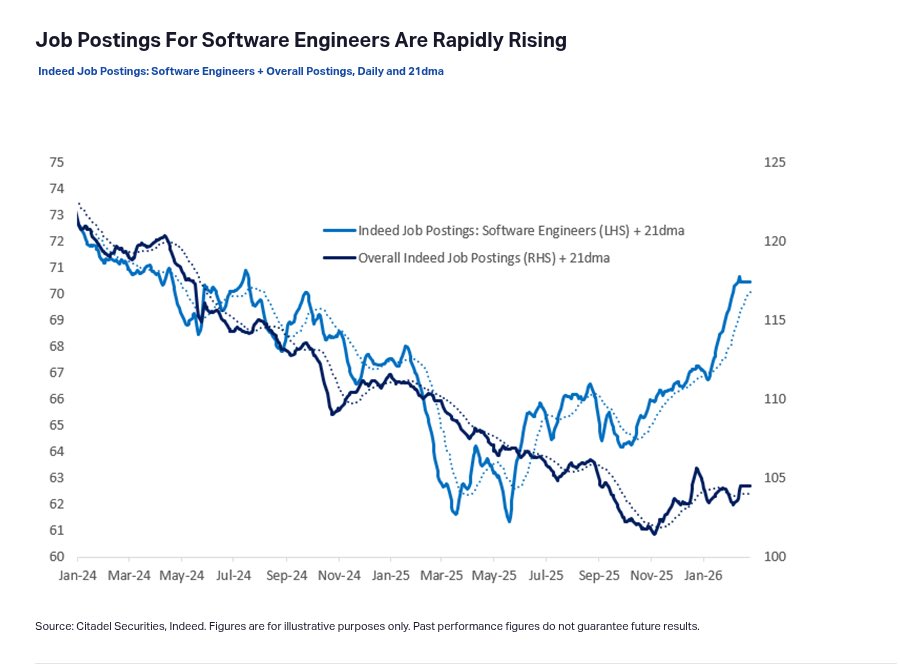
Q: How are job postings for software engineers rising rapidly despite AI agents automating coding?
A: Because there’s far more code to manage than ever before. We’re already seeing a 14x YoY increase in GitHub commits, and it’s accelerating.
AI has dramatically lowered the cost of writing code, so it’s now being used across far more businesses, applications, and use cases.
We’re at the beginning of a massive productivity boom driven by the proliferation of bespoke software throughout the entire economy.
Coding has been AI’s breakout use case this year. The fact that it’s increased demand for software engineers — rather than decreased it — should call into question the entire “AI will cause mass job loss” narrative.
As evidenced by the unbridled promotion and implementation of technology at the expense of human dignity, we are truly experiencing an eclipse of the sense of what it means to be human. It is imperative to recover an understanding of the true meaning and grandeur of humanity as intended by God. It is in this sense that the challenge we currently face is not technological, but anthropological, and it is my hope that the Encyclical Letter to be published within a few days will contribute to answering this challenge.
Massie's not only the most conservative member of congress - in the freedom and constitutionalist sense - but also the smartest.
He graduated from MIT with a B.S. in Electrical Engineering and Master of Science in Mechanical Engineering and while there, invented a haptic computer interface, founded a technology company in his dorm room, got dozens of patents, and made millions of dollars.
Today the tech he invented is used in surgical training, robotics, and molecular research, among other things.
Man who went viral for remaining in his seat as he ate food during the WH Correspondents' Dinner shooting says he didn't want his new tux on the dirty Hilton floor.
He also said he is from New York, so he hears sirens and activity all the time.
"I’m a New Yorker. We live with sirens and activity happening all the time," Michael Glantz, an agent at Creative Artists Agency, said.
"I wasn’t scared. There are hundreds of Secret Service agents hurtling themselves over tables and chairs, and I wanted to watch."
"First of all, I have a bad back. I couldn’t get on the floor, and if I did get on the floor, they’d have to bring in people to get me off the floor. And No. 2, I’m a hygiene freak. There was no freaking way I was getting in my new tux on the dirty Hilton floor. It was not happening."
I have changed my mind on how AI will impact jobs in America.
Previously, I believed AI would replace many entry level roles typically filled by young employees. The technology would then work its way up the organization and eventually reduce the total number of jobs in a company.
The data is saying something different, so when I get new information I am willing to change my mind.
The number of software engineers being hired has been increasing. The number of open software engineer roles is growing.
The number of new college grads who get hired has increased 5.6% over the last 12 months. The unemployment level for people aged 20-24 years old who have a college degree has fallen from nearly 9% to almost 5% as well.
The Wall Street Journal recently wrote “AI created 640,000 jobs between 2023 and 2025 in the U.S., according to an analysis by LinkedIn of job posting data, including new white-collar positions such as Head of AI and AI engineer.”
And I am starting to see companies throughout our portfolio aggressively hiring to keep up with the demand for their products and services.
If AI can make employees more productive, which is widely accepted as fact, then companies are going to want as many productive units of labor as possible. This is a key reason why I am changing my mind.
AI appears to be a magical technology that will make companies more productive and more profitable. The net result will be more corporations, more startups, and more jobs.
All three are big, positive wins for the American economy.
Yes, cats really do clock the difference. The wiring behind it is mammal-wide and ancient, and Konrad Lorenz mapped it back in 1943.
Lorenz, an Austrian biologist, noticed that babies of pretty much every mammal look kind of similar. Big head, big eyes set low on the face, small nose, chubby cheeks. He called it the baby schema. Any face hitting those proportions trips a switch in the brain’s reward circuit. Same circuit that fires when you eat something delicious or hear your favorite song.
Oxford researchers nailed down the timing in 2008. Using a brain scanner that tracks activity down to the millisecond, they showed that adults’ reward circuits light up in roughly a seventh of a second when a baby’s face appears. All before you’ve consciously processed who you’re looking at.
It also works across species. Swiss researchers showed in 2013 that just looking at puppy faces for a few minutes shifts how cute adults then rate human baby photos. The brain is using the same wiring to judge cuteness in both. Stand baby chimps, gorillas, orangutans, and human babies side by side and they all share the same proportions: rounder face, bigger eyes lower in the head. Mammals are born with this response.
Now add sound. Cats hear high pitches that humans can’t reach. Their best hearing range happens to be where kitten distress calls live, and right where the harshest pitches of a human baby’s cry land. Both sounds pull on the same alarm. Researchers writing in Nature in 2023 traced the exact brain pathway in mice that releases oxytocin, the bonding hormone, when a mother hears her pups cry. The hearing region of the brain wires straight into the part that controls hormones, and similar wiring shows up across mammals.
So when a cat sits next to a toddler and stays calm, the explanation runs back hundreds of millions of years. Soft thing, big head, high-pitched noises, do not attack.
Just landed at an airport in Mexico. Handed over my Pakistani passport for immigration, and the officer smiled warmly, looked at me and said, “You’re a global peacemaker. We’re proud of you.”Made my day.🇵🇰🇵🇰
I'm having more fun building software today than I've ever had.
(Except, of course, when I run through my whole Claude MAX plan in 2 hours. That sucks big time.)
I'm writing less code, but that doesn't bother me.
The fun part for me has always been building new things.
Writing the code is a means to an end. Fun, but not the most important piece.
I'm still proud of the code I write, by the way. And I try to make it as nice as possible, but I'm also learning to let go and trust coding agents more.
These are new times.
Being a mentor for Team 13201 Hazmat is one of the most rewarding things I do, and this amazing group of students just qualified for the World Championship in Houston! 📷📷
https://t.co/obc7FPrtAy