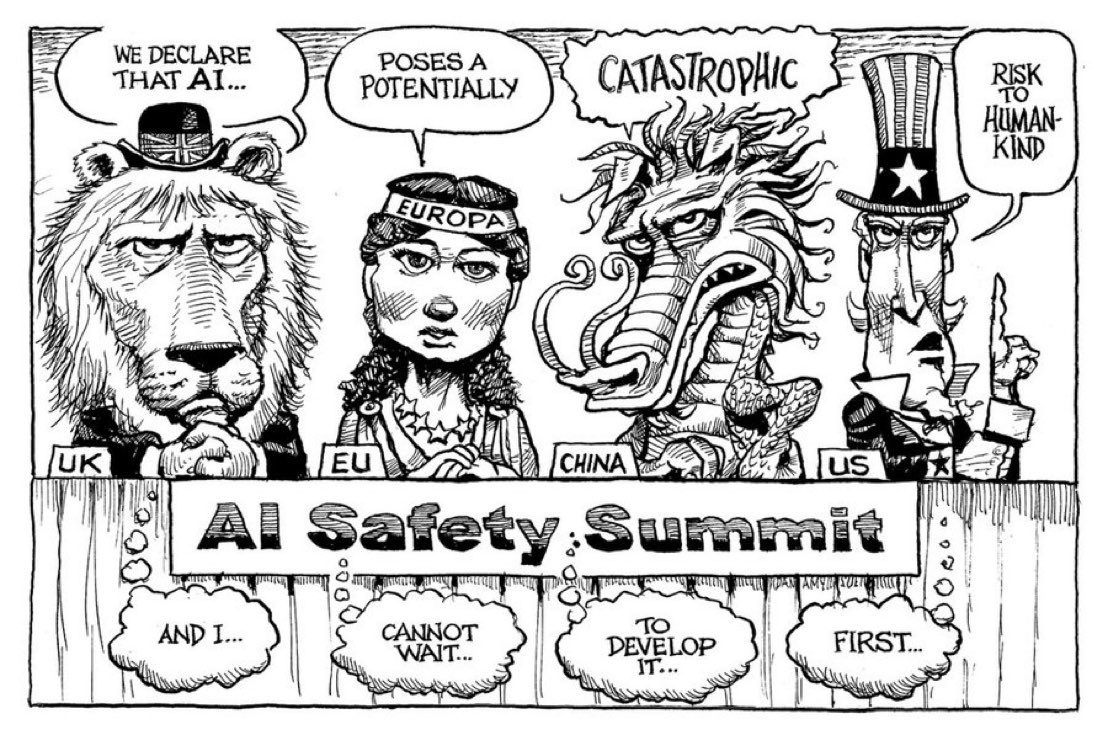
The loudest voices stoking fears about AI dangers have made tremendous headway in the past two weeks. AI technology has not taken some unexpected, dangerous turn, but the hype around it — propelled by what appears to be a well orchestrated PR campaign — has drummed up considerable fear. I worry that it represents a setback for our field.
I have written frequently that fears of AI are overhyped. AI’s capabilities can be uncannily human-like and unpredictable, and it’s rational to worry when people who are directly involved express concerns. But I see the problems as a sign of the engineering work that ahead, rather than insurmountable barriers or the sky falling. AI technology continues to advance — which is a good thing! — but technical advances, poorly understood by the public, give those who seek to generate hype repeated opportunities to do so.
First, I don’t see any step up in the risk of human extinction from AI compared to a few months ago. The theories about this remain the same fantastical, science fiction scenarios as a few months ago. The biggest change in AI risk is its cybersecurity capabilities — a topic which we should take seriously — but this, too, will not lead to the end of the world.
The most notable recent event leading to increased fear was when an OpenAI team deployed an agent swarm that hacked into Hugging Face. Much of the popular press contained significant hype. For example, some publications reported that a swarm of 1,200 agents carried out the attack. While this was technically accurate, as I write this, I have about 1,300 processes running on my laptop. Yes, the ability to get large swarms of agents to work in parallel on a task is a significant technical advance, And, in computing, many processes run at the same time. So this shouldn’t be seen as some magical capability.
Additionally, OpenAI’s buggy sandboxing and monitoring processes were key to enabling this incident. Fixing these bugs and putting in place improved monitoring would be appropriate fixes, not pausing AI. There are many well known ways to attack software systems. The main advantage of AI agents is that they are relentless. They will tirelessly try many tactics — and have the patience to chain vulnerabilities together — that previously would have taken an infeasible amount of human effort. But in the long term, I believe the advantage will lie with defenders (because they have more information with which to identify bugs, which they can fix), but the cyber-threat landscape has changed significantly. There are still bottlenecks to identifying and exploiting a vulnerability. AI agents still have to try a lot of things to see what works, and taking these actions takes time and might be detected by defenders. This is why, even though it is now easy to obtain versions of leading open weight models that have had their guardrails removed or weakened, so they will not refuse to try to execute cyber attacks, the world has not ended.
I am also concerned about the anthropomorphization of AI in a lot of reporting, where LLMs and agents are unnecessarily treated as if they were people. If I wield a hammer, miss a nail, and accidentally dent the wall, it’s not the fault of the hammer. The problem lies in how I used the hammer. Similarly, if I prompt an agent and it hacks into someone else’s system, the responsibility lies with me, not the agent.
Of course, we want to build systems that are as safe and predictable as possible. (For example, an unsafe hammer would be one whose head randomly flies off under normal use.) Today’s agentic systems are not predictable, but I see no reason why, by applying sound engineering practices, we won’t be able to make them extremely safe to use. One new element in the forecasts of AI-enabled doom is AI companies disclaiming responsibility for their own products. “I didn’t do it; my out-of-control agent did!” There’s a balance to be struck between the responsibility of the tool maker and the tool user, but when something goes wrong, let’s hold the people building and/or using the hammer responsible, rather than the hammer. (By the way, if you’re worried about AI bioweapon risk, David Bellamy has a great post on why this, too, is overhyped. Briefly, the bottleneck in building a bioweapon is not intelligence, but lab work and manufacturing.)
Pausing AI progress will create much more harm than benefit. First, our adversaries will certainly not slow down. Second, engineering requires discovering problems empirically so we can fix them. If we pause AI by a decade, we will also delay finding and implementing safety engineering fixes by about the same duration.
Of course, the incentive to stoke fears — for regulatory capture, to garner attention, or to make one’s technology seem more powerful — remains the same as before. Disclaiming responsibility is a new one. Taking a hard technical look at the actual risks however, I see little factual basis for the degree of fear that’s been stoked up. We still have hard research and engineering work ahead to improve AI safety, but the beneficial applications continue to vastly outweigh the risks, and we should keep building.
[Original text (with links): https://t.co/jni2tWazAH ]
This is exactly right. Source code is on the verge of becoming like assembly.
The next step is getting rid of “source code” entirely and just making an efficient binary directly with AI.
Μια συναρπαστική συνέντευξη που πήρε από τον Νόλαν μια Κινέζα (!) podcaster, με βαθιά γνώση της Οδύσειας και του αρχαίου Ελληνικού πολιτισμού, που δείχνει πόσο ρηχός είναι ο Κρίστοφερ Νόλαν.
Η Κινέζα τον ρωτάει γιατί, ενώ ο Όμηρος στα έπη του δοξάζει τον πόλεμο και τους θριάμβους, αυτός θέλει να περάσει ένα αντιπολεμικό μήνυμα - στο οποίο ο Νόλαν απαντά ότι προσπαθεί να βάλει "τη ματιά του θεατή" στην ταινία.
Τον ρωτάει γιατί εκχριστιανίζει την Οδύσσεια του Ομήρου. Εκείνος λέει ότι δεν το έχει σκεφτεί πραγματικά, αλλά η παραβίαση των νόμων του Δία του φάνηκε μια ενδιαφέρουσα πτυχή.
Τον ρωτάει γιατί οι δυτικοί κινηματογραφιστές νιώθουν ότι πρέπει να ζητήσουν συγγνώμη που απεικονίζουν το μεγαλείο. Εκείνος λέει ότι πρέπει να βάλουμε το μεγαλείο στο πλαίσιο του τώρα, επειδή πιστεύουμε στην ισότητα και στις δημοκρατικές αξίες.
Τον ρωτάει αν οι θεοί είναι πραγματικοί στην ταινία του και εκείνος λέει ότι φαίνονται πραγματικοί σε ανθρώπους που πιστεύουν σε αυτούς.
Είναι πραγματικά απίστευτο πόσο λίγο φαίνεται να έχει σκεφτεί κάτι από αυτά. Κάθε φορά που μιλάει, προσπαθεί να χλευάσει κάθε συντηρητική φωνή, προσπαθώντας να μας πει ότι η ταινία του έχει κάποιο είδος κρυφών πανανθρώπινων μηνυμάτων ή να είναι οτιδήποτε άλλο εκτός από μια Χολιγουντιανή υπερπαραγωγή.
Όσο για τους κριτικούς κινηματογράφου και "επαγγελματίες δημοσιογράφους" που χαριεντίζονται μαζί του χασκογελώντας στις συνεντεύξεις μαζί του, λέει πολλά ότι το μόνο άτομο που ήταν πρόθυμο να του κάνει τέτοιες βαθιές ερωτήσεις ήταν μια Κινέζα podcaster. Είναι απολαυστική.
Prof. Donald Knuth opened his new paper with "Shock! Shock!"
Claude Opus 4.6 had just solved an open problem he'd been working on for weeks — a graph decomposition conjecture from The Art of Computer Programming.
He named the paper "Claude's Cycles."
31 explorations. ~1 hour. Knuth read the output, wrote the formal proof, and closed with: "It seems I'll have to revise my opinions about generative AI one of these days."
The man who wrote the bible of computer science just said that. In a paper named after an AI.
Paper: https://t.co/juSOmK9vOt
Η σύναψη της Συμφωνίας Ελεύθερων Συναλλαγών Ινδίας-ΕΕ σήμερα σηματοδοτεί ένα σημαντικό ορόσημο στις σχέσεις μας. Ευχαριστώ όλους τους ηγέτες της Ευρώπης όλα αυτά τα χρόνια για το εποικοδομητικό τους πνεύμα και τη δέσμευσή τους στην επίτευξη αυτού του στόχου. Αυτή η συμφωνία θα εμβαθύνει τους οικονομικούς δεσμούς, θα δημιουργήσει ευκαιρίες για τους λαούς μας και θα ενισχύσει την εταιρική σχέση Ινδίας-Ευρώπης για ένα ευημερούν μέλλον.
This is very dishonest and harmful advice for yound people. Don't do this. Stay away from a humanities PhD.
It's extremely irresponsible of The Chronicle to even publish an article like this.
The writer of this artilce, Ada Palmer, is a tenured professor at the University of Chicago and is telling folks to do a PhD in history.
You'll have to live below the poverty line for 5-7 years in order to become a jobless PhD.
You can become jobless without wasting 5-7 years.
If you're interested in writing and research, acquire useful skills like writing for SEO and social media or marketing or programing.
Acquire skills that you can learn in 6-12 months and are immediately monetizable.
Consider doing a PhD in history only if your grandfather left you a trust fund.
Announcing The Stargate Project
The Stargate Project is a new company which intends to invest $500 billion over the next four years building new AI infrastructure for OpenAI in the United States. We will begin deploying $100 billion immediately. This infrastructure will secure American leadership in AI, create hundreds of thousands of American jobs, and generate massive economic benefit for the entire world. This project will not only support the re-industrialization of the United States but also provide a strategic capability to protect the national security of America and its allies.
The initial equity funders in Stargate are SoftBank, OpenAI, Oracle, and MGX. SoftBank and OpenAI are the lead partners for Stargate, with SoftBank having financial responsibility and OpenAI having operational responsibility. Masayoshi Son will be the chairman.
Arm, Microsoft, NVIDIA, Oracle, and OpenAI are the key initial technology partners. The buildout is currently underway, starting in Texas, and we are evaluating potential sites across the country for more campuses as we finalize definitive agreements.
As part of Stargate, Oracle, NVIDIA, and OpenAI will closely collaborate to build and operate this computing system. This builds on a deep collaboration between OpenAI and NVIDIA going back to 2016 and a newer partnership between OpenAI and Oracle.
This also builds on the existing OpenAI partnership with Microsoft. OpenAI will continue to increase its consumption of Azure as OpenAI continues its work with Microsoft with this additional compute to train leading models and deliver great products and services.
All of us look forward to continuing to build and develop AI—and in particular AGI—for the benefit of all of humanity. We believe that this new step is critical on the path, and will enable creative people to figure out how to use AI to elevate humanity.
🚀Friendly reminder: Don’t miss out on our upcoming DataBri-X Tool Session 3 'Unlocking tools for data description and preservation' on 3 May 2024. 📅🔍 Info and registration: https://t.co/r2KJQmsmTK
#DataManagement#DataPreservation#DataBriX#Toolsession#Innovation
The EU AI Act negotiations ended.
One contentious issue was the regulation of foundation models, particularly open source ones.
Kudos to the French, German, and Italian governments for not giving up on open source models.
Juicy part:
"The legislation ultimately included restrictions for foundation models but gave broad exemptions to “open-source models,” which are developed using code that’s freely available for developers to alter for their own products and tools. The move could benefit open-source AI companies in Europe that lobbied against the law, including France’s Mistral and Germany’s Aleph Alpha, as well as Meta, which released the open-source model LLaMA."
https://t.co/6N3azO8yzx
Google’s latest AI model is only marginally better than the one from OpenAI that’s been out for eight months, @parmy writes https://t.co/sHZnKkKgy6 via @opinion
Gemini is multimodal and can recognize images and speak in real-time.
With a score of 90%, Gemini Ultra is the FIRST AI model to outperform human experts on the MMLU benchmark.
This demo is incredible.
The numbers are huge. 93% of employers expect to use #generativeAI in the next 5 years. Employees will need training, and @amazon is filling that gap with “AI Ready,” a commitment that aims to provide free AI skills to 2 million people by 2025.
This includes free #AI & generative AI courses for professionals, a new generative AI scholarship program for high school and university students globally, and a collaboration with @codeorg to inspire young learners about the possibilities of this transformative technology.
If you want to learn generative AI skills, we have the programs to get you started. https://t.co/WlxLOLKIi9
An article about my vociferous support of open source AI platforms.
Demis Hassabis, Dario Amodei, and Sam Altman (among others) have scared governments about what they claim are risks of AI-fueled catastrophes.
I know that Demis, at least, is sincere in his claims, but I think those claims are incorrect and counterproductive.
The inevitable *effect*, intentional or not, if governments believe those claims would be a regulatory capture profiting their companies.
I do think that the short-term societal dangers of proprietary AI systems that will soon mediate everyone's digital diet are considerably higher than any imagined catastrophe caused by the misuse of open source AI systems.
And I believe that the benefits of open source AI platforms in terms of progress, safety, economic development, and cultural diversity are overwhelming.
https://t.co/UQImxIaTEj
The global AI Safety Summit starts in the UK today.
Here’s what we hope to achieve:
✅Agree on the risks of AI, to inform how we manage them
✅Discuss how we can collaborate better internationally
✅Look at how safe AI can be used for good globally
There’s more🧵