One way a church can care well for those who have experienced trauma is by including corporate lament in the liturgy.
In lament we name the sins committed against us and the suffering present in the world, bringing them honestly before God.
The Psalms show us that faithful worship makes space not only for praise, but also for grief and comfort.
“You have kept count of my tossings; put my tears in your bottle. Are they not in your book?” Psalm 56:8
We cannot weep during the entire course of our sorrow. The body cannot bear it.
But there is a bottle and a book where the tears are kept ever before the Lord.
His compassions never fail.
At the heart of biblical counseling is the vicarious humanity of Christ. We are not asking weary people to perform better, but inviting them to receive and rest in the obedience, faith, and life of Jesus for them.
How does God feel toward His children when they sin?
1. His posture toward them does not change.
2. He feels fatherly compassion, not disgust.
3. He is grieved because sin wounds His beloved, not because His patience is drained.
4. He moves toward sinners, not away.
5. He disciplines, but never to destroy, only to restore.
6. His love remains as full on your worst day as on your best.
Self-pity responds to sin by saying, “I should have done better.” Repentance responds in faith by saying, “Jesus is enough for even this.” One keeps us stuck in shame. The other leads us to grace, freedom, and hope.
Every time we treat someone with dignity rather than shame, respect rather than disregard, concern rather than exploitation, kindness rather than brutality, and careful attention rather than turning away, we are doing things that are the reverse of trauma and evil.
For years, I knew God was holy—but I didn’t grasp how holy.
I thought I could close the gap with effort, discipline, sincerity.
I didn't understand the Covenant of Works and how it demands perfection.
Not improvement. Not potential. Perfect obedience.
Part of me still believed I could manage it—prove myself, meet the standard, perform, be enough.
I felt God loved me but He was mostly disappointed with me. Frustrated. Annoyed. Shaking His head thinking I should be doing better.
Then I saw Jesus not just as my Savior, but as the only One who ever fulfilled the Covenant. Perfectly. Joyfully. Fully.
He didn’t just die for my sins—He gave me His perfect obedience and righteousness. And now, under the Covenant of Grace, I don’t strive for acceptance—I live from it.
That truth, over the years, has quieted my striving and melted my pride.
It’s replaced fear with worship. Shame with rest. It continues to do so daily.
Each day I remind myself I don't have to try to be enough.
Jesus is enough for me.
Your future isn’t built in breakthrough moments — it’s shaped in the quiet, ordinary choices no one claps for. The ones where you show up. Say no. Stick to your values.
Growth looks like consistency, not just intensity. And that’s really good news — because it means you can start today… right now.
Keep this post in your back pocket for when you face a big (or small) decision.
Save it so you can come back to it. Wisdom is in the questions you ask yourself.
Today we remember that God washes our feet.
The fingers that crafted the universe scrub scum from between toes.
The hands that painted the cosmos wash feet painted with dirt and sweat.
The One before whom all angels bow gets on his knees to labor as a slave.
We become clean, he becomes filthy.
In doing this, Jesus our God gives us a humble epiphany, a revelation of who he is. He is the God who makes his glory visible in lowliness and servitude.
He is the God who gives
-his cheek to the betraying lips of Judas
-his face to the slapping hand of the high priest
-his countenance to the spit of the Sanhedrin.
He is the God who gives
-his head to the thorns
-his feet to the spikes
-his side to the spear.
He is the God who embraces rejection, shame, torture, and death, to give himself to you.
And here is why: because that’s who God is. He is the God who is love. Therefore he loves you by giving to you. For God so loved the world that he gave his only Son. What he gives you is nothing less than himself.
God gives, you receive. This is everything.
He not only washes your feet; he washes you clean, body and soul, through the holy bath in his name. He fills the baptismal font with water from his spear-pierced side and kneels there to wash off the dirt and sweat and grime of your evil.
He feeds you himself, his body, his blood. Every natural food we take into our bodies is transformed into our bodies. We don't become corn on the cob or hamburgers. But the supper of our Lord is different. This food transforms you into that which it is. You, the church, are the body of Christ. You are what you eat.
So, come and eat. Come and drink. Come to the lowly God who has joined you in your lowliness that he might exalt you in himself.
On Maundy Thursday, let us recall, with thanksgiving, how fitting it all is:
How fitting that humanity, which plunged into death by eating forbidden fruit, should receive life and immortality by a meal provided by our Savior, the Last Adam.
How fitting that sinners, their unity rent asunder by hatred and violence, should be gathered into one communion by partaking of the one loaf, baked from many scattered grains.
How fitting that we, who are hard pressed and beaten down by evil, should be comforted and uplifted by drinking from the Lord’s cup, filled with the blood of grapes that have been trampled and pressed underfoot.
How divinely and beautifully fitting, on this holy Thursday, that we have our feet lovingly washed by the very God from whom we once ran in terror and shame.
Here is our God, Jesus Christ, who comes not to be served, but to serve, and to give his life as a ransom for many.
Satan gives Adam an apple, and takes away paradise. Therefore in all temptations consider not what he offers, but what we shall lose.
— Richard Sibbes (1577–1635)
When we choose partners unconsciously, we re-create our childhood dynamic. it's the greatest opportunity for healing. But if we refuse to look within, it creates more pain and complex trauma.
“Knowing your own darkness is the best method for dealing with the darknesses of other people. It would help you to have a personal insight into the secrets of the human soul. Otherwise everything remains a clever intellectual trick consisting of empty words leading to empty talk.”
— Carl Jung
It’s sad that two generations of young men were lied to by their parents that traveling, “having experiences,”focussing on career, “finding out who you are,” etc. are all more fulfilling than coming home to this. This is leveling up, not “settling down.”
https://t.co/32j9Z56l9S
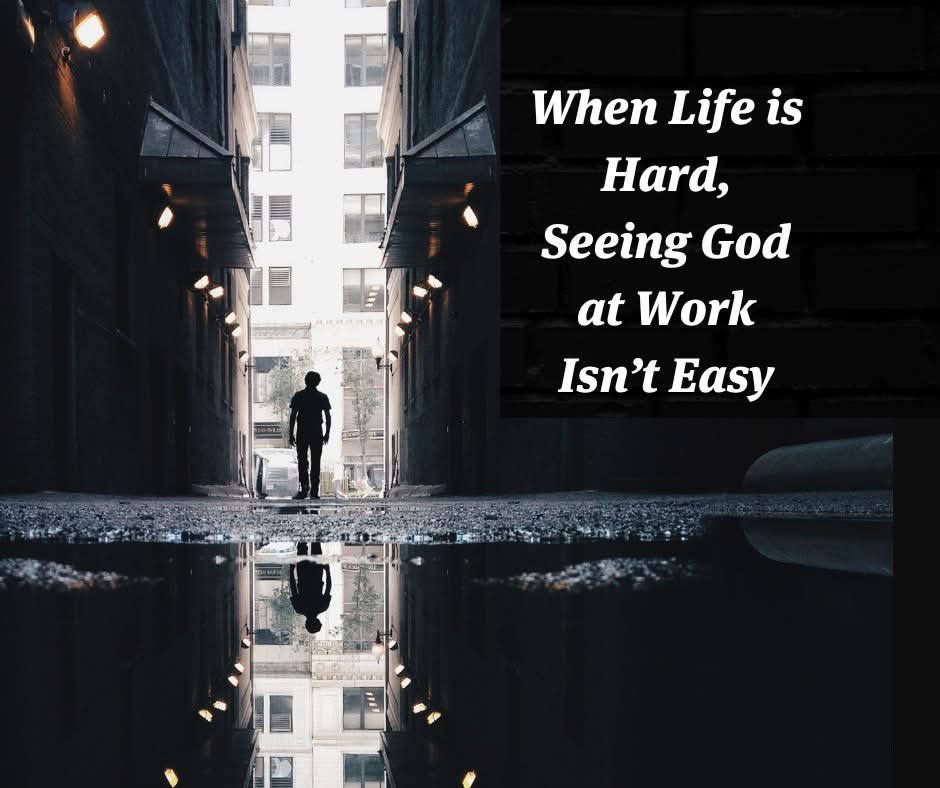
How do you tell your life’s story? When Christians tell theirs, especially when we get to the hard parts of the story, we might add something like: “I didn’t realize what God was doing at the time…”
Implicit in those words is this confession: When life is hard, seeing God at work isn’t easy.
With that in mind, perhaps we understand better why Genesis 39 tells us, four times, that the LORD was with Joseph (verses 2-3, 21, 23).
[1] He had been betrayed and sold into slavery, but “the LORD was with Joseph” (39:2).
[2] Even Potiphar, the Egyptian master of Joseph, saw that “the LORD was with him” (39:3).
[3] When Joseph was falsely accused of attempted rape and incarcerated, “the LORD was with Joseph” (39:21).
[4] Even in prison, Joseph rose to leadership because “the LORD was with him” (39:23).
These expressions are unique in the whole Joseph narrative. They only occur here. And rightly so. Because in these years, Joseph was learning the hardest lessons of life.
There is a powerful lesson here for us as well. When life is hard and seeing God at work isn’t easy, remember that the LORD is with you. You may not see any evidence of that; in fact, you might see evidence that suggests his absence.
But Jesus, the Son of the Father, is Immanuel, “God with us.” With us as we cry ourselves to sleep. With us when we are betrayed. With us when we are falsely accused. With us no matter what, no matter where we are in life, no matter how many things seem stacked against us.
The LORD Jesus is with us, now and to the end, as he promised, “Behold, I am with you always, to the end of the age” (Matthew 28:20).
++++++
We read Genesis 39 today in Bible in One Year. Join our online community of Bible readers and students! For more information and to sign up, visit https://t.co/XxNvEtNH7e
You can only help people by entering into their darkness. You cannot talk people out of suffering, trauma, addiction, or great grief. You must go to them, sit with them, listen and understand; then little by little you can begin to walk with them toward a new and different place.
Yesterday Sebastian Cappelen teed off in his first KFT event in his comeback at the @BahamasKFTour But his story is worth your time.
(a long one upcoming)
Cappelen, who is from Denmark, was a 4x All-American at Arkansas. In 2014 he turned pro and attempted a Mon Q for a KFT event. And got through a 7 for 2 playoff to earn his first ever KFT start.
All he did in his first start was shoot 66-65-65-66 and won. He played 12 events that year and nearly got his PGA Tour card. He got an exemption into Sanderson that year, led after the first round and finished T35. It seemed he was destined to be a pga tour member in no time.
But things don't always go as planned and Cappelen grinded on the KFT for years, before winning again in 2019 and finally earning his PGA Tour card for 2020.
He struggled there, while battling injuries, playing 44 career events making 16 cuts. His battles with injuries caused Cappelen to walk away from the game in 2021. He got into private equity. He and his wife Audrey had two children. But something wasn't right.
One Saturday morning last may Cappelen felt lost and unable to deal with everyday things . He thought "I have to get out of here."
He went to bathroom and cried for nearly an hour. Audrey came in to comfort him, neither knowing what was wrong. "I just couldn't deal with day to day stuff".
Cappelen called his Dad who got him in touch with a therapist. The next six weeks or so Cappelen hardly left the house. Getting out of bed was a victory. He dove into therapy headfirst. And was diagnosed with ADHD.
Always a deep thinker the diagnosis was freeing for Cappelen, while thinking about some struggles he blocked out for most of his life.
A few months ago he considered a comeback in golf and talked with Audrey about it. He called friends and found sponsors. He was open with them about his struggles, "you find out who your true friends are". Countless people committed to help him. The comeback became a reality.
Audrey and he continue to see therapists, continue to be open with each other about the journey. Cappelen has status for the full season this year on KFT from his medical exemption and plans to play the entire season.
Yesterday Sebastian Cappelen teed it up in his first event, promising himself he wouldn't be results oriented. He wants to enjoy the time, something he thinks he didn't his first run at pro golf.
I talked with him after the round, he shot Even and sits outside the cut line. I asked him how it went and he said "look around, how could you not love it" He focused our conversations with the ones he had with his wife. Process, process, process. Talked about his therapy.
Golf is not the most important thing this time around.
The tragedy of trauma is that we’re prone even to distrust kindness.
We’ll self-protect and even sabotage the goodness offered.
Even as God approached Adam and Eve in the garden, they hid.
And so that fatal step is taken, the bond of trust is broken, and we are lost. We know that we are naked, vulnerable, easily hurt. We hide ourselves from God. We compete with each other. The neighbor given to us to be a neighbor becomes our rival. The world given to us to be our garden becomes a wilderness with which we have to fight. And there comes that terrible cry echoing throughout the garden: Adam, where are you?
Lesslie Newbigin