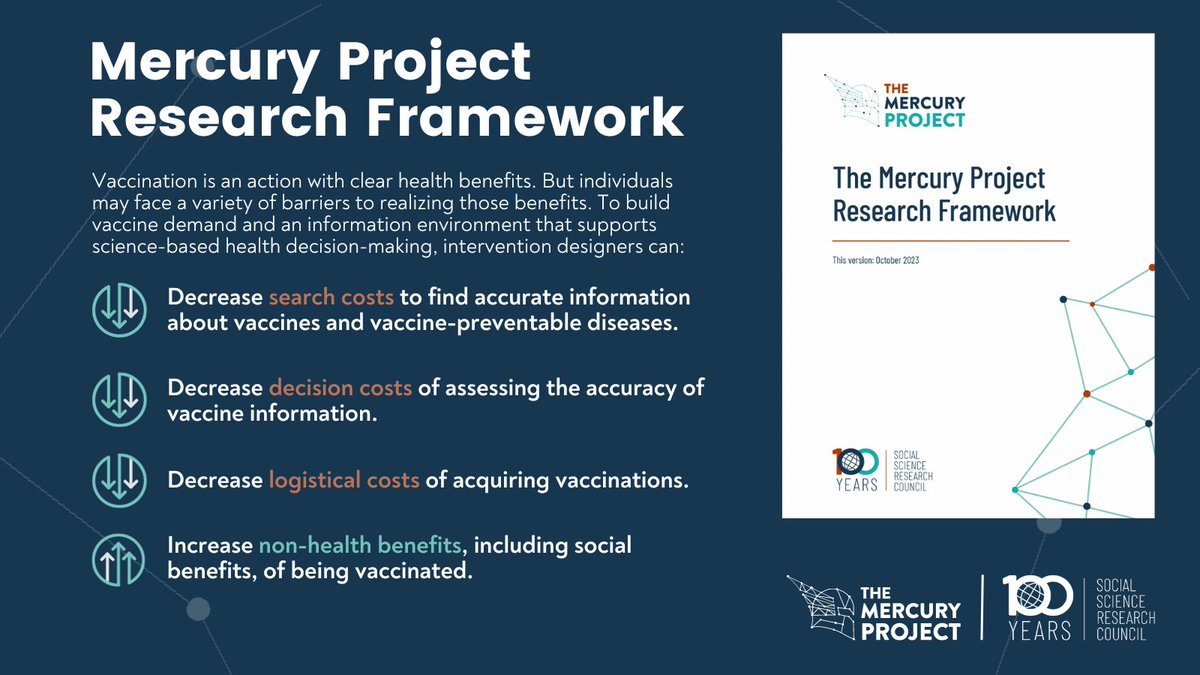
We are pleased to release a new version of the #MercuryProject Research Framework.
Currently used by 18 teams globally, the framework is designed to help funders, researchers & policymakers coordinate on effective interventions to ⬆️vaccine uptake.
https://t.co/0BQnqZCJ4x
🧵👇
.@NIH Acting Director Larry Tabak recently said, "We'll have to have the discipline to stop supporting underpowered boutique studies."
Read our proposal to @NIH_CommonFund to ⬆️ the chances of finding replicable policy solutions using “master protocols”:
https://t.co/TOKnklrn0a
My short piece on the 2019 Piatúa River protests (Ecuadorian Amazon) is out in @SSRC_items. In the essay I focus on the gap between formal rights protections vs. their actual exercise on the ground, & highlight the key role of local Indigenous organizing.
https://t.co/OFTCNhhLCT
READ Our latest research review on #heritage, #prevention of violent conflict, and #MassAtrocity (https://t.co/iC7NH5Ppnf). Complements our earlier essay series (https://t.co/riG4G8e3W0). Thx to our own @bolinresearch!
It's our 100th birthday! 🎂
In 1923, social and behavioral scientists from @AEAinformation@APSAtweets@ASAnews@AmstatNews founded @ssrc_org to support policy-relevant social and behavioral science aimed at advancing human well-being.
#SSRC100
https://t.co/hJirXDUTxn 🧵👇
Two years after the storming of the US Capitol, we revisit @ChristinaKulic2 and @bethiamswellman’s essay unpacking the infamous incident through the lens of democratic erosion scholarship. https://t.co/V1ShjwKrfW
"True success means a public health infrastructure that doesn’t have to claim success from recovering from predictable tragedy"
SSRC #MercuryProject grantee @NeilLewisJr, w/@DraCoquiMD & @ChomiloMD, examine narratives vs reality of Covid-19 inequalities
https://t.co/qA43jDUHcx
“The feeling of abandonment that permeates the history of favelas was so amplified during the pandemic that civic leaders stopped making demands of the state and instead focused on dealing with the crisis themselves.” https://t.co/qXLkqSL006
🚨New paper out! "The Blind Spots of Sociotechnical Imaginaries: COVID-19 Scepticism in Brazil, the United Kingdom and the United States". 🌎https://t.co/T7E78x4r9l 🧶 @SAGEPubIndia
The mobilization of civic organizations in favelas in response to Covid-19 exemplify how democracy can be reinvented when government fails to provide support to these communities, explain @AnjuliFahlberg and her coauthors. https://t.co/zHLfs2UoMd
We are pleased to announce the recipients of the 2022 Religion, Spirituality, and Democratic Renewal Fellowships, in partnership with @FetzerInstitute. Fellows will receive 12 months of support for their research projects.
https://t.co/1qEZHOlnND
“Accustomed to fending for themselves, residents pulled together their resources and activated networks of civic associations to provide food, masks, and other basics.” https://t.co/acJVBUuF1t
NEW FORUM | The forum on "Hindutva and the shared scripts of the global right" examines the rise of far-right movements and actors globally with Hindutva and the Hindu right at the center of this inquiry. Read the introduction from Supriya Gandhi (@Yale): https://t.co/0DykTCqgYr
In Alabama, immigrant-serving organizations collaborated with other minority groups to provide support to immigrant voters, @HajYazdiha & @BlancaArRamirez found. https://t.co/HUNYY2PLuB
In light of the Brazilian state’s retreat during the pandemic, local civic organizations have mobilized to provide aid to low-income neighborhoods, particularly favelas, @AnjuliFahlberg and her coauthors find. https://t.co/rIwugTXLJu
Focusing on immigrant-serving nonprofits in the US South, @HajYazdiha & @BlancaArRamirez investigate how the rollback of voter protections reshaped immigrant advocacy. https://t.co/AfRQAlfNZu
“Immigrant rights organizations across the South were building deep networks that would only bolster their resistance during the onslaught of anti-immigrant executive orders during the Trump presidency.” https://t.co/mL5nDacOiO
“By livestreaming their participation in popular mobilizations and company negotiations, digitally fluent peasant leaders are increasingly claiming control over how they are represented in narratives around extraction.” https://t.co/J3c2QMgRdI