Your old phone might be doing more for cybersecurity than you think.
I’ve been looking into Obsidio, a Swiss cyber resilience platform built on @Acurast
Swiss financial institutions use it to simulate cyberattacks and test how their infrastructure responds to threats like DDoS.
Here’s the interesting part:
Instead of relying only on centralized data centers, Obsidio can use Acurast’s decentralized smartphone network to generate realistic traffic from residential connections across 175+ countries.
That means a phone sitting on my charger could potentially contribute to testing the resilience of real-world infrastructure.
I’m currently running Processor Lite on my Samsung and Vivo.
No factory reset. No dedicated hardware. Just idle computing power during the hours I’m not using my devices.
And while running Lite doesn’t guarantee an Obsidio workload, it shows something I think deserves more attention:
Decentralized compute doesn’t have to be about AI demos or blockchain experiments.
It can support applications people actually depend on.
The part I find most important is that these tests are designed for authorized cybersecurity research, with safeguards around device participation and execution.
We talk a lot about what decentralized infrastructure can replace.
But maybe the better question is:
What real-world problems can it solve that centralized infrastructure struggles to address?
Would you let your idle phone contribute to cybersecurity testing if you could see exactly what it was doing?
Read the official announcement :
https://t.co/9HUztiR5Su
I’m Shafi, and I spend my days exploring and researching promising projects like this one. Thank you for your support and for being along for the journey💚
Join @Acurast through my invitation :
https://t.co/6JqFmOQWiJ
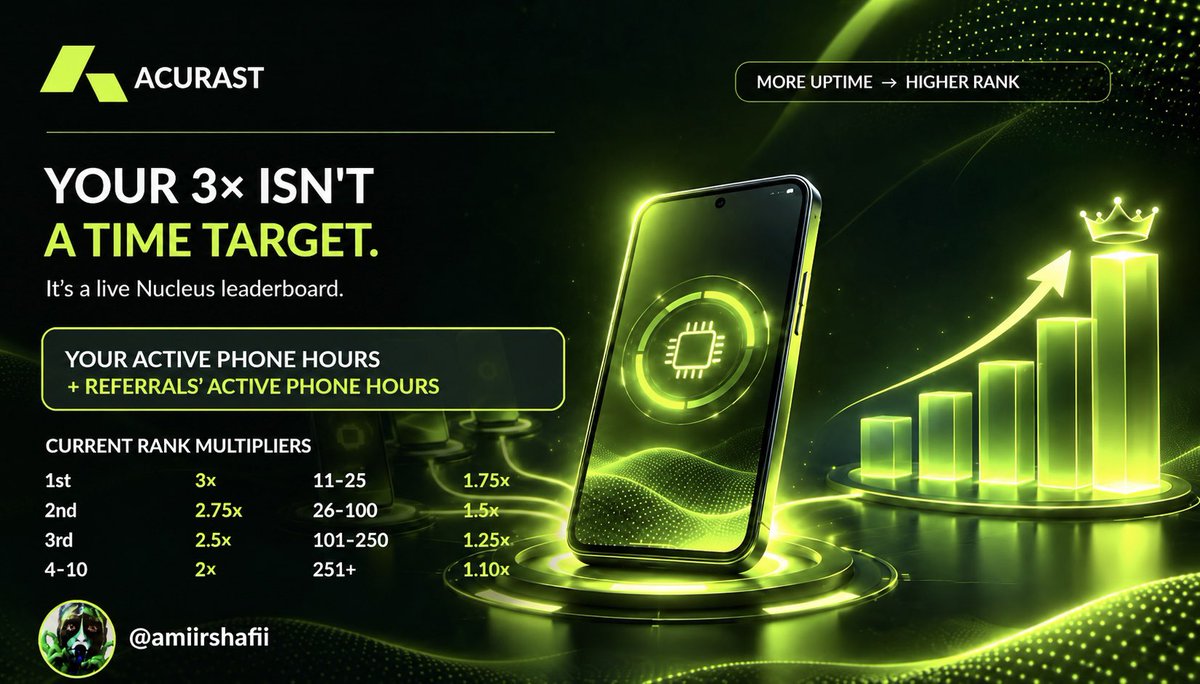
What if your biggest Acurast advantage isn’t owning more phones, but keeping more phones active?
That’s something worth thinking about when building your Nucleus strategy.
A referral is only the beginning. What really matters is the active time contributed by your processor and the devices connected through your network.
Nucleus uses that combined activity to rank creators.
And the difference between rankings is significant:
🏆 Top 1: 3x
Top 3: 2.5x
Top 10: 2x
Top 25: 1.75x
Top 100: 1.5x
Top 250: 1.25x
Others: 1.10x
This changes how I’d approach the campaign.
Instead of spending all my time collecting invitations, I’d focus on three things:
→ Keeping my own processor consistently online.
→ Making sure referred devices actually complete setup.
→ Helping contributors maintain stable connectivity and uptime.
There’s another detail worth remembering:
Your Nucleus multiplier affects your contribution score, not your direct ACU mining rewards.
So don’t confuse building a referral network with increasing your device earnings.
My strategy is simple: build a smaller network that actually works rather than a large network that exists only on paper.
What’s your priority right now: expanding your network or improving uptime?
I’m Shafi, and I’m here to explore this exciting project. Thank you all for your continued support!
https://t.co/6JqFmOQWiJ
Yesterday, when I checked my @Acurast dashboard, my Processor balance was 0.12 ACU, with no deployments scheduled.
Today, things look different!
My balance has reached 0.32 ACU, and a few other interesting changes have appeared on the dashboard.
But what caught my attention wasn’t just the increase in balance.
Let’s take a closer look at what each indicator tells us:
🔹 Running: The device is active and available.
🔹 Heartbeat: Shows that the network recently communicated with the device.
🔹 Attested: Confirms successful hardware-backed verification.
🔹 Compute Score: Reflects the phone’s processing capabilities based on benchmarks.
🔹 Deployment: Shows that a computing task has been assigned to the device.
One important thing about Acurast: you don’t necessarily need an active deployment to qualify for Base Benchmark Rewards. Simply making your phone’s computing power available can contribute to rewards, without requiring staking.
However, actually executing deployments can provide additional benchmark weight during the corresponding reward period.
Another important clarification: 0.32 ACU is my current balance, not the amount I earned today.
I believe understanding these details is essential for anyone getting started with Acurast.
Don’t focus only on your balance. Keep an eye on connectivity, attestation, computing power and deployment activity.
Which part of the Acurast dashboard do you usually check first?
Have a compatible Android or iPhone? You can try Processor Lite without resetting your device.
I’m Shafi and My invite: 👇🏻
https://t.co/6JqFmOQWiJ
What if your biggest Acurast advantage isn’t owning more phones, but keeping more phones active?
That’s something worth thinking about when building your Nucleus strategy.
A referral is only the beginning. What really matters is the active time contributed by your processor and the devices connected through your network.
Nucleus uses that combined activity to rank creators.
And the difference between rankings is significant:
🏆 Top 1: 3x
Top 3: 2.5x
Top 10: 2x
Top 25: 1.75x
Top 100: 1.5x
Top 250: 1.25x
Others: 1.10x
This changes how I’d approach the campaign.
Instead of spending all my time collecting invitations, I’d focus on three things:
→ Keeping my own processor consistently online.
→ Making sure referred devices actually complete setup.
→ Helping contributors maintain stable connectivity and uptime.
There’s another detail worth remembering:
Your Nucleus multiplier affects your contribution score, not your direct ACU mining rewards.
So don’t confuse building a referral network with increasing your device earnings.
My strategy is simple: build a smaller network that actually works rather than a large network that exists only on paper.
What’s your priority right now: expanding your network or improving uptime?
I’m Shafi, and I’m here to explore this exciting project. Thank you all for your continued support!
https://t.co/6JqFmOQWiJ
Yesterday, when I checked my @Acurast dashboard, my Processor balance was 0.12 ACU, with no deployments scheduled.
Today, things look different!
My balance has reached 0.32 ACU, and a few other interesting changes have appeared on the dashboard.
But what caught my attention wasn’t just the increase in balance.
Let’s take a closer look at what each indicator tells us:
🔹 Running: The device is active and available.
🔹 Heartbeat: Shows that the network recently communicated with the device.
🔹 Attested: Confirms successful hardware-backed verification.
🔹 Compute Score: Reflects the phone’s processing capabilities based on benchmarks.
🔹 Deployment: Shows that a computing task has been assigned to the device.
One important thing about Acurast: you don’t necessarily need an active deployment to qualify for Base Benchmark Rewards. Simply making your phone’s computing power available can contribute to rewards, without requiring staking.
However, actually executing deployments can provide additional benchmark weight during the corresponding reward period.
Another important clarification: 0.32 ACU is my current balance, not the amount I earned today.
I believe understanding these details is essential for anyone getting started with Acurast.
Don’t focus only on your balance. Keep an eye on connectivity, attestation, computing power and deployment activity.
Which part of the Acurast dashboard do you usually check first?
Have a compatible Android or iPhone? You can try Processor Lite without resetting your device.
I’m Shafi and My invite: 👇🏻
https://t.co/6JqFmOQWiJ
Your smartphone might be more useful to decentralized computing than you think.
Setting up @Acurast is actually pretty simple, especially if you start with the Hub on your laptop.
Just select “Add New Device,” open Processor Lite on your compatible phone, tap “Connect to Hub,” and scan the QR code.
But here’s the interesting part: don’t stop at connecting.
Go back to the Hub and check that your device is online. That’s when it clicks: your phone is now available to handle real workloads from developers.
No dedicated hardware. Just a device you already own.
Curious how many people are already putting their spare phone capacity to work?
My Cloud Rebellion invite 👇
https://t.co/gVx4fhX4iR
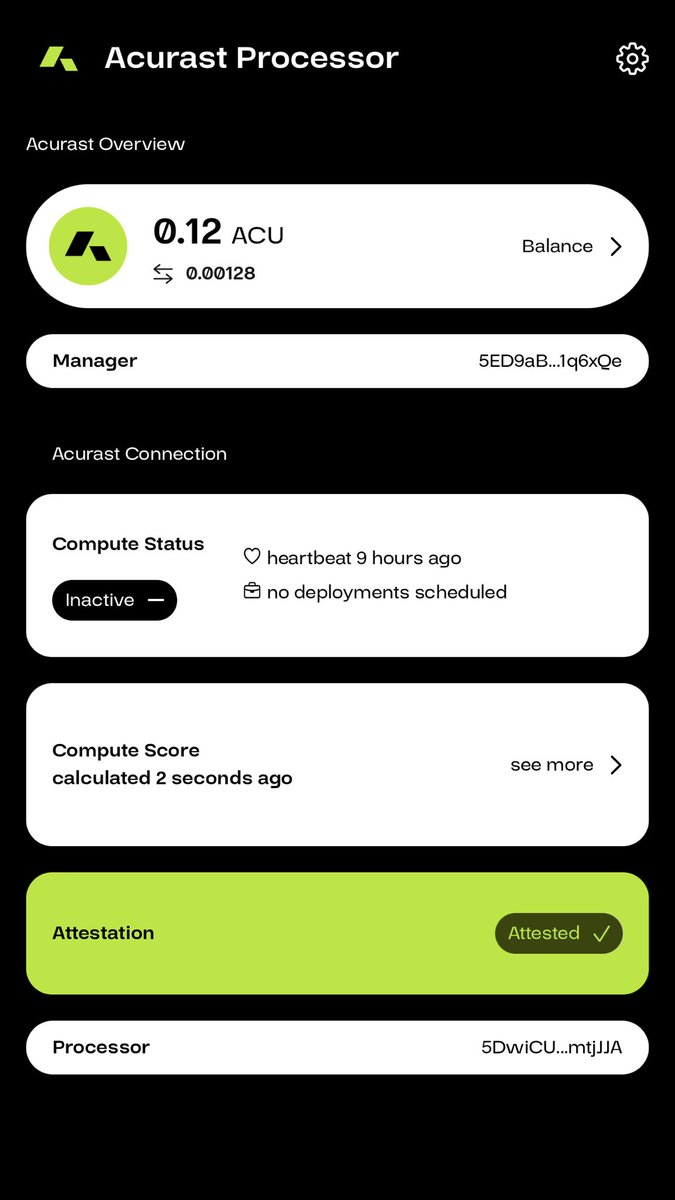
0.12 ACU on my phone. Zero deployments scheduled.
Both numbers appear on the same @Acurast Processor screen, and there’s an interesting story behind that.
My device is Active and Attested.Its last heartbeat was 3 minutes ago, but no developer workload was running when I took the screenshot.
That got me curious about something worth understanding: how does Acurast reward phones when nobody is using their computing power?
There are two mechanisms to know :
⚜️Base Benchmark Rewards
Your processor can earn rewards based on its hardware benchmarks, even without executing a developer deployment.
⚜️Busy Bonus
When your processor executes a deployment during an epoch, it receives an additional 10% weight on its benchmark metrics for that epoch.
Important distinction: that’s a scoring boost, not a guaranteed 10% increase in earnings.
Also, the 0.12 ACU shown is my current balance, not daily earnings.
Now I’m watching three things:
• Heartbeat consistency
• Balance changes
• Actual workloads arriving
Because making computing power available and having someone actually use it are two different things.
That’s what makes exploring Acurast interesting: you get to see both sides directly on your own device.
Are you running a processor with active deployments, or are you still waiting for your first workload ?
I’m Shafi, and I’m exploring and diving deeper into this exciting project. Thank you for your warm support and all the kindness you’ve always shown me.🍀
https://t.co/6JqFmOQWiJ
Your smartphone might be more useful to decentralized computing than you think.
Setting up @Acurast is actually pretty simple, especially if you start with the Hub on your laptop.
Just select “Add New Device,” open Processor Lite on your compatible phone, tap “Connect to Hub,” and scan the QR code.
But here’s the interesting part: don’t stop at connecting.
Go back to the Hub and check that your device is online. That’s when it clicks: your phone is now available to handle real workloads from developers.
No dedicated hardware. Just a device you already own.
Curious how many people are already putting their spare phone capacity to work?
My Cloud Rebellion invite 👇
https://t.co/gVx4fhX4iR
Being online isn’t the same as contributing.
@Acurast rewards uptime, but completing workloads adds extra reward weight.
Should networks reward availability or actual contribution more?