I joined @MaxfusionAI as CTO in May 2026. Now AI writes all of our code without exception.
8x the code with 2 developers
9.9x paid usage
5x fewer errors per generation
5x less technical debt
What number would change your mind, if not these? https://t.co/PoI6qFTwS7
A bit more than a year ago, I refused to use AI for coding. Now, at @MaxfusionAI, I kick off the agent, don't hear from him until he is done, and merge the PR.
What still makes you watch the thread? https://t.co/9OtjCy1X20
Today we are launching Timeline
Your copilot agentic video editor
Use the MCP as you always do
All your edits saved on timelines
Comment directly on the timeline
Agents edit your ads & launch them
the fastest rendering on the market
The code your agent writes is not for you. It is for the next agent, who will copy it again.
Part 2 of Building with agents.
Which mistake does your agent keep repeating? https://t.co/Q6tBf095pR
The code your agent writes is not for you. It is for the next agent, who will copy it again.
Part 2 of Building with agents.
Which mistake does your agent keep repeating? https://t.co/Q6tBf095pR
@vibefinch@MaxfusionAI What would be example of bad step mid-run? I would recommend to setup agent env so you don't have to worry and let them just run
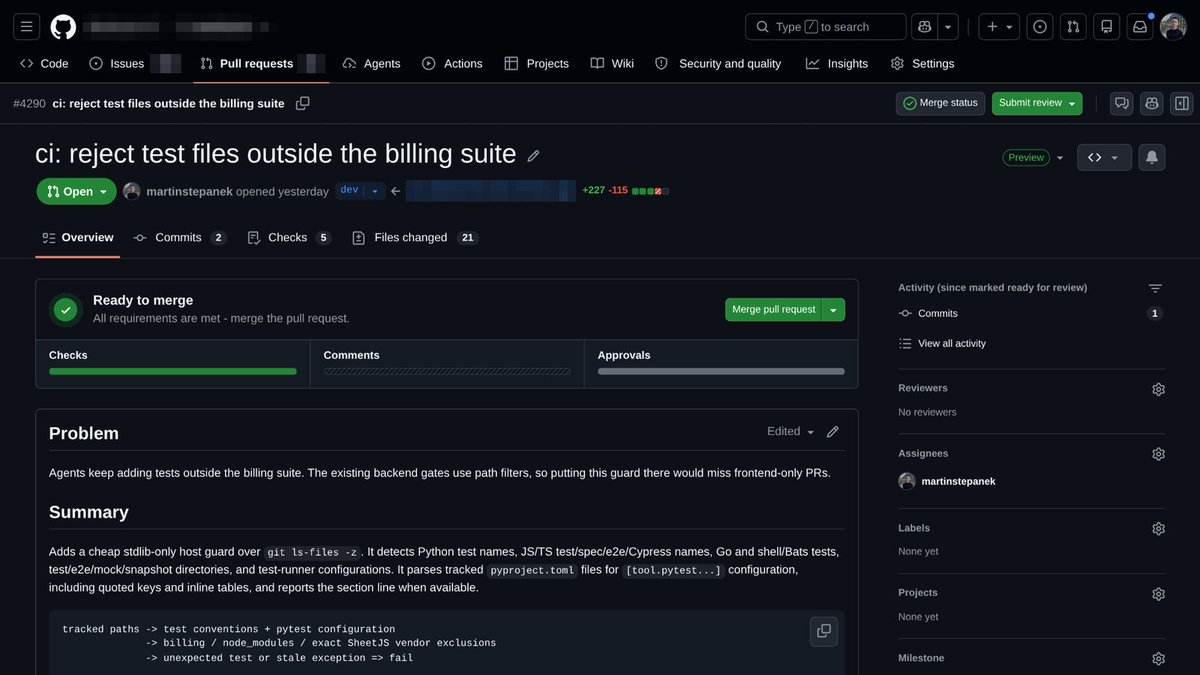
GitHub redesigned their PR view. Too late.
They are, together with Google, clear examples of huge corporations that move too slowly in this AI revolution.
Do you still use GitHub to review PRs?
@gaurav0bhowmick@MaxfusionAI No, only raise it. The floor is protection so that agent does not underplay severity. It's better to have low impact PR graded as high than other way around.
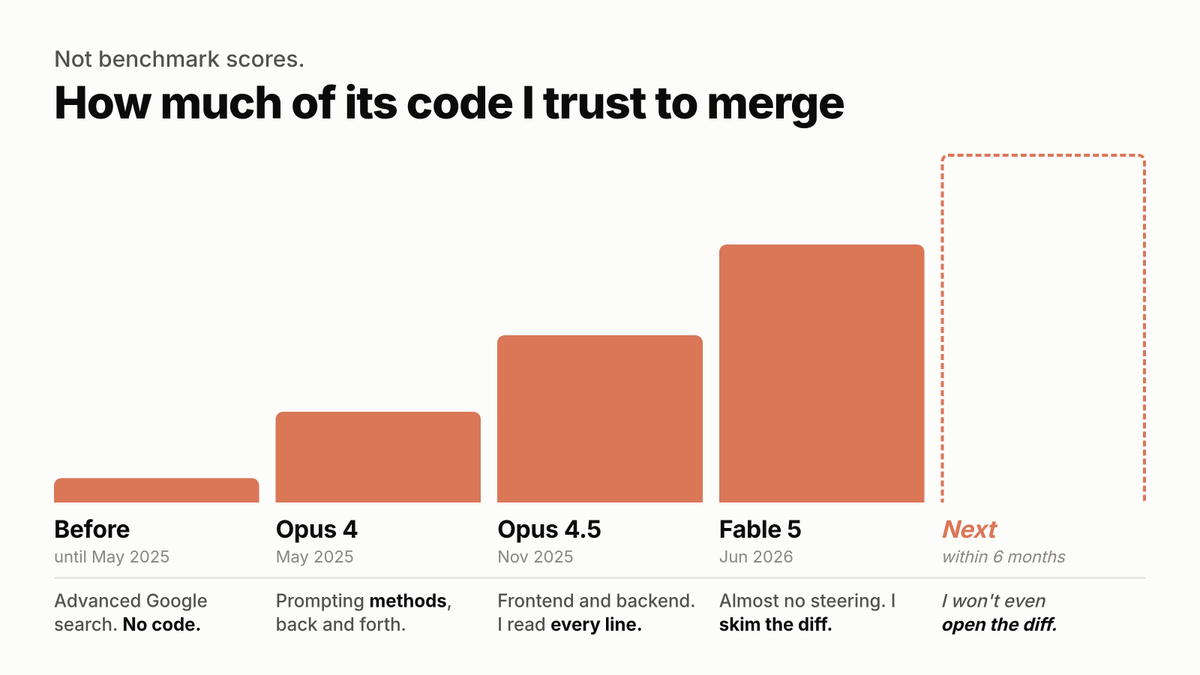
I don't care what score a model got on some benchmark. I care how much of its code I trust to merge.
Astra is crazy good. It can do things no model can, not even Fable. But I don't trust its code the way I trust Fable's.
There have been three real breakpoints in AI coding so far. Each one changed how I develop.
Before them, AI was just an advanced Google search or Stack Overflow for me. Brainstorming, advice, no code.
Opus 4 was the first model where writing a prompt was easier than writing the code. At least for some tasks. Still on the level of methods, not classes or integration. I was prompting back and forth in one thread, watching the code change in front of my eyes, copy-pasting names of files and methods so it knew where to work. Sometimes it was still faster to write it myself than to explain what I wanted and correct it over and over.
Opus 4.5 was the first model that could do full implementations. Multiple methods, frontend and backend. It still needed active steering. I was still pointing at places in the code and I read every line it produced. But tasks got longer, so it made sense to run 1-5 sessions at once.
Fable was the breaking point. Almost no steering. It one-shots complex implementations and verifies its own work. It runs so long that I run 1-20 threads at once. I believe Fable is better than the average engineer without AI.
I don't read every line of its PRs anymore. I skim the diff, unless it's core logic of the platform. What I care about is the intent. Did it understand the problem and the way I want it fixed? The specific solution I trust it to pick most of the time. I analyzed my PRs, and I have to intervene in only about 11.5% of them. This is also when I completely stopped using an IDE.
Until Fable, you could still argue whether AI really makes developers more productive, or just makes them feel more productive. Not anymore. Anthropic went from around 2,500 merged changes per day in May to over 30,000 in September. And I believe it's because of Fable.
GPT 5.5 was a great model at the time, and I used it a lot. Fable 5.1 is great too. But neither changed how I work. That's why I did not list them.
The next breakpoint will be a model whose code doesn't need to be read. I won't even open the diff. I will only check that it understood the problem and picked the right solution. The PR description with the problem definition, maybe a high-level description of the solution. Practically a software factory.
I believe we are very close. Six months at most. Unless governments or the labs themselves intentionally slow it down.
Which model changed how you work?
@gaurav0bhowmick@MaxfusionAI Yes we currently have Impact section in PRs where 3 areas are calculated: Blast radius, Revertibility and Production impact. Each on low/medium/high.
It's partly by deterministic script setting the floor (if specific files were changed etc) and agent judge.
A bit more than a year ago, I refused to use AI for coding. Now, at @MaxfusionAI, I kick off the agent, don't hear from him until he is done, and merge the PR.
What still makes you watch the thread? https://t.co/9OtjCy1X20
I joined @MaxfusionAI as CTO in May 2026. Now AI writes all of our code without exception.
8x the code with 2 developers
9.9x paid usage
5x fewer errors per generation
5x less technical debt
What number would change your mind, if not these? https://t.co/PoI6qFTwS7
I don't really like these surveys since they are always tragically behind, because of how AI development moves fast.
Fable is too expensive for most people. So Opus 5.5 is the first model most people experience "Fable-level" intelligence. It's out for only about a month. It will take a few months for a most devs to really learn to utilize this level of capability.
So surveys collected by end of this year might be telling something about current models, by which time it will again be misleading.