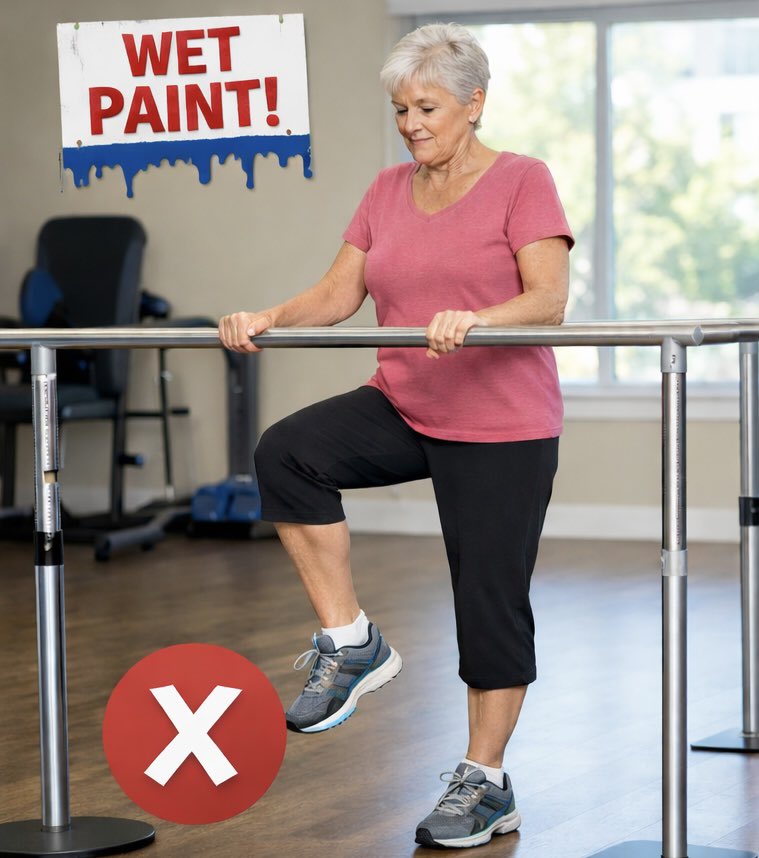
Holiday tip:
When you’re spending time with your older parents or relatives, gently ask them:
"If you ended up on the floor, are you 100% confident you'd be able to get up again by yourself?"
Their response can reveal a lot about what support they may need
If you find you’re routinely using your hands to maintain a position, it often means the exercise is just a bit too tough right now...
...and you should adjust to something slightly easier and build up from there.
Happy balancing!
🖐️ Balance Tip: Imagine the Wet Paint Trick!
Ever tried a balance exercise and found yourself holding onto something for dear life?
Or just touching it to try to hold the position?
Well, this could actually be preventing you from improving your balance 😮
So when you do balance exercises, instead of aiming for a fixed number like 10 or 15, the right number of repetitions depends on the exercise and the person.
For one movement, it might be 5 good repetitions.
For another, it might be 20 or even more.
Q: If you want to improve your balance, how many reps should you do of each exercise?
A: The answer is almost NEVER 10! 🚩
You should do as many as you can before fatigue starts to impair performance
(or you're out of time to share between your other movement skill goals)
If you're trying to improve your balance you must remember these 3 key principles:
1. Learn to move your feet in every direction
2. Train to develop movement skills
3. Prioritise your sessions based on the skills you need most
👉 Balance is more than doing a few static holds
@PHSAdvPhysio Dual task training is an important element to move from the associative to autonomous phase of skill acquisition...
...but it's just that: a progression
Introducing dual task training too early is just as bad as standing on a wobble board before a client has a step response
Exercises like this are great if you want to rehab and ankle injury or improve your static balance on a dynamic surface...
...but does little to develop an integrated ankle-hip-step response
Great for surfing/skating. Terrible for reducing the risk of falls
There's 2 ways to help an older adult improve balance:
1) Prioritise functional deficits, then systematically improve performance in select task(s) before moving onto the next one
2) Simultaneous address all skill deficits & achieve gradual improvements across the board
Physios:
Whenever prescribing balance rehabilitation exercises it's important to consider that context is a form of progression...
...and that anxiety affects not just performance, but motor learning
Static exercises that isolate ankle strategy only train ankle strategy...
...while balance exercises that include stepping simultaneously train ankle, hip and step strategies
One of these is effective at replicating real world balance needs, one of these is a vanity exercise
You can judge the effectiveness of a balance & mobility rehab program by not just what's included, but also what's included:
🛑 Ineffective & overused:
👎 Standing hip abduction
👎 SLS behind a chair
✅ Necessary but neglected:
👍 Stepping in all directions
👍 Cross-and-step