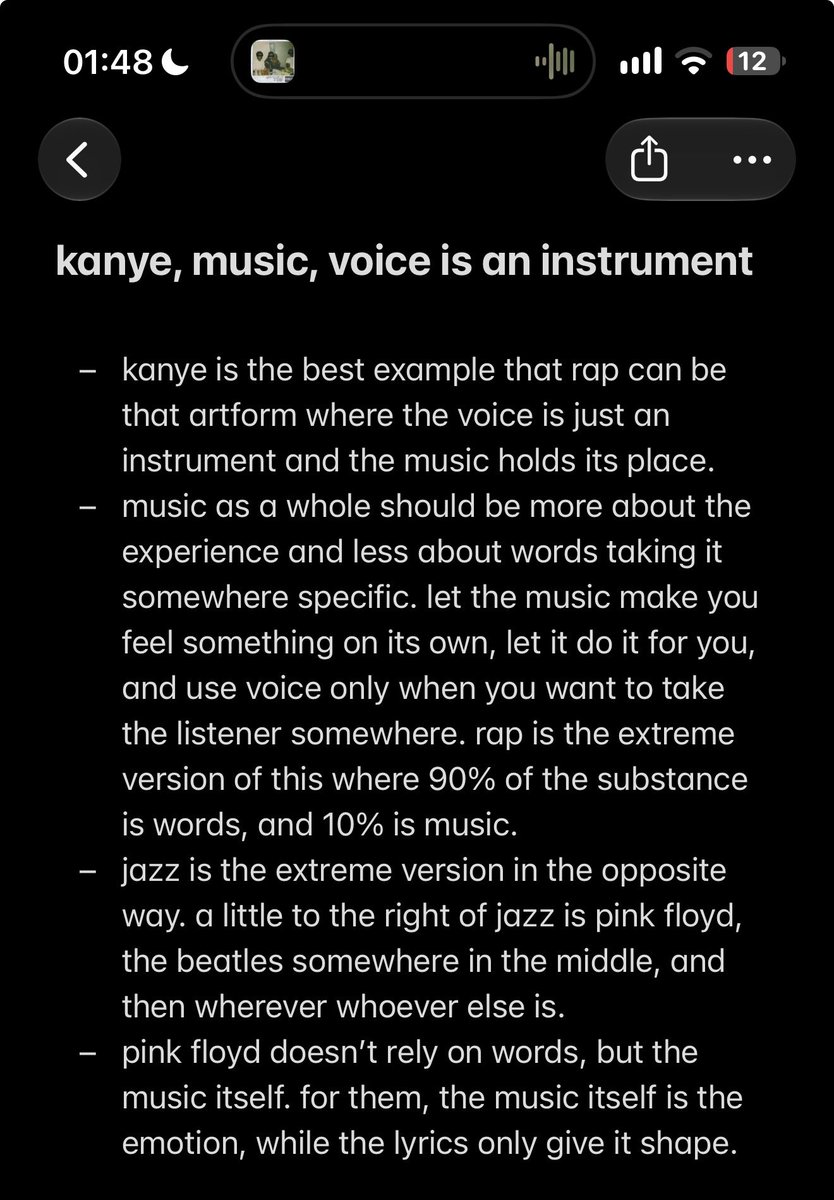
my dad told me that rap / electronic wasn’t “real music” and just words
rather than argue about the merits of what makes something music or not music, or the artistic qualities of the medium, I found it easier to listen for how real fans engage with the content, dissect it for meaning, critique the wordplay, analyze the verbal percussion, break down how every instrument is layered and talk about the split between conscious and unconscious choices, in plain language
what matters more in art is the depth and curiosity that it makes humans engage
suddenly a project written in Bend with 500 stars, I had no idea?
(this actually makes me anxious because there is so much I want to improve NOW, but I'm stuck doing business 😭)
really cool though, anything done in Bend should automatically get exponentially better soon 🫡
need to frame this tweet
whether or not it’s true it helps assign a visceral consequence to the programs you run in your thought loops, your beliefs or fear and doubt, states of mania or anxiety and paranoia creating a totally different reality than others perceive
your nervous system is a prediction machine that hallucinates a continuous world from 5 percent real-time data and 95 percent guess, which makes you not a sensor but a generator, which means reality is not something you perceive but something you emit, which means you have been committing creation since birth without ever being told you had the clearance
what's the process that makes amazon logistics so optimized that it knows what you want to order, has it stocked in your region, has a route to you, and gets it there overnight?
people say you need to do something manually before you automate it, because that teaches you what to automate.
counterintuitively, the best way to build a system for something is to do a lot of it
if you want a super optimized process, force more volume into it through more users and more demand
my favorite example of demand rearranging reality to meet it - the ice trade from the 1800s. Ppl in India wanted cold drinks, and the available ice was in new england so ppl cut frozen ponds into blocks, packed the blocks in sawdust, loaded onto ships in boston, and sailed around africa for months.
early shipments to the Caribbean lost money because much of the ice melted, but the demand kept coming, and every part of the chain got worked on, from the ice packing to how the blocks were cut so they stack tight, until enough of it survived the trip to india for the whole thing to keep running
amazon orders did the same thing to its warehouses and trucks so a package could show up at your door overnight
Can we PLEASE normalize just hanging out at each other’s houses again? Why does every friendship meetup need to be a whole production, a restaurant reservation, and a $150 bill? I just want to sit on your couch, drink something, and talk for hours.
Highly suggest playing around with making games with AI even if you don't like the concept of video games.
getting addicted to your own games feels like a superpower, like finally having some agency over your addictive tendencies by channelling it into something of your design
interpretability might be the most important scientific problem in the world right now, as I don't think we can solve alignment if we don't know what we're building. I think I have good news about it. I co-authored early work in mechanistic interpretability at OpenAI and came away pessimistic, because neural networks appeared to fold into arbitrary tangled knots. years later, I started openai's first large-scale automated interpretability project, finding about 2% of neurons legible with the primitive tools we had
with modern agentic tools and a much closer look, the picture looks totally different. the vast majority in models up to trillions of parameters are legible, and their circuits beautiful. many famous examples of tangled neurons turned out to be misunderstood. The roadblocks I expected mostly aren't there. I now think ambitious interpretability will be solved by the time we need it most, and possibly quite soon, as automated scientists keep improving. it may be a bitter lesson for interpretability: the simple thing, at absurd scale, works
https://t.co/zHij5zwKGT
webassembly was supposed to replace docker
except... the great part of docker is that it *just worked*
if i can do it on my laptop, i can do it in a container
but webassembly went a different direction
instead of focusing on linux compatibility, they went off and built the component model that has very very little adoption
which is exactly why we built agentOS to bring linux compatibility to webassembly:
- posix filesystem
- networking stack
- process trees
people lack nuance with the word “understanding” – there are multiple resolutions / zoom levels and it’s normal that mathematicians don’t have 100% internalized understanding of every theorem loaded because nobody does
for instance i know that if i call sorted(scores), i get the scores back in order. one level down i understand how it builds sorted runs and merges them. further down i’m working through the invariants that prove why this produces a sorted result without losing or duplicating anything. i don’t need all of that loaded to build a leaderboard, i need to understand the guarantee i’m using and when it applies
same with a theorem – they need to understand what it lets them conclude and the conditions where it applies. they don’t need to understand every dependency to its core, they don’t need to rederive everything, they can rely on other people having checked it and go into the proof when they need to
engineering would not work if everybody forced full resolution for everything. the resolution you need depends on what you’re trying to do, and that can change when something breaks
the reason why we want our experts to understand stuff deeply is because we put them in situations where they need to move up and down the scales / zoom levels of magnification and debug stuff and diagnose which level the problem is at, or go 5 levels deep to find the cause. that doesn’t mean they need to keep all 5 levels fully loaded every time they use the system
just trying to reverse engineer how a mathematician works
like I wasn't aware they actually did that; take a well known theorem and then obsessively apply it to your own work, without really understanding the underlying proofs of that theorem
so, in a way, every mathematician is working on their own slice of the mathematical space, which is shaped by the theorems they are familiar with. and then human intuition kicks in and they start noticing patterns in that space, which allows them to prove something new
so the process of aggregating knowledge could be described as kind of a random search on top of a space you're familiar with. and the raw symbolic knowledge loop is, thus, just: we accumulate a book of theorems (memory), we search the proof for new theorems on top of it (compute), then we drop the proofs, put the new theorems in context, and go solve something else. then loop
Made an SF-based MapleStory clone, was so fun to make and my wife played for 5 hrs straight!
I recommend messing around by making someAI games even if you think it's a waste of time, it unblocked me and loosened my mind enough to see where i was stuck
https://t.co/idNrmGPhSE