Our USDC launch model failed.
The idea made sense on paper. Quote every bonding curve in USDC, route trading fees into the reserve, move that reserve into @OndoFinance USDY, and let the resulting yield accrue back to holders.
The problem was much simpler: people did not want to trade internet coins against USDC.
We learned that very quickly.
So we spent the entire day restructuring how Stable Dollar launches work, how liquidity is formed, and how the reserve sits underneath each coin without forcing traders into a market structure they do not already use.
Going forward, pump-style pairs can participate in the same yield-bearing reserve model while keeping the trading experience people already understand.
The market can trade the way it wants to trade. Underneath it, Stable Dollar can still route value into USDY, build a productive reserve, and attribute the resulting accrual back to holders.
That distinction matters.
We do not want users changing their behavior to accommodate our financial mechanics. The mechanics should disappear into the product and work around the behavior that already exists.
USDC pairs were our first attempt at solving that problem. The market gave us a very clear answer, so we changed it.
Stable Dollar is still built around the same idea: internet coins can have productive assets sitting underneath them.
We just found a much better way to get there.
https://t.co/Aq2ekfUJ6p
To clear up any confusion, here is exactly how Stable Dollar works.
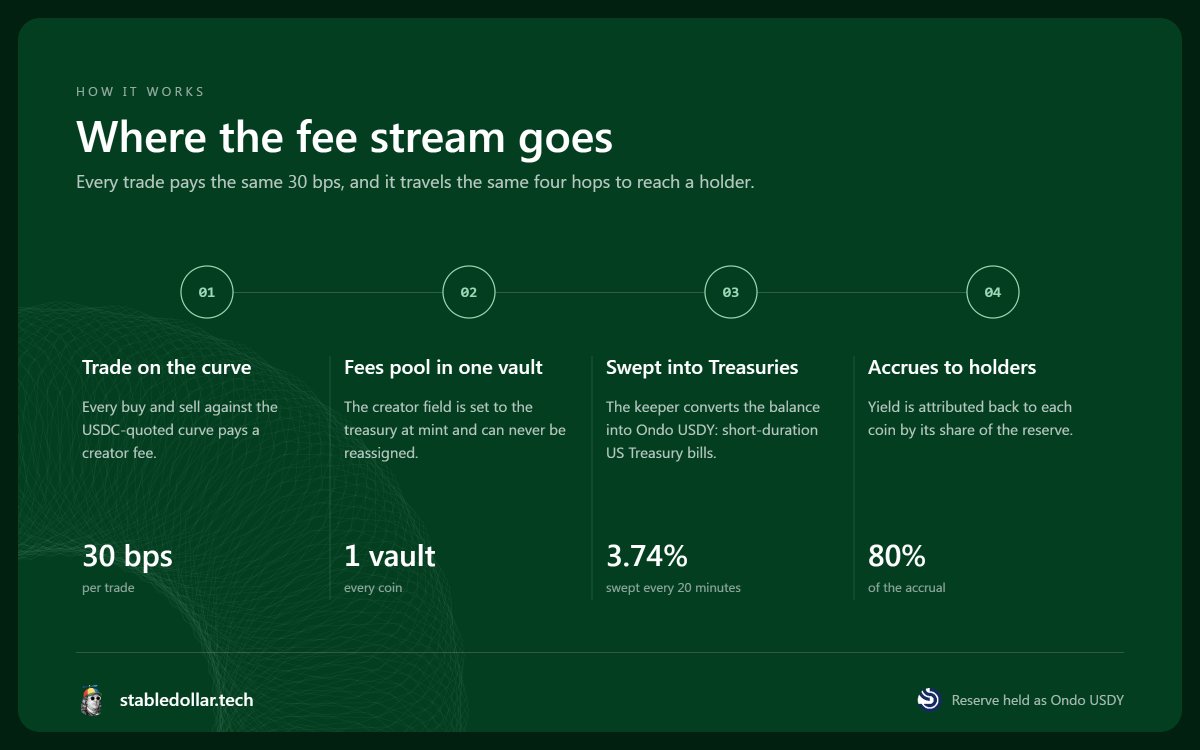
Every coin launches on a USDC-quoted bonding curve. A fixed portion of every buy and sell is routed into a program-derived treasury vault.
Every 20 minutes, a keeper sweeps the accumulated USDC from that vault into the reserve.
The reserve is held in @OndoFinance USDY, backed by short-duration U.S. Treasuries and bank demand deposits. USDY accrues through NAV appreciation, so the reserve earns without staking, rebasing, or manual claims.
Each coin is credited with its share of the reserve based on the capital its trading generated, and 80% of the resulting accrual is attributed pro rata to holders.
https://t.co/5xwhoz45Yg
A new class of internet asset.
Born on a bonding curve, backed by an onchain reserve, and earning through tokenized treasuries after graduation.
$STABLE
17 internet coins have already launched through Stable Dollar.
Right now, this is the only place you can launch an internet coin where trading volume builds an onchain reserve, the reserve earns through @OndoFinance USDY, and 80% of that accrual is attributed back to holders.
It puts internet coins on the same financial rails now being used for tokenized Treasuries and onchain money market products from institutions like @FTDA_US.
Speculation on one side. Productive assets underneath.
A new way to launch internet coins.
https://t.co/pvuE3O4bqg
Token launches have converged on the same playbook for too long.
That needs to change.
Over the next few days, we’ll be speaking with some of the most influential traders in the space about where token launches go next, and what new mechanics are worth bringing to the market.
The playing field should be getting wider, not narrower.
Tokenization gets interesting when it stops being about wrapping old assets in new rails.
The bigger opportunity is making entirely new assets possible because those rails exist.
Internet coins on one side, tokenized cash and treasuries on the other, with entirely new financial structures emerging in between.
Internet coins and money market funds should probably have nothing to do with each other.
And yet @Ondo has brought treasury exposure onchain, while @FTDA_US has brought institutional money market infrastructure onchain.
Stable Dollar brings internet coins into the emerging onchain economy for treasuries, stablecoins, and money market assets.
This is going to get interesting.
Launches are now open.
Every coin launched through Stable Dollar routes a portion of trading volume into an onchain reserve held in USDY, with 80% of the resulting accrual attributed back to holders.
Create a coin, let the people trade it, and let the reserve build underneath it.
https://t.co/5xwhoz45Yg
The first yield-bearing internet coin is live.
CA: CY7N5pmzqrKw7Y968yzqkSeiTddcM7ZK4gYA3u2mpump
Trading volume builds an onchain reserve, that reserve earns through USDY, and 80% of the accrual goes back to holders.
https://t.co/wDAHJOvGEH
Introducing Stable Dollar Digital Assets, a new way to launch internet coins.
https://t.co/pvuE3O4bqg
We forked @tokens and rebuilt what happens after a coin launches.
Every coin follows the same path:
trade → vault → sweep → USDY → holder
Each buy and sell contributes to an onchain reserve. That capital is periodically moved into Ondo USDY, which is backed by short-duration U.S. Treasuries and bank demand deposits and accrues through NAV appreciation.
As the reserve earns, 80% of the resulting accrual is attributed pro rata to holders.
Trading volume gradually capitalizes a pool of productive assets. The more volume a coin generates, the more capital that accumulates behind it, turning that volume into a reserve that continues earning after the individual trades have settled.
This is where the model starts to resemble money-market infrastructure.
The reserve beneath each coin is ultimately composed of the same broad class of assets used by government money-market products: short-duration U.S. government securities and cash equivalents. Instead of that reserve existing as a separate fund that users have to enter, Stable Dollar makes it part of the economics of the coin itself.
Franklin Templeton’s OnChain U.S. Government Money Fund, FOBXX, provides a useful institutional comparison. FOBXX holds government securities and records ownership through blockchain-integrated infrastructure, including its BENJI share-class token. Stable Dollar takes that same underlying idea of putting capital into productive government assets and connects it directly to the lifecycle of an internet coin.
The difference is where the capital comes from and who participates in the economics. With Stable Dollar, the reserve is built continuously from volume around the coin, held onchain through USDY, and the majority of the resulting accrual is attributed back to holders.
Stable Dollar is not affiliated with or endorsed by Franklin Templeton. Both systems show what becomes possible when money-market assets and blockchain-native ownership begin operating on the same rails.
Stable Dollar brings that structure underneath internet coins, giving each one a growing Treasury-backed reserve that can continue accruing independently of trading volume.
Stable Dollar Digital Assets
A new way to launch internet coins.
https://t.co/pvuE3O4bqg