1/@shipyardbuild is joining StackGen. Shipyard gives every pull request a full-stack ephemeral environment and removes it on merge. Why we're excited 🧵
We'll be at #BackstageCon on November 9, during #KubeCon NA 2026 in Salt Lake City. If you're attending, we'd be interested to hear where AI agents fit into your Backstage setup.
P.S. We're also meeting engineers and SREs at Gracie's that evening. RSVP here: https://t.co/vd4smlHz9E
If your team uses Backstage, you already have a place where developers can find services, understand ownership, and access their tools.
Now consider AI coding agents opening pull requests throughout the day. Developers still need to test those changes, check the infrastructure, and approve what reaches production.
When your on-call engineer receives a critical alert, they need to find the cause before approving a fix. That often means checking logs, metrics, and dashboards.
This walkthrough shows how Aiden for SRE provides an RCA with evidence and a proposed fix for human approval.
#SRE #AISRE
Her four principles are in the latest AI SRE Files: https://t.co/gD3rmHe2hK
P.S. If you’ll be at Microsoft Ignite in San Francisco, StackGen has an invite-only executive happy hour: https://t.co/jdzn68DU5E
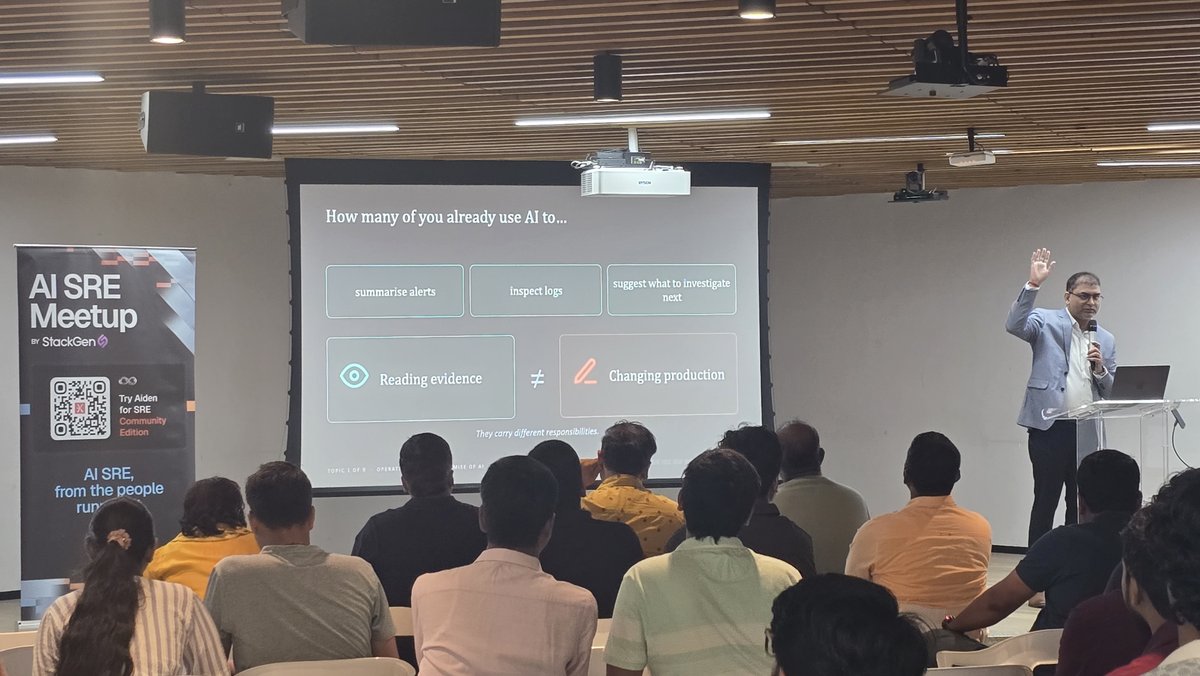
How sure does an AI agent need to be before it fixes a production issue on its own?
For Microsoft’s Kaustubha Shravan, a confident diagnosis isn’t enough. At 95% confidence, an agent may restart a single VM alone, while the same restart across a cluster should wait for an engineer.
Her question for teams: do you trust the agent to decide?
Our latest blog explains where these delays occur and how teams can keep pace with faster development cycles.
Read the full article: https://t.co/QYX2R600Oq
Google reported 17.5% more change lists per engineer per month, while Microsoft saw 24% more merged pull requests per engineer per day.
That's more code making its way through development. But how quickly can teams get it into production?
Infrastructure still needs to be provisioned, deployments need to be managed, and production incidents still need attention. Each step takes time, especially with manual handoffs between teams.
How much of a production incident can an AI agent realistically handle on its own?
An agent needs operational context, an understanding of service dependencies, and clear boundaries around the actions it can take. That becomes more complicated when it has to work across multiple tools and infrastructure environments.
Our Field CTO, @sd_architect, will discuss these architectural challenges in his session, “The 4-Body Problem of SRE: Building an Agentic OS for Autonomous Operations,” at All Day AI.
October 22 | 12:30 PM ET
Register: https://t.co/IXFDgcD4LX
With Aiden for InfraOps, developers can request infrastructure through tools like Claude Code, Copilot, Kiro, or Backstage. Aiden uses approved modules, checks policies, and prepares the plan for human approval.
After deployment, it also detects configuration drift when cloud resources no longer match the code.
See how it works: https://t.co/JOMSHQVBhr
A developer needs a new environment. The request sounds simple, but the platform team still has to check the infrastructure modules, validate policies, and approve the deployment.
Now imagine handling those requests across 1,000+ applications and thousands of deployments every month.
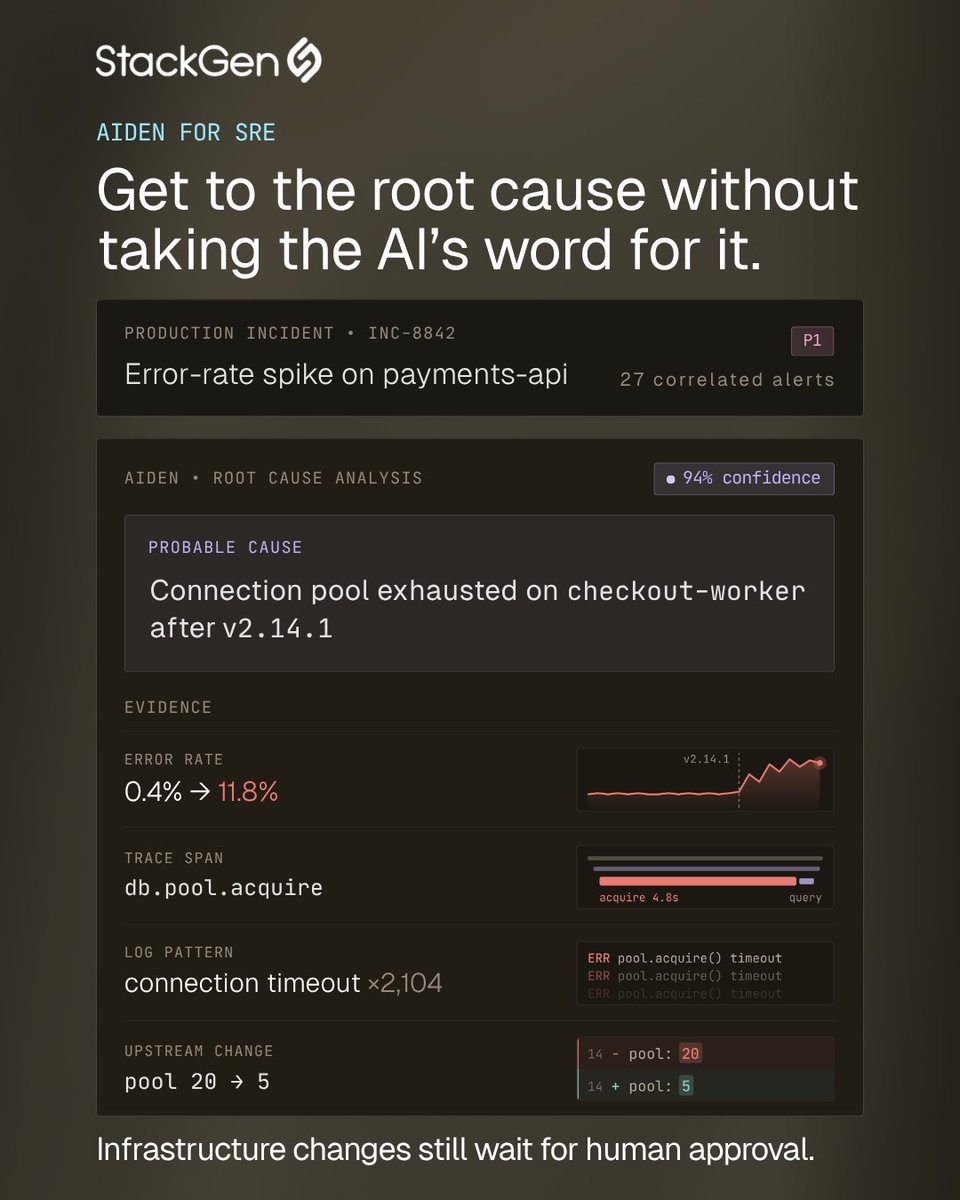
An AI agent says it's 94% confident about the root cause of your production incident, but you'd probably want to see the evidence before approving a fix.
In this example, Aiden for SRE traces a spike in payment API errors to connection pool exhaustion after a deployment. The error rate jumped from 0.4% to 11.8%, traces show slow connection acquisition, and the logs contain 2,104 connection timeouts.
Joining the discussion are VINAY GATTU, Principal SRE at Optum, Sreenadh Ganti VS, System Manager at EPAM, and Ashish Aggarwal, Head of Product at Broadcom.
A timely conversation about how much autonomy SRE teams are comfortable giving AI in production.
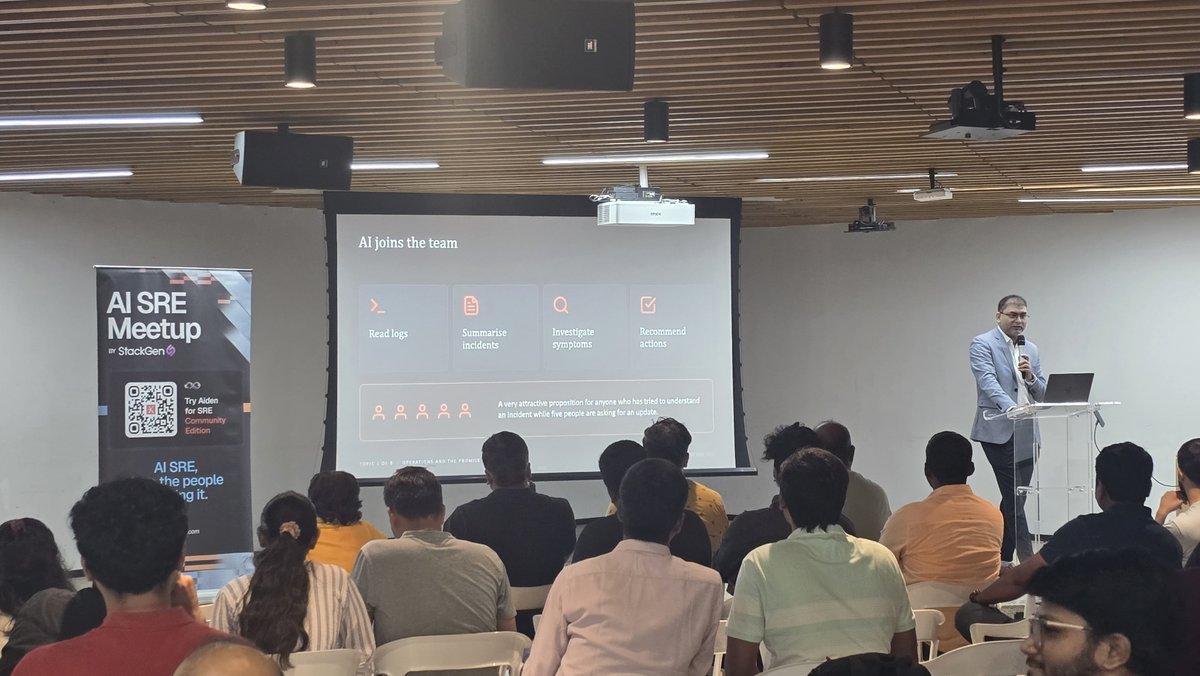
How close are we to an incident that can resolve itself without an engineer stepping in? It's an interesting idea until you consider everything that happens during a real production incident. An agent might identify the cause and recommend a fix, but giving it permission to change production systems is a much bigger decision.
That's the topic of our panel at AISRE Meetup Hyderabad today: "The Self-Driving Incident: What Full Autonomy in SRE Actually Looks Like."
How quickly can your monitoring detect a production issue? Meenu shares Freshworks' approach to using AI-powered observability to identify incidents sooner and bring down MTTD.
An incident can start affecting users long before anyone gets an alert. And by the time the on-call engineer knows there's a problem, the clock has already been ticking.
Meenu Sowjanya Chandrasekaran, SRE at Freshworks, is presenting "O11y: Our AI-Powered MTTD Framework" at AI SRE Meetup Hyderabad!
#AISRENext #AISRE
There's only so much you can explain with slides.
Sravanthi Naga from Pegasystems is running a live demo at the AISRE Meetup Hyderabad!
#AISRENext#AISRE
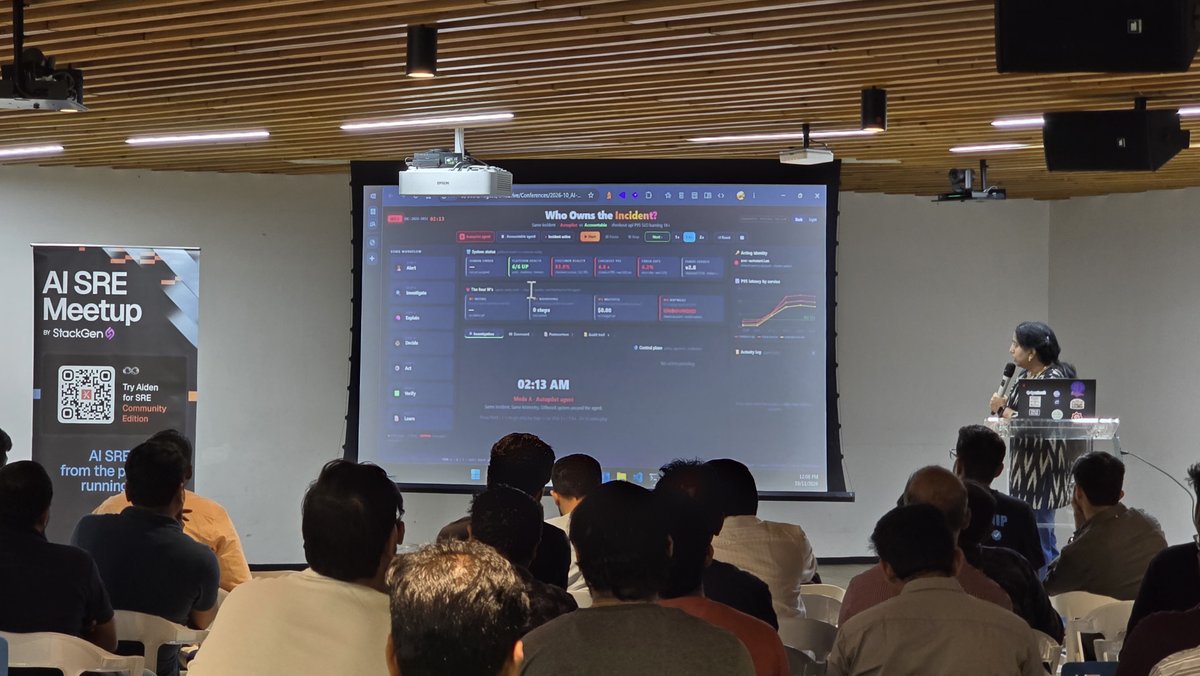
Today, AI agents handle more of the on-call workload, but someone still has to decide when to trust their recommendations, when to escalate, and who answers for the outcome when a fix goes wrong.
At AISRE Meetup Hyderabad today, Sravanthi Naga, Senior Engineering Manager at Pegasystems, is sharing her insights on "Who Owns the Incident? Accountability When AI Joins the On-Call."
#AISRENext #AISRE
For engineering leaders responsible for systems that thousands of businesses rely on, deciding how much control to give an AI agent has real consequences.
Surya Srinivas, SVP of Engineering at greytHR, is delivering his keynote, "The Autonomy Budget: How Much Freedom Can Production Afford?", at AI SRE Meetup Hyderabad today!
#AISRENext #AISRE
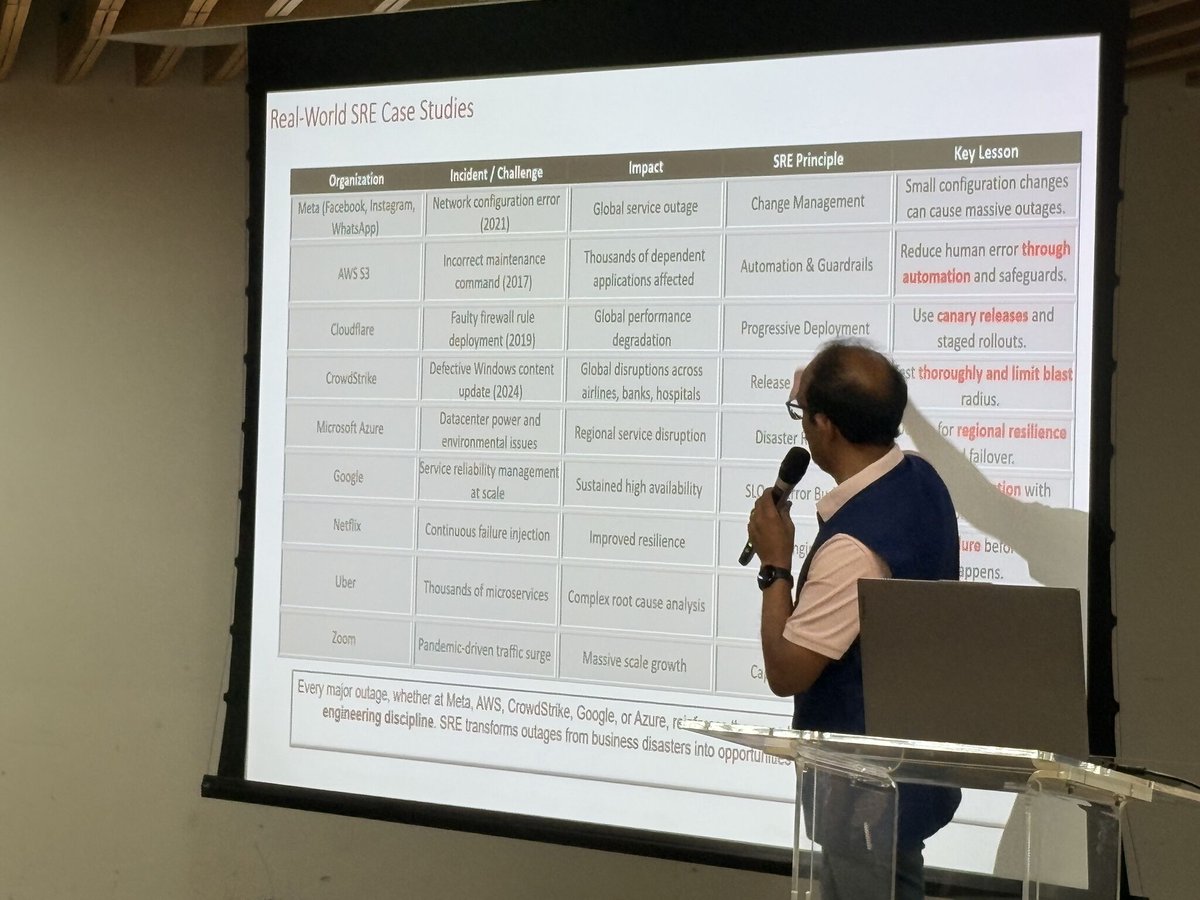
Keeping systems reliable at enterprise scale comes with a lot of difficult decisions, especially as teams start bringing AI into production operations.
We're at AISRE Meetup Hyderabad today, where Dr. Nagarjun Malladi, VP and Group Delivery Head at Tech Mahindra, is sharing his perspective on the challenges of maintaining reliability across large organisations and how agentic AI, autonomous infrastructure, and SRE practices can help.
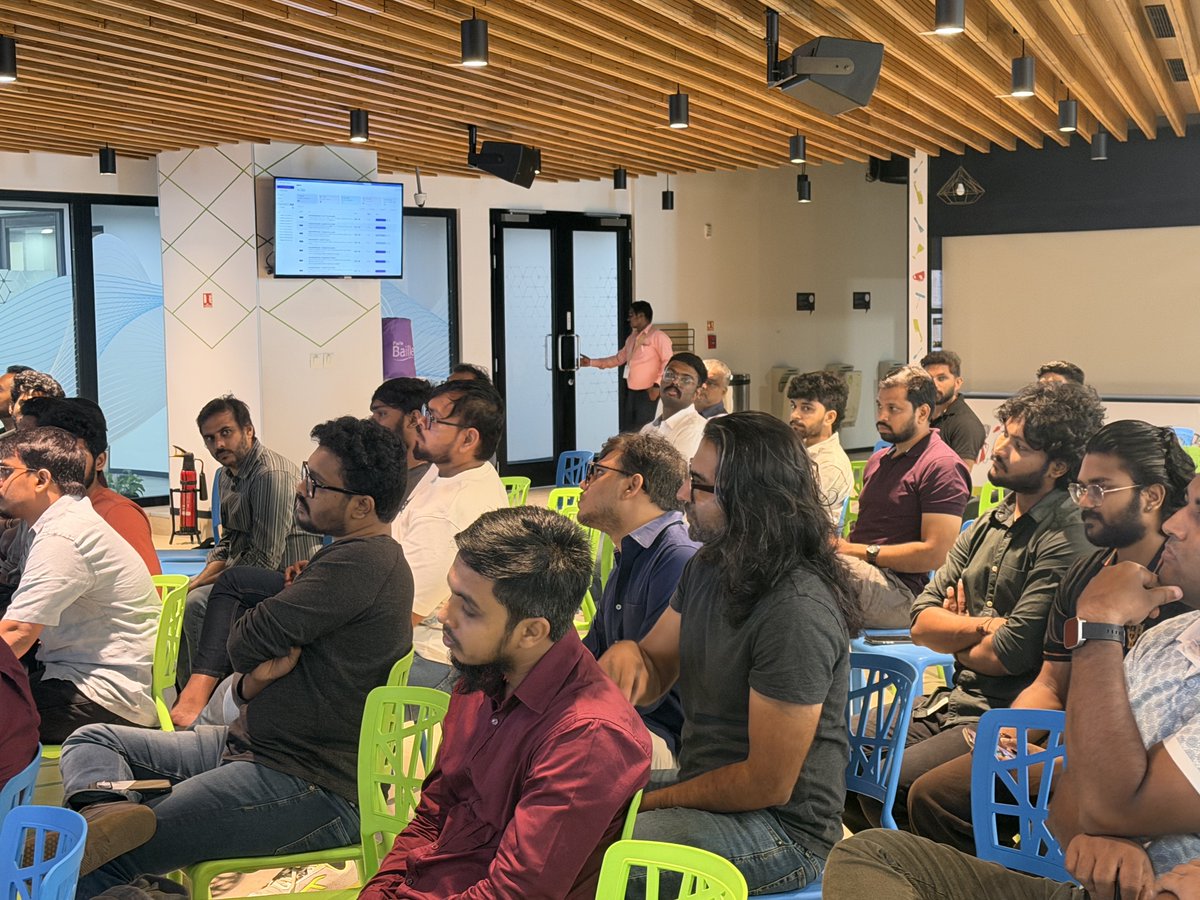
Sharing a few moments from his session!
#AISRENext #AISRE