I open-sourced ThreeUI, my library of three.js components and landing pages.
160+ are free, and the tool is free too. It includes procedural 3D hero sections, icons, and motion designs. Copy the prompt or source, give it to your agent, then change the theme, lighting, motion or layout.
Live site: https://t.co/rtCfqeZnOP
Repo: https://t.co/B66ahgxHVl
I'm adding a lot more soon. Pro comes with 50+ extra components, MCP, and skills. Early adopters get 50% off right now.
Check this!! Microsoft open-sourced a no-code data analysis tool.
It's called Data Formulator and it provides AI-powered data analysis and an drag-and-drop UI for viz tasks.
It also works beyond the initial dataset by creating relevant fields and the corresponding viz.
it's topic based so you can easily use it for chatrooms or even normal SaaS workflows to control who gets what updates
quickstart here
https://t.co/I3p8mewa8F
Push Notification System: The Basics
Push notifications keep users engaged, but setting up a solid system can be quite the challenge. We're talking in-app notifications, emails, SMS, and even social media pushes – it's a lot to handle!
So, how does it all work?
🔹 First off, the business services send notifications to the gateway. It can handle them one by one or in batches.
🔹 Next, the distribution service takes over. It validates, formats, and schedules the messages based on user preferences and templates.
🔹 Then, the notifications head to the routers (usually message queues) for smooth delivery.
🔹 The channel services take it from there, making sure the notifications reach users through various channels – in-app, email, SMS, social media, you name it!
🔹 Finally, the tracking and analytics service keeps an eye on the delivery metrics. This way, the operations team can check out the reports and make the user experience even better.
It's a complex process that we often take for granted.
–
Subscribe to our weekly newsletter to get a Free System Design PDF (158 pages): https://t.co/6j06DUIbVn
It’d be cool if someone would make a specialized stack for each Postgres use case, with nice docs, perf comparisons, tutorials, etc - so you don’t have to leave Postgres :)
I'll say it again. #AWSSAM is just CloudFormation with #Serverless specific resources and a massively powerful, and serverless-centric CLI.
It still shocks folks when I tell them you can use regular CloudFormation resources in SAM.
I built a new tool! It's a single page web app that runs OCR against images and PDFs entirely in your browser (no file upload needed) using Tesseract.js and PDF.js
You can drop files onto it, or you can click to select and open them (which works on Mobile Safari as well)
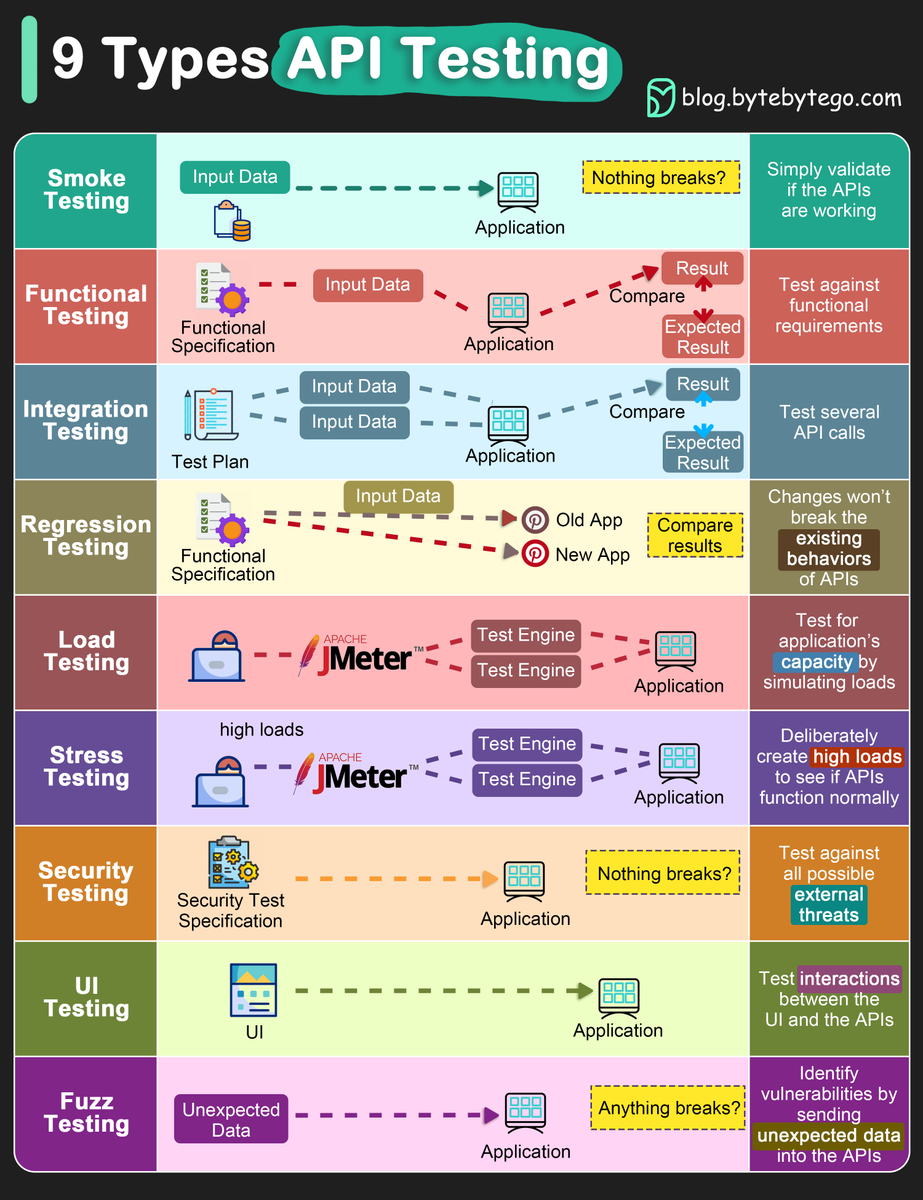
Explaining 9 Types of API Testing
🔹 Smoke Testing
This is done after API development is complete. It simply validates if the APIs are working and nothing breaks.
🔹 Functional Testing
This creates a test plan based on the functional requirements and compares the results with the expected outcomes.
🔹 Integration Testing
This test combines several API calls to perform end-to-end tests. It tests intra-service communications and data transmissions.
🔹 Regression Testing
This test ensures that bug fixes or new features don't break the existing behaviors of APIs.
🔹 Load Testing
This tests an application's performance by simulating different loads. It helps calculate the capacity of the application.
🔹 Stress Testing
This deliberately creates high loads on the APIs to test if they are able to function normally under stress.
🔹 Security Testing
This tests the APIs against possible external threats to ensure security.
🔹 UI Testing
This tests the UI interactions with the APIs to make sure the data is displayed properly.
🔹 Fuzz Testing
This injects invalid or unexpected input data into the API and tries to crash it. This helps identify API vulnerabilities.
–
Subscribe to our weekly newsletter to get a Free System Design PDF (158 pages): https://t.co/6j06DUIbVn
Top 6 Database Models.
Data models provide the foundation for storing, retrieving, and manipulating data in database management systems (DBMS) and influence how data is structured and accessed.
The diagram below shows top 6 data models.
🔹 Flat Model
The flat data model is one of the simplest forms of database models. It organizes data into a single table where each row represents a record and each column represents an attribute. This model is similar to a spreadsheet and is straightforward to understand and implement. However, it lacks the ability to efficiently handle complex relationships between data entities.
🔹 Hierarchical Model
The hierarchical data model organizes data into a tree-like structure, where each record has a single parent but can have multiple children. This model is efficient for scenarios with a clear "parent-child" relationship among data entities. However, it struggles with many-to-many relationships and can become complex and rigid.
🔹 Relational Model
Introduced by E.F. Codd in 1970, the relational model represents data in tables (relations), consisting of rows (tuples) and columns (attributes). It supports data integrity and avoids redundancy through the use of keys and normalization. The relational model's strength lies in its flexibility and the simplicity of its query language, SQL (Structured Query Language), making it the most widely used data model for traditional database systems. It efficiently handles many-to-many relationships and supports complex queries and transactions.
🔹 Star Schema
The star schema is a specialized data model used in data warehousing for OLAP (Online Analytical Processing) applications. It features a central fact table that contains measurable, quantitative data, surrounded by dimension tables that contain descriptive attributes related to the fact data. This model is optimized for query performance in analytical applications, offering simplicity and fast data retrieval by minimizing the number of joins needed for queries.
🔹 Snowflake Model
The snowflake model is a variation of the star schema where the dimension tables are normalized into multiple related tables, reducing redundancy and improving data integrity. This results in a structure that resembles a snowflake. While the snowflake model can lead to more complex queries due to the increased number of joins, it offers benefits in terms of storage efficiency and can be advantageous in scenarios where dimension tables are large or frequently updated.
🔹 Network Model
The network data model allows each record to have multiple parents and children, forming a graph structure that can represent complex relationships between data entities. This model overcomes some of the hierarchical model's limitations by efficiently handling many-to-many relationships. However, it can be complex to design and query, and it has largely been superseded by the relational model in most applications, though it still finds use in certain specialized domains.
Over to you: Which database model have you used?
--
Subscribe to our weekly newsletter so you won't miss it: https://t.co/uc5M7CdXXC
An unfortunate limitation of transpiling frameworks like React is they depend on Node (or similar) for SSR.
https://t.co/D1Yrto9GSW SSR now showing support for Node, Deno, Ruby, Python, PHP and Java.
YES: backend agnostic serverside rendering *real* HTML web components.
Did you know that you might be 𝗱𝗼𝘂𝗯𝗹𝗲 𝗽𝗮𝘆𝗶𝗻𝗴 for requests handled by API Gateway? And it's all because of CORS.
It's easy to enable CORS on API Gateway, but you do end up having to pay for those preflight requests.
Because API Gateway charges you by request and data transfer, it means paying for two requests instead of one!
It's common to see people use subdomains for their APIs, e.g. https://t.co/axnT88WI1P. Unfortunately, this still counts as a cross-origin request.
If you want to avoid this extra charge, then consider moving your API to https://t.co/Ew79MVW6xI instead.
To be clear, I'm not saying using https://t.co/axnT88WI1P is a bad idea! For most companies, the extra cost is an acceptable trade-off so they can use subdomains to segregate their many APIs.
But this tip is helpful for personal projects or side hustles, where you want to cut costs as much as possible. Especially if you only have one API to support your frontend application.
If you liked this, then you might also enjoy the tips and tutorials I publish every week about AWS and serverless.
Subscribe to my free newsletter and level up your AWS game:
https://t.co/xj2Ixa7cTM
#aws #serverless #apigateway
Confused about what AWS IAM Actions are available?
Me too! All the time 😅
Here are four handy references to help write your IAM policies:
1. https://t.co/0lQEnh9sgU
2. https://t.co/r4Rr139N83
3. https://t.co/UeosB9IaFA
4. Official list from AWS https://t.co/Y0eMhHdEAZ
If Bun performs worse than Node at your company in a production environment, please email [email protected] and we will ask for more details to investigate