Here's where our Bitcoin bottom signal is. Still not there.
You can continue to follow random 23 year old influencers or follow research-backed data.
https://t.co/HTHk31o06K
The World Doesn’t Need a God. It Needs a Plumber.
Here’s something the frontier labs will never tell you because it undermines their entire pricing model: the vast majority of AI tasks don’t require a frontier model.
Not even close.
If you’re summarizing a document, classifying customer support tickets, writing marketing copy, running basic data analysis, generating code for an app, or automating a spreadsheet workflow, you don’t need GPT-5. You don’t need Claude Opus. You need something fast, cheap, specialized, and good enough.
This is already how the market works. Most enterprise AI deployments run on smaller, fine-tuned models, not frontier systems. The reason is simple: frontier models are expensive to run, slow for many tasks, and wildly overpowered for 90% of use cases. It’s like hiring a neurosurgeon to put on a Band-Aid.
The AI market isn’t going to be one premium model serving everyone. It never was. It’s going to be thousands of specialized models serving billions of tasks at varying price points. The company that charges $60 per million tokens captures the top of the pyramid — the hardest reasoning, the most complex research, the bleeding edge. Fine. That’s a real business.
But the base of the pyramid, the everyday workloads, the automation, the inference, the grunt work of an AI-powered economy, is a far larger market. And it will run on cheap, specialized, open models deployed across distributed infrastructure.
bittensor:native
Some people today are discouraging others from learning programming on the grounds AI will automate it. This advice will be seen as some of the worst career advice ever given. I disagree with the Turing Award and Nobel prize winner who wrote, “It is far more likely that the programming occupation will become extinct [...] than that it will become all-powerful. More and more, computers will program themselves.” Statements discouraging people from learning to code are harmful!
In the 1960s, when programming moved from punchcards (where a programmer had to laboriously make holes in physical cards to write code character by character) to keyboards with terminals, programming became easier. And that made it a better time than before to begin programming. Yet it was in this era that Nobel laureate Herb Simon wrote the words quoted in the first paragraph. Today’s arguments not to learn to code continue to echo his comment.
As coding becomes easier, more people should code, not fewer!
Over the past few decades, as programming has moved from assembly language to higher-level languages like C, from desktop to cloud, from raw text editors to IDEs to AI assisted coding where sometimes one barely even looks at the generated code (which some coders recently started to call vibe coding), it is getting easier with each step.
I wrote previously that I see tech-savvy people coordinating AI tools to move toward being 10x professionals — individuals who have 10 times the impact of the average person in their field. I am increasingly convinced that the best way for many people to accomplish this is not to be just consumers of AI applications, but to learn enough coding to use AI-assisted coding tools effectively.
One question I’m asked most often is what someone should do who is worried about job displacement by AI. My answer is: Learn about AI and take control of it, because one of the most important skills in the future will be the ability to tell a computer exactly what you want, so it can do that for you. Coding (or getting AI to code for you) is a great way to do that.
When I was working on the course Generative AI for Everyone and needed to generate AI artwork for the background images, I worked with a collaborator who had studied art history and knew the language of art. He prompted Midjourney with terminology based on the historical style, palette, artist inspiration and so on — using the language of art — to get the result he wanted. I didn’t know this language, and my paltry attempts at prompting could not deliver as effective a result.
Similarly, scientists, analysts, marketers, recruiters, and people of a wide range of professions who understand the language of software through their knowledge of coding can tell an LLM or an AI-enabled IDE what they want much more precisely, and get much better results. As these tools are continuing to make coding easier, this is the best time yet to learn to code, to learn the language of software, and learn to make computers do exactly what you want them to do.
[Original text: https://t.co/HdI3Jb9HmF ]
The AI Tsunami is Coming—Will You Ride the Wave or Get Wiped Out?🌊
Most people are blissfully unaware of the transformative changes that are about to hit society.
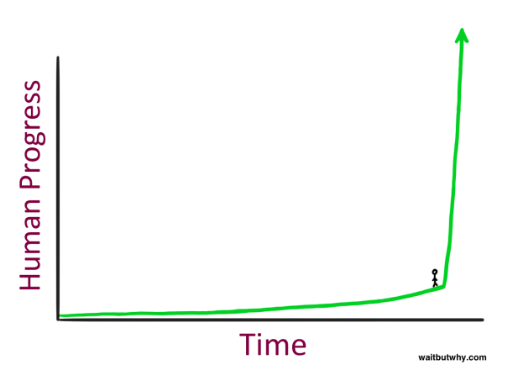
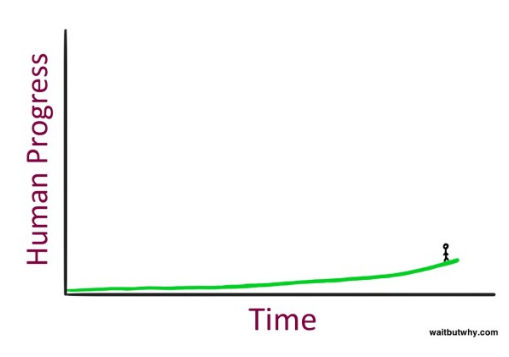
The first attached image is the world you have been living in.
The second attached image is what's coming.
Not only are AI models improving exponentially, but bitcoin, robotics, quantum computing, 3d printing, among other technological breakthroughs are all accelerating. They’re going to wash across society like a tsunami (think of that vertical green line as a tsunami that many know is coming).
You have two choices:
1️⃣ Prepare in advance and thrive
2️⃣ Get caught off guard and struggle to keep up.
Here are 10 rules to prepare, adapt, and thrive in the coming AI era:
1. Utilize AI Tools 🏄♂️
Don’t fight the trend, ride it. Those who effectively use AI will dramatically outcompete those who don’t by automating repetitive tasks, enhancing decision-making, and multiplying their productivity. Learn to integrate AI into your work, finances, and daily life to maximize efficiency.
2. Strengthen Your Physical Health 🏋️♂️
AI will bring incredible advancements in longevity and medicine, but you need to be in top shape to take full advantage of them. Prioritize diet, exercise, sleep, and overall well-being—staying strong means you’ll be ready for the future and around long enough to experience the breakthroughs ahead.
3. Strengthen Your Mental Health 🧠
The rapid changes brought by AI will create uncertainty, disruption, and stress. Those who can stay mentally strong and adaptable will be the ones who flourish in the new era. Build resilience through stress management techniques.
4. Reallocate Your Investments💰
Investing in technology positions you at the core of these changes (keeping in mind that a lot of tech will get disrupted too). At the same time, scarce assets like Bitcoin, prime real estate and digital art stand to benefit as AI drives abundance in many areas, making scarce assets more and more valuable.
5. Develop Future-Proof Skills 🔥
Human-centric abilities will be increasingly valuable. Focus on agency (self-driven action), adaptability (thriving in uncertainty), creativity (leveraging AI to innovate), problem-solving (navigating complexity), critical thinking (filtering information), and grit (long-term persistence).
6. Develop Your Brand / Start a Business 📢
AI is making entrepreneurship and content creation more accessible than ever. Whether through social media, newsletters, or AI-powered businesses, building an online presence can unlock massive leverage, new opportunities, and financial freedom. The barriers to starting the business of your dreams are disappearing—take advantage and get started today.
7. Strengthen Cybersecurity & Digital Privacy 🔒
As AI advances, so do cyber threats—hacking, deepfakes, and identity theft will become more sophisticated and widespread. Your personal data, finances, and online identity will be more vulnerable than ever. Staying ahead means taking your privacy and security seriously.
8. Prepare for the Worst🛡️
I’m very optimistic about the future AI will bring—unprecedented innovation, abundance, and opportunity. But massive change also brings uncertainty, and it’s wise to be prepared if things don’t go as planned. Even if there’s a 1% chance, it’s with spending at least some time and money preparing for the worst.
9. Strengthen Relationships & Help Others Prepare 🤝
The rise of AI will lead to more digital interactions, but human relationships will remain essential. Strengthen family bonds, form close friendships, and build local and online communities. Help others to prepare in advance and the more prepared you are the more you’ll be able to lift up those who fall through the cracks.
10. Enjoy the Ride & Prepare for a Post-Scarcity World 🚀
AI will eventually eliminate many traditional constraints, opening up opportunities beyond your current imagination. Focus on doing what you love, exploring creative pursuits, and optimizing your life for fulfillment rather than just survival. A world of abundance is coming— increasingly live your ideal life.
Figure AI just unveiled Helix - a breakthrough in humanoid robotics. 🦾
Using an open-source 7b vision-language-action model, these robots run intelligence "on-device".
Here's what you need to know (and wild demo videos): 🧵
10. Enjoy the Ride & Prepare for a Post-Scarcity World 🚀
AI will eventually eliminate many traditional constraints, opening up opportunities beyond your current imagination. Focus on doing what you love. A world of abundance is coming— increasingly live your ideal life.
The AI tsunami is coming—will you ride the wave or get wiped out?🌊
Here’s your 10-rule survival guide. 🧵👇
Most people are blissfully unaware of the transformative changes that are about to hit society. This is the world you have been living in:
9. Strengthen Relationships & Help Others Prepare 🤝
AI will reshape work and interactions, but human connections will always matter. Build strong communities—both online and offline. Help others prepare, and support those who fall through the cracks over time.