Lord, You are my rescue
I put my hope In You
Lord, You are my Savior
I will trust and will not fear
You give me strength
When I put my hope in You
You give me strength
Lord, I put my hope You
https://t.co/gicZgAXTT4
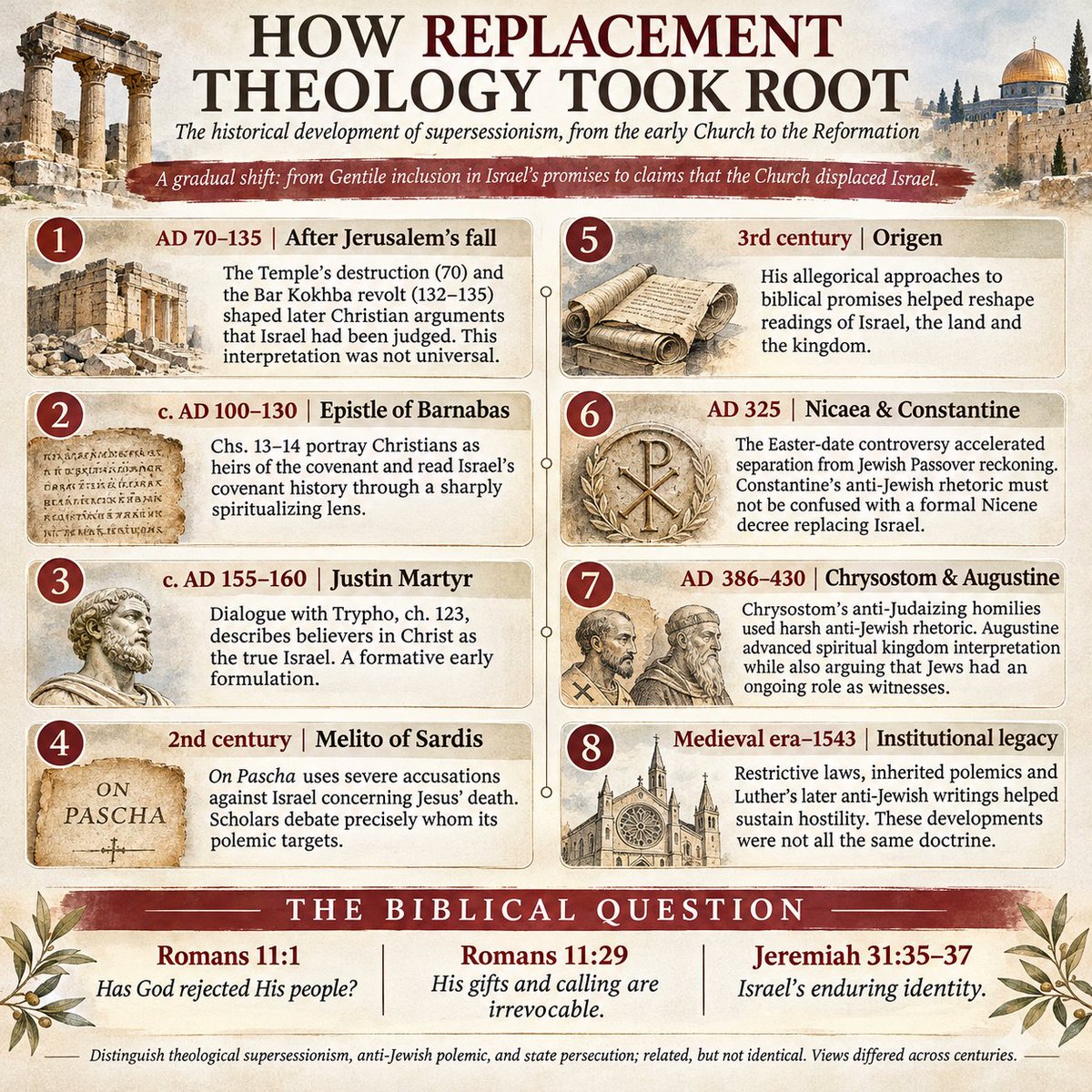
HOW DID THE CHURCH COME TO INHERIT ISRAEL'S PROMISES WHILE DENYING ISRAEL'S FUTURE?
The rise of Replacement Theology, the forgotten early Church witnesses, and God's irrevocable covenants.
How did a movement founded by Jewish apostles, built upon Jewish Scriptures, and centered upon Israel's Jewish Messiah eventually develop theological traditions that denied Israel a distinctive covenantal future?
It is one of the most consequential questions in Church history.
The apostles were Jewish. The prophets were Jewish. The Messiah was Jewish. The covenants, promises, patriarchs, and divine revelation were entrusted to Israel (Romans 9:4–5).
Yet within generations, influential Gentile theologians increasingly interpreted Israel's promises as belonging to the Church, while national restoration, the land, Jerusalem, and David's kingdom were reinterpreted primarily as spiritual realities.
This development became known as Supersessionism, commonly called Replacement Theology.
It did not originate with one council or theologian. Nor did the early Church unanimously embrace it.
But its influence would be enormous.
1. THE ASTONISHING REVERSAL
In Acts 2, the Church begins among Jewish believers in Jerusalem.
In Acts 10, Gentiles receive the Holy Spirit.
In Acts 15, the apostles affirm that Gentiles need not become Jews to receive salvation.
The controversy was never whether Israel had ceased to matter. It concerned how Gentiles could participate in the blessings promised through Israel's Messiah.
But as Christianity spread across the Roman Empire, Gentile believers increasingly outnumbered Jewish believers.
The destruction of Jerusalem in AD 70 and the aftermath of the Bar Kokhba revolt in AD 135 accelerated the separation between Jewish and Christian communities.
Some theologians interpreted these catastrophes as evidence that Israel had forfeited its covenantal standing.
Yet Moses had already anticipated Israel's dispersion and eventual regathering (Deuteronomy 30:1–5).
God explicitly declared that even in exile He would not utterly reject Israel or break His covenant (Leviticus 26:44–45).
Israel's judgment was never proof of Israel's permanent abandonment.
Here is the extraordinary irony:
The wild branches graciously grafted into Israel's olive tree eventually developed theological traditions that questioned the natural branches' continuing national inheritance.
And Paul had specifically warned against such arrogance (Romans 11:17–21).
2. HOW REPLACEMENT THEOLOGY TOOK ROOT
The Epistle of Barnabas (early second century) argued that believers in Jesus were the rightful covenant heirs, interpreting Israel's covenantal history in ways that diminished the Jewish people's distinctive claim.
Justin Martyr (c. AD 155–160) identified believers in Christ as the true Israel in Dialogue with Trypho.
Origen (third century) helped popularize spiritual and allegorical approaches to Scripture. His interpretations were complex, but his methods contributed to traditions in which Israel's geographical promises could receive primarily spiritual meanings.
Augustine (fourth–fifth centuries) advanced an understanding of the millennium as Christ's present spiritual reign, helping establish a framework that became dominant in Western Christianity.
These theologians did not hold identical positions.
Nevertheless, a consequential interpretive shift became increasingly influential:
Promises originally addressed to Israel were increasingly understood as fulfilled in the Church without requiring a future national fulfillment for Israel.
Over time, some forms of supersessionist thought became entangled with anti-Jewish rhetoric and discrimination.
The two are not identical. Many Christians holding supersessionist interpretations today unequivocally reject antisemitism.
But the historical consequences of religious contempt toward the Jewish people cannot be ignored.
3. THE FORGOTTEN VOICES OF THE EARLY CHURCH
Here is something frequently overlooked.
The early Church Fathers were not unanimous about the future earthly kingdom.
Papias, whose teachings survive through later writers, anticipated a future earthly reign.
Justin Martyr presents an especially fascinating case.
Although he identified believers as the true Israel, he also affirmed a future thousand-year reign in a restored Jerusalem (Dialogue with Trypho, chapter 80).
He openly acknowledged that other orthodox believers disagreed.
Then consider Irenaeus of Lyons, writing in the late second century.
In Against Heresies, Book 5, chapter 32, Irenaeus reasoned that Abraham never personally possessed the full inheritance God promised him.
Therefore, he argued, the promise awaited future fulfillment in the resurrection and earthly kingdom.
Irenaeus also viewed the Church as Abraham's seed. He was not articulating every feature of a modern interpretation of Israel's national restoration.
Nevertheless, his testimony is remarkable.
An influential second-century Church Father insisted that God's earthly promise to Abraham still awaited fulfillment.
Long before Augustine's millennial framework became dominant, significant early Christian voices anticipated a future earthly kingdom.
History is considerably more nuanced than the claim that the Church Fathers unanimously rejected such expectations.
4. THE COVENANT DISTINCTION THAT CHANGES EVERYTHING
Much of the confusion surrounding Replacement Theology comes from treating God's covenants as interchangeable.
They are not.
The Abrahamic Covenant preceded the Mosaic Covenant by centuries.
Genesis 12, 15, and 17 contain promises of descendants, land, nationhood, and worldwide blessing.
In Genesis 15, Abram falls into a deep sleep while the symbolic manifestations of God's presence pass between the divided pieces.
The emphasis falls upon God's sovereign commitment.
Genesis 17 describes an everlasting covenant.
Psalm 105:8–11 explicitly connects that covenant to the land promised to Abraham, Isaac, and Jacob.
Hebrews 6:13–18 emphasizes the certainty of God's promise and oath.
The Mosaic Covenant was different.
Established at Sinai, it contained conditions governing Israel's national obedience and blessings.
Israel violated those conditions.
The New Testament teaches that the Mosaic covenantal administration has been surpassed through the Messiah (Hebrews 8).
But Paul makes a decisive statement in Galatians 3:17:
The Law, introduced 430 years afterward, cannot annul God's earlier promise.
Consider the implication.
If the Mosaic Law itself could not annul the Abrahamic Covenant, how could Israel's violation of that Law permanently cancel God's earlier oath?
The end of the Mosaic covenantal order is not the cancellation of God's promises to Abraham.
Nor does the New Covenant erase Israel.
Jeremiah 31:31 explicitly names the house of Israel and the house of Judah as its recipients.
Through Jesus, Gentiles share in its spiritual blessings.
But Gentile inclusion does not require Israel's exclusion.
5. THE QUESTION JESUS NEVER DISMISSED
After the resurrection, the disciples asked Jesus whether He was about to restore the kingdom to Israel (Acts 1:6).
Think about the timing.
Jesus had completed His earthly ministry, risen from the dead, and instructed them concerning God's kingdom.
Yet they still anticipated Israel's restoration.
Jesus redirected their attention to the Father's authority over its timing and to their coming worldwide mission.
He did not explicitly announce that Israel's restoration had been canceled.
He withheld the timing, not an explicit denial of the promise.
6. PAUL'S WARNING TO GENTILE BELIEVERS
Romans 11 is indispensable.
Paul addresses Israel's unbelief without concluding that God has permanently rejected His people.
He describes Israel's hardening as partial.
He warns Gentiles against boasting.
He declares that the natural branches can be grafted into their own olive tree again.
He anticipates a future divine work of salvation involving Israel.
Then comes his remarkable conclusion.
Israel remains loved on account of the patriarchs, because God's gifts and calling are irrevocable (Romans 11:28–29).
Notice the context.
Paul is discussing Israel, its patriarchs, its election, and its future.
He never teaches that Jewish ancestry guarantees salvation apart from the Messiah.
But neither does he declare God's covenantal calling permanently canceled.
The Church's participation in Abraham's blessings does not require the dispossession of Abraham's physical descendants.
THE FINAL FOUR WITNESSES
Consider four biblical witnesses.
MOSES: Israel will be scattered, yet God promises to regather the people (Deuteronomy 30).
JEREMIAH: Israel's continuing national identity is tied to the fixed order of creation (Jeremiah 31:35–37).
GABRIEL: Jesus will receive David's throne and reign over Jacob's descendants forever (Luke 1:32–33).
PAUL: God has not rejected His people, and His gifts and calling are irrevocable (Romans 11).
Four witnesses. Centuries apart. One extraordinary testimony concerning God's covenant faithfulness.
If Moses, Jeremiah, Gabriel, and Paul affirm God's continuing commitments to Israel, what authority does any later theological system possess to declare those promises permanently transferred?
The issue is not whether Jesus fulfills Scripture.
He does.
The issue is whether fulfillment means God can disregard the specific promises He made.
The Church has received extraordinary blessings through Israel's Messiah.
We have been brought near. We have become fellow heirs. We have been grafted into the olive tree.
But the grafted branches must never boast over the natural branches.
If God can permanently revoke His sworn promises to Israel, how can we be certain of His promises to anyone else?
God's faithfulness to Israel does not diminish His grace toward the nations.
It demonstrates that He keeps His Word.
Nearly two thousand years ago, Paul asked the question that still confronts the Church:
“Did God reject his people?”
“By no means!” (Romans 11:1, NIV)
The gifts and the calling of God are irrevocable.
God keeps His covenants. All of them.
Christians are being BEHEADED, BURNED ALIVE, and slaughtered for their faith in Jesus Christ.
Little girls are being abducted and forcibly converted to Islam. 😢🙏
Sometimes
If we’re really going to help others, by delivering what we perceive as “the answer” to their problem, at least one of two things must happen:
1. We must have credibility in their life / circle to the level that they trust / believe us.
🦋 Even if it is obvious to us what they need, they are actively in survival mode holding on the that which is familiar.
🦋 If they don’t know you, they really aren’t listening.
2. We must present in a way that shows how much better life is given our advice.
🦋 Again, it may be obvious to us, but again, they are in stealth mode (fight or flight / survivor mode) and can’t here you.
🦋 It needs to not just be said but demonstrated.
If they don't know / trust us, and or it does not look promising, to someone just hearing our words is just noise.
We need to show this person, something more familiar or comforting than where they are at, and we can’t even get through to them by trying to convince or allure them with spoken urging.
This kind of attempt comes across as controlling and leads to more anger, fear, and even escalates it.
It is always better, to have a credible example in our own life, one that clearly demonstrates:
1. (Part of One above) Credibility
and
2. (Part of Two above) Clarity
In Short:
The contrast between their current position (their familiar comfort zone) and the superior position (that they can’t yet see) must be true and believable, demonstrated and delivered without delay, freely.
If it sounds threatening or it sounds like we're making a deal, or going into a debate, we lose credibility.