Friends, Jesus says, “Fear no one.” If finitude in awareness is anxiety—and it is—and ruthless people know how to use our fears to manipulate us, how do we avoid being afraid?
It is possible if and only if you go through something like a “metanoia.” “Meta” means “beyond”; “nous” means “mind.” Therefore, “metanoia” means to go beyond the mind you have, to change your way of thinking and seeing—to change the fundamental attitude of your life.
What if you were to undergo a metanoia, and the center of your life became not your body and its preoccupation but the soul?
What made St. Joseph the Terror of Demons?
Fr. Donald Calloway, MIC, joins Fr. Gregory to discuss St. Joseph's quiet strength, his faithful obedience, and why the Church continues to invoke his powerful intercession.
🎥 Watch the full episode: https://t.co/Wc9hqlFjup
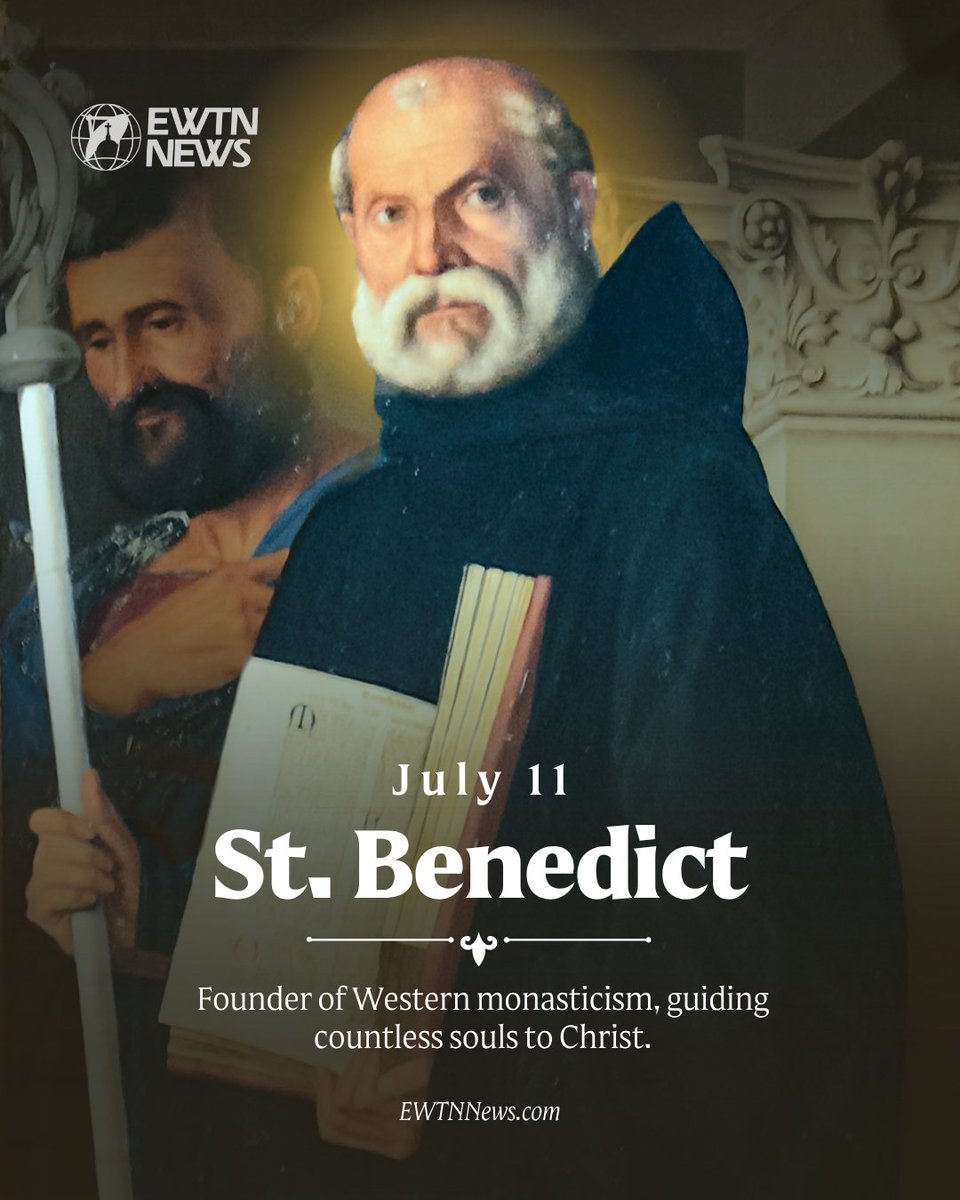
Today (July 11) we celebrate Saint Benedict Abbot, the father of Western monasticism and a patron saint of Europe, whose spiritual wisdom laid the foundation for a renewed Christian civilization.
Quick facts every Catholic should know about Saint Benedict Abbot:
Hoy, 11 de julio, la Iglesia celebra a San Benito de Nursia, abad, fundador del monacato occidental y patrono de Europa, cuya vida y legado marcaron profundamente la historia de la Iglesia y la formación espiritual y cultural del continente europeo.
Nacido en Nursia, Italia, hacia el año 480, San Benito abandonó una vida cómoda y prometedora para buscar a Dios en el silencio, la oración y la austeridad. Tras un tiempo de vida eremítica, reunió a numerosos discípulos y fundó varios monasterios, entre ellos el célebre Montecassino, desde donde irradiaría una espiritualidad que transformó generaciones enteras.
Su mayor legado fue la Regla de San Benito, una guía para la vida monástica basada en el equilibrio entre la oración, el trabajo y la vida fraterna. Su célebre lema, "Ora et labora" (Ora y trabaja), resume una enseñanza que sigue siendo actual: el trabajo cotidiano encuentra su verdadero sentido cuando nace de una profunda relación con Dios.
Los monasterios benedictinos no solo fueron centros de oración, sino también espacios donde se conservaron manuscritos, florecieron la educación, el arte, la agricultura y la cultura. Gracias a esta labor, San Benito es reconocido como uno de los grandes constructores de la civilización cristiana en Europa y fue proclamado Patrono de Europa por el Papa San Pablo VI en 1964.
La tradición también recuerda numerosos milagros realizados por el santo y su firme lucha contra el mal, razón por la cual la Cruz o Medalla de San Benito se ha convertido en uno de los sacramentales más difundidos de la Iglesia, como signo de protección y confianza en el poder de Cristo.
San Benito enseñó que la santidad no consiste en realizar obras extraordinarias, sino en vivir cada día con fidelidad, disciplina, humildad y amor a Dios. Su vida demuestra que la oración transforma el corazón y que el trabajo realizado con espíritu cristiano puede convertirse en camino de santificación.
¡San Benito de Nursia, ruega por nosotros! 🙏✝️📖
As the World Cup enters its final rounds, Norway is making headlines. Erling Haaland purchased a $134,000 rare Christian manuscript and donated it to his hometown library, while the Diocese of Oslo pursues the canonization cause of Catholic convert Sigrid Undset.
On July 11, the Catholic Church celebrates the feast of Saint Benedict of Nursia, the sixth-century abbot who gave Christian monasticism its lasting foundation in Western Europe.
For his historic role as the “Father of Western Monasticism,” St. Benedict was declared a co-patron of Europe (along with Saints Cyril and Methodius). St. Benedict is also the patron saint of Pope Benedict XVI's pontificate.
Born to upper-class parents in modern-day Italy during the year 480, Benedict was sent to Rome to study the humanities. However, he soon became disgusted with the loose morals that prevailed among the students. Withdrawing from the city, he lived briefly with a group of monks, then as a hermit.
The young man spent three years in solitude, facing and overcoming severe temptations through prayer and asceticism. Only after doing so, did he have the confidence to emerge as an organizer of monastic communities. His first monasteries were established in the Anio valley outside Subiaco.
Benedict's monasteries in Subiaco became centers of education for children, a tradition which would continue in the order during his lifetime and beyond. His monastic movement, like its forebears in the Christian East, attracted large numbers of people who were looking to live their faith more deeply.
During 529, Benedict left Subiaco for Monte Cassino, 80 miles south of Rome. The move was geographically and spiritually significant, marking a more public emergence of the Western monastic movement. Benedict destroyed a pagan temple atop the mountain, and built two oratories in its place.
It was most likely at Monte Cassino that the abbot drew up a rule of life, the famous “Rule of St. Benedict,” which emphasised prayer, work, simplicity, and hospitality. Though known as a rule for monks, it is addressed to all those who seek “to do battle for Christ the Lord, the true King.”
Around the age of 63, Benedict suffered his final illness. He was carried into the church by his fellow monks, where he received the Eucharist for the last time.
https://t.co/OOTdP0Qpb8
This easy-to-read, short booklet illustrates the awe-inspiring duties of fatherhood while explaining society's need for good fathers. This must-read title is a foundational solution to the problems that plague modern society. Get copies for your sons, brothers, and all the men in your life today!
https://t.co/Uas8gQ7kJm
St. Benedict’s Medal:
The purpose of this sacramental is to call down God's blessing and protection upon us, wherever we are, and upon our homes and possessions, especially through the intercession of St. Benedict. By the conscious and devout use of the medal, it becomes, as it were, a constant silent prayer and reminder to us of our dignity as followers of Christ.
The medal is essentially a prayer of exorcism against Satan, a prayer for strength in time of temptation, a prayer for a peaceful death in the Lord, a prayer for peace among ourselves and among the nations of the world, a prayer that the Cross of Christ be our light and guide, a prayer of firm rejection of all that is evil, a prayer of petition that we may with Christian courage "walk in God's ways, with the Gospel as our guide," as St. Benedict urges us.
A profitable spiritual experience can be ours if we but take the time to study the array of inscriptions and representations found on the two sides of the Medal. The lessons found there can be pondered over and over to bring true peace of mind and heart into our lives as we struggle to overcome the weaknesses of our human nature and realize that our human condition is not perfect, but that with the help of God and the intercession of the saints our condition can become better.
The Medal of St. Benedict can thus serve as a constant reminder of the need for us to take up our cross daily and "follow the true King, Christ our Lord," and thus learn "to share with patience in the sufferings of Christ so that we may one day share in his heavenly kingdom," as St. Benedict urges us in the Prologue of his Rule.
Front Side of Medal:
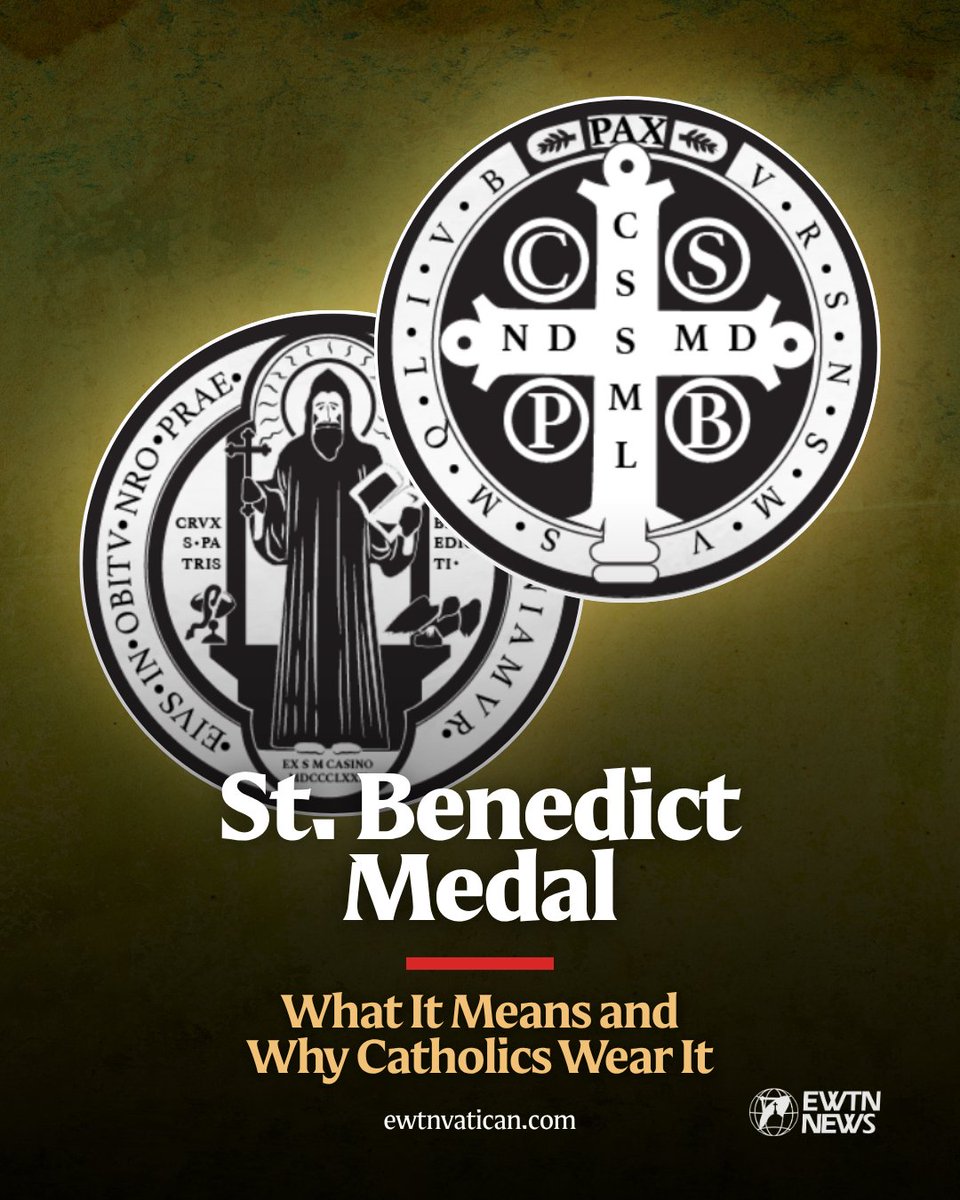
On the face of the medal is the image of St. Benedict. In his right hand he holds aloft the cross as the symbol of our salvation, also reminding us of the vast work of evangelizing and civilizing England and Europe carried out mainly by the Benedictine monks and nuns, especially from the sixth to the ninth/tenth centuries. In Benedict's left hand is his Rule for Monks, which could well be summed up in the words of the Prologue exhorting us to "walk in God's ways, with the Gospel as our guide."
On a pedestal to the right of St. Benedict is the poisoned cup, shattered when he made the sign of the cross over it.
On a pedestal to the left is a raven about to carry away a loaf of poisoned bread that a jealous enemy had sent to St. Benedict.
Above the cup and the raven are the Latin words: CRUX S. PATRIS BENEDICTI (The Cross of Our Holy Father Benedict).
On the margin of the medal, encircling the figure of St. Benedict, are the Latin words: EIUS IN OBITU NOSTRO PRAESENTIA MUNIAMUR! (May we be strengthened by his presence in the hour of our death!). Benedictines have always regarded St. Benedict as a special patron of a happy death, He himself died in the chapel at Montecassino while standing with his arms raised up to heaven, and supported by the brethren, shortly after having received Holy Communion.
Below the figure of St. Benedict is a Latin inscription giving the origin and date of the Jubilee Medal: Abbey of Montecassino, 1880.
Reverse Side of Medal:
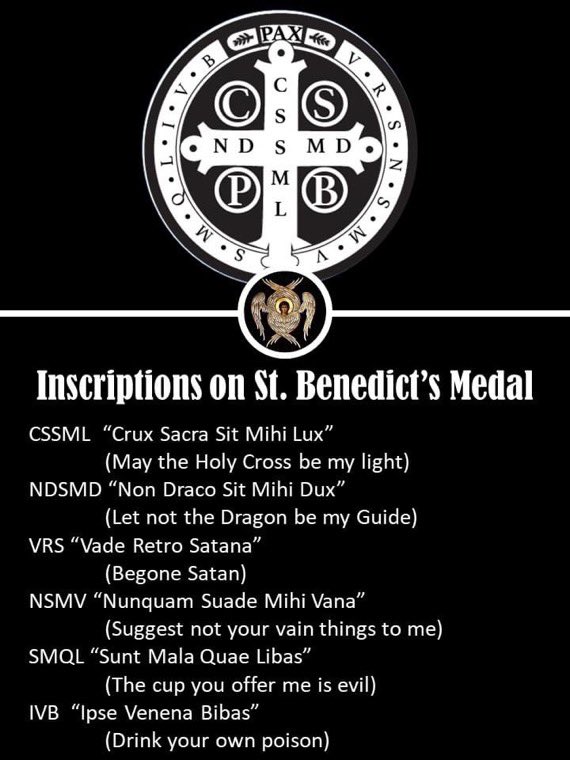
On the back of the medal, the cross is dominant. On the arms of the cross are the initial letters of a rhythmic Latin prayer: CRUX SACRA SIT MIHI LUX! NUNQUAM DRACO SIT MIHI DUX! (May the holy Cross be my light! The dragon never be my guide!).
In the angles of the cross, the letters C S P B stand for CRUX SANCTI PATRIS BENEDICTI (The cross of our holy father Benedict).
Above the cross is the word PAX (Peace), which has been a Benedictine motto for centuries.
Around the margin of the back of the medal, the letters V R S N S M V -- S M Q L I V B are the initial letters, as mentioned before, of a Latin prayer of exorcism against Satan: VADE RETRO SATANA! NUNQUAM SUADE MIHI VANA! SUNT MALA QUAE LIBAS. IPSE VENENA BIBAS! (Begone, Satan! Tempt me not with your vanities! What you offer me is evil. Drink the poisoned cup yourself!).
When you see a sister, that's a big way of God saying, "I want you to remember: I love you, I see you, and you're made for more." 💛
🎥Watch the full video with Sr. Magnificat Rose and Sr. Mary Grace: https://t.co/9tezQtQil7
One woman's prayer for the whole world.
At the National Eucharistic Pilgrimage, Belinda from St. Francis de Sales Parish shared her prayer intention: peace and unity for every nation, through the Sacred Heart of Jesus and the intercession of Our Blessed Mother.
The more people praying, the more powerful the prayers.
Join us every night for the Family Rosary Across America — because prayers like Belinda's are stronger together.
#FamilyRosary #NationalEucharisticPilgrimage #CatholicFaith #RelevantRadio #PrayForPeace
July 11 is the feast of Saint Benedict of Nursia, the author of the Rule of Saint Benedict, who is honored by many as the father of Western monasticism.
One of the earliest biographies of his life was written by Pope Saint Gregory the Great, and it includes many stories of incredible miracles performed by the monk.
Here are seven of the best miracles Saint Benedict of Nursia performed:
1) Saint Benedict broke a glass full of poison with the Sign of the Cross.
2) Saint Benedict saved a man from drowning by briefly becoming another person.
3) Saint Benedict read the minds of his monks.
4) Saint Benedict brought a child back to life.
5) Saint Benedict moved a huge stone with his prayer.
6) Saint Benedict exorcised a stubborn demon.
7) Saint Benedict was unfazed by the devil’s trickery.
Full Story: https://t.co/qGCJpZRxrU
Have you heard of Our Lady of Kibeho? She appeared to Rwandan schoolchildren in the 1980s, and those apparitions were approved by the Church in 2001.
Her message conveyed an urgency in the world repenting and making reparations for sins against her Son. She encouraged people to pray the Rosary and the Seven Sorrows Rosary, and she's sometimes called Our Lady of Sorrows of Kibeho.
https://t.co/8zWFbiLy5z
Members of the Fourth Degree carry the major relics of St. Margaret Mary Alacoque during the Mass marking the 250th anniversary of the United States at the Basilica of the National Shrine of the Assumption of the Blessed Virgin Mary in Baltimore on July 5. (Photo by Matthew Barrick)
Can’t make it inside for Adoration while traveling?
Just park outside any Catholic church. Jesus is truly present in the Tabernacle — Body, Blood, Soul, and Divinity. You can make a powerful Holy Hour right from your car.
The Holy Spirit has brought about an incredible revival of Eucharistic devotion across the United States over the last several years.
This fall, you have a powerful opportunity to be part of that movement at St. Patrick's Cathedral in the heart of New York City.
On October 13, 2026, the Napa Institute will once again host this powerful opportunity to walk with Jesus through the streets of New York City during rush hour, impacting thousands both in person and online.
Over the past several years, this event has not only captured the attention of tourists and commuters throughout New York City but has also gone viral around the world, garnering millions of views online.
Last year, Jonathan Roumie, Cardinal Seán O'Malley, Cardinal Giorgio Marengo, and Fr. Ambrose Criste led attendees in spiritual reflections, Mass, and the Eucharistic procession.
This year's program is as follows:
The afternoon begins at 3:00 p.m. with Eucharistic meditations led by Fr. John Burns and Fr. Gregory Pine, O.P. At 4:00 p.m., Bishop Joseph Espaillat will celebrate Mass and preach the homily before the procession departs the cathedral at 5:00 p.m.
The Boston Boys Choir will provide beautiful sacred music during the Mass and Eucharistic procession.
Each year, Catholics from a wide variety of communities participate, including the Franciscan Friars of the Renewal, the Sisters of Life, the Order of Malta, Catholic school students, and parish groups from across New York City and the Diocese of Rockville Centre. We encourage individuals, families, and parish groups to join us.
You can register by visiting the Napa Institute website. Groups of 10 or more should email the Napa Institute team at [email protected].
As we celebrate the 250th anniversary of the United States and commemorate the consecration of our nation to the Sacred Heart of Jesus, this year's procession promises to be a powerful witness to the Real Presence of Jesus Christ in the Blessed Sacrament and an unforgettable experience for all who attend.
This year's Eucharistic Procession marks the beginning of two days of inspiring Catholic events in New York City. On October 14, 2026, the Napa Institute will once again host its Faith & Business Conference at the Metropolitan Club, bringing together leaders to explore the renewal of America's cities as centers of faith, freedom, and prosperity.
https://t.co/GL6uvpWPPo
July 11 is the Feast of St. Benedict — and millions of Catholics around the world wear his medal. But do you know what it actually means?
Known as the "devil-chasing medal," the St. Benedict Medal is one of the most powerful sacramentals in the Catholic Church. Its power comes not from the object itself, but from Christ, who works through the faith of the one who uses it.
The Front:
St. Benedict holds a cross. At his side are a broken cup—after monks tried to poison him, it shattered when he blessed it—and a raven carrying away a poisoned loaf, another failed attempt on his life. Around the edge is the inscription:
Eius in obitu nostro praesentia muniamur
"May we be strengthened by his presence in our hour of death."
The Back:
A large cross bears the initials of the famous prayer:
C.S.P.B. – Crux Sancti Patris Benedicti
"The Cross of our Holy Father Benedict."
C.S.S.M.L. – Crux Sacra Sit Mihi Lux
"May the Holy Cross be my light."
N.D.S.M.D. – Non Draco Sit Mihi Dux
"May the dragon not be my guide."
Around the border is the exorcism prayer:
V.R.S. – Vade Retro, Satana!
"Begone, Satan!"
N.S.M.V. – Numquam Suade Mihi Vana!
"Never tempt me with your vanities!"
S.M.Q.L. – Sunt Mala Quae Libas.
"What you offer is evil."
I.V.B. – Ipse Venena Bibas!
"Drink your own poison!"
At the bottom is a single word:
PAX — Peace.
The medal was formally approved by Pope Benedict XIV in 1742. It became widely known after the miraculous healing of a young man named Brunone, who later entered the Benedictine Order and eventually became Pope St. Leo IX.
St. Benedict, pray for us! 🙏
Today, the Church remembers Venerable Augustus Tolton.
Father Tolton’s life is a witness to the Church to reckon with its past and to build a future rooted in justice, equity, and the Gospel truth that all people are made in the image of God.
Learn more about Venerable Tolton and his cause for canonization at: https://t.co/VcfH0CjFYd