On our Substack today: we tested our Standard Model on data from @MSKCancerCenter during the iHub Challenge 2025 Cohort Program—and we’re releasing the model weights for public use.
Blog post: https://t.co/fdvF8sBcbw
Docs & quickstart guide: https://t.co/O2kg04UPCS
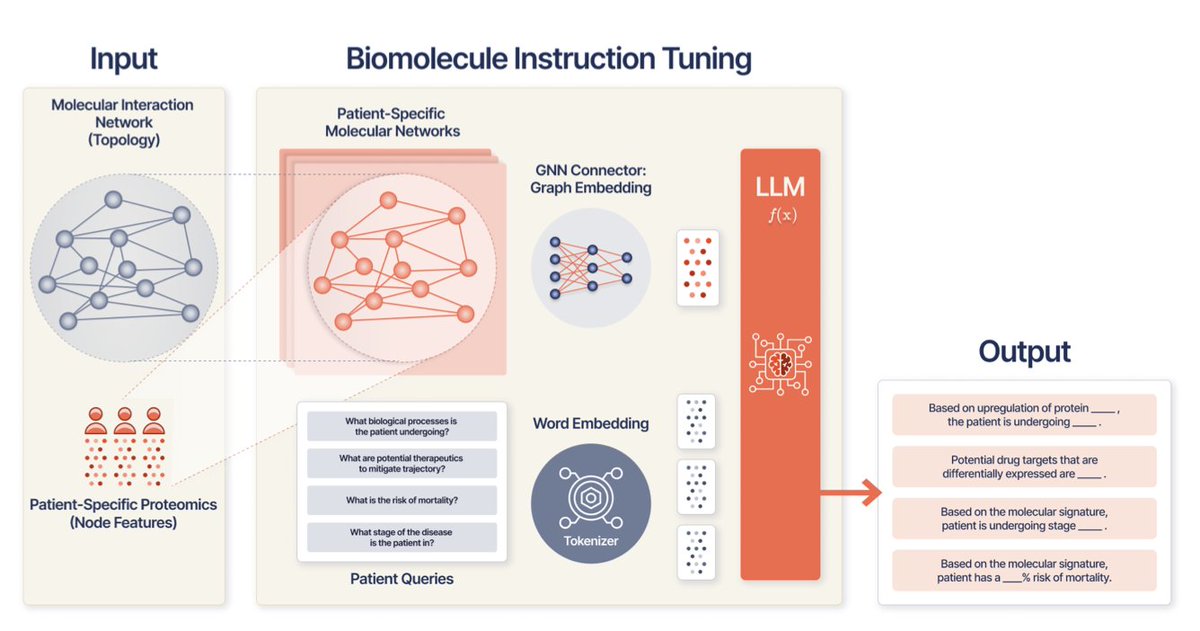
Patient-Specific Biomolecular Instruction Tuning of Graph-LLMs
1. A novel study introduces CPTAC-PROTSTRUCT, the first dataset designed for instruction-tuning in oncology proteomics, containing over 370k examples from more than 1000 patients. This dataset bridges the gap between proteomics data and clinical reasoning, enabling more precise and personalized cancer treatment.
2. The study proposes KRONOS, a novel graph-LLM framework that integrates patient-specific proteomics with molecular interaction topology. By leveraging graph neural networks, KRONOS captures the complex interactions between proteins, significantly enhancing clinical reasoning and prognostic tasks.
3. KRONOS demonstrates superior performance in various clinical benchmarks, achieving an AUC of up to 0.857 in mortality prediction and cancer type classification. This highlights the importance of incorporating molecular interaction networks into AI models for more accurate patient stratification and prognosis.
4. The study addresses key limitations in current proteomics analysis by developing a specialized instruction-tuning dataset and a unified graph-LLM architecture. This approach not only improves the interpretability of proteomics data but also advances precision medicine through enhanced diagnostic and prognostic capabilities.
5. The authors emphasize the potential of KRONOS to empower large language models with a deeper understanding of patient-level pathogenesis. This innovation could pave the way for more effective personalized treatments and better clinical outcomes in oncology.
📜Paper: https://t.co/K7rsEz25XI
#Proteomics #GraphLLMs #PrecisionMedicine #CancerResearch #AIinHealthcare
We’ve been pretty quiet on here so far, but today we’re excited to introduce ourselves and share three new papers on foundation models in bio. 👋 Come take a look at our Substack post to learn more, and follow us here to receive future updates, too. 📥 https://t.co/KWy8qAppS0